
How Many Calories in Eggnog?
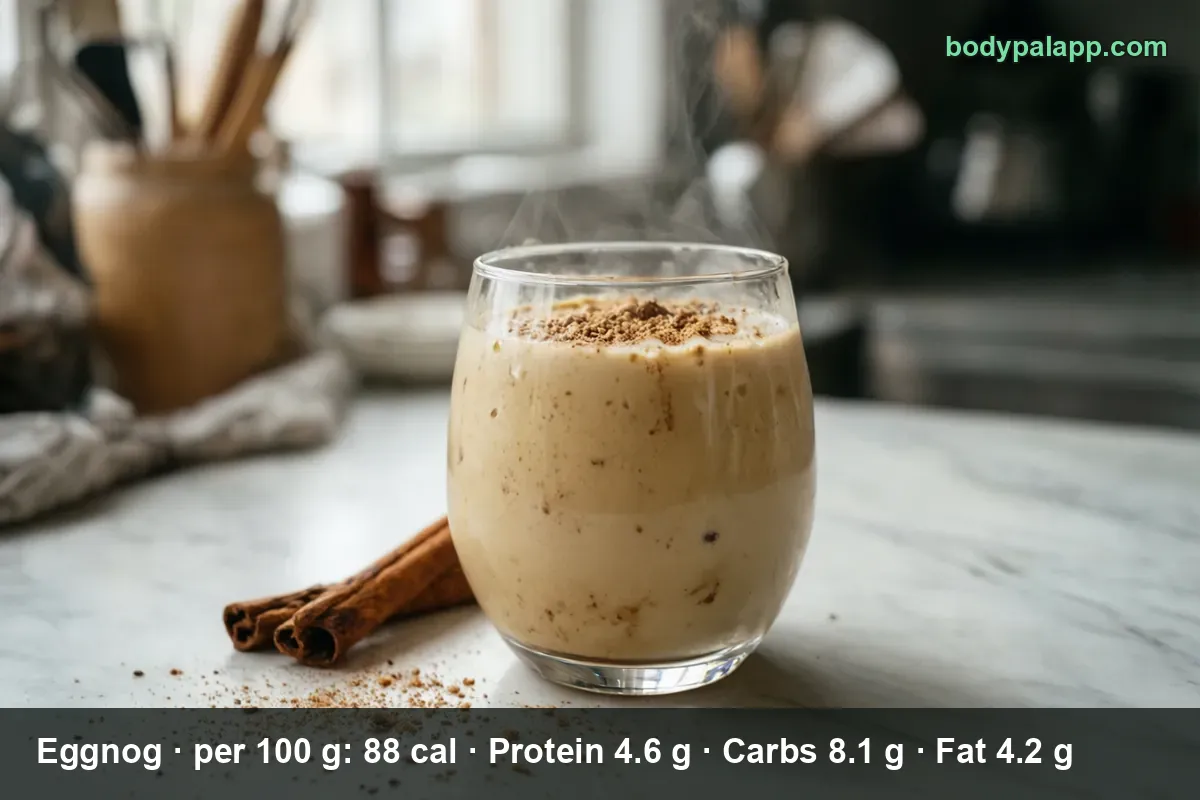
Eggnog runs 88 calories per 100 g, which makes a full cup of 254 g 224 calories and the half-cup pour printed on American cartons 112. That is the generic USDA figure. The carton in your refrigerator is thicker than the government's recipe, and it will cost you more like 150 to 190 for the same half cup.
On this page
- Eggnog quick facts
- The carton in your fridge is not this number
- Every pour, from a splash to a quart
- The two rows that eat your day
- Spiked, from a mix, or straight
- How does eggnog compare?
- Most popular eggnog brands
- FAQ
Eggnog quick facts
The reference entry is USDA's Eggnog (fdc_id 171258), and the serving is USDA's own cup: 254 g.
| Nutrient | Per 100 g | Per 1 cup (254 g) | % Daily Value |
|---|---|---|---|
| Calories | 88 kcal | 224 kcal | — |
| Total fat | 4.19 g | 10.6 g | 14% |
| Saturated fat | 2.59 g | 6.6 g | 33% |
| Carbohydrate | 8.05 g | 20.4 g | 7% |
| Dietary fiber | 0 g | 0 g | 0% |
| Total sugars | 8.05 g | 20.4 g | — |
| Protein | 4.55 g | 11.6 g | 23% |
| Sodium | 54 mg | 137 mg | 6% |
| Cholesterol | 59 mg | 150 mg | 50% |
| Potassium | 165 mg | 419 mg | 9% |
% Daily Value is based on a 2,000-calorie diet, the reference set out in the FDA's Daily Value tables. Total sugars carry no Daily Value, so that row stays blank.
Verified nutrition data
Numbers on this page come from USDA FoodData Central, the U.S. Department of Agriculture’s food composition database, and from manufacturer labels where a branded product is named. Last verified September 2026. How we verify our data →
Two things are missing from that panel on purpose. Added sugars and trans fat are not printed here because they do not exist in the USDA entry for eggnog at all, in either the reference edition or the survey one. Writing a zero would be inventing a number, so the rows are gone instead.
Read the carbohydrate line again. Carbohydrate is 8.05 g and total sugars are 8.05 g, the same figure twice. Every gram of carbohydrate in eggnog is sugar. There is no starch and no fiber in the glass, which is why the fiber row is a flat zero.
The carton in your fridge is not this number
Here is the gap almost every eggnog calorie chart glosses over.
USDA's generic eggnog is 88 calories per 100 g. Real cartons on an American shelf are denser than that, and the labels say so: Straus Family Creamery lists 125 per 100 g, Clover Sonoma 133, Organic Valley and Dean's 150, Darigold and Turkey Hill 158. At the top of the range a regional carton reaches 167.
That is not a disagreement between sources. It is a different drink. Dairies build eggnog with more cream and more sugar than the composite recipe USDA measured, and a thicker nog costs more calories per identical pour.
The practical consequence lands on the standard label serving, which is 1/2 cup, or 120 mL. By USDA that pour is 112 calories. By carton it runs roughly 150 to 190. Same glass, same half cup, up to 78 calories apart.
So the rule for logging eggnog is simple. If you poured from a carton, use the number on that carton. If you are drinking someone's homemade nog, or estimating from a punch bowl at a party, the USDA figure is the honest fallback. Never split the difference between the two, because the average describes nobody's glass.
Every pour, from a splash to a quart
| Pour | Weight | Calories |
|---|---|---|
| Splash in coffee, 1 fl oz | 31.8 g | 28 cal |
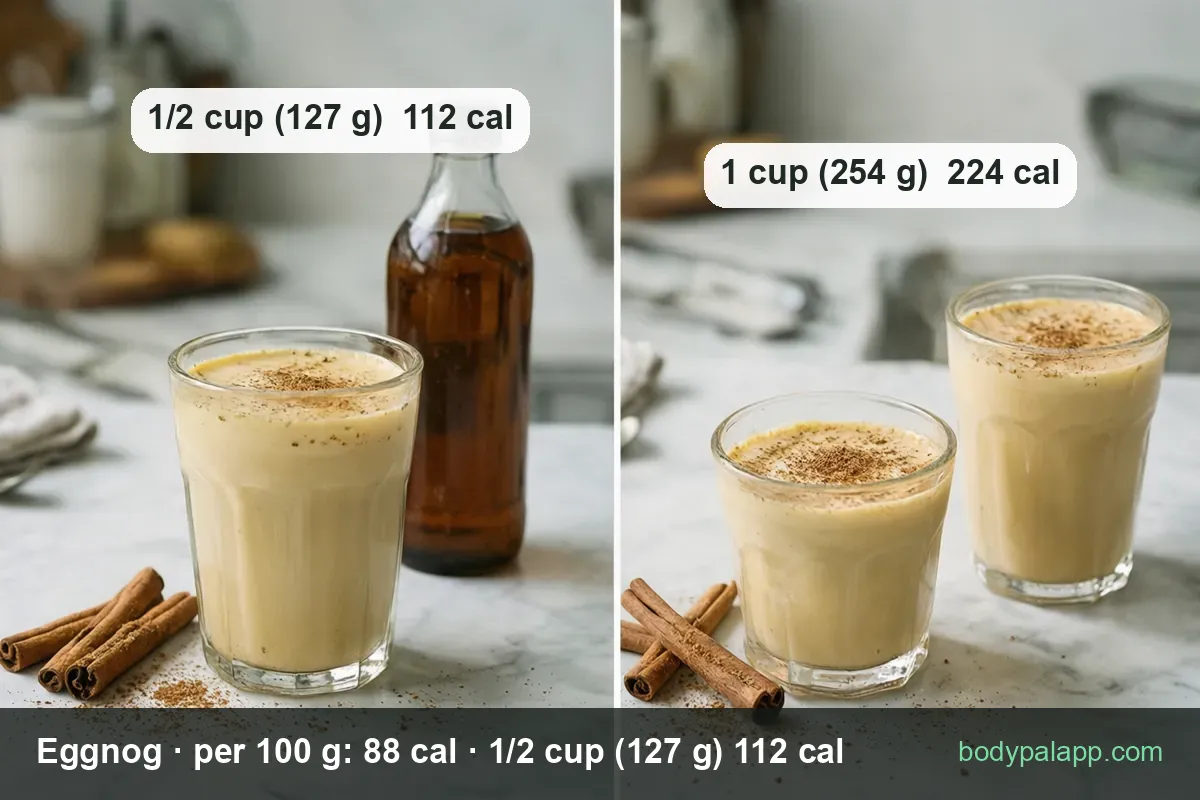
| Half cup, the label serving | 127 g | 112 cal |
| Full cup | 254 g | 224 cal |
| One quart | 1016 g | 894 cal |
| One ounce by weight | 28.35 g | 25 cal |
The cup, the fluid ounce and the quart come straight from USDA's portion data for this entry. The half cup is exactly half of USDA's cup, and it matters more than the full one, because it is the serving American dairies print on the side of the carton.
Now the trap in that table, and it is a good one. One fluid ounce of eggnog is 31.8 g, not 28.35 g. Eggnog is heavier than water, so a fluid ounce of volume and an ounce of weight are two different things. Anyone who assumes 8 fl oz weighs 227 g is short by about 27 g, or roughly 24 calories, every single cup.
There is no raw-versus-cooked complication here. Eggnog is poured and drunk as it is, and the only preparations that move the number are the ones in the next two sections: liquor, powder, or a carton recipe richer than the generic.
One footnote for anyone comparing calculators. USDA's survey database carries the same eggnog with an identical nutrient profile but counts a cup as 256 g rather than 254, which lands at 225 calories. A one-calorie spread between two federal cups is noise, not news.
The two rows that eat your day
Calories are what people search for. On this drink they are not the interesting part of the panel.
A single cup carries 150 mg of cholesterol, half the 300 mg Daily Value, and 6.6 g of saturated fat, 33% of the day. Real eggs and real cream are doing exactly what real eggs and real cream do. The Dietary Guidelines for Americans ask adults to keep saturated fat under 10% of daily calories, and one glass of nog spends a third of that allowance before any food is on the table.
The sugar line is worth a second look too. A cup holds 20.4 g of total sugars, all of the carbohydrate in the glass. What USDA does not tell us is how much of that was added versus how much came from the milk, because the added sugars field is empty in this entry. Without it there is no honest way to check the glass against the 50 g Daily Value for added sugars, and this page will not guess at a split.
The protein is the redeeming row. At 11.6 g a cup, or 23% of the Daily Value, eggnog delivers more protein than most sweet drinks manage, and the dairy group is where that protein and the 419 mg of potassium come from. Sodium is genuinely low at 137 mg a cup, 6% of the day.
If you drink eggnog once in December, none of this needs managing. If you drink it nightly through the holidays, the saturated fat row is the one to watch, not the calorie row.
Spiked, from a mix, or straight
| Version | Per 100 g | Typical serving | Calories |
|---|---|---|---|
| Classic eggnog | 88 kcal | 1 cup (254 g) | 224 cal |
| Spiked eggnog | 113 kcal | 1 drink (240 g) | 271 cal |
| Made from a powdered mix | 95 kcal | 1 cup (272 g) | 258 cal |
| Store-bought carton | 125–167 kcal | 1/2 cup (120 mL) | 150–190 cal |
Pour in the liquor and USDA has a separate entry for it: eggnog, alcoholic runs 113 calories per 100 g, so the 240 g drink lands at 271 — about 47 more than a full cup of the plain version. A 1 fl oz splash of the spiked stuff is 34 calories.
The interesting part is what the alcohol does to the rest of the glass. Protein falls from 4.55 g per 100 g to 3.74, saturated fat from 2.59 to 2.13, cholesterol from 59 mg to 49. Liquor dilutes everything nutritional in the nog while raising the energy, because it brings calories and nothing else. That unlabeled bottle next to the glass is what the extra 47 calories buy, and it brings none of the protein.
The powdered mix goes the other direction. Eggnog-flavor mix prepared with whole milk is 95 calories per 100 g, and a 272 g cup is 258 calories — more than real eggnog per cup, because the cup is bigger and the mix is sweeter. Carbohydrate jumps to 14.2 g per 100 g against 8.05 for the real thing.
But look at its cholesterol: 11 mg per 100 g against 59. That is the tell. The mix is flavored, sweetened milk with no real egg in it, so the fat and cholesterol that define eggnog largely vanish, and sugar takes their place. Whether that trade appeals is a matter of taste. Numerically it is the cheapest way to drink something eggnog-shaped without the saturated fat load.
How does eggnog compare?
| Drink | Per 100 g | US serving | Calories |
|---|---|---|---|
| Eggnog | 88 kcal | 1 cup (254 g) | 224 cal |
| Spiked eggnog | 113 kcal | 1 drink (240 g) | 271 cal |
| Eggnog from a mix | 95 kcal | 1 cup (272 g) | 258 cal |
| Vanilla low-fat yogurt | 85 kcal | 6 oz container (170 g) | 145 cal |
That yogurt row is in the table for one reason: at 85 calories per 100 g it is essentially identical in density to eggnog's 88, and it is built from completely different parts. Yogurt carries 1.25 g of fat per 100 g against eggnog's 4.19, and 4.93 g of protein against 4.55. Same calories, a third of the fat, slightly more protein.
Our take: for a holiday drink you actually want to taste, plain eggnog at 224 a cup is the right pick, and pouring the label's half cup instead of a full one is the single biggest saving available — 112 calories, no substitution, no compromise. If you are drinking nog every night and the saturated fat is adding up, the powdered mix is the honest step down for cholesterol at 11 mg per 100 g, and low-fat vanilla yogurt does the creamy-and-sweet job for 145 calories a container. Spiking it is the one change that costs calories without giving anything back.
Most popular eggnog brands in the United States
Ranked by how widely each product appears among foods sold in the United States, from the BodyPal food database of over 3.3 million products. Calories are the figures printed on each Nutrition Facts label, checked against USDA FoodData Central.
| Product | Calories (per 100 g) |
|---|---|
| Darigold Eggnog | 158 cal |
| Darigold Caramel Eggnog | 150 cal |
| Organic Valley Eggnog | 150 cal |
| Turkey Hill Eggnog | 158 cal |
| Dean's Eggnog | 150 cal |
| Country Fresh Eggnog | 150 cal |
Brand popularity: BodyPal food database. Nutrition: manufacturer labels / USDA FoodData Central.
Eggnog FAQs
How many calories are in eggnog?
88 calories per 100 g by USDA, which makes a 254 g cup 224 calories and the half-cup label serving 112. Store-bought cartons are richer, at 125 to 167 calories per 100 g, so a half cup poured from one runs roughly 150 to 190 instead.
How many calories in a cup of eggnog?
224 calories in USDA's 254 g cup. That cup also carries 11.6 g of protein, 10.6 g of fat, 20.4 g of sugar and 150 mg of cholesterol. USDA's survey database counts the cup as 256 g and gets 225, a difference small enough to ignore.
How many calories in half a cup of eggnog?
112 calories for the 127 g half cup, using the generic USDA figure of 88 per 100 g. Half a cup is the serving printed on American cartons, and by those labels the same pour is 150 to 190 calories, because carton eggnog is denser than the USDA recipe.
How many calories in spiked eggnog?
271 calories in a 240 g drink, at 113 calories per 100 g. That is about 47 more than a full cup of plain eggnog. A 1 fl oz splash is 34 calories. Protein drops from 4.55 g per 100 g to 3.74, because the liquor adds energy and nothing else.
How much sugar is in eggnog?
20.4 g in a 254 g cup, or 8.05 g per 100 g. That is the entire carbohydrate content of the drink, since eggnog contains no starch and no fiber. USDA does not break out added sugars for this entry, so there is no way to compare it fairly against the 50 g Daily Value.
Is eggnog high in cholesterol?
A cup carries 150 mg, which is 50% of the 300 mg Daily Value, along with 6.6 g of saturated fat at 33% of the day. Both come from the eggs and cream. Eggnog made from a powdered mix has 11 mg of cholesterol per 100 g against 59 for the real thing.
How many calories are in store-bought eggnog?
Between 125 and 167 calories per 100 g depending on the dairy, so the 1/2 cup label serving lands between 150 and 190. Lighter cartons list 125 to 133; the richest reach 158 to 167. Use the number on your own carton rather than the generic USDA figure.
Does eggnog have much protein?
11.6 g in a cup, which is 23% of the Daily Value and more than most sweet drinks offer. It also brings 419 mg of potassium and only 137 mg of sodium. The spiked version gives less: 3.74 g of protein per 100 g against 4.55 for plain eggnog.
Similar foods
- Egg Nog — 224 cal per cup
- Hot Cocoa — 193 cal per cup
- Milk Coffee — 186 cal per cup
- Long Island Iced Tea — 241 cal per drink
- Mike's Hard Lemonade — 228 cal for 11.2 fl oz bottle
- Fruit Smoothie — 143 cal per cup
Count it without the math
Point the camera at the glass and BodyPal logs the pour, the sugar and the saturated fat before the nutmeg settles.


How long does it take to burn off eggnog?
A cup (254 g) is 224 kcal. Enter your weight and the amount you ate to see how long it takes you to burn that off:
lb
| Activity | Time to burn 224 kcal |
|---|---|
| Walking, brisk | 45 min |
| Cycling, moderate | 28 min |
| Swimming, moderate | 32 min |
| Jogging | 26 min |
| Weight training, moderate | 50 min |
Times are for a 155 lb adult at a steady pace; change the weight to see yours. The amount is set to the portion in the text (254 g); change it to what you actually ate. BodyPal works this out from your steps automatically.
Want the bigger picture? Calculate your daily calorie needs — your maintenance figure, a target for losing or gaining, and the date you get there.