
How many calories are in a turkey burger?
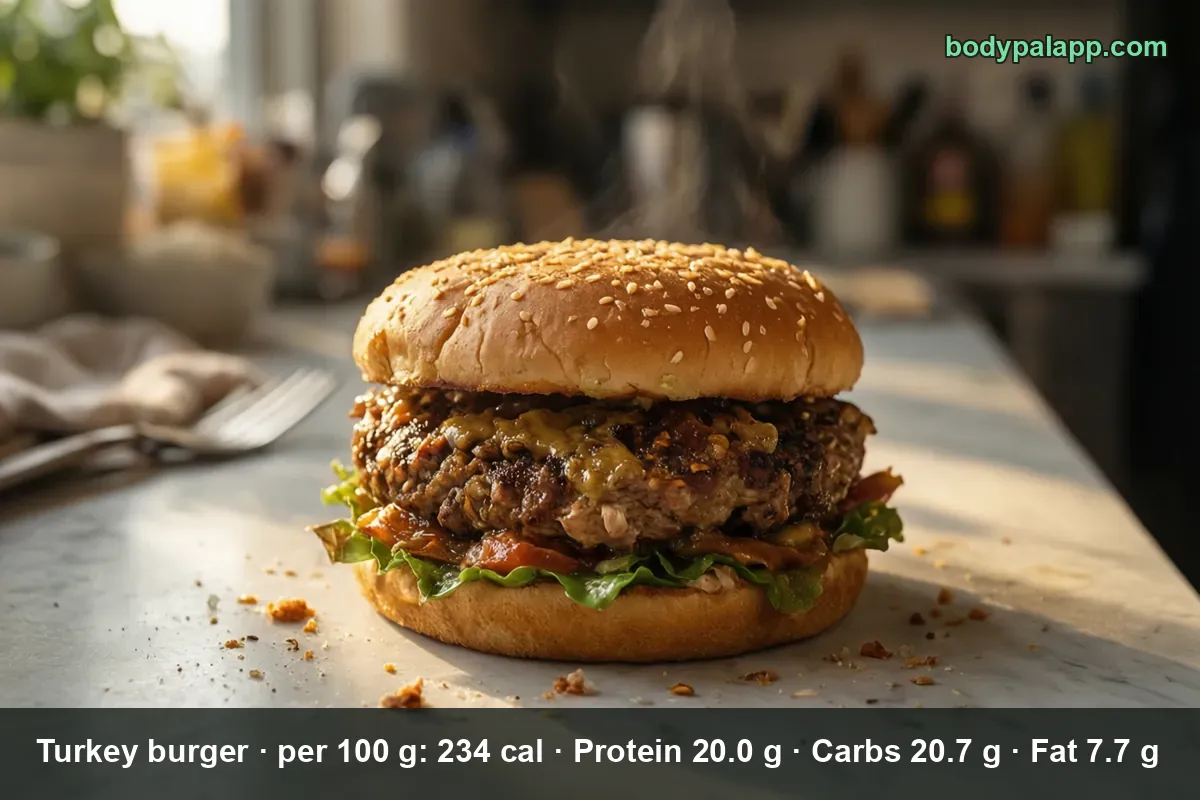
A turkey burger on a white bun weighs 145 g and carries 339 calories. Per 100 g the whole sandwich runs 234 calories, which is less than most people expect from something that eats like fast food. The patty is lean; the bun is what pushes the number up.
On this page
- Turkey burger quick facts
- US servings, from one ounce to two burgers
- Wheat bun, and the patty without the bun
- Protein beats sodium here
- How does a turkey burger compare?
- Most popular turkey burger brands
- Turkey burger FAQs
Turkey burger quick facts
The number below comes from FNDDS 2707018, "Turkey or chicken burger, on white bun", the 2021-2023 survey record. It was picked because it matches what a person actually holds: a cooked patty already inside a bun, the way a turkey burger arrives off a grill or out of a diner kitchen. It is also the only record in this family with a household serving attached, "1 sandwich" at 145 g, so nobody has to guess at a weight.
A white bun is the default in American supermarkets and restaurants, which is why it leads the page. The wheat-bun record gets its own section further down.
| Nutrient | Per 100 g | Per 1 sandwich (145 g) | % Daily Value |
|---|---|---|---|
| Calories | 234 | 339 | — |
| Total fat | 7.69 g | 11.2 g | 14% |
| Saturated fat | 1.91 g | 2.8 g | 14% |
| Carbohydrate | 20.68 g | 30.0 g | 11% |
| Dietary fiber | 0.7 g | 1.0 g | 4% |
| Total sugars | 3 g | 4.4 g | — |
| Protein | 20.03 g | 29.0 g | 58% |
| Sodium | 356 mg | 516 mg | 22% |
| Cholesterol | 54 mg | 78 mg | 26% |
| Potassium | 222 mg | 322 mg | 7% |
% Daily Value is based on a 2,000-calorie diet.
Verified nutrition data
Numbers on this page come from USDA FoodData Central, the U.S. Department of Agriculture’s food composition database, and from manufacturer labels where a branded product is named. Last verified September 2026. How we verify our data →
Two rows you would see on a package label are missing here: added sugars and trans fat. This edition of the survey database does not publish either value for the record, so listing them would mean inventing them. Total sugars has no Daily Value at all, which is why that cell is a dash rather than a percentage.
The 516 mg of sodium in one sandwich is roughly a quarter teaspoon of table salt, and most of it is baked into the bun and the seasoning rather than sprinkled on at the table.
US servings, from one ounce to two burgers
| Serving | Weight | Calories |
|---|---|---|
| 1 oz | 28.4 g | 66 kcal |
| Half a sandwich | 73 g | 171 kcal |
| One turkey burger, standard | 145 g | 339 kcal |
| Two turkey burgers | 290 g | 679 kcal |
| Per 100 g | 100 g | 234 kcal |
Only the 145 g line is a USDA household serving. The ounce, the half and the two-burger row are our own arithmetic scaled from the USDA 100 g figure, not USDA servings, which is worth knowing if you are reconciling this page against a database export.
That two-burger row is the one people underestimate. A second turkey burger costs another 339 calories, 29 g of protein and 516 mg of sodium, so a double lunch lands at 679 calories and 1,032 mg of sodium before a single fry joins the plate. Half a burger, on the other hand, is a genuinely small 171 calories and a reasonable way to pair a burger with a bowl of soup.
Wheat bun, and the patty without the bun
| Version | Per 100 g | Typical serving | Calories |
|---|---|---|---|
| Turkey burger on a white bun | 234 kcal | 1 sandwich, 145 g | 339 kcal |
| Turkey burger on a wheat bun | 227 kcal | 1 sandwich, 145 g | 329 kcal |
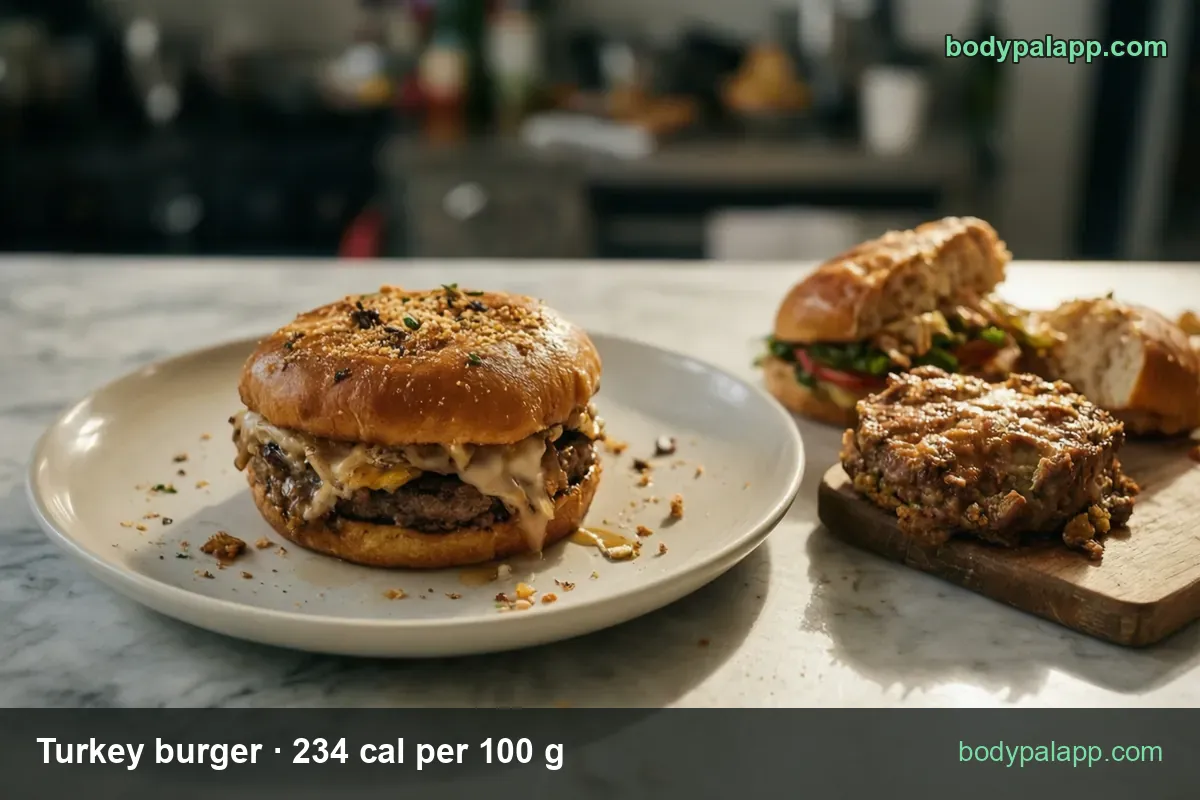
Swapping the white bun for wheat saves 10 calories on the sandwich. That is nothing. What actually changes is the fiber: 3.2 g in the wheat version against 1.0 g in the white one, from 2.2 g versus 0.7 g per 100 g. Carbohydrate drops too, from 30.0 g to 27.2 g, and sodium from 516 mg to 484 mg. The difference between these two records is the bun, not the source — both are the same survey database, measured the same way.
So if someone tells you the wheat bun is the lighter choice, they are right by ten calories and wrong about why it matters. The fiber tripling is the real result, and it moves a sandwich from 4% of the daily fiber target to 11%.
There is no USDA survey record for a cooked turkey patty served without a bun, so this page cannot give you a verified calorie count for the naked patty. What exists instead are package labels for raw patties, and they are useful as a floor: store turkey burgers run from 126 to 195 calories per 100 g of raw meat. A lean Jennie-O patty is 180 calories for a 4 oz (112 g) raw portion, a standard Jennie-O turkey burger 259 for a 149 g raw patty, and a bacon-and-cheddar version 291 for the same weight. Remember these are raw weights: a 4 oz raw patty cooks down to roughly 3 oz on the plate, because water and some fat leave in the pan.
Put those two facts side by side and you have the whole story of this food. The lean Jennie-O patty on the shelf is 161 calories per 100 g. The finished sandwich is 339. The bun, the cheese and whatever goes on top are doing more work than the choice of ground turkey ever will.
Protein beats sodium here
One turkey burger delivers 29.0 g of protein, which is 58% of the FDA Daily Value of 50 g, against 22% of the sodium limit. That ratio is unusual for a sandwich. Most handheld lunches hand you more of the sodium budget than the protein budget, and this one does the reverse by a factor of more than two.
Saturated fat is the other quiet win: 2.8 g, or 14% of the 20 g Daily Value. The Dietary Guidelines for Americans put saturated fat at under 10% of daily calories, and a single turkey burger uses about a seventh of the allowance while providing more than half a day's protein. MyPlate counts ground turkey among lean protein foods for exactly this reason.
Two caveats keep this honest. Cholesterol is 78 mg, 26% of the Daily Value, higher than the calorie count suggests. And the sodium figure covers a plain burger: cheese, bacon, pickles and a squeeze of ketchup can add several hundred milligrams before you sit down. If you are watching sodium, the toppings are where to cut, not the meat.
How does a turkey burger compare?
FNDDS does not publish a gram weight for the three sandwiches below, so a per-serving column would be guesswork. Comparing them per 100 g is the honest version.
| Sandwich | Per 100 g | Protein per 100 g | Fat per 100 g |
|---|---|---|---|
| Turkey burger, white bun | 234 kcal | 20.03 g | 7.69 g |
| Chiliburger, with or without cheese | 232 kcal | 14.76 g | 11.01 g |
| Hamburger, school cafeteria | 243 kcal | 17.8 g | 7.36 g |
| Cheeseburger, school cafeteria | 250 kcal | 18.73 g | 8.64 g |
Our take: on calories alone the turkey burger wins almost nothing. Only the chiliburger is lighter per 100 g, and by two calories, which is noise. The gap opens on protein, where 20.03 g per 100 g is the highest of the four and beats the chiliburger by more than a third. Fat is the one row where turkey is not first: the cafeteria hamburger is marginally leaner at 7.36 g. For a filling lunch under 400 calories, the turkey burger is the pick; for a purely lighter lunch, skip the burger category entirely.
Most popular turkey burger brands in the United States
Ranked by how widely each product appears among foods sold in the United States, from the BodyPal food database of over 3.3 million products. Calories are the figures printed on each Nutrition Facts label, checked against USDA FoodData Central.
| Product | Calories (per 100 g) |
|---|---|
| Jennie-O Turkey Bacon & Cheddar Turkey Burgers | 195 cal |
| Jennie-O Turkey Burger | 174 cal |
| Jennie-O Lean Turkey Burger Patties | 161 cal |
| Diestel Family Ranch Turkey Burgers with Uncured Bacon | 195 cal |
| Jennie-O Turkey Burgers | 168 cal |
| Diestel Organic Turkey Burgers | 126 cal |
Brand popularity: BodyPal food database. Nutrition: manufacturer labels / USDA FoodData Central.
Turkey burger FAQs
How many calories are in a turkey burger?
339 calories in one standard turkey burger on a white bun, a 145 g sandwich, at 234 calories per 100 g. That includes the patty, the bun and the usual seasoning. Two burgers come to 679 calories, and half a burger to 171.
How many calories in a turkey burger without the bun?
Package labels for raw patties run 126 to 195 calories per 100 g, since USDA does not publish a survey record for a cooked turkey patty on its own. A typical 149 g raw patty lands near 250 to 260 calories before cooking losses, and there is no verified USDA figure to check it against.
How much protein is in a turkey burger?
29.0 g of protein in one 145 g turkey burger, which is 58% of the FDA Daily Value of 50 g. Per 100 g the sandwich carries 20.03 g. That is the highest protein density of the burger records on this page, and it comes with only 2.8 g of saturated fat.
How many calories in a 4 oz turkey burger patty?
180 calories for a lean 4 oz (112 g) raw patty, going by the Jennie-O label. Richer blends are higher: a 149 g bacon and cheddar patty is 291. Note that 4 oz is the raw weight, and 4 oz raw cooks down to roughly 3 oz on the plate.
Is a turkey burger healthier than a beef burger?
Slightly: a turkey burger is 234 calories per 100 g against 243 for a cafeteria hamburger and 250 for a cheeseburger, with more protein: 20.03 g versus 17.8 g and 18.73 g. The gaps are real but small, and toppings move the total more than the meat does.
How many carbs are in a turkey burger?
30.0 g of carbohydrate in one 145 g turkey burger, 11% of the Daily Value, of which 4.4 g is total sugars. Nearly all of it is the bun, since ground turkey itself contributes essentially none. A wheat bun brings the sandwich down to 27.2 g.
How much sodium is in a turkey burger?
516 mg of sodium in one 145 g turkey burger, 22% of the 2,300 mg Daily Value, or about a quarter teaspoon of table salt. Per 100 g the sandwich holds 356 mg. Cheese, bacon and condiments are added on top of that figure, not included in it.
Does a wheat bun change the calories in a turkey burger?
Barely: 329 calories against 339 for the same 145 g sandwich, a difference of 10. The meaningful change is fiber, which goes from 1.0 g to 3.2 g, and sodium, which drops from 516 mg to 484 mg. Pick wheat for the fiber, not the calorie saving.
Similar foods
- Chicken Burger — 339 cal per burger
- Burger King Flame Grilled Burger — 678 cal per Whopper
- Jamaican Beef Patty — 303 cal per patty
- Steak Fajita — 277 cal per cup
- Chicken Fries — 216 cal for 7 pieces
- Chicken Nachos — 605 cal per order
Count it without the math
Point the camera at the plate and BodyPal counts the burger for you, bun and toppings included.


How long does it take to burn off 339 kcal of turkey burger?
One sandwich (145 g) is 339 kcal. Enter your weight and the amount you ate to see how long it takes you to burn that off:
lb
| Activity | Time to burn 339 kcal |
|---|---|
| Walking, brisk | 1 hr 8 min |
| Cycling, moderate | 42 min |
| Swimming, moderate | 48 min |
| Jogging | 40 min |
| Weight training, moderate | 1 hr 15 min |
Times are for a 155 lb adult at a steady pace; change the weight to see yours. The amount is set to the portion in the text (145 g); change it to what you actually ate. BodyPal works this out from your steps automatically.
Burning it off is one side of it. The other is knowing your number: work out how many calories you need a day, with macros and a goal date.