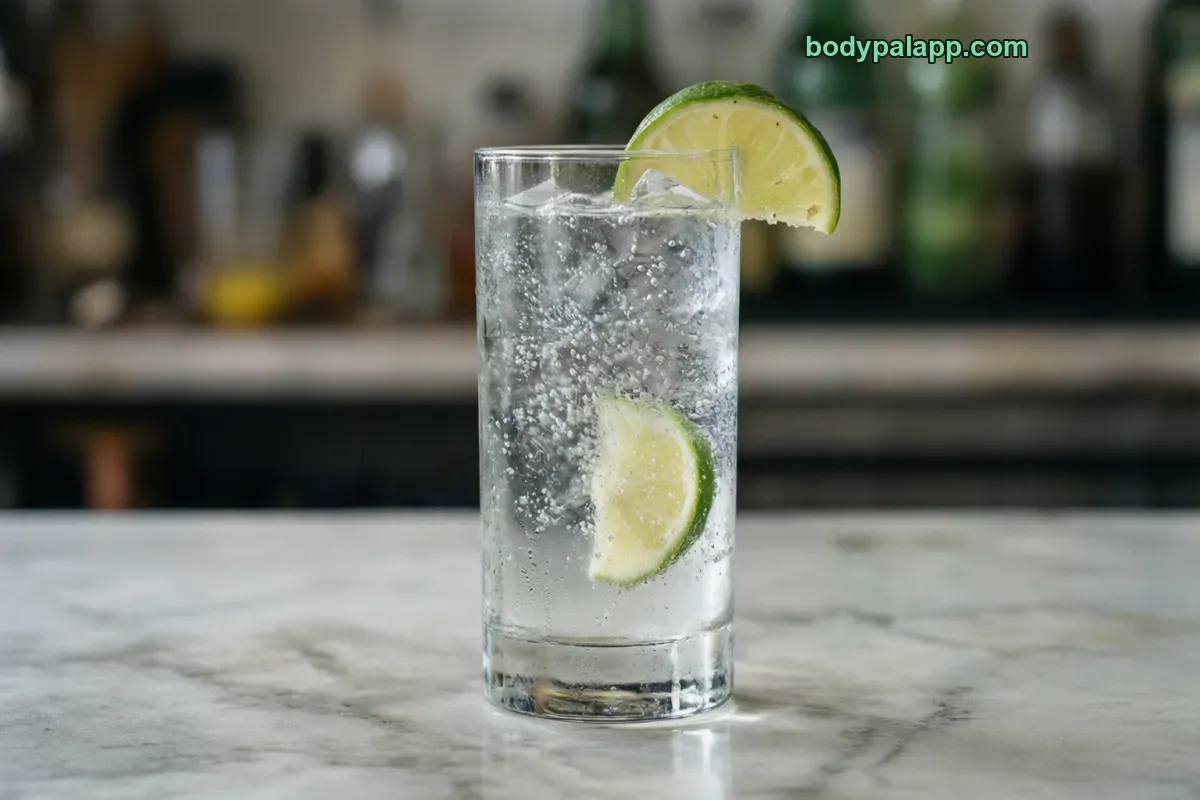
Vodka and tonic calories come to 189 for one 225 g drink, or 84 per 100 g. Every gram of carbohydrate in it is sugar, 14.8 g per glass, and there is no protein or fat at all. The figure that really swings your total is how many rounds you order.
189kcal
1 drink · 225 g, mixed drink
0%protein
0 gProtein
15 gCarbs
0 gFat
How to burn off 189 kcal
—Walking, brisk
—Jogging
—Cycling, moderate
—Swimming
Skip the math. BodyPal counts these calories from your steps and workouts automatically.
Nutrition facts
Mixed drink · per 225 g
Calories
189 kcal
Protein
0 g
Carbohydrate
14.8 g
Fat
0 g
Saturated fat
0 g
Cholesterol
0 mg
Sodium
20 mg
Potassium
2 mg
Iron
0 mg
Source: USDA FoodData Central
🛡️
Verified nutrition data
Numbers on this page come from USDA FoodData Central, the U.S. Department of Agriculture’s food composition database, and from manufacturer labels where a branded product is named. Last verified September 2026. How we verify our data →
Vodka and tonic: calories, protein and sodium by serving
Percent of daily value uses the FDA reference of 2,000 kcal a day.
Serving
kcal
Protein
Carbs
Fat
Sodium
% DV kcal
1 drink (225 g)
189
0 g
14.8 g
0 g
20 mg
9%
1 fl oz (30 g)
25
0 g
2 g
0 g
3 mg
1%
100 g
84
0 g
6.6 g
0 g
9 mg
4%
3 × 1 drink (225 g)
567
0 g
61 mg
5 × 1 drink (225 g)
945
0 g
101 mg
One drink is 189 calories, three are 567
A standard vodka and tonic of 225 g lands at 189 calories, about 9% of a 2,000-calorie daily value. On its own that is a modest number, roughly what a small snack costs. The problem is that people rarely stop at one.
Two drinks bring you to 378 calories. Three reach 567, and a long evening of five adds up to 945 calories across 1,125 g of liquid. That last figure is close to half of a typical daily calorie budget, delivered without a bite of food.
Smaller pours scale down neatly. A 1 fl oz (30 g) splash is 25 calories with 2 g of sugar, which is useful if you log a half-finished glass or a tasting pour. If you track honestly, count the rounds, not just the first glass.
The tonic brings the sugar, the vodka brings the rest
The label macros look odd at first. Per 100 g there is 0 g protein, 0 g fat and 6.6 g carbohydrate, so carbs are listed as 100% of the macro split. Yet 6.6 g of carbs cannot account for 84 calories by themselves. The gap is the alcohol, which carries calories but does not appear in the protein, carb or fat columns.
The comparison with vodka and soda makes the split visible. Vodka and soda has 0 g carbs per 100 g and still lands at 59 calories, so that baseline is the spirit. Swap the soda for tonic and you add the sugar, pushing the total to 84 per 100 g.
In practice this means two levers. The pour of vodka sets the floor, and the mixer decides how much sugar goes on top. Neither lever adds protein or fiber, so the drink does nothing to fill you up.
Sugar is the row to watch, not sodium
Regular tonic water is a sweetened soft drink, and it shows. One drink holds 14.8 g of sugars, and every gram of the carbohydrate is sugar. Two rounds bring that to roughly double, all from the mixer.
Sodium, by contrast, barely registers. A single drink has 20 mg, about 1% of the daily value, and even five drinks total only 101 mg. If you watch salt, this is not the drink to worry about.
Cholesterol, saturated fat and fiber all read 0, and potassium is just 1 mg per 100 g. So the nutrition story is short: calories from the spirit, sugar from the tonic, and very little else.
Fitting a vodka tonic into a day of eating
Because the drink supplies calories with no protein or fiber, it is easy to stack on top of a full meal without noticing. If you plan a couple of rounds, it helps to count them before dinner rather than after, so the 378 calories for two drinks are already in your numbers.
Pairing matters more than the glass itself. Bar snacks like fries or nuts can outweigh the drinks quickly, while a protein-forward plate makes the evening more filling. Alternating each drink with water also slows the pace of rounds.
If logging is the hard part, BodyPal can log a vodka and tonic from a photo, which makes it simpler to keep count when the second and third glasses arrive.
How does vodka and tonic compare?
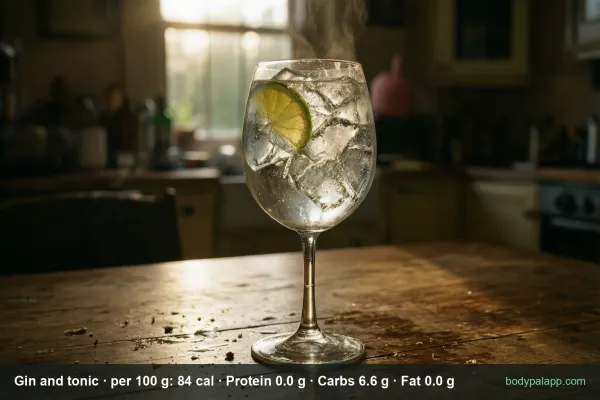
Here is how vodka and tonic stacks up against gin and tonic, vodka and soda, and vodka Sprite, per 100 g and per usual serving.
Verdict: If calories are your priority, pick vodka and soda at 133 per drink, about 0.7 times a vodka and tonic, with 0 g carbs. Gin and tonic is a straight swap at 84 per 100 g, while vodka Sprite is the heaviest at 200 per drink, so skip it if you are counting.
Vodka and tonic FAQs
How many calories are in a vodka and tonic?
About 189 calories in one 225 g drink, or 25 calories per fl oz.
Is vodka and tonic good for weight loss?
One drink has 189 calories and 14.8 g of sugar from the tonic. A vodka and soda of the same size has 133 calories and 0 g of sugar.
Vodka and tonic vs gin and tonic: which has fewer calories?
They are the same: 84 calories per 100 g, or 189 calories per 225 g drink.
How much sugar is in a vodka and tonic?
About 14.8 g per drink (6.57 g per 100 g), all from the tonic water. It has 0 g of protein and 0 g of fat.
How many calories are in two vodka tonics?
Two vodka tonics come to 378 calories across 450 g of drink. Three rounds reach 567 calories, so the total climbs quickly over an evening even though each glass seems light.
How many calories are in 1 fl oz of vodka and tonic?
One fl oz (30 g) of vodka and tonic has 25 calories and 2 g of sugar. That is handy for logging a partial glass or a small tasting pour.
Is vodka and tonic fattening?
One drink has 189 calories, about 9% of the daily value, with no protein or fiber to fill you up. It is the number of rounds, not a single glass, that makes the total add up.
Does vodka and tonic have carbs?
Yes, one drink has 14.8 g of carbohydrate, and all of it is sugar from the tonic. Vodka and soda, by comparison, lists 0 g carbs per 100 g.
Which has fewer calories, vodka tonic or vodka soda?
Vodka soda is lighter at 133 calories per drink versus 189 for vodka and tonic. The difference is the sweetened tonic water; soda water adds no carbs.