
How many calories are in a gin and tonic?
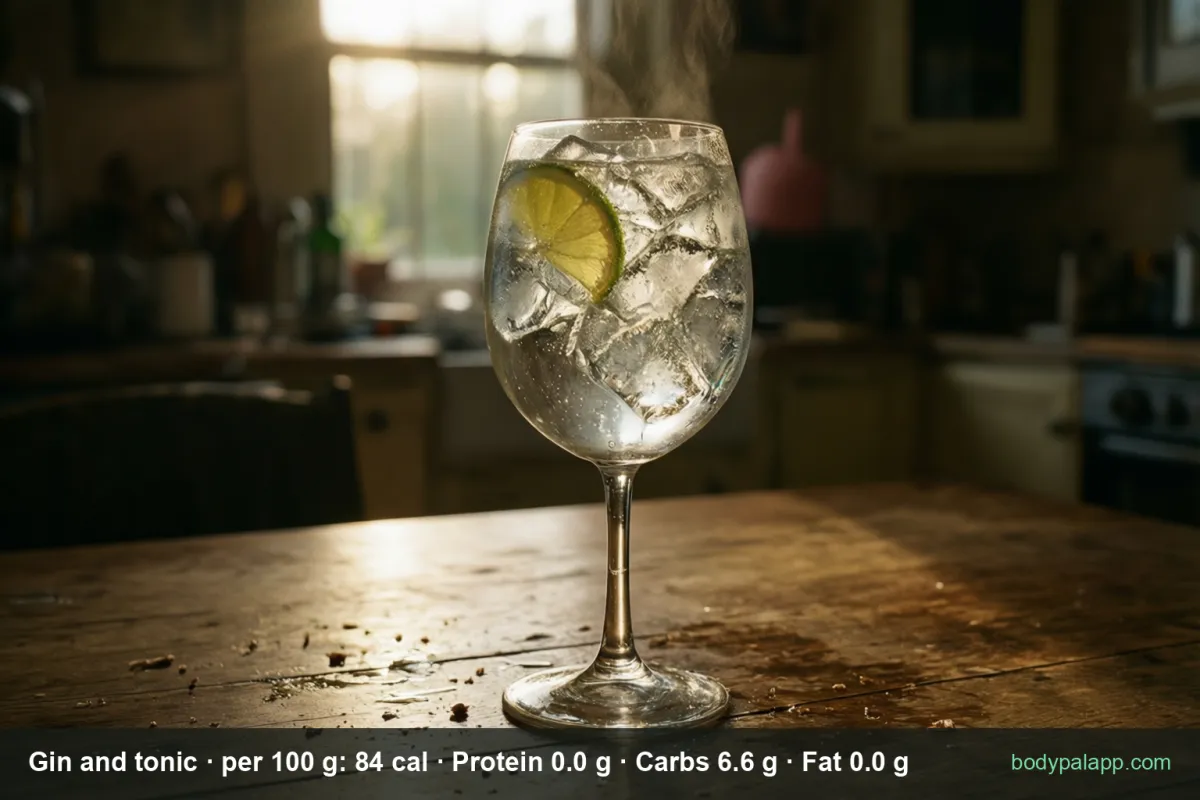
A standard gin and tonic weighs 225 g and carries 189 calories. Per 100 g the drink runs 84 calories, which puts it among the lighter things poured over ice. Almost none of that is fat or protein. The count comes from the gin and from the sugar dissolved in the tonic water, and nothing else.
On this page
- Gin and tonic quick facts
- US servings from a 1 oz taste to a tall glass
- Vodka tonic rum and cola and the rest of the bar rail
- Where the 189 calories actually come from
- How does a gin and tonic compare?
- FAQ
Gin and tonic quick facts
The record behind every number on this page is FNDDS 2710633, "Gin and tonic", filed under liquor and cocktails. It describes the finished mixed drink, not the bottle of gin and not the bottle of tonic, which is exactly what a person holds when they ask how many calories are in the glass. It also ships with a household measure of its own, "1 drink" at 225 g, so the serving column below is not an invented portion.
Foundation Foods and SR Legacy have no entry for the cocktail at all. That single FNDDS row is the whole of the official picture, which is worth knowing before you compare it with a bar menu that gives a calorie count without saying how big the glass was.
| Nutrient | Per 100 g | Per 1 drink (225 g) | % Daily Value |
|---|---|---|---|
| Calories | 84 | 189 | — |
| Total fat | 0 g | 0 g | 0% |
| Saturated fat | 0 g | 0 g | 0% |
| Carbohydrate | 6.57 g | 14.8 g | 5% |
| Dietary fiber | 0 g | 0 g | 0% |
| Total sugars | 6.57 g | 14.8 g | — |
| Protein | 0 g | 0 g | 0% |
| Sodium | 9 mg | 20 mg | 1% |
% Daily Value is based on a 2,000-calorie diet.
Verified nutrition data
Numbers on this page come from USDA FoodData Central, the U.S. Department of Agriculture’s food composition database, and from manufacturer labels where a branded product is named. Last verified September 2026. How we verify our data →
Two rows you would see on a US label are missing here: added sugars and trans fat. The FNDDS edition simply does not publish either value for this record, so listing them would mean guessing, and guessing is not what this page is for. Cholesterol is 0 mg per drink and potassium is 2 mg, both of which round to 0% of the Daily Value. The percentages come from the FDA reference amounts for a 2,000-calorie diet.
US servings from a 1 oz taste to a tall glass
| Serving | Weight | Calories |
|---|---|---|
| 1 fl oz | 30 g | 25 kcal |
| 1 oz by weight | 28.4 g | 24 kcal |
| 2 fl oz | 60 g | 50 kcal |
| One drink, standard glass | 225 g | 189 kcal |
| 8 fl oz tall pour | 240 g | 202 kcal |
| Per 100 g | 100 g | 84 kcal |
Two of these are USDA measures: the 225 g drink and the 1 fl oz pour. The 2 fl oz line, the 8 fl oz line and the 1 oz weight line are our own arithmetic from the USDA 100 g figure, not USDA servings, scaled straight off the 84 calories per 100 g.
This is where most gin and tonic math goes wrong. A calorie tracker that offers you "1 fl oz" as the default unit is offering 25 calories, and a real glass is about seven and a half times that. Log one fluid ounce when you drank a full glass and you have hidden 164 calories from yourself. If your glass is a tall one filled to 8 fl oz, you are at 202 calories rather than 189, which is a small enough gap that the ice matters more than the arithmetic.
Weight and volume are close but not identical here. One fluid ounce of the mixed drink weighs about 30 g, while one ounce on a kitchen scale is 28.4 g, and that is the difference between 25 and 24 calories. At the size of a real drink, ignore it.
Vodka tonic rum and cola and the rest of the bar rail
| Drink | Per 100 g | Typical pour | Calories |
|---|---|---|---|
| Gin and tonic | 84 kcal | 1 fl oz (30 g) | 25 kcal |
| Vodka and tonic | 84 kcal | 1 fl oz (30 g) | 25 kcal |
| Whiskey and ginger ale | 83 kcal | 1 fl oz (30 g) | 25 kcal |
| Seven and Seven | 87 kcal | 1 fl oz (30 g) | 26 kcal |
| Greyhound | 87 kcal | 1 fl oz (30 g) | 26 kcal |
| Rum and cola | 89 kcal | 1 fl oz (30 g) | 27 kcal |
| Cocktail, NFS | 89 kcal | 1 fl oz (30 g) | 27 kcal |
Vodka and tonic lands on 84 calories per 100 g, the same figure as gin and tonic, right down to the 6.57 g of carbohydrate. The spirit is not what you are counting; the mixer is.
Whiskey and ginger ale is the lightest row on this table at 83 calories per 100 g, and the margin is one calorie. Treat it as a tie, not as a saving.
Seven and Seven and the Greyhound both sit at 87. They get there differently: the lemon-lime soda pushes carbohydrate to 7.63 g per 100 g, while the grapefruit juice in a Greyhound brings 6.28 g of carbohydrate plus small amounts of protein and fat that the other drinks do not have at all.
Rum and cola is the heaviest at 89 calories per 100 g with 7.8 g of carbohydrate, and USDA's generic Cocktail, NFS record carries exactly the same numbers, which tells you something about what the average American mixed drink looks like in the data.
One note on cans. USDA's Branded database has no US entry filed under "gin and tonic" at all, because ready-to-drink cans are catalogued under their brand names rather than under the name of the cocktail. If you are drinking one, the can's own Nutrition Facts panel beats every number on this page, since the mix ratio is set at the factory.
Where the 189 calories actually come from
Look at the carbohydrate and total sugars rows in the quick facts table: 6.57 g and 6.57 g. They are the same number. Every gram of carbohydrate in a gin and tonic is sugar, fiber is 0 g, and in a full 225 g glass that comes to 14.8 g of sugar. All of it arrives in the tonic water. Gin brings no carbohydrate whatsoever.
That 14.8 g is 5% of the FDA Daily Value for total carbohydrate. Total sugars have no Daily Value, so that cell stays blank on any honest label, and the added sugars line that would tell you the useful part is one of the two values USDA does not publish for this record.
The rest of the 189 calories is alcohol. Fat, saturated fat and protein all read 0 g, so once you have accounted for the sugar there is nothing else on the label left to hold calories. That is why a gin and tonic behaves differently from a dessert of the same size: you can cut the sugar by changing the mixer, but you cannot cut the alcohol without pouring less gin.
Sodium is a non-event at 20 mg per drink, or 1% of the Daily Value, which is less than a hundredth of a teaspoon of table salt. The Dietary Guidelines for Americans advise adults of legal drinking age either not to drink or to drink in moderation, and the CDC's alcohol facts put numbers on what moderation means. If you are watching your intake, the drink count matters more here than the calorie count does.
How does a gin and tonic compare?
| Drink | Per 100 g | US serving | Calories |
|---|---|---|---|
| Gin and tonic | 84 kcal | 1 fl oz (30 g) | 25 kcal |
| Vodka and tonic | 84 kcal | 1 fl oz (30 g) | 25 kcal |
| Whiskey and ginger ale | 83 kcal | 1 fl oz (30 g) | 25 kcal |
| Rum and cola | 89 kcal | 1 fl oz (30 g) | 27 kcal |
Our take: there is no meaningful calorie decision to make between a gin and tonic, a vodka tonic and a whiskey with ginger ale. Six calories per 100 g separate the lightest of these four from the heaviest, and that gap disappears the moment one glass is filled a little fuller than another. The only lever with real leverage is the mixer's sugar and the size of the pour. Switch the tonic for something sugar-free and the 14.8 g of sugar leaves with it; keep the tonic and order a second drink and you have added another 189 calories, which is more than every ingredient swap on this table combined.
Gin and tonic FAQs
How many calories are in a gin and tonic?
A standard gin and tonic of 225 g carries 189 calories, or 84 calories per 100 g in the USDA record. That is the full glass a bartender hands you, ice and lime included. A single fluid ounce, the amount in a taste or a sample pour, is only 25 calories.
How many calories in a double gin and tonic?
USDA publishes no separate row for a 450 g double, so the honest number is arithmetic. A 450 g pour, twice the standard glass, works out to 378 calories from the 84 per 100 g figure. If only the gin is doubled and the glass stays the same size, the drink lands somewhere between 189 and 378.
How many carbs are in a gin and tonic?
One drink holds 14.8 g of carbohydrate, which is 5% of the FDA Daily Value of 275 g. Per 100 g the figure is 6.57 g. All of it arrives in the tonic water, since gin itself brings no carbohydrate at all, and the dietary fiber row reads 0 g.
How much sugar is in a gin and tonic?
All 14.8 g of the carbohydrate in a 225 g drink is sugar, because carbohydrate and total sugars are the same value in the USDA record. Per 100 g that is 6.57 g. Total sugars carry no Daily Value, so the percentage cell for that row stays empty on a US label.
Is a gin and tonic keto friendly?
Not comfortably: one 225 g glass brings 14.8 g of carbohydrate, every gram of it sugar and none of it fiber, which is 5% of the Daily Value in a single drink. The gin is not the problem here; the tonic is, and it is the only ingredient carrying carbohydrate.
Is vodka tonic lower in calories than gin and tonic?
No: vodka and tonic is 84 calories per 100 g in the USDA data, exactly the same as gin and tonic, because the tonic does the work and both spirits are carbohydrate-free. Swapping the bottle changes the flavor, not the count. Whiskey and ginger ale is a single calorie lower at 83.
How many calories in a gin and tonic with diet tonic?
USDA publishes no row for diet or slimline tonic, so there is no honest number to put beside the 189. What the data does show is where the calories sit: all 14.8 g of sugar in a standard drink comes from regular tonic, so a zero-sugar mixer leaves the alcohol as the only calorie source.
How much sodium is in a gin and tonic?
A 225 g gin and tonic contains 20 mg of sodium, which is 1% of the FDA Daily Value of 2,300 mg. Per 100 g the figure is 9 mg. That is less than a hundredth of a teaspoon of table salt, so sodium is not a row worth watching in this particular glass.
Similar foods
- Butter Chardonnay (Buttery Oaked White Wine) — 123 cal per glass
- Chardonnay — 123 cal per glass
- Vodka Tonic — 189 cal per drink
- Chardonnay Wine — 123 cal per glass
- Pinot Grigio — 122 cal per glass, 5 fl oz
- Pinot Gris — 122 cal per glass
Count it without the math
Point the camera at the glass and BodyPal counts the drink for you, tonic and all.


How long does it take to burn off 189 kcal of gin and tonic?
One drink (225 g) is 189 kcal. Enter your weight and the amount you ate to see how long it takes you to burn that off:
lb
| Activity | Time to burn 189 kcal |
|---|---|
| Walking, brisk | 38 min |
| Cycling, moderate | 24 min |
| Swimming, moderate | 27 min |
| Jogging | 22 min |
| Weight training, moderate | 42 min |
Times are for a 155 lb adult at a steady pace; change the weight to see yours. The amount is set to the portion in the text (225 g); change it to what you actually ate. BodyPal works this out from your steps automatically.
Want the bigger picture? Calculate your daily calorie needs — your maintenance figure, a target for losing or gaining, and the date you get there.