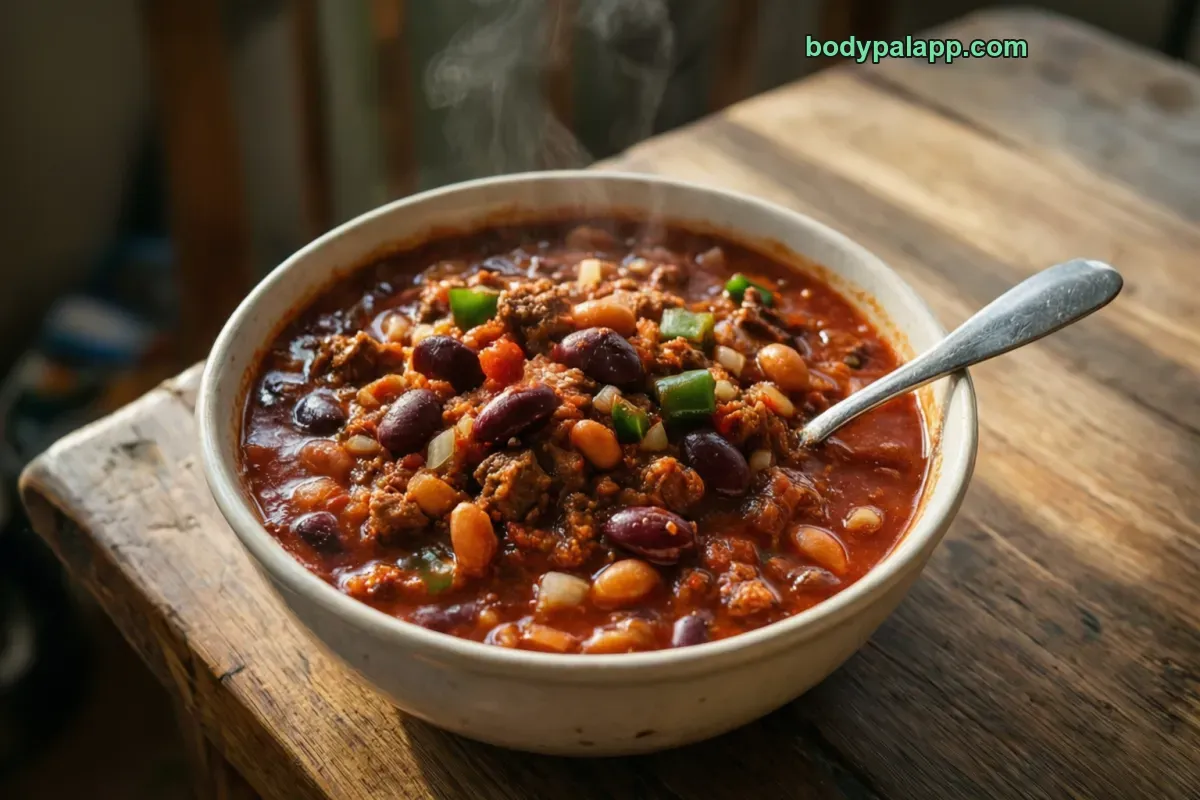
Wendy's chili calories come to 244 for 1 cup (244 g) and 100 per 100 g, based on a USDA reference for chili with beans rather than Wendy's own menu figures. The number to notice is sodium. That cup carries 939 mg, 41% of the daily value, while its calories are only 12%.
244kcal
1 cup · 244 g, chili with beans
23%protein
14.3 gProtein
27 gCarbs
9 gFat
How to burn off 244 kcal
—Walking, brisk
—Jogging
—Cycling, moderate
—Swimming
Skip the math. BodyPal counts these calories from your steps and workouts automatically.
Nutrition facts
Chili with beans · per 244 g
Calories
244 kcal
Protein
14.3 g
Carbohydrate
27 g
Fat
9 g
Saturated fat
3.3 g
Cholesterol
24 mg
Sodium
939 mg
Potassium
598 mg
Iron
2.8 mg
Source: USDA FoodData Central
🛡️
Verified nutrition data
Numbers on this page come from USDA FoodData Central, the U.S. Department of Agriculture’s food composition database, and from manufacturer labels where a branded product is named. Last verified September 2026. How we verify our data →
Wendy's chili: calories, protein and sodium by serving
Percent of daily value uses the FDA reference of 2,000 kcal a day.
Serving
kcal
Protein
Carbs
Fat
Sodium
% DV kcal
1 cup (244 g)
244
14.3 g
26.5 g
9 g
939 mg
12%
8 oz portion (227 g)
227
13.3 g
24.7 g
8.4 g
874 mg
11%
Large bowl (422 g)
422
24.7 g
45.9 g
15.5 g
1,625 mg
21%
100 g
100
5.9 g
10.9 g
3.7 g
385 mg
5%
3 × 1 cup (244 g)
732
42.8 g
2,818 mg
5 × 1 cup (244 g)
1,220
71.4 g
4,697 mg
A large bowl runs 422 calories
A 1 cup (244 g) serving comes to 244 calories, 14.3 g protein and 7.1 g fiber. That is 12% of the daily calorie value for a bowl that eats like a meal. An 8 oz portion (227 g) is close behind at 227 calories, so the two sizes are nearly interchangeable on a log.
The large bowl (422 g) is where the total climbs: 422 calories, 24.7 g protein and 12.2 g fiber, or 21% of the daily calorie value. Chili with beans sits at 100 calories per 100 g, which makes the math easy. Grams and calories run almost one for one, so a kitchen scale tells you nearly everything.
Seconds add up fast. Two cups come to 488 calories and three cups to 732. If chili is the whole dinner, a bigger bowl is reasonable. If it sits beside fries or a burger, the cup is the size that keeps the meal in check.
Carbs lead, fat takes a third
Per 100 g, this chili carries 10.9 g carbs, 5.9 g protein and 3.7 g fat. By calories that splits into 44% carbs, 33% fat and 23% protein. The beans drive the carb share and bring fiber with them: 2.9 g per 100 g, with only 1.8 g of sugars.
Fat deserves a second look. It is just 3.7 g per 100 g, yet it supplies a third of the calories because fat is dense. Saturated fat is 1.4 g per 100 g, a modest figure for a meat and bean dish. Cholesterol sits at 10 mg per 100 g.
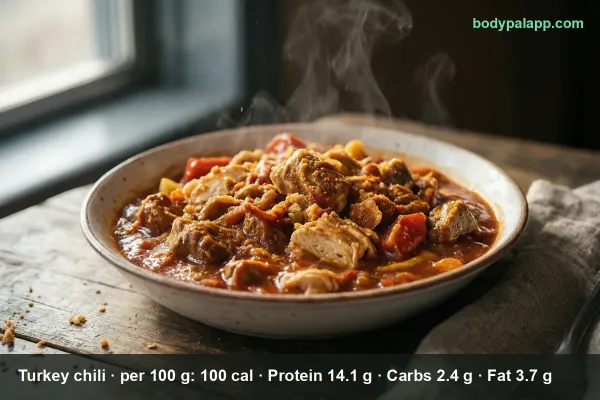
Protein is solid rather than headline. A cup gives 14.3 g, 29% of the daily value, and together with the fiber that makes the bowl filling. If you want more protein from your chili, turkey chili's 14.1 g per 100 g is the obvious upgrade.
Sodium is the row to watch
Each 100 g carries 385 mg of sodium, 17% of the daily value. A cup brings that to 939 mg, or 41%, while delivering only 12% of the day's calories. That gap is the single most useful thing to know about this bowl.
Size up and it gets steep. The large bowl holds 1,625 mg, 71% of the daily value, and two cups reach 1,879 mg. Pair either with salted fries or a burger and most of the day's sodium can be gone in one meal.
If you watch sodium, stick to the cup or the 8 oz portion (874 mg, 38%), go easy on salty toppings, and keep the rest of the day lighter on processed foods. Potassium, at 245 mg per 100 g, is a modest figure next to the salt.
Chili makes a smarter side than fries
For its calories, a cup of chili brings a lot to the table. At 244 calories with 7.1 g fiber and 14.3 g protein, it is more filling than its number suggests. Swapping it in for a side of fries shifts the whole meal toward protein and fiber.
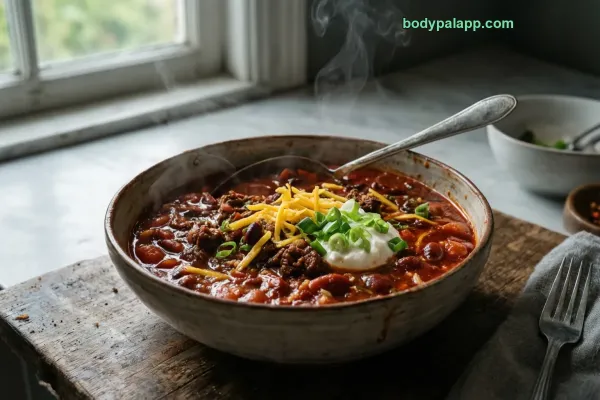
At home, pair it with something low in sodium: a plain baked potato, a green salad with a light dressing, or fresh fruit. Cheese, sour cream and crackers add calories and salt quickly, so add them by measure rather than by handful. BodyPal can log a bowl of chili from a photo.
Keep in mind these figures are a USDA reference for chili with beans in microwavable bowls, not Wendy's published nutrition. Restaurant recipes differ, so treat the numbers as a close guide rather than an exact match.
How does Wendy's chili compare?
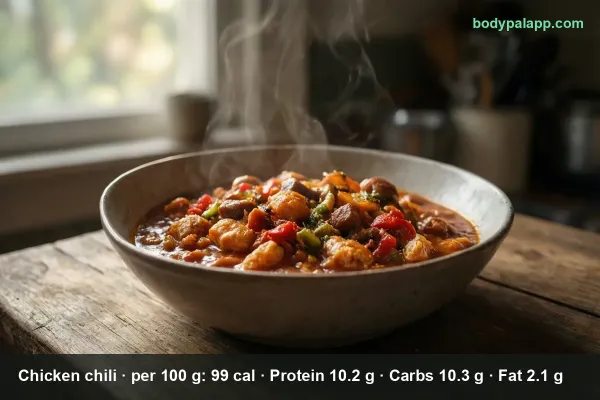
Here is how Wendy's chili stacks up against classic chili, chicken chili and turkey chili, per 100 g and per usual serving.
Verdict: For the most protein at the same calories, pick turkey chili, which matches the 100 calories per 100 g but packs 14.1 g protein with just 2.4 g carbs. Classic chili runs heavier at 118 calories per 100 g and 301 per cup, so Wendy's chili is the lighter bowl of the two.
Wendy's chili FAQs
How many calories are in Wendy's chili?
A 244 g cup is 244 calories and a 422 g bowl is 422 calories. Per 100 g the chili is 100 calories.
Is Wendy's chili good for weight loss?
A cup is 244 calories with 14.3 g protein and 7.1 g fiber, which is low for a hot fast-food portion of that size.
Wendy's chili vs chili con carne: which is lighter?
Chili con carne is 118 calories per 100 g against 100 here, so the same 244 g cup would be 288 calories instead of 244.
How much protein is in Wendy's chili?
About 14.3 g in a 244 g cup and 24.7 g in the 422 g bowl, from 5.85 g of protein per 100 g.
How many calories are in a large bowl of Wendy's chili?
A large bowl (422 g) has 422 calories, 21% of the daily value, with 24.7 g protein and 45.9 g carbs. It also carries 1,625 mg of sodium, which is 71% of the daily value.
How much sodium is in Wendy's chili?
A cup holds 939 mg of sodium, 41% of the daily value. Per 100 g it is 385 mg. The 8 oz portion drops to 874 mg, which is still 38% of the daily value.
How much fiber is in Wendy's chili?
A cup gives 7.1 g of fiber, mostly from the beans, and only 4.5 g of sugars. Per 100 g that is 2.9 g of fiber. The large bowl reaches 12.2 g.
Is Wendy's chili high in fat?
Not by weight: it has 3.7 g fat per 100 g and 9 g per cup, with 1.4 g saturated fat per 100 g. Fat still supplies 33% of the calories because it is dense.