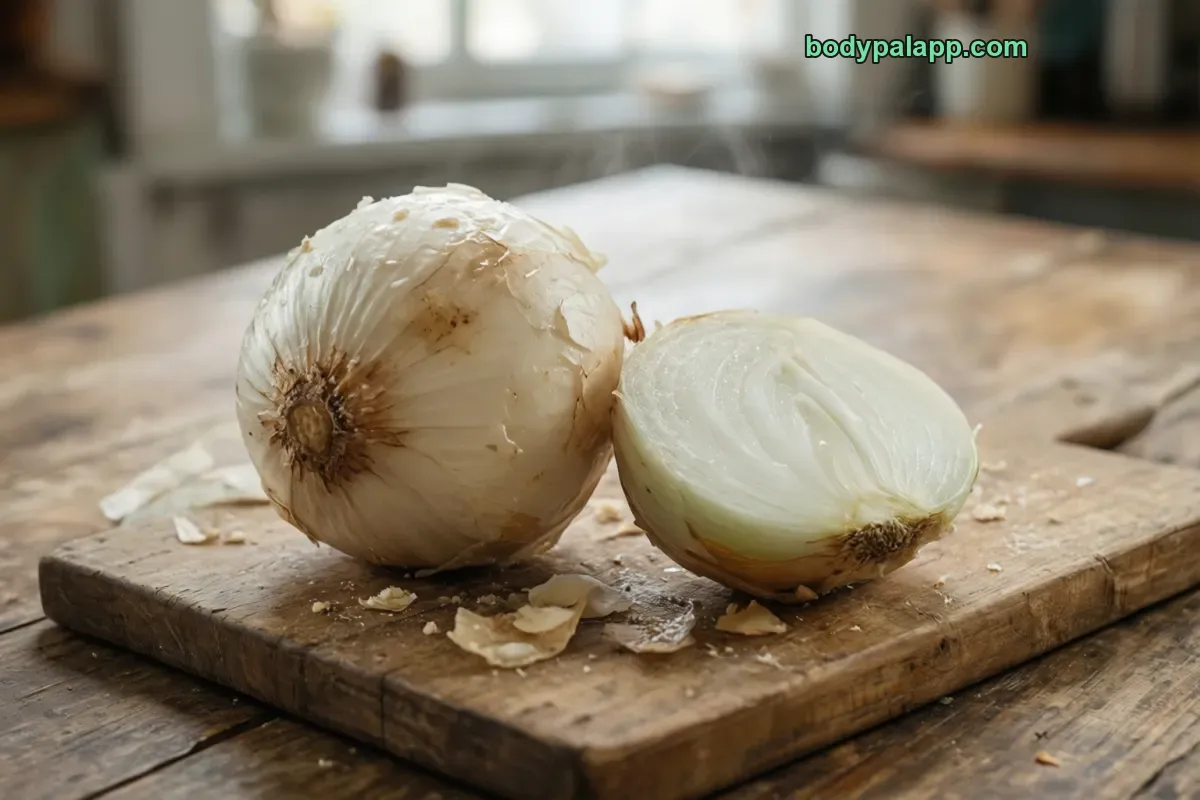
White onion calories come to 40 for one medium onion (113 g) and 35 per 100 g, raw. Nearly all of that energy is carbohydrate, 87% of it, with almost no fat and next to no sodium. Portion size barely matters here: even a large 170 g onion lands at just 60 calories.
40kcal
1 medium onion · 113 g, raw
10%protein
1 gProtein
9 gCarbs
0.1 gFat
How to burn off 40 kcal
—Walking, brisk
—Jogging
—Cycling, moderate
—Swimming
Skip the math. BodyPal counts these calories from your steps and workouts automatically.
Nutrition facts
Raw · per 113 g
Calories
40 kcal
Protein
1 g
Carbohydrate
8.7 g
Fat
0.1 g
Sodium
2 mg
Potassium
159 mg
Iron
0.2 mg
Source: USDA FoodData Central
🛡️
Verified nutrition data
Numbers on this page come from USDA FoodData Central, the U.S. Department of Agriculture’s food composition database, and from manufacturer labels where a branded product is named. Last verified September 2026. How we verify our data →
White onion: calories, protein and sodium by serving
Percent of daily value uses the FDA reference of 2,000 kcal a day.
Serving
kcal
Protein
Carbs
Fat
Sodium
% DV kcal
1 medium (113 g)
40
1 g
8.7 g
0.1 g
2 mg
2%
1 small (85 g)
30
0.8 g
6.5 g
0.1 g
2 mg
1%
1 large (170 g)
60
1.5 g
13.1 g
0.2 g
3 mg
3%
100 g
35
0.9 g
7.7 g
0.1 g
2 mg
2%
3 × 1 medium (113 g)
119
3 g
7 mg
5 × 1 medium (113 g)
198
5 g
11 mg
A large onion is still only 60 calories
A small white onion of 85 g has 30 calories, a medium one of 113 g has 40, and a large 170 g bulb has 60. That range covers almost any onion you will pull from the bin. The largest has twice the calories of the smallest and still barely registers in a full day of eating.
Cooking in bulk changes the picture only slightly. Two medium onions, 226 g in all, add 79 calories. Three come to 119 calories for 339 g, and five medium onions, a full 565 g, total 198. That is enough onion for a big pot of soup or a tray of caramelized onions, and the onion side of the ledger stays modest.
Percent daily values tell the same story. One medium onion supplies 2% of daily calories and a large one 3%. If you track closely, weigh rather than guess, because the size label you choose decides whether you log 30 calories or 60. Most recipes just say one onion without a size, so the kitchen scale settles it.
Carbs supply 87% of the calories
Per 100 g, white onion carries 7.7 g of carbohydrate, 0.9 g of protein and 0.1 g of fat. In calorie terms that splits into 87% carbs, 10% protein and 3% fat. This is a carb food, but a dilute one: most of the bulb's weight delivers no energy at all, which is why the per 100 g figure is only 35.
A medium onion holds 8.7 g of carbs and a large one 13.1 g. Fiber accounts for part of that, with 1.4 g in a medium onion and 2 g in a large one, against a 28 g daily value. Protein stays at about 1 g per medium onion, so onions will not move your protein total in any meaningful way.
Fat is close to zero in every serving, at 0.1 g in a small or medium onion and 0.2 g in a large one. Almost any fat you see next to onions on a plate comes from how they were cooked, not from the onion. Sauté a medium onion in butter or oil and the fat line on your log will be set by the pan, not the produce.
Sodium barely registers
A medium white onion has 2 mg of sodium, which rounds to 0% of the 2300 mg daily value. The small onion has the same 2 mg and the large one 3 mg. Per 100 g the figure is 2 mg as well.
Scaling up does not change that. Five medium onions, 565 g of food, add just 11 mg. Three medium onions stop at 7 mg. For anyone counting sodium, raw onion is effectively a free ingredient.
Potassium is the larger mineral line, at 141 mg per 100 g against a 4700 mg daily value. That is a modest contribution rather than a major source. The practical point: if a dish built on onions runs salty, the sodium came from the salt shaker, the broth or the sauce, not the bulb. Season with that in mind and let the onion carry more of the flavor so the dish leans less on salt.
Cooking fat matters more than the onion
Onion is a flavor base more than a food you eat for its nutrients. With 0.9 g of protein per 100 g, it does little for your protein total, so pair it with a protein such as eggs, beans, chicken or fish and let it add volume and taste to the plate.
The bigger variable is cooking fat. A medium onion has 40 calories, but onions fried in oil or butter soak up fat, and that fat belongs on your log as a separate entry. Raw onion in salads, salsas and sandwiches keeps the count close to the card values.
Pre-cut packs such as Crazy Fresh Diced White Onion or Caldwell Fresh Foods Diced White Onion save prep time. Mixes like H-E-B Diced Bell Pepper & White Onion add other vegetables, so check their labels before logging. If you cook from scratch, BodyPal can log a plate of onions from a photo.
How does white onion compare?
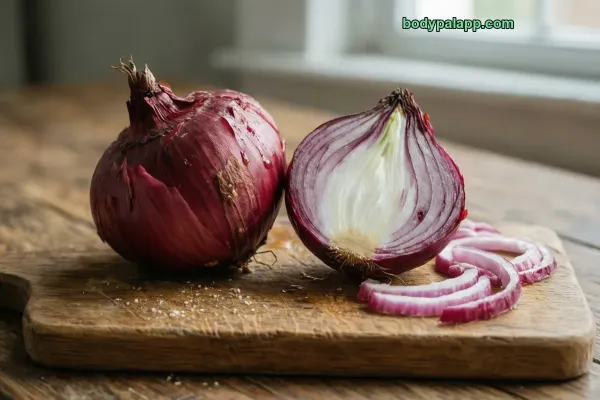
Here is how white onion stacks up against yellow, red and green onion, per 100 g and per usual serving.
Verdict: White onion is the leanest bulb here at 35 calories per 100 g, against 38 for yellow and 44 for red, so pick it if you want the lowest count per bite. Green onion is lower still at 32 per 100 g and only 5 per stalk, which makes it the best topping choice, while red onion's 87-calorie whole bulb is the heaviest default serving.
Most popular white onion brands in the United States
Ranked by popularity in the BodyPal database
# Productkcal / 100 g
1Crazy Fresh Diced White Onion0.5 cup · 85 g41 kcal
2Caldwell Fresh Foods Diced White Onion0.75 cup · 85 g41 kcal
4H-E-B Diced Bell Pepper & White Onion1 container · 198 g23 kcal
5Russ Davis Wholesale Diced Bell Pepper & White Onion0.5 cup · 85 g29 kcal
Packaged diced onion is labeled at 41 calories per 100 g, slightly above the raw whole onion, and the blends read lower because they are mixed with bell pepper or cilantro. Source: manufacturer labels / USDA FoodData Central.
White onion FAQs
How many calories are in one white onion?
A medium white onion (113 g) has about 40 calories. A small one (85 g) has 30 calories and a large one (170 g) has 60.
Is white onion good for weight loss?
White onion is 35 calories per 100 g with 1.2 g of fiber, so a whole medium onion adds about 40 calories to a meal.
White onion vs sweet onion: which is lower in calories?
Sweet onion is 32 calories per 100 g and white onion is 35. Across a medium 113 g onion that is 36 calories versus 40.
How many carbs are in a white onion?
Per 100 g white onion has 7.7 g of carbs and 1.2 g of fiber. A medium 113 g onion works out to 8.7 g of carbs and 1.4 g of fiber.
How many calories are in 100 g of white onion?
Raw white onion has 35 calories per 100 g. That weight also carries 7.7 g of carbs, 0.9 g of protein, 0.1 g of fat and 1.2 g of fiber, so it is a low-energy way to add bulk and flavor to a dish.
How many calories are in a large white onion?
A large white onion of 170 g has 60 calories, or 3% of the daily value. It brings 13.1 g of carbs, 1.5 g of protein and 2 g of fiber, with only 0.2 g of fat.
How many calories are in a small white onion?
A small white onion weighing 85 g has 30 calories. It provides 6.5 g of carbs, 0.8 g of protein and 1 g of fiber, so small onions barely move a daily total even if a recipe calls for two or three.
What are the macros of a white onion?
By calories, white onion is 87% carbs, 10% protein and 3% fat. A medium 113 g onion gives 8.7 g of carbs, 1 g of protein and 0.1 g of fat, for 40 calories in total.