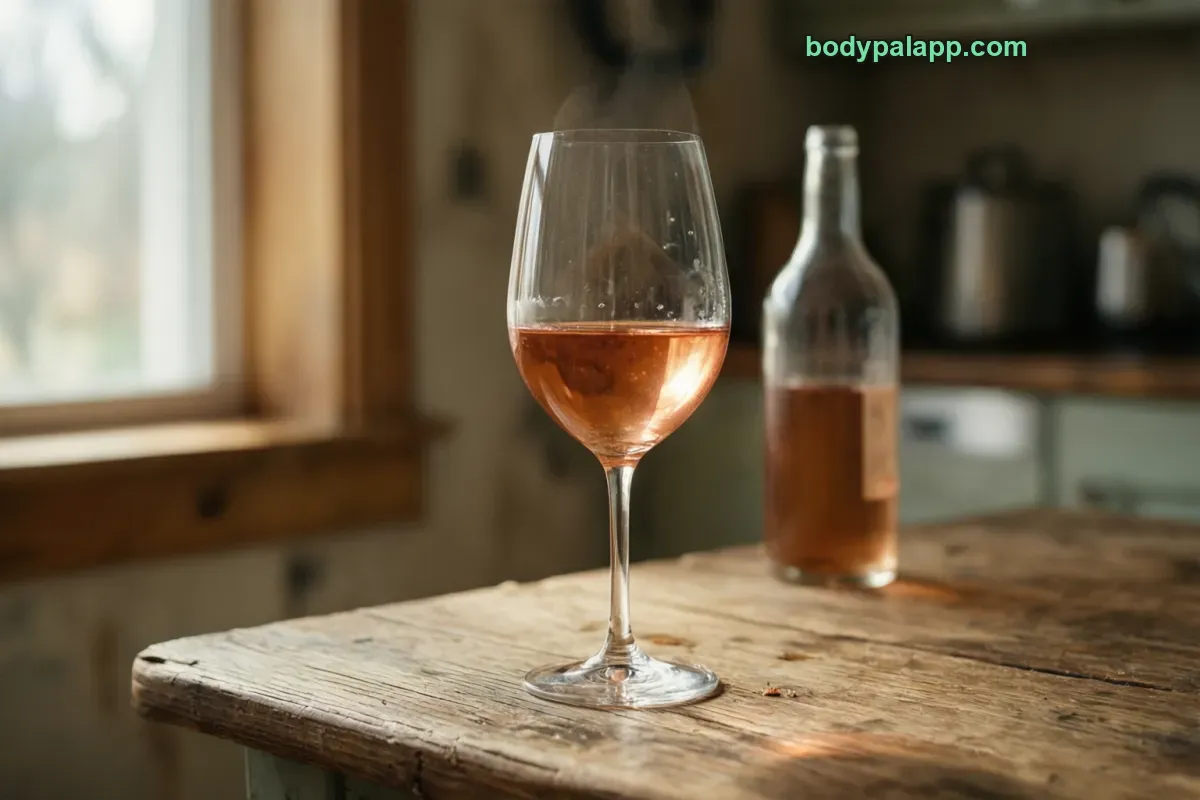
Rose wine calories come to 149 for a 180 g glass and 83 per 100 g. The number to notice is the pour: a measured 5 oz glass of 142 g has 118 calories, so the size of your glass moves the total more than the bottle you pick. Almost none of it comes from fat or protein.
149kcal
1 glass · 180 g, table wine
9%protein
0.6 gProtein
7 gCarbs
0 gFat
How to burn off 149 kcal
—Walking, brisk
—Jogging
—Cycling, moderate
—Swimming
Skip the math. BodyPal counts these calories from your steps and workouts automatically.
Nutrition facts
Table wine · per 180 g
Calories
149 kcal
Protein
0.6 g
Carbohydrate
6.8 g
Fat
0 g
Saturated fat
0 g
Cholesterol
0 mg
Sodium
9 mg
Potassium
106 mg
Iron
0.4 mg
Source: USDA FoodData Central
🛡️
Verified nutrition data
Numbers on this page come from USDA FoodData Central, the U.S. Department of Agriculture’s food composition database, and from manufacturer labels where a branded product is named. Last verified September 2026. How we verify our data →
Rose wine: calories, protein and sodium by serving
Percent of daily value uses the FDA reference of 2,000 kcal a day.
Serving
kcal
Protein
Carbs
Fat
Sodium
% DV kcal
1 glass (180 g)
149
0.6 g
6.8 g
0 g
9 mg
7%
5 oz pour (142 g)
118
0.5 g
5.4 g
0 g
7 mg
6%
Half bottle (375 g)
311
1.4 g
14.3 g
0 g
19 mg
16%
100 g
83
0.4 g
3.8 g
0 g
5 mg
4%
3 × 1 glass (180 g)
448
1.9 g
27 mg
5 × 1 glass (180 g)
747
3.2 g
45 mg
Your pour size sets the total
The 149 figure assumes a 180 g glass, which is a generous pour. A measured 5 oz pour weighs 142 g and lands at 118 calories, or 6% of a 2000-calorie daily value. That difference is the easiest one to control, because it comes from the bottle and your wrist, not from the wine.
Refills add up in a straight line. Two large glasses bring 299 calories, three bring 448, and five glasses, 900 g of wine, reach 747. A half bottle of 375 g carries 311 calories, which is 16% of the daily value and roughly what two big glasses deliver. Each extra large glass is another 149 calories, exactly like the first.
If you track intake, measure your usual pour once at home and note the weight. A wide bowl can make 180 g look modest, so the eye is a poor scale. Once you know your real glass, every later entry gets simpler, and a smaller glass becomes the low-effort fix.
Alcohol, not sugar, carries most of the calories
The calorie split for rose reads 91% carbs and 9% protein, with 0 from fat. That split counts only the macros on the label, and the grams behind it are small: 3.8 g of carbs and 0.4 g of protein per 100 g.
Those grams cannot explain 83 calories on their own. Most of the energy comes from the alcohol itself, which nutrition tables do not list as a macro. A rose that tastes dry is not automatically a light one, because its calories sit mostly in the alcohol rather than in the sugar.
Protein is a rounding error at 0.6 g per glass, 1% of the daily value. Fat is 0. Rose supplies energy with almost nothing that keeps you full, which is why the food next to the glass matters more than the wine itself. Count the drink as its own line in your log, not as part of the meal's protein or carbs.
Sugar is the only label row that moves
Every carb in rose shows up as sugar: 3.8 g per 100 g, which means 6.8 g in a 180 g glass and 5.4 g in a 5 oz pour. A half bottle brings 14.3 g. These figures describe a standard table rose, so a bottle sold as sweet may read differently.
Sodium is close to nothing. A glass has 9 mg, which rounds to 0% of the daily value, and even a half bottle reaches only 19 mg, or 1%. Five large glasses still total just 45 mg. Potassium is modest too, at 59 mg per 100 g.
Cholesterol, fiber and saturated fat all read 0. If you watch sugar, rose is worth counting, since the grams climb with every refill even when the wine tastes dry. If you watch sodium, the glass adds almost nothing; the salt sits on the snack plate beside it.
Treat the glass as part of the meal
One large glass uses 7% of a 2000-calorie day and returns almost no protein and no fiber. That makes it a pure add-on: it does not replace anything on the plate, so it helps to decide ahead of time where it fits.
Pair it with food that does the filling work, such as grilled fish, a bean salad or roasted vegetables, and keep cheese or chips to a measured portion. If you plan for two glasses, count the 299 calories when you build the plate rather than after dinner. That way the wine is part of the budget instead of a surprise on top of it.
Alternating each glass with water slows the pace and keeps the refill count honest. Pouring for yourself at the table, instead of letting someone top you up, does the same job. To log the drink without a measuring cup, snap a photo of the glass and BodyPal can log it from the picture.
How does rose wine compare?
Here is how rose stacks up against white wine, Chardonnay and pinot gris, per 100 g and per usual serving.
Verdict: Per 100 g these wines sit within a couple of calories of each other, from 82 for white wine to 84 for Chardonnay, so the bigger serving number on rose comes from its larger default glass, not a richer wine. For the fewest calories pour any of them into a 147 g glass; for the fewest carbs, pinot gris edges ahead at 2.1 g per 100 g.
Rose wine FAQs
How many calories are in a glass of rose wine?
A 180 g glass is 149 calories. A smaller 5 oz pour (142 g) is 118 calories.
Is rose wine good for weight loss?
A glass carries 149 calories and 6.8 g of carbs, all of it sugar. Two glasses take up about 298 calories of a day's total.
Rose wine vs white wine: which has fewer calories?
White wine has 82 calories per 100 g and rose 83, so a 180 g glass is 148 calories versus 149. The difference is about one calorie.
How much sugar is in rose wine?
Rose wine has 3.8 g of sugar per 100 g, so a 180 g glass holds about 6.8 g. It has 0.36 g of protein per 100 g and no fat.
Is rose wine fattening?
A 180 g glass of rose has 149 calories and 0 g of fat, so one glass is a modest entry. The total grows with refills: three glasses come to 448 calories and five reach 747.
What are the nutrition facts for rose wine?
Per 100 g, rose wine has 83 calories, 3.8 g of carbs, all of it sugar, 0.4 g of protein, 0 g of fat, 5 mg of sodium and 59 mg of potassium. Fiber and cholesterol both read 0.
How many calories are in a 5 oz pour of rose?
A 5 oz pour of rose, 142 g, has 118 calories and 5.4 g of sugar. That is 6% of a 2000-calorie daily value, compared with 149 calories for a larger 180 g glass.
How many calories are in a half bottle of rose?
A half bottle of rose, 375 g, has 311 calories, 16% of the daily value, plus 14.3 g of sugar and 19 mg of sodium. Split between two people, each share lands near one large glass.
How many calories are in two glasses of rose?
Two 180 g glasses of rose add up to 299 calories, with 18 mg of sodium and 1.3 g of protein. A third glass takes the total to 448 calories.