White wine calories come to 121 for a 147 g glass and 82 per 100 g. Very little of that is sugar: a glass holds just 1.4 g of sugars and 3.8 g of carbs, so alcohol supplies most of the energy. Pour size and refills move your total far more than the choice of grape.
121kcal
1 5 fl oz glass · 147 g, table wine
3%protein
0.1 gProtein
4 gCarbs
0 gFat
How to burn off 121 kcal
—Walking, brisk
—Jogging
—Cycling, moderate
—Swimming
Skip the math. BodyPal counts these calories from your steps and workouts automatically.
Nutrition facts
Table wine · per 147 g
Calories
121 kcal
Protein
0.1 g
Carbohydrate
3.8 g
Fat
0 g
Saturated fat
0 g
Cholesterol
0 mg
Sodium
7 mg
Potassium
104 mg
Iron
0.4 mg
Source: USDA FoodData Central
🛡️
Verified nutrition data
Numbers on this page come from USDA FoodData Central, the U.S. Department of Agriculture’s food composition database, and from manufacturer labels where a branded product is named. Last verified September 2026. How we verify our data →
White wine: calories, protein and sodium by serving
Percent of daily value uses the FDA reference of 2,000 kcal a day.
Serving
kcal
Protein
Carbs
Fat
Sodium
% DV kcal
1 glass (147 g)
121
0.1 g
3.8 g
0 g
7 mg
6%
Large pour (180 g)
148
0.1 g
4.7 g
0 g
9 mg
7%
Half bottle (375 g)
308
0.3 g
9.8 g
0 g
19 mg
15%
100 g
82
0.1 g
2.6 g
0 g
5 mg
4%
3 × 1 glass (147 g)
362
0.3 g
22 mg
5 × 1 glass (147 g)
603
0.5 g
37 mg
A glass is 121 calories, a large pour is 148
The standard serving here is a 147 g glass, close to a 5 fl oz pour, and it lands at 121 calories. That is 6 percent of the daily calorie value used on this page. Restaurant and home pours often run bigger. A 180 g large pour comes to 148 calories, or 7 percent of the daily value, and almost nobody counts it as more than one glass.
Refills add up in a straight line. Two glasses (294 g) total 241 calories, three glasses (441 g) reach 362, and five glasses, 735 g of wine, hit 603. A half bottle of 375 g sits at 308 calories, which is 15 percent of the daily value from a drink alone.
If you track, log the pour you actually drink, not the idea of a glass. The gap between a 147 g glass and a 180 g pour looks small on one evening, but repeated across a week of dinners it becomes the biggest variable in the count. Weighing a pour once, or snapping a photo so BodyPal can log it, tells you which size lands in your glass.
Alcohol, not sugar, carries most of the calories
The calorie split for white wine reads 97 percent carbs, 3 percent protein and 0 percent fat. Read that with care. Per 100 g the label lists only 2.6 g of carbs, 0.1 g of protein and 0 g of fat, and those grams cannot add up to 82 calories on their own. Most of the energy comes from the alcohol, which has no row of its own in a standard macro table.
Sugars are just 1 g per 100 g and 1.4 g per glass. So the worry about sugar in wine misses the point for a table white: the residual sugar is small, and the alcohol is what sets the count. Cutting sweetness does little; cutting volume does a lot.
Protein and fat are effectively absent, at 0.1 g of protein and 0 g of fat per glass. A glass adds energy without the protein or fat that make a meal feel substantial, which is why it works better alongside food than in place of it.
Sodium and sugar barely register
If you watch sodium, white wine is not where it hides. A 147 g glass holds 7 mg, which rounds to 0 percent of the 2300 mg daily value. Even a half bottle stops at 19 mg, or 1 percent. Salt in the food on the table will matter far more than anything in the glass.
Sugar tells a similar story. One glass lists 1.4 g of sugars, a large pour 1.7 g and a half bottle 3.6 g. Those are small figures for a drink. Sweet dessert styles are a different product, and this table wine row does not describe them.
The rest of the label is mostly zeros: 0 g of saturated fat, 0 mg of cholesterol and 0 g of fiber. Potassium reaches 71 mg per 100 g, a minor contribution next to the 4700 mg daily value. For most people tracking their intake, calories are the only line on a white wine label that changes the day's totals in a meaningful way.
Budget wine like a snack, not a free drink
A glass of white wine brings almost no protein, fiber or fat, so its 121 calories land on top of whatever you eat rather than replacing part of it. Two glasses at 241 calories are snack-sized in energy. Three at 362 add up to a small meal's worth without any food on the plate.
The simplest system is to decide on a number of glasses before the bottle opens and log each one as you pour. If you prefer a large pour of 180 g, count it at 148 calories rather than as a standard glass, because that difference repeats every time you refill.
Pair the glass with a plate that does the filling: lean protein, vegetables and a measured portion of starch. That way the wine is the extra you planned for, not the reason dinner ran long on calories.
How does white wine compare?
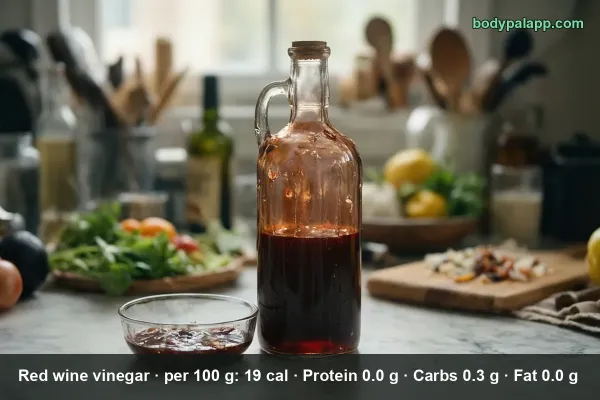
Here is white wine next to red wine, wine in general and red wine vinegar, compared per 100 g and per usual serving.
Verdict: Pick your wine by taste, not by count: white at 121 calories per glass and red at 125 are effectively tied, and generic wine at 123 sits between them. If you want wine flavor in cooking for the fewest calories, red wine vinegar at 19 per 100 g beats any pour.
White wine FAQs
How many calories are in a glass of white wine?
A standard 5 fl oz glass (147 g) has about 121 calories. Per 100 g, white wine is 82 calories.
Is white wine good for weight loss?
One 5 fl oz glass adds 121 calories and two glasses 242, with 0 g of fat and only 0.1 g of protein per glass.
White wine vs red wine: which has fewer calories?
White wine has 82 calories per 100 g and red wine 85, so a 5 fl oz glass is 121 calories against 125 for red.
How many carbs are in white wine?
A 5 fl oz glass (147 g) has 3.8 g of carbs, of which 1.4 g is sugar. Per 100 g that is 2.6 g of carbs and 0.96 g of sugar.
How many calories are in a bottle of white wine?
A half bottle of white wine (375 g) has 308 calories. Five standard 147 g glasses, 735 g in total and close to a full bottle, come to 603 calories, so the number of glasses matters far more than the label.
How many calories are in two glasses of white wine?
Two 147 g glasses of white wine total 241 calories, from 294 g of wine. Add a third glass and the total reaches 362 calories, so each refill adds roughly another 121.
How many kcal does white wine have per 100 g?
White wine has 82 kcal per 100 g, with 2.6 g of carbs, 1 g of sugars, 0.1 g of protein and 0 g of fat. Most of that energy comes from the alcohol rather than the listed macros.
What is the nutrition breakdown of a glass of white wine?
A 147 g glass of white wine provides 121 calories, 3.8 g of carbs, 1.4 g of sugars, 0.1 g of protein and 7 mg of sodium. Fat, fiber and cholesterol are all 0.