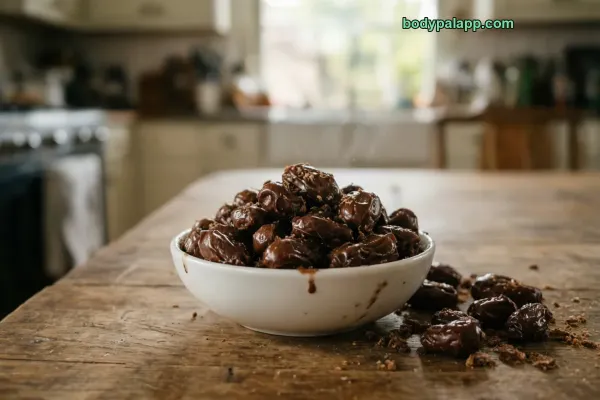
Yogurt covered raisins calories come to 170 for a 40 g serving of about 34 pieces, and 425 per 100 g. The number to notice is where those calories come from: the coating adds a lot of fat, most of it saturated, and each serving carries 25 g of sugars. Protein barely registers.
170kcal
1 serving of 34 pieces · 40 g, packaged, per label
2%protein
1 gProtein
28 gCarbs
7 gFat
How to burn off 170 kcal
—Walking, brisk
—Jogging
—Cycling, moderate
—Swimming
Skip the math. BodyPal counts these calories from your steps and workouts automatically.
Nutrition facts
Packaged, per label · per 40 g
Calories
170 kcal
Protein
1 g
Carbohydrate
28 g
Fat
7 g
Saturated fat
6 g
Cholesterol
0 mg
Sodium
15 mg
Source: USDA FoodData Central
🛡️
Verified nutrition data
Numbers on this page come from USDA FoodData Central, the U.S. Department of Agriculture’s food composition database, and from manufacturer labels where a branded product is named. Last verified September 2026. How we verify our data →
Yogurt covered raisins: calories, protein and sodium by serving
Percent of daily value uses the FDA reference of 2,000 kcal a day.
Serving
kcal
Protein
Carbs
Fat
Sodium
% DV kcal
34 pieces (40 g)
170
1 g
28 g
7 g
15 mg
9%
1/4 cup (30 g)
130
1 g
22 g
6 g
20 mg
6%
100 g
425
2.5 g
70 g
17.5 g
38 mg
21%
3 × 34 pieces (40 g)
510
3 g
46 mg
5 × 34 pieces (40 g)
850
5 g
76 mg
One serving is 170 calories, a bag can reach 850
The label serving is 34 pieces, or 40 g, for 170 calories. That covers 9% of the daily calorie value. A quarter cup weighs a little less, 30 g, and lands at 130 calories, which makes it the easier measure if you scoop with a cup instead of counting pieces.
Totals climb quickly because the pieces are small and easy to eat without looking. Two servings (80 g) reach 340 calories, three servings (120 g) come to 510, and five servings, or 200 g, hit 850. A bag eaten on the couch can drift into that last range before you notice. Protein barely moves along the way: even 200 g gives only 5 g.
The fix is mechanical, not willpower. Pour one serving into a bowl and close the bag. Counting out 34 pieces once shows you what 40 g looks like, and after that your eyeball estimate gets much closer to the label.
Carbs and fat split the calories, protein is a rounding error
Per 100 g, yogurt covered raisins carry 70 g of carbohydrate, 17.5 g of fat and 2.5 g of protein. In calorie terms that works out to 63% carbs, 35% fat and 2% protein. The raisin supplies most of the carbs; the coating supplies nearly all of the fat.
The name suggests a cup of yogurt, but the coating behaves more like candy. It adds fat and sugar rather than protein, which is why fat reaches 35% of the calories in what looks like a fruit snack. Think of the product as a confection with a raisin in the middle.
Fiber is modest too: 2.5 g per 100 g, or 1 g in a 40 g serving, the same as the protein. With so little of either, there is not much in each handful to slow you down. That is exactly why the portion habits above matter more here than with most snacks.
Saturated fat and sugar are the rows to watch
Of the 17.5 g of fat in 100 g, 15 g is saturated. The daily value for saturated fat is 20 g, so a 100 g portion uses most of it on its own. Even two servings, 80 g, put a real dent in that allowance. If you track saturated fat, this is the number that should set your portion.
Sugar is the other heavy row. A 40 g serving holds 25 g of sugars and a quarter cup holds 19 g. Per 100 g the figure is 62.5 g, so well over half the weight of the snack is sugar. Nearly all of the carbohydrate on the label is sugar rather than starch or fiber.
Sodium, by contrast, is a non-issue. A serving has 15 mg, just 1% of the daily value, and even 100 g stays at 38 mg. Cholesterol is listed at 0. The trade-off is clear: this snack is easy on salt and hard on sugar and saturated fat.
Treat them as dessert, not a fruit serving
Because the calories lean on sugar and saturated fat, yogurt covered raisins fit a day best in the slot you would give a cookie or a few squares of chocolate. Planned that way, one 170-calorie serving is a reasonable sweet finish. Counted as fruit, it quietly adds more than you expect.
If you like them in trail mix, let them be the minority ingredient next to nuts, seeds or plain cereal, so a handful is not mostly coating. Pairing them with plain yogurt or cottage cheese adds the protein the raisins lack, since a serving offers just 1 g. A few pieces scattered over oatmeal also go further than a loose handful.
Varieties differ. Sun-Maid sells vanilla, chocolate and mixed versions, and Good & Gather makes a Greek-style coating, so check the label on the bag you actually buy, because the numbers here come from one packaged product. If counting pieces is a chore, BodyPal can log the bowl from a photo.
How does yogurt covered raisins compare?
Here is how yogurt covered raisins stack up against chocolate covered raisins, chocolate raisins and chocolate covered banana, per 100 g and per usual serving.
Verdict: Swapping yogurt for chocolate saves almost nothing: chocolate covered raisins sit at 422 calories per 100 g against 425 here, while chocolate raisins come in at 390 with more protein, 4.1 g. If you want the lightest coated fruit, pick chocolate covered banana at 213 per 100 g, about half the calorie density.
Most popular yogurt covered raisins brands in the United States
How many calories are in a serving of yogurt covered raisins?
A 40 g serving (about 34 pieces) has 170 calories. A quarter cup (30 g) has about 130.
Are yogurt covered raisins good for weight loss?
They are calorie dense at 425 calories per 100 g, compared with 299 for plain dark raisins. The coating adds 17.5 g of fat per 100 g.
Yogurt covered raisins vs chocolate covered raisins: which has fewer calories?
Per 100 g, yogurt covered raisins have 425 calories and chocolate-covered raisins have 390.
How much sugar is in yogurt covered raisins?
About 25 g of sugar per 40 g serving, or 62.5 g per 100 g. The same serving has 1 g of protein.
How many calories are in a quarter cup of yogurt covered raisins?
A quarter cup (30 g) of yogurt covered raisins has 130 calories, with 6 g of fat, 22 g of carbs and 19 g of sugars. That is lighter than the 40 g label serving, which has 170 calories.
How much saturated fat is in yogurt covered raisins?
Yogurt covered raisins have 15 g of saturated fat per 100 g, out of 17.5 g of total fat. The daily value for saturated fat is 20 g, so a large portion uses up most of it.
How many yogurt covered raisins are in a serving?
A serving is about 34 pieces, weighing 40 g and supplying 170 calories. Counting them out once is the easiest way to learn what a real portion looks like before you pour straight from the bag.
Do yogurt covered raisins have much protein?
No. A 40 g serving has 1 g of protein, and protein supplies only 2% of the calories. Even 200 g, five servings and 850 calories, gives just 5 g of protein.
How many calories are in 100 g of yogurt covered raisins?
100 g of yogurt covered raisins has 425 calories, which is 21% of the daily value. It also carries 62.5 g of sugars and 17.5 g of fat, so a 100 g portion is a sizable treat.