
How Many Calories in Raspberries?
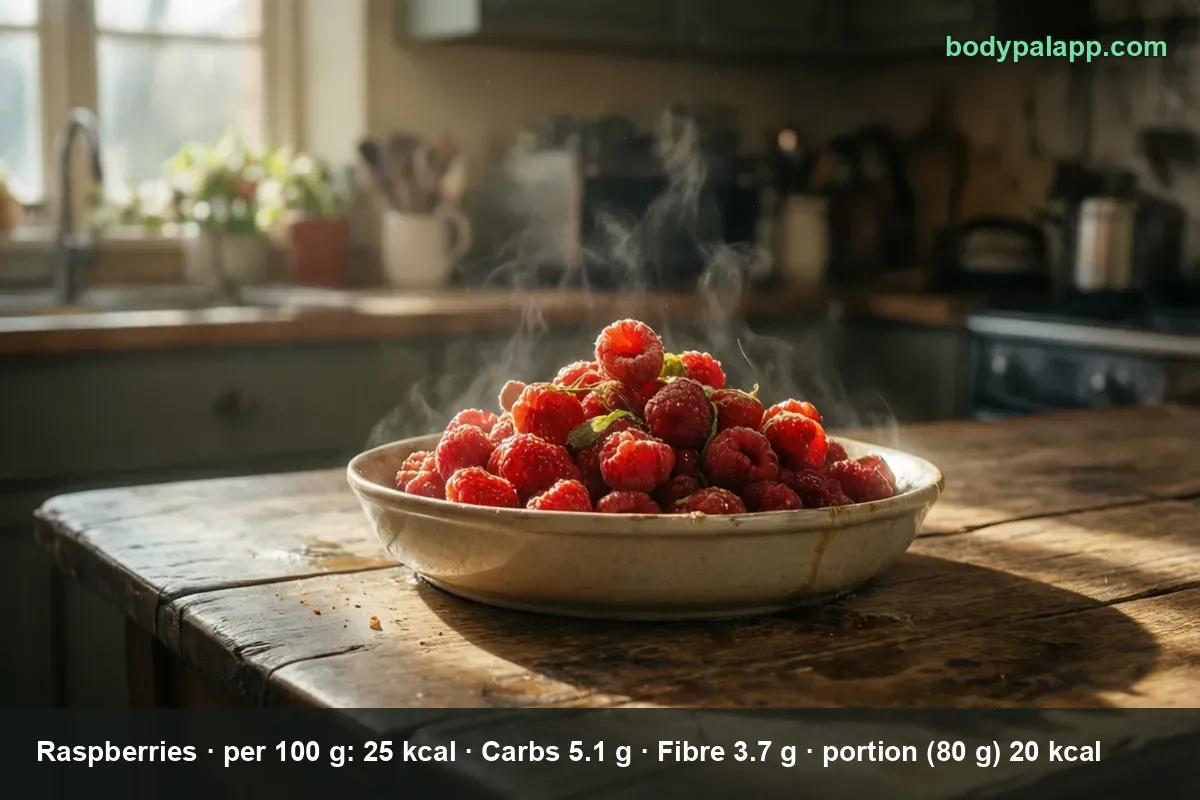
An 80 g portion of raspberries is 20 calories, and 100 g is 25. A full 150 g punnet comes to 38. Nothing common in the fruit aisle is lighter, and nothing else gives you 3.7 g of fibre per 100 g at that price.
On this page
- Raspberry quick facts
- The cheapest fibre in the supermarket
- A handful, a punnet, a whole box
- Stewed, with and without sugar
- Frozen raspberries are the same raspberries
- Raspberries against the other berries
- Popular raspberry products
- FAQ
Raspberry quick facts
Raw raspberries. The middle column is an 80 g portion, the standard UK measure for one of your five a day.
| Nutrient | Per 100 g | Portion (80 g) | RI%* |
|---|---|---|---|
| Energy | 25 kcal / 105 kJ | 20 kcal / 84 kJ | 1% |
| Protein | 0.8 g | 0.6 g | 1% |
| Carbohydrates | 5.1 g | 4.1 g | 2% |
| – of which sugars | 5.1 g | 4.1 g | 5% |
| Fat | 0.3 g | 0.2 g | <1% |
| – of which saturates | 0.1 g | 0.1 g | <1% |
| Fibre | 3.7 g | 3.0 g | – |
| Salt | Trace | Trace | <1% |
*RI% = an 80 g portion's share of an adult's daily reference intake, based on 2,000 kcal. Fibre has no reference intake figure on labels.
Verified nutrition data
Numbers on this page come from CoFID, the UK government’s Composition of Foods Integrated Dataset, and from manufacturer labels where a branded product is named. Last verified September 2026. How we verify our data →
One portion is 1% of a day's energy. There is not much else on a supermarket shelf where the energy row rounds down that far.
The cheapest fibre in the supermarket
Raspberries carry 3.7 g of fibre per 100 g. That is the highest figure among the everyday fruits, above pears and above apples, and it comes attached to only 25 calories.
Put the two numbers together and an 80 g portion gives you 3 g of fibre for 20 calories. The NHS target for fibre is 30 g a day, and most adults in the UK fall well short of it. One small bowl of raspberries covers a tenth of that for a rounding error in a calorie diary.
For scale, wholemeal bread runs at 7.0 g of fibre per 100 g. Raspberries reach more than half of that, and they do it as a fruit rather than as a food you have to budget for.
The fibre is structural. A raspberry is not one berry but a cluster of tiny drupelets, each with its own skin and its own seed, packed around a hollow core. All those skins and seeds are what shows up in the fibre column, and it is also why the fruit collapses the moment you press it.
A handful, a punnet, a whole box
- A small handful (40 g): 10 kcal
- An 80 g portion, one of your five a day: 20 kcal
- A 150 g punnet: 38 kcal
- Two punnets across a day (300 g): 75 kcal
The 80 g line is the one the NHS 5 A Day guidance uses for a portion of fruit, and for raspberries it is a genuinely small handful.
A whole punnet in one sitting is 38 calories and 5.6 g of fibre. That is the number worth carrying around, because a punnet is the unit people actually eat, and almost nobody bothers to weigh out 80 g of a fruit this light.
Even the greedy version stays small. Three hundred grams of raspberries, which is a serious amount of fruit spread over a morning, is 75 kcal and 11 g of fibre, still barely visible against a 2,000 kcal day.
Where the total moves is the company they keep. Raspberries turn up on granola, in cream, under a crumble topping. The berries are never the expensive part of that plate.
Stewed, with and without sugar
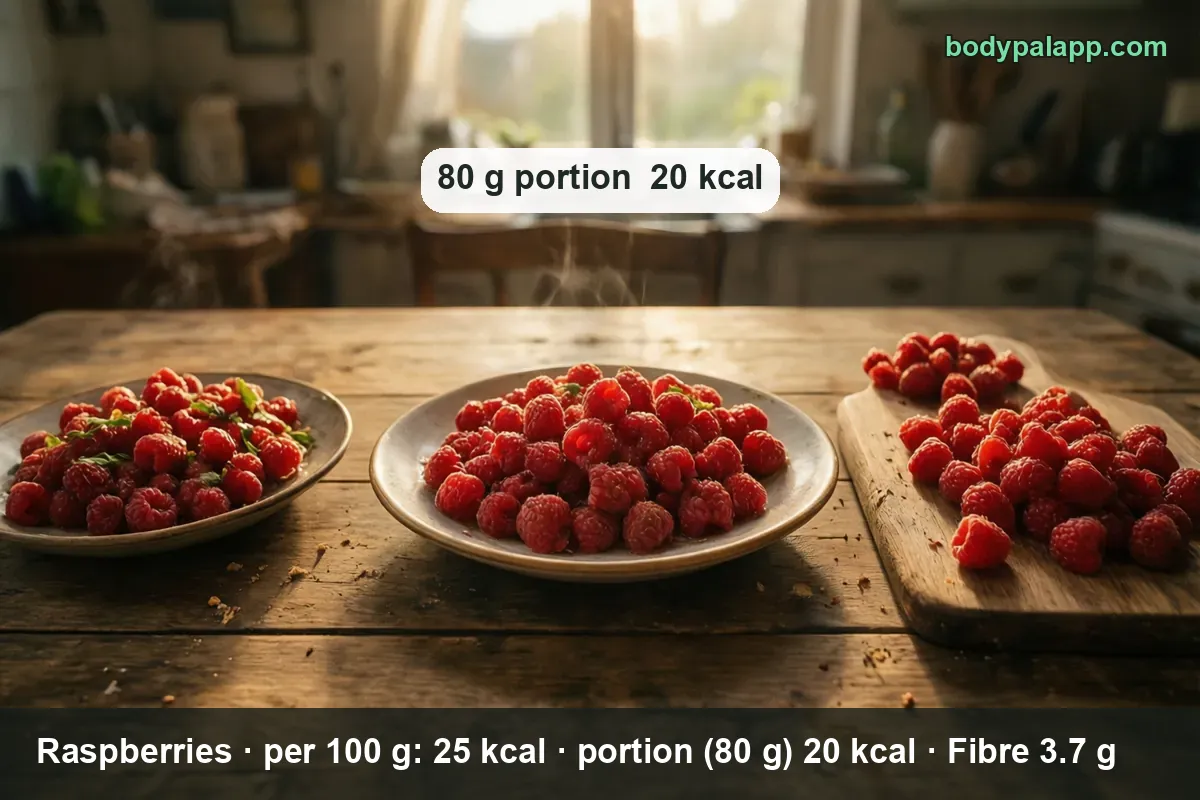
Stewing raspberries changes the figure only if sugar goes in the pan.
| Per 100 g | Energy | Protein | Carbohydrates |
|---|---|---|---|
| Raw | 25 kcal / 105 kJ | 0.8 g | 5.1 g |
| Stewed without sugar | 24 kcal / 100 kJ | 1.4 g | 4.4 g |
| Stewed with sugar | 63 kcal / 264 kJ | – | 15.0 g |
Stewed without sugar is 24 kcal per 100 g, effectively unchanged from raw. Some water cooks off, which is why the protein figure edges up to 1.4 g while the carbohydrate drops slightly to 4.4 g. Nothing has been added and nothing has been lost.
Stewed with sugar is 63 kcal per 100 g, two and a half times the raw figure. Carbohydrate goes from 5.1 g to 15.0 g, and the extra 10 g per 100 g is sugar out of the bag. A 150 g bowl of the sweetened version is 95 kcal against 36 for the unsweetened.
Raspberries are tart enough that the sugar feels necessary. It is worth knowing that it triples the cost of the bowl, and that adding it after tasting, rather than before cooking, usually means less of it.
Frozen raspberries are the same raspberries
Frozen raspberries carry the same calorie, sugar and fibre figures as fresh ones. Freezing does not remove energy and it does not remove fibre.
This matters more for raspberries than for most fruit, because fresh ones are the fastest thing in the punnet to go over. A frozen bag keeps for months, costs less per kilo, and logs identically at 25 kcal per 100 g.
The texture is the only real difference. Thawed raspberries go soft and release juice, which is fine in porridge, yogurt, a smoothie or a compote, and no good at all scattered on a pavlova. Check the bag for added sugar before you assume the numbers hold: plain frozen raspberries match the raw figures, sweetened ones will not.
Raspberries against the other berries
| Fruit | Per 100 g | Per 80 g portion |
|---|---|---|
| Raspberries | 25 kcal | 20 kcal |
| Strawberries | 30 kcal | 24 kcal |
| Blueberries | 40 kcal | 32 kcal |
| Cherries | 63 kcal | – |
| Grapes | 65 kcal | 52 kcal |
Raspberries win the table outright, and the spread across it is wider than it looks. Grapes are 160% denser per 100 g, and cherries are not far behind, because both are built to be sweet and neither carries the skins and seeds that bulk out a raspberry.
The verdict, if you want the largest bowl for the fewest calories, is raspberries, and it is not close: 150 g of raspberries is 38 kcal while 150 g of grapes is 98. If you want fruit that survives in a lunchbox and does not turn to mush by eleven o'clock, blueberries are worth the extra 12 calories per portion. Strawberries sit between the two on both counts.
Popular raspberry products in the BodyPal food database
Ranked by how widely each product appears among foods sold in the United Kingdom, from the BodyPal food database of over 3.3 million products. Calories are the figures printed on each label.
| Product | Calories (per 100 g) |
|---|---|
| Raspberries (Tesco) | 35 kcal |
| Frozen Raspberries (Sainsbury's) | 40 kcal |
| Frozen Raspberries (Essential Waitrose) | 40 kcal |
| Raspberries (Oaklands) | 25 kcal |
Brand popularity: BodyPal food database. Nutrition: manufacturer labels.
Raspberry FAQs
How many calories in raspberries?
25 kcal per 100 g of raw raspberries, based on UK government composition data. An 80 g portion is 20 kcal and a standard 150 g punnet is 38 kcal, which makes them the lightest of the common berries.
How many calories in a punnet of raspberries?
38 kcal for a 150 g punnet. The same punnet carries 5.6 g of fibre and 7.7 g of sugars, so a whole box eaten in one go is still under 2% of a 2,000 kcal day.
How much fibre is in raspberries?
3.7 g per 100 g, or 3 g in an 80 g portion, which covers a tenth of the 30 g a day the NHS recommends. It is the highest fibre figure among the everyday fruits, and it costs 20 calories.
Do frozen raspberries have the same calories?
Yes. Plain frozen raspberries match the raw figures at 25 kcal per 100 g, with the same sugar and fibre. Freezing changes the texture, not the nutrition. Check the bag, as sweetened frozen fruit will read higher.
How many calories in stewed raspberries?
24 kcal per 100 g stewed without sugar, which is essentially the raw figure. Stewed with sugar it is 63 kcal per 100 g, as carbohydrate climbs from 5.1 g to 15.0 g.
How much sugar is in raspberries?
5.1 g per 100 g, or 4.1 g in an 80 g portion, which is 5% of the daily reference intake. All of the carbohydrate in a raspberry is sugar, and there is less of it than in any other berry on this page.
Raspberries or strawberries?
Raspberries, narrowly: 25 kcal per 100 g against 30, or 20 against 24 for an 80 g portion. The bigger gap is fibre, at 3.7 g per 100 g for raspberries, which is what makes a small bowl feel like more food.
Are raspberries good for a calorie deficit?
They are among the easiest fruits to fit into one. A 150 g punnet is 38 kcal and 5.6 g of fibre, so the bowl is large and the number stays small. What raspberries usually arrive with, cream, granola or a crumble lid, is where the calories actually sit.
Similar foods
- Melon — 19 kcal per 80 g slice
- Strawberries — 24 kcal per 80 g handful
- Peach — 45 kcal a medium fruit
- Grapefruit — 72 kcal per whole fruit
- Orange — 43 kcal per medium fruit
- Blueberries — 32 kcal per 80 g handful
Count it without the maths
Snap the bowl and BodyPal counts what went in with the raspberries as well as the raspberries.


Burning it off is one side of it. The other is knowing your number: work out how many calories you need a day, with macros and a goal date.