
How many calories are in an apple?
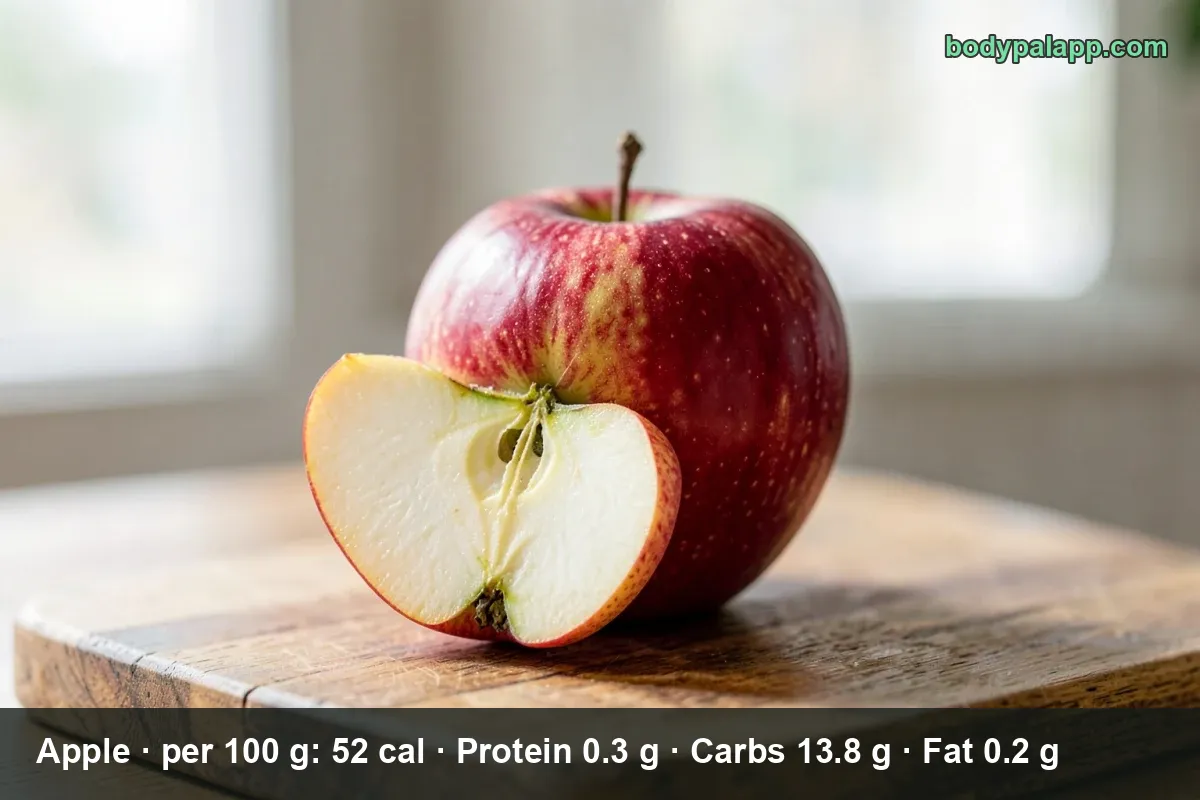
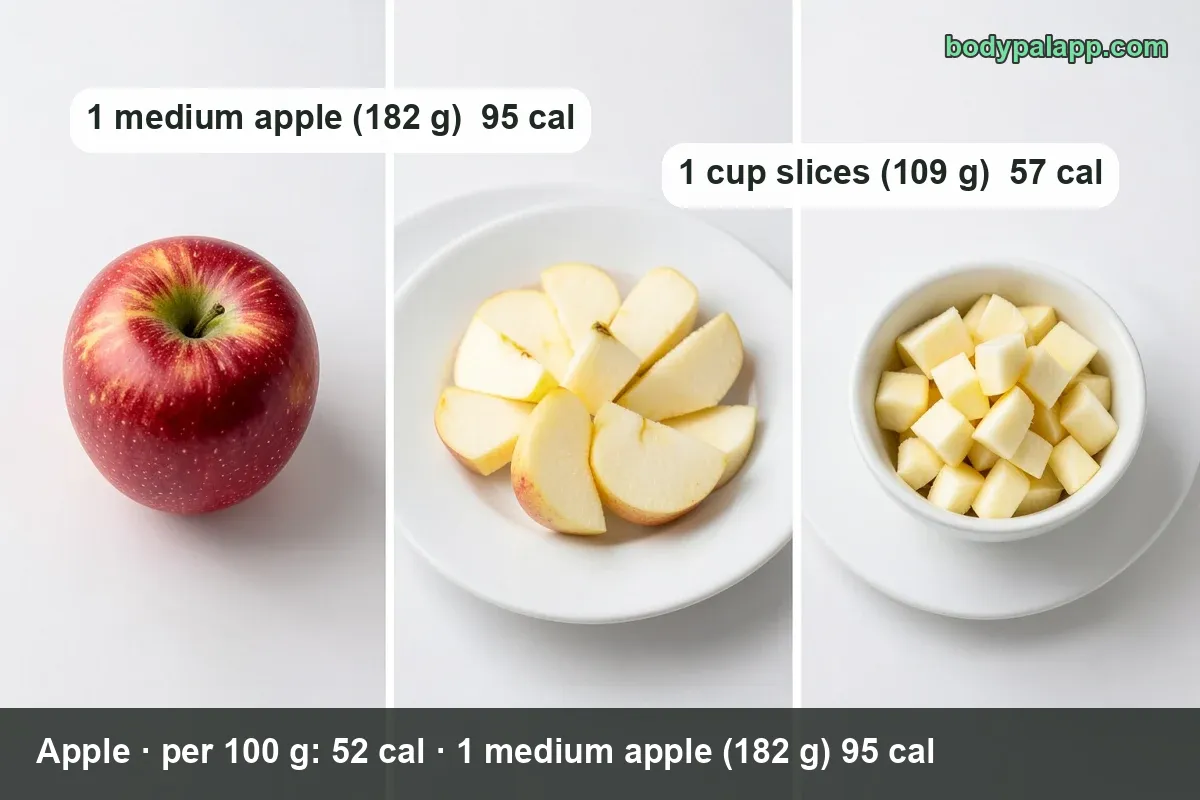
One medium apple, three inches across and 182 g on the scale, carries 95 calories. Per 100 g the raw fruit runs 52 calories, one of the lowest figures on the whole fruit shelf. Almost all of it is carbohydrate: 25.1 g in that apple, 4.4 g of which is fiber, with essentially no fat and no protein worth counting.
On this page
- Apple quick facts
- US servings, from a cup of slices to a large apple
- Gala, Fuji, Granny Smith and the peeled apple
- Dried apple is the trap
- Fiber is the row that earns the apple its keep
- How does an apple compare?
- Most popular apple brands
- FAQ
Apple quick facts
The numbers below come from SR Legacy record 171688, "Apples, raw, with skin". That is the record for the thing a person is actually holding: a whole, unpeeled, uncooked apple, no variety specified. It is also the only apple entry with a full set of household measures attached — medium, large, small and a cup of slices — which is what makes it usable for anyone logging food rather than reading a spreadsheet.
The named varieties get their own USDA rows, and they are all a little higher. Those live further down the page as variants, not as the headline, because nobody types "calories in a golden delicious" before they type "calories in an apple."
| Nutrient | Per 100 g | Per 1 medium apple (182 g) | % Daily Value |
|---|---|---|---|
| Calories | 52 | 95 | — |
| Total fat | 0.17 g | 0.3 g | 0% |
| Saturated fat | 0.03 g | 0.1 g | 0% |
| Carbohydrate | 13.81 g | 25.1 g | 9% |
| Dietary fiber | 2.4 g | 4.4 g | 16% |
| Total sugars | 10.39 g | 18.9 g | — |
| Protein | 0.26 g | 0.5 g | 1% |
| Sodium | 1 mg | 2 mg | 0% |
% Daily Value is based on a 2,000-calorie diet.
Verified nutrition data
Numbers on this page come from USDA FoodData Central, the U.S. Department of Agriculture’s food composition database, and from manufacturer labels where a branded product is named. Last verified September 2026. How we verify our data →
There is no added-sugars row here, because the SR Legacy edition does not publish added sugars for raw fruit — and a fresh apple has none by definition. Cholesterol is zero, as it is in every plant food. Potassium is the one mineral worth a line of its own: 107 mg per 100 g, so 195 mg in a medium apple, or 4% of the FDA Daily Value of 4,700 mg. Respectable, but an apple is not the potassium fix some people think it is.
US servings, from a cup of slices to a large apple
| Serving | Weight | Calories |
|---|---|---|
| 1 oz raw | 28 g | 15 kcal |
| 1 cup slices | 109 g | 57 kcal |
| One small apple, 2-3/4" dia | 149 g | 78 kcal |
| One medium apple, 3" dia | 182 g | 95 kcal |
| One large apple, 3-1/4" dia | 223 g | 116 kcal |
| Per 100 g | 100 g | 52 kcal |
Four of those are USDA household measures straight off record 171688: the three diameters and the cup of slices. The 1 oz line is our own arithmetic from the USDA 100 g figure, not a USDA serving, and it exists mainly so you can price a couple of slices dropped into oatmeal.
The spread across the three sizes is 38 calories, small enough that guessing "medium" when you actually grabbed a large costs you about the same as a single walnut. The cup of slices is the more useful measure anyway. One cup is 109 g, a little over half an apple, and it is the only apple portion most people can measure without a scale.
Gala, Fuji, Granny Smith and the peeled apple
| Version | Per 100 g | Typical piece | Calories |
|---|---|---|---|
| Raw, with skin (base record) | 52 kcal | 1 medium, 182 g | 95 kcal |
| Peeled, no skin | 48 kcal | 1 medium, 161 g | 77 kcal |
| Gala | 57 kcal | 1 medium, 172 g | 98 kcal |
| Golden Delicious | 57 kcal | 1 medium, 169 g | 96 kcal |
| Granny Smith | 58 kcal | 1 medium, 167 g | 97 kcal |
| Fuji | 63 kcal | 1 medium, 192 g | 121 kcal |
Here is the thing almost nobody logging apples knows: the variety moves the number more than the size does. A medium Fuji is 121 calories. A medium Granny Smith is 97. That is a 24-calorie gap between two things both called "one apple," and it is driven by two effects stacking — Fuji is the sweetest variety in the database at 63 calories per 100 g, and Fuji apples are physically bigger, 192 g against 167 g.
Red Delicious sits at 59 calories per 100 g. USDA does not publish a medium-fruit weight for it, so it stays out of the table rather than getting a made-up gram figure.
Peeling is the other surprise, and it goes the wrong way for anyone doing it to save calories. Peeled apple is 48 calories per 100 g against 52 with the skin — four calories, nothing. But fiber falls from 2.4 g per 100 g to 1.3 g, so a peeled medium apple gives you 2.1 g instead of 4.4 g. In Daily Value terms that is 7% instead of 16%. You give up more than half the reason to eat the apple to save about the calories in a stick of gum.
Bagged fresh apples carry a label, and the labels track the USDA numbers closely. A whole Pink Lady apple is listed at 54 calories per 100 g, so the 242 g fruit on the label comes to 131 calories — bigger than a USDA medium, which is why the number looks high. A 140 g pack of Pink Lady slices, twelve of them, is 50 calories per 100 g and 70 calories for the pack.
Dried apple is the trap
Dried apple runs 243 calories per 100 g. Fresh apple runs 52. Nothing is added in most plain dried rings — the water simply leaves, and it takes four-fifths of the weight with it.
The practical consequence: a 1 oz handful, 28 g, is about 68 calories. That is our own arithmetic from the 100 g figure rather than a USDA serving, and it is roughly three-quarters of a whole medium apple, eaten in maybe six bites with no juice, no crunch and no stretch on the stomach. An ounce of dried apple rings is a snack you finish in under a minute; a whole fresh apple takes ten. If you are choosing between them for appetite control rather than for calories, the fresh one wins on both counts.
Fiber is the row that earns the apple its keep
Strip the marketing away and the apple's real nutritional argument is one number: 4.4 g of fiber in a medium fruit, 16% of the 28 g Daily Value, for 95 calories. Very few foods deliver that ratio. Most Americans fall well short of the fiber target, and fruit is one of the easier places to close the gap — MyPlate's fruit guidance puts whole fruit ahead of juice for exactly this reason, since juicing removes the fiber the same way peeling removes part of it.
The sugar row tends to spook people: 18.9 g in a medium apple sounds like a lot next to a cookie. It is all naturally occurring sugar, arriving inside a cell structure with 4.4 g of fiber and 195 mg of potassium, which is a different proposition from the same grams in a soda. If sugar grams are what you track rather than calories, a Granny Smith is the lowest-sugar option here at 9.59 g per 100 g.
Sodium is a non-issue. Two milligrams in a medium apple is 0% of the Daily Value — less table salt than you would pick up licking a chip. If you are watching sodium, fresh fruit is free real estate.
How does an apple compare?
| Food | Per 100 g | US serving | Calories |
|---|---|---|---|
| Apple, raw with skin | 52 kcal | one medium, 182 g | 95 kcal |
| Applesauce, unsweetened | 52 kcal | 1 cup, 244 g | 127 kcal |
| Raspberries, raw | 52 kcal | 1 cup, 123 g | 64 kcal |
| Pineapple, raw | 50 kcal | 1 cup chunks, 165 g | 83 kcal |
Three of these four foods are identical per gram at 52 calories per 100 g; only pineapple is lighter, at 50. So the entire difference in the calories column comes from how much of each thing lands in a normal portion. A cup of unsweetened applesauce is 244 g of apple with the structure blended out, which is why it costs 127 calories — more than the whole apple it came from, and it will not keep you full as long.
Our take: for weight management, the whole apple is the better buy of the four, not because it is lower in calories per gram but because 182 g of it takes real time to chew and stops you at 95. If you want the smallest number on the table, a cup of raspberries at 64 calories wins outright. Save the applesauce for cooking, where it is doing a job, and keep the dried rings for hikes where the calorie density is the point.
Most popular apple brands in the United States
Ranked by how widely each product appears among foods sold in the United States, from the BodyPal food database of over 3.3 million products. Calories are the figures printed on each Nutrition Facts label, checked against USDA FoodData Central.
| Product | Calories (per 100 g) |
|---|---|
| Pink Lady Apple | 54 cal |
| Pink Lady Apple Slices | 50 cal |
Brand popularity: BodyPal food database. Nutrition: manufacturer labels / USDA FoodData Central.
Apple FAQs
How many calories are in a medium apple?
A medium apple 3 inches across weighs 182 g and holds 95 calories. That comes from the USDA's raw-with-skin record at 52 calories per 100 g. You also get 4.4 g of fiber, 18.9 g of natural sugar and 195 mg of potassium, with essentially no fat and 2 mg of sodium.
How many calories in a large apple?
A large apple, 3-1/4 inches across and 223 g, comes to 116 calories, 21 more than the 95 in a medium. A small apple, 149 g, is 78 calories. Across all three USDA sizes the spread is only 38 calories, so picking a big apple costs you less than most people assume.
How many calories in a cup of apple slices?
One cup of raw apple slices weighs 109 g and comes to 57 calories, a little more than half a medium apple. It carries 2.6 g of fiber and 11.3 g of sugar. Slicing changes nothing nutritionally; it only makes the portion easier to measure and easier to stop eating.
Does peeling an apple change the calories?
Barely. Peeled apple is 48 calories per 100 g against 52 with the skin, so a peeled medium apple of 161 g is 77 calories. The real loss is fiber: 1.3 g per 100 g instead of 2.4 g, which drops a medium apple from 16% of the Daily Value to 7%.
Which apple variety has the fewest calories?
Gala and Golden Delicious tie at 57 calories per 100 g, the lowest of the five varieties USDA lists on their own. Fuji is the heaviest at 63. Per whole fruit the order shifts, because Fuji apples are bigger: a medium Fuji is 121 calories, a medium Golden Delicious only 96.
How much fiber is in one apple?
A medium apple with the skin on has 4.4 g of fiber, 16% of the 28 g Daily Value, more than most people expect from something this sweet. Roughly half of that sits in the skin, since peeled apple drops to 1.3 g per 100 g from 2.4 g.
How much sugar is in an apple?
A medium apple holds 18.9 g of total sugars, or 10.39 g per 100 g. All of it is naturally occurring; there are no added sugars in a fresh apple, which is why the USDA record leaves that line blank. The 4.4 g of fiber comes along with it.
Are dried apples more fattening than fresh apples?
Per ounce, yes: dried apple runs 243 calories per 100 g against 52 for fresh, so a 1 oz handful is about 68 calories, roughly three-quarters of a whole medium apple in a few bites. Water is the only thing removed, but it takes the volume and the fullness with it.
Similar foods
- Mixed Berries — 78 cal per cup
- Cosmic Crisp Apple — 95 cal per medium apple
- Envy apple — 95 cal per medium apple
- Pink Lady Apple — 80 cal per medium apple
- Raspberries — 64 cal per cup
- Cutie Mandarin (Clementine) — 47 cal per Cutie
Count it without the math
Point the camera at the fruit bowl and BodyPal counts the apple for you, variety and size included.


How long does it take to burn off an apple?
One medium apple (182 g) is 95 kcal. Enter your weight and the amount you ate to see how long it takes you to burn that off:
lb
| Activity | Time to burn 95 kcal |
|---|---|
| Walking, brisk | 19 min |
| Cycling, moderate | 12 min |
| Swimming, moderate | 14 min |
| Jogging | 11 min |
| Weight training, moderate | 21 min |
Times are for a 155 lb adult at a steady pace; change the weight to see yours. The amount is set to the portion in the text (182 g); change it to what you actually ate. BodyPal works this out from your steps automatically.
Want the bigger picture? Calculate your daily calorie needs — your maintenance figure, a target for losing or gaining, and the date you get there.