
How many calories are in raspberries?
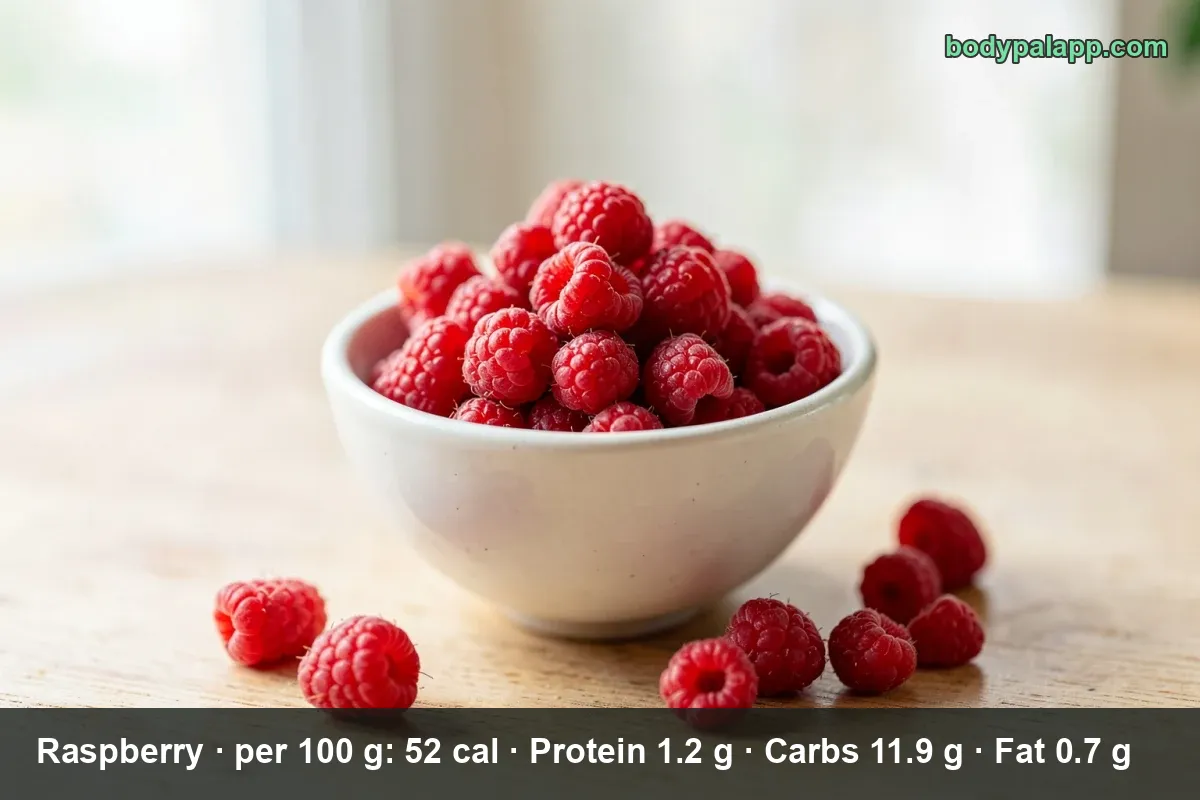
A 1-cup (123 g) serving of fresh raspberries is 64 calories, and per 100 g raspberries run 52 calories. That cup also carries 8.0 g of fiber, which is 29% of a day's worth. Frozen and canned versions move the number a lot, and the direction depends entirely on added sugar.
On this page
- Raspberry quick facts
- US servings, from ten berries to a pint
- Frozen, canned and pureed raspberries
- Fiber is the row that makes raspberries unusual
- How do raspberries compare?
- Most popular raspberry brands
- Raspberry FAQs
Raspberry quick facts
The numbers below come from SR Legacy 167755, "Raspberries, raw". It is the row for the fruit you are actually holding: a clamshell of fresh red raspberries from the produce aisle, nothing added, nothing cooked. It is also the only raw-raspberry record with a complete profile, meaning sugars, fiber and sodium all filled in, plus the US household measures people search for.
USDA carries two other raw raspberry records, and they disagree slightly with this one. The Foundation and FNDDS rows put raw raspberries at 57 calories per 100 g rather than 52, because those calories are calculated with Atwater factors and the Foundation row leaves sugars blank. Same berry, different math. If your tracking app shows 57 instead of 52, that is the reason, and neither number is wrong.
| Nutrient | Per 100 g | Per 1 cup (123 g) | % Daily Value |
|---|---|---|---|
| Calories | 52 | 64 | — |
| Total fat | 0.65 g | 0.8 g | 1% |
| Saturated fat | 0.02 g | 0.0 g | 0% |
| Carbohydrate | 11.94 g | 14.7 g | 5% |
| Dietary fiber | 6.5 g | 8.0 g | 29% |
| Total sugars | 4.42 g | 5.4 g | — |
| Protein | 1.2 g | 1.5 g | 3% |
| Sodium | 1 mg | 1 mg | 0% |
% Daily Value is based on a 2,000-calorie diet.
Verified nutrition data
Numbers on this page come from USDA FoodData Central, the U.S. Department of Agriculture’s food composition database, and from manufacturer labels where a branded product is named. Last verified September 2026. How we verify our data →
There is no added sugars row here, and no trans fat row either: the SR Legacy edition does not publish them, and raw fruit has no added sugar by definition. Cholesterol is 0 mg, as it is for every plant food. Potassium comes to 151 mg per 100 g, or 186 mg per cup, which is 4% of the Daily Value.
US servings, from ten berries to a pint
| Serving | Weight | Calories |
|---|---|---|
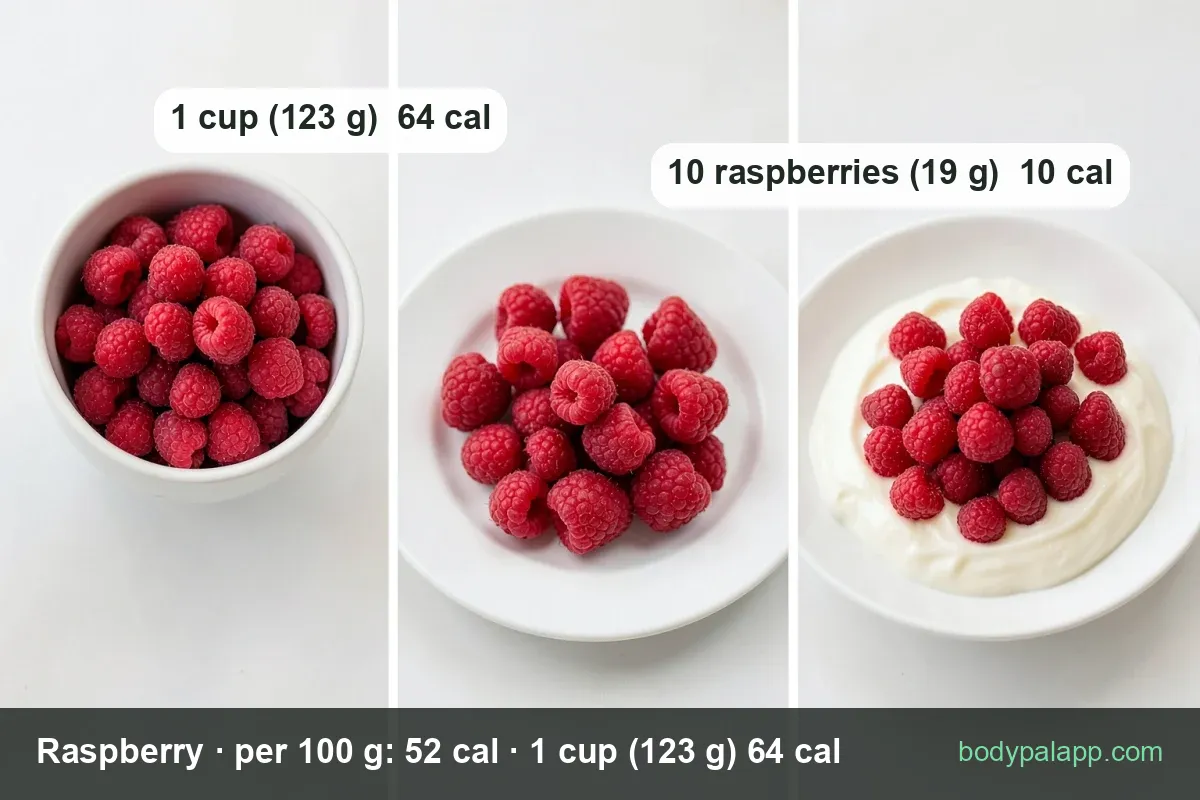
| 10 raspberries | 19 g | 10 kcal |
| 1 oz | 28.35 g | 15 kcal |
| 1/2 cup | 61.5 g | 32 kcal |
| 1 cup | 123 g | 64 kcal |
| 1 pint as purchased | 312 g | 162 kcal |
| Per 100 g | 100 g | 52 kcal |
The cup and the pint are USDA household measures for this record. The half cup and the 1 oz line are our own arithmetic from the USDA 100 g figure, not USDA servings, and the ten-berry weight is USDA's own estimate for an average berry.
The number worth staring at is the cup weight. A cup of raspberries is only 123 g, while a cup of blueberries or grapes is closer to 150 g, because raspberries are hollow domes that stack with air between them. That is why a cup of raspberries can look like a lot of fruit and still cost 64 calories. It also means volume measures are unusually forgiving here: pile the cup high and you are off by a handful of calories, not fifty.
A whole pint container, the standard clamshell, yields 312 g and 162 calories. Eating the entire thing in one sitting is a normal afternoon for a lot of people and still lands under a typical snack budget.
Frozen, canned and pureed raspberries
| Version | Per 100 g | Typical serving | Calories |
|---|---|---|---|
| Fresh, raw | 52 kcal | 1 cup (123 g) | 64 kcal |
| Frozen, unsweetened | 56 kcal | 1 cup unthawed (140 g) | 78 kcal |
| Frozen, sweetened | 103 kcal | 1 cup thawed (250 g) | 258 kcal |
| Canned in heavy syrup | 91 kcal | 1 cup (256 g) | 233 kcal |
| Puree, with seeds | 55 kcal | 1 oz (28.35 g) | 16 kcal |
| Puree, seedless | 41 kcal | 1 oz (28.35 g) | 12 kcal |
| Raw, FNDDS profile | 57 kcal | 1 cup (150 g) | 86 kcal |
Unsweetened frozen raspberries are the honest substitute. At 56 calories per 100 g they are a whisker above fresh, and the difference is water lost in freezing rather than anything added. Fiber drops to 4.3 g per 100 g and sugars rise to 6.54 g, both consequences of the same concentration effect.
Sweetened frozen raspberries are the trap in the freezer aisle. Two things stack up at once: the pack contains added sugar at 21.76 g per 100 g, and a thawed cup weighs 250 g instead of 123 g because the fruit collapses and the syrup fills the gaps. Multiply those together and one cup is 258 calories, four times the fresh cup. Canned in heavy syrup lands in the same neighborhood at 233 calories a cup.
The two purees split on seeds. With seeds, 55 calories per 100 g and 4.3 g of fiber. Strained seedless, 41 calories and just 0.9 g of fiber. Sieving out the seeds removes about four-fifths of the fiber, which is the whole nutritional point of the berry.
Store-brand plain frozen bags cluster tightly around the USDA figure. Stahlbush Island Farms, Wyman's, Wild Harvest and Great Value all label 50 calories per 100 g and 70 calories for their 140 g serving, while Best Choice and Dole list 57 and 80. Any bag whose only ingredient is raspberries will sit in that band; anything higher has sugar in it.
Fiber is the row that makes raspberries unusual
Most fruit is a calorie bargain. Raspberries are a fiber bargain, and that is a rarer thing. One cup gives 8.0 g of fiber against the FDA Daily Value of 28 g, so 29% of the daily target arrives inside 64 calories. Very little else in the produce section does that.
Put it per calorie and the ratio is striking: 8.0 g of fiber for 64 calories works out to one gram of fiber for every eight calories eaten. A whole pint pushes it further, 20.3 g of fiber for 162 calories, which is roughly three-quarters of the day's fiber from a single clamshell.
The seeds are doing that work. They are also why net carbs come out low: 14.7 g of carbohydrate minus 8.0 g of fiber leaves 6.7 g per cup by our own arithmetic from the USDA figures, which is why raspberries turn up on low-carb lists that exclude most other fruit.
Sodium is a non-issue at 1 mg per cup, effectively nothing against the 2,300 mg Daily Value. Protein is 1.5 g, which is real but not a reason to eat them. MyPlate counts a cup of raspberries as a full cup toward the fruit group, so one bowl covers a solid share of a two-cup daily fruit target.
How do raspberries compare?
| Fruit | Per 100 g | US serving | Calories |
|---|---|---|---|
| Raspberries, raw | 52 kcal | 1 oz (28.35 g) | 15 kcal |
| Apple, raw with skin | 52 kcal | 1 oz (28.35 g) | 15 kcal |
| Pineapple, canned in light syrup | 52 kcal | 1 oz (28.35 g) | 15 kcal |
| Passion-fruit juice, raw | 51 kcal | 1 oz (28.35 g) | 14 kcal |
Our take: gram for gram these four are a dead heat, three of them at exactly 52 calories per 100 g and the juice one calorie behind. Calories are not the deciding factor here, so pick on what else comes with them. Raspberries win on fiber, 6.5 g per 100 g, and on the fact that a cup of them weighs so little that a generous bowl still costs 64 calories. Passion-fruit juice is the same calorie density but goes down in seconds and leaves you hungry, and canned pineapple only matches raspberries because its syrup is the light kind. For appetite control per calorie, the berries take it.
Most popular raspberry brands in the United States
Ranked by how widely each product appears among foods sold in the United States, from the BodyPal food database of over 3.3 million products. Calories are the figures printed on each Nutrition Facts label, checked against USDA FoodData Central.
| Product | Calories (per 100 g) |
|---|---|
| Stahlbush Island Farms Red Raspberries | 50 cal |
| Wyman's Fresh Frozen Red Raspberries | 50 cal |
| Best Choice Raspberries | 57 cal |
| Wild Harvest Organic Raspberries | 50 cal |
| Dole Raspberries | 57 cal |
| Great Value Raspberries | 50 cal |
Brand popularity: BodyPal food database. Nutrition: manufacturer labels / USDA FoodData Central.
Raspberry FAQs
How many calories are in a cup of raspberries?
A cup of fresh raspberries weighs 123 g and carries 64 calories. That is the USDA household measure for record 167755, and it is the number most people want. The same cup delivers 8.0 g of fiber and 5.4 g of total sugars, with essentially no fat and 1 mg of sodium.
How many calories are in 10 raspberries?
Ten raspberries weigh about 19 g and come to 10 calories. Berry size varies, so treat it as a good working average rather than a precise count. At that weight you also get about 1.2 g of fiber. Snacking on a handful barely moves a daily calorie total.
How much fiber is in raspberries?
Raspberries carry 6.5 g of fiber per 100 g, so a 123 g cup delivers 8.0 g, or 29% of the 28 g Daily Value. Very few foods put that much fiber next to only 64 calories. The seeds are doing the work, which is why seedless puree drops to 0.9 g per 100 g.
Are frozen raspberries the same calories as fresh?
Unsweetened frozen raspberries run 56 calories per 100 g against 52 for fresh, so they are close. Sweetened frozen is a different food: 103 calories per 100 g, and a thawed cup weighing 250 g reaches 258 calories. Check the bag for added sugar before you log it as fruit.
How many carbs are in raspberries?
A cup has 14.7 g of carbohydrate, 5% of the Daily Value. Fiber accounts for 8.0 g of it, so by our own arithmetic from the USDA figures the net carbs come to 6.7 g per cup. Per 100 g the total is 11.94 g with 4.42 g of sugars.
How much sugar is in raspberries?
A cup holds 5.4 g of total sugars, and none of it is added, since USDA does not list added sugars for raw fruit. Per 100 g that is 4.42 g. Sweetened frozen raspberries carry 21.76 g per 100 g, roughly five times as much, which is where the sugar question actually matters.
How many calories in a pint of raspberries?
A pint as purchased yields 312 g of berries and 162 calories. That is the USDA weight for a pint container, and it is the whole clamshell, the kind of thing people finish over an afternoon without noticing. It also supplies 20.3 g of fiber, more than two-thirds of the daily target.
Are raspberries good for weight loss?
At 52 calories per 100 g with 6.5 g of fiber, raspberries are one of the cheapest ways to fill a bowl. A fresh cup costs 64 calories. Trading a thawed cup of sweetened frozen berries, 258 calories, for a fresh cup saves 194 calories by our own arithmetic. Volume and fiber, not magic.
Similar foods
- Apple — 95 cal per medium apple
- Mixed Berries — 78 cal per cup
- Cosmic Crisp Apple — 95 cal per medium apple
- Envy apple — 95 cal per medium apple
- Pink Lady Apple — 80 cal per medium apple
- Cutie Mandarin (Clementine) — 47 cal per Cutie
Count it without the math
Point the camera at the bowl and BodyPal counts the raspberries for you, cup or clamshell.


How long does it take to burn off raspberries?
A 1-cup (123 g) serving is 64 kcal. Enter your weight and the amount you ate to see how long it takes you to burn that off:
lb
| Activity | Time to burn 64 kcal |
|---|---|
| Walking, brisk | 13 min |
| Cycling, moderate | 8 min |
| Swimming, moderate | 9 min |
| Jogging | 8 min |
| Weight training, moderate | 14 min |
Times are for a 155 lb adult at a steady pace; change the weight to see yours. The amount is set to the portion in the text (123 g); change it to what you actually ate. BodyPal works this out from your steps automatically.
This table assumes you know your daily total. If you do not, the daily calorie calculator works it out from five numbers.