
How many calories are in an Envy apple?
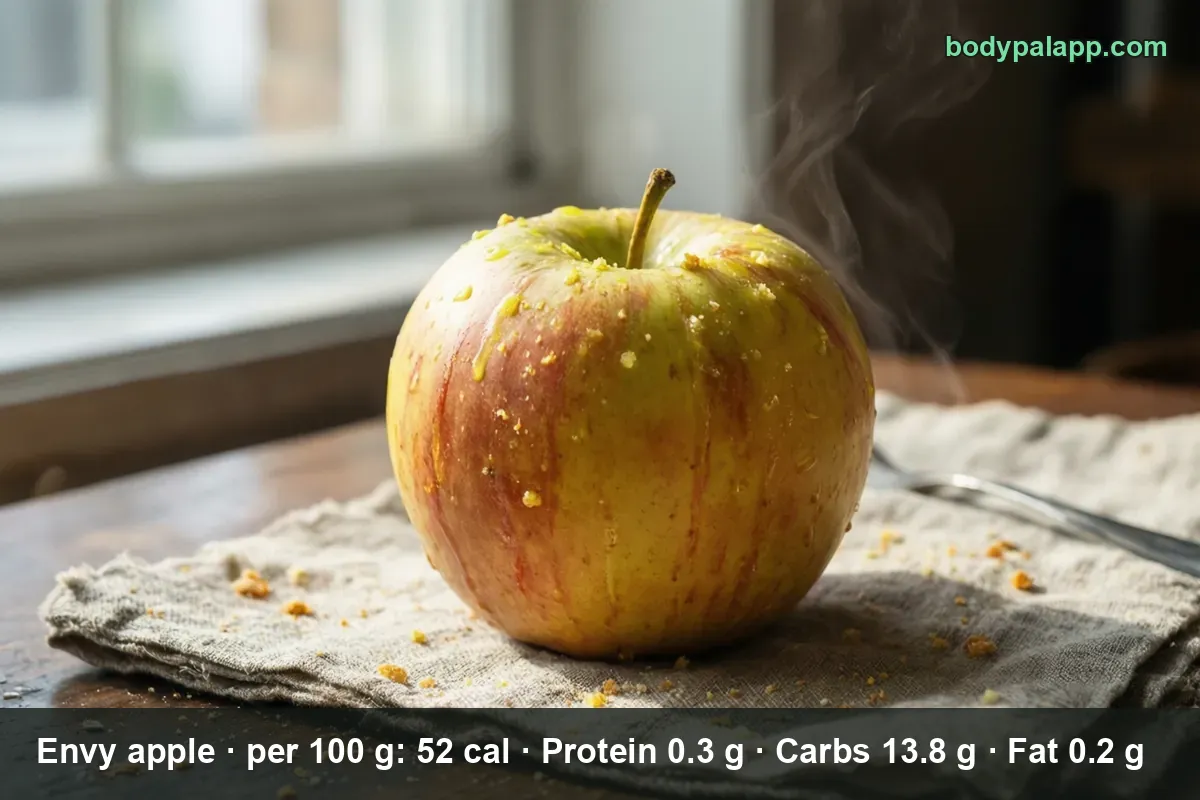
A medium Envy apple, 182 g on the scale, is 95 calories, or 52 calories per 100 g. A large one at 223 g is 116. A cup of slices is 57. Every figure on this page comes from USDA's generic raw-apple record, for a reason worth knowing up front: USDA has never measured an Envy.
On this page
- Envy apple quick facts
- USDA has no Envy row
- US servings, extra small to large
- The cup that changes its mind
- Peeled, sliced, large and cooked
- Fiber is the surprise, not sugar
- How does an Envy apple compare?
- FAQ
Envy apple quick facts
Envy is a trademarked name for Scilate, a New Zealand cross of Royal Gala and Braeburn. Search all four USDA collections for it and nothing comes back: no Foundation record, no SR Legacy record, no survey record, no packaged product. What an Envy is, nutritionally, is a raw apple eaten with the skin on, and that USDA has measured thoroughly.
The line behind every number here is SR Legacy 171688, "Apples, raw, with skin", and it was chosen over the variety-specific records for three reasons. It is generic, so it never pretends to be a variety it isn't. It carries a complete nutrient profile, including saturated fat and cholesterol, which the SR Legacy variety records leave out and the Foundation variety records replace with a gap of their own: no total sugars at all. And it has its own household serving weights, so every serving below is scaled from the same record rather than borrowed from a different one.
| Nutrient | Per 100 g | Per 1 medium apple (182 g) | % Daily Value |
|---|---|---|---|
| Calories | 52 | 95 | — |
| Total fat | 0.17 g | 0.3 g | 0% |
| Saturated fat | 0.03 g | 0.05 g | 0% |
| Carbohydrate | 13.81 g | 25.1 g | 9% |
| Dietary fiber | 2.4 g | 4.4 g | 16% |
| Total sugars | 10.39 g | 18.9 g | — |
| Protein | 0.26 g | 0.5 g | 1% |
| Sodium | 1 mg | 2 mg | 0% |
% Daily Value is based on a 2,000-calorie diet.
Verified nutrition data
Numbers on this page come from USDA FoodData Central, the U.S. Department of Agriculture’s food composition database, and from manufacturer labels where a branded product is named. Last verified September 2026. How we verify our data →
One row a packaged label would carry is absent, and it is absent deliberately. SR Legacy reports no added-sugars value for this record. A raw apple obviously has none, but the source does not say so, and printing a zero would mean reporting something nobody measured. Total sugars carry no Daily Value on a US label either, which is why that cell is a dash rather than a percentage.
Three numbers that rarely reach a calorie chart come off the same record: 1 mg of sodium per 100 g, which is 2 mg in the whole apple and 0% of the day, zero cholesterol, and 107 mg of potassium per 100 g. The nutritional story of an apple is carbohydrate, sugar and fiber. The rest of the label rounds to nothing.
USDA has no Envy row
So what is actually in an Envy? The honest answer is a range, and here is the range.
| USDA record | fdc_id | Calories per 100 g |
|---|---|---|
| Apples, raw, without skin | 171689 | 48 |
| Apples, raw, with skin (this page) | 171688 | 52 |
| Apples, raw, gala, with skin | 168204 | 57 |
| Apples, raw, golden delicious, with skin | 168202 | 57 |
| Apples, raw, granny smith, with skin | 168203 | 58 |
| Apples, raw, red delicious, with skin | 168201 | 59 |
| Apples, honeycrisp, with skin, raw | 1105547 | 60 |
| Apples, gala, with skin, raw | 1105781 | 61 |
| Apples, raw, fuji, with skin | 167793 | 63 |
| Apples, fuji, with skin, raw | 1105897 | 65 |
Thirteen calories separate the lightest skin-on record on that list from the heaviest, per 100 g. The newer Foundation measurements sit at the top of that band: Gala reads 57 in the older SR Legacy record and 61 in the newer Foundation one, and Fuji reads 63 and 65. One of Envy's parents, Gala, is on that list twice. The other, Braeburn, has no USDA record at all.
Which means a real Envy is likelier to sit in the upper half of the band than at 52. What we will not do is average the records to manufacture a tidier figure, because an average of two sources describes neither of them. 52 is what the chosen record says; the band is what the other records say; both are on the page, with their fdc_ids, so you can see exactly where the uncertainty lives. Any site quoting a precise calorie count "for Envy" is doing the same thing, usually without saying so.
US servings, extra small to large
| Serving | Weight | Calories |
|---|---|---|
| 1 oz | 28 g | 15 |
| 1 extra small apple (2-1/2" dia) | 101 g | 53 |
| 1 cup slices | 109 g | 57 |
| 1 cup, quartered or chopped | 125 g | 65 |
| 1 small apple (2-3/4" dia) | 149 g | 78 |
| 1 medium apple (3" dia) | 182 g | 95 |
| 1 large apple (3-1/4" dia) | 223 g | 116 |
| 1 NLEA serving | 242 g | 126 |
Size beats variety, and it is not close. Scaled to USDA's own weights, the same apple runs from 53 calories for an extra small one to 116 for a large one. That is more than double, from a single record, with no change of variety at all. The entire spread between the lightest and heaviest skin-on record per 100 g, remember, is 13 calories.
This matters for Envy specifically, because Envy is marketed and priced as a large apple. If the fruit in your hand is a big one, the 223 g row describes it better than the 182 g row does, and the difference between them, 21 calories, is larger than the difference between a generic apple and a Fuji per 100 g.
The last row is a curiosity worth knowing. The 242 g NLEA serving is the reference amount US labeling rules use for fresh apples, which is why a supermarket sign may quote 126 calories. It is heavier than any apple in the display. Nobody eats a serving; people eat an apple.
The cup that changes its mind
Here is the trap that catches people who log by volume rather than by object.
A cup of sliced apple is 109 g and 57 calories. A cup of the same apple quartered or chopped is 125 g and 65. Same cup, same apple, eight calories apart.
Nothing was added. Cubes pack tighter than slices, so a cup of them holds 16 g more fruit. Chopping does not add calories to an apple; it adds apple to the cup. If your food log offers both measures, pick the one that matches what is actually in the container, or skip the cup entirely and weigh the fruit.
Peeled, sliced, large and cooked
| Version | Per 100 g | Serving | Calories |
|---|---|---|---|
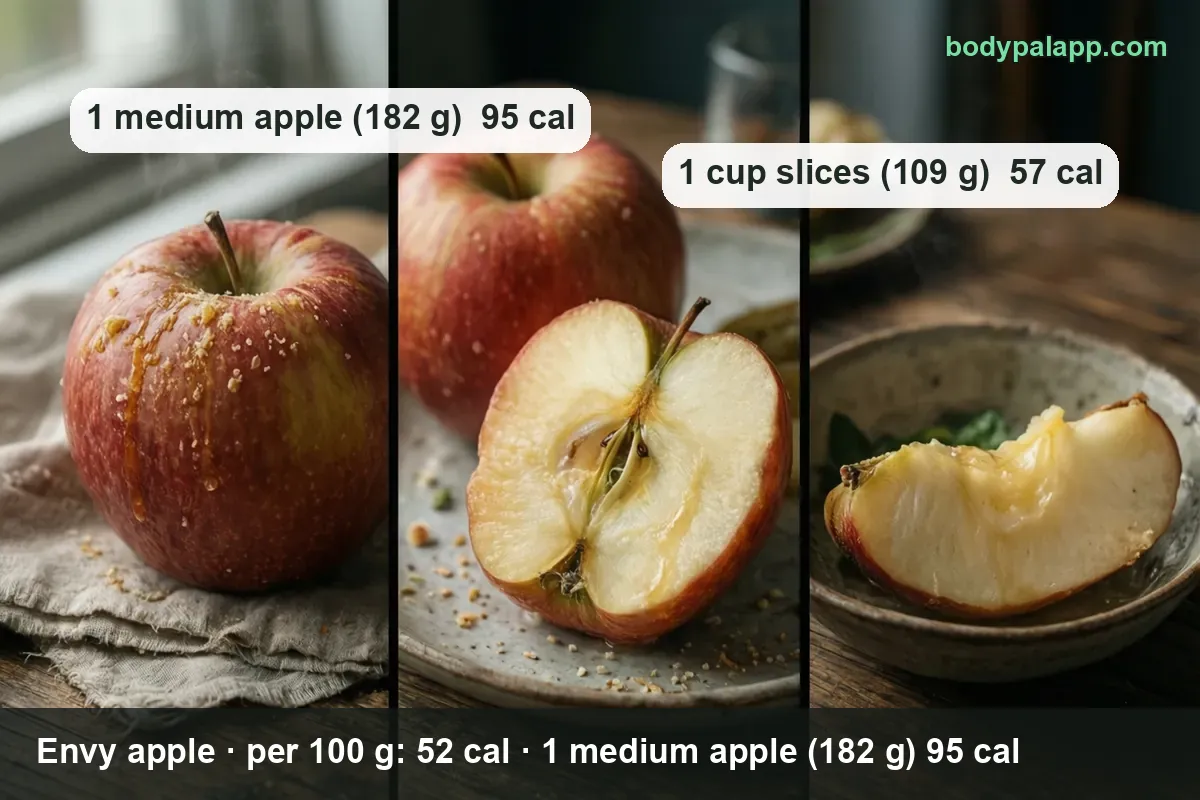
| With skin (this page) | 52 | 1 medium apple (182 g) | 95 |
| With skin, sliced | 52 | 1 cup slices (109 g) | 57 |
| With skin, large | 52 | 1 large apple (223 g) | 116 |
| Peeled | 48 | 1 medium peeled apple (161 g) | 77 |
| Peeled, sliced | 48 | 1 cup slices (110 g) | 53 |
| Cooked, peeled, boiled | 53 | per 100 g | 53 |
Peeling is the decision people think is about calories. It saves 4 calories per 100 g, dropping the record from 52 to 48, and a peeled medium apple is 77 rather than 95, mostly because a peeled apple weighs 161 g instead of 182 g once the skin is gone.
What it costs is fiber: 2.4 g per 100 g with the skin, 1.3 g without. That is close to half the fiber, traded for 4 calories. Sugar barely moves, from 10.39 g to 10.1 g. On every row that a nutritionist would look at, the peel is the good part of the apple.
The large apple is where the fiber gets interesting: 223 g gives 30.8 g of carbohydrate, 23.2 g of sugars and 5.4 g of fiber, which is 19% of the Daily Value in one piece of fruit. A cup of slices with the skin on carries 15.1 g of carbohydrate and 2.6 g of fiber.
Cooking is the one row that behaves against intuition. USDA's boiled peeled apple reads 53 calories per 100 g, slightly more than the raw peeled apple at 48, because boiling drives off water and concentrates what is left. USDA publishes no household serving for that record, so it stays per 100 g here rather than being dressed up as a portion.
Fiber is the surprise, not sugar
Eighteen point nine grams of sugar in a medium apple sounds like the headline, and every low-carb thread on the internet treats it as one. Look at the percentage column instead and a different row is doing the work.
An apple spends 9% of the day's carbohydrate allowance and returns 16% of the day's fiber. Protein is 1%, fat is 0%, sodium is 0%. Against the FDA Daily Values there is exactly one row where a raw apple is a heavyweight, and it is the row most calorie charts do not print.
That is also the row peeling destroys. Skin-on 2.4 g per 100 g against 1.3 g peeled, for a saving of 4 calories. Nobody peels an apple to save 4 calories, but plenty of people peel them for children, for salads, for pies, and the fiber goes out with the peel every time.
MyPlate counts whole fruit toward the fruit group, and fiber is one of the nutrients the Dietary Guidelines for Americans list as under-consumed in the US. A skin-on apple is one of the cheaper ways to move that number: 4.4 g of fiber for 95 calories, 5.4 g if it is a large one.
How does an Envy apple compare?
Every row below is a USDA variety record with its own serving weight, so this is apples against apples rather than a lineup of unrelated snacks.
| Variety | Per 100 g | Serving | Calories | Protein / Carbs / Fat |
|---|---|---|---|---|
| Apple, raw with skin (this page) | 52 | 1 medium (182 g) | 95 | 0.5 / 25.1 / 0.3 g |
| Gala | 57 | 1 medium (172 g) | 98 | 0.4 / 23.5 / 0.2 g |
| Golden Delicious | 57 | 1 medium (169 g) | 96 | 0.5 / 23.0 / 0.3 g |
| Granny Smith | 58 | 1 medium (167 g) | 97 | 0.7 / 22.7 / 0.3 g |
| Fuji | 63 | 1 medium (192 g) | 121 | 0.4 / 29.2 / 0.3 g |
Four of the five land within three calories of each other, 95 to 98, even though their per-100 g figures differ by six. The reason is that USDA's "medium" is a different weight for every variety: the denser apples are the smaller ones, and the size cancels the density. Fuji breaks the pattern honestly, being both the densest at 63 and the biggest at 192 g, which is how it reaches 121 calories.
Honeycrisp, the apple most Envy shoppers are actually choosing between, sits in Foundation at 60 calories per 100 g with no USDA serving weight attached, so it cannot be given a per-apple figure here without inventing one.
Our take: at the fruit bowl, variety is noise. Ninety-five against ninety-eight is not a decision, so buy the apple you like eating, and if that is Envy, the price is the only thing that separates it from a Gala. The number that does move your day is the size of the fruit you pick up, 116 calories against 53, and the second is whether you peel it, which costs almost nothing in calories and nearly half the fiber.
Envy apple FAQs
How many calories are in an Envy apple?
95 calories in a medium apple weighing 182 g, or 52 calories per 100 g. A small one at 149 g is 78 calories and a large one at 223 g is 116. USDA has no record for the Envy variety itself, so those figures come from its generic raw apple with skin, SR Legacy 171688.
How many calories are in a large Envy apple?
116 calories for a large apple of 223 g, carrying 30.8 g of carbohydrate, 23.2 g of sugars and 5.4 g of fiber, which is 19% of the Daily Value. Envy is sold as a big apple, so this row often describes the fruit in your hand better than the 182 g medium does.
What are the nutrition facts for an Envy apple?
A medium 182 g apple has 95 calories, 0.5 g of protein, 25.1 g of carbohydrate, 18.9 g of sugars, 4.4 g of fiber, 0.3 g of fat and 2 mg of sodium. Per 100 g that is 52 calories. Cholesterol is zero and potassium is 107 mg per 100 g.
How many carbs are in an Envy apple?
25.1 g in a medium apple, which is 9% of the Daily Value, made up of 18.9 g of sugars and 4.4 g of fiber. Per 100 g the figure is 13.81 g. A cup of slices holds 15.1 g and a large apple 30.8 g.
How much sugar is in an Envy apple?
18.9 g in a medium apple and 10.39 g per 100 g, all of it occurring naturally in the fruit. USDA reports no added-sugars value for this record, and total sugars carry no Daily Value on a US label, so there is no percentage to quote. A large apple has 23.2 g.
Envy or Honeycrisp: which has fewer calories?
USDA's Honeycrisp record is 60 calories per 100 g against 52 for the generic apple used here, and neither has been measured under the name Envy. Every measured skin-on record falls between 52 and 65, so that gap sits inside the uncertainty. Honeycrisp has no USDA serving weight, so per apple the two cannot be compared.
Are Envy apples good for weight loss?
One medium apple is 95 calories with 4.4 g of fiber, 16% of the Daily Value, and 0.3 g of fat. That is a large object for the calories, which is what makes whole fruit easy to fit into a day. Size is the lever that matters: 116 calories for a large apple, 53 for an extra small one.
How many calories are in a cup of sliced Envy apple?
57 calories for a cup of slices weighing 109 g, with 15.1 g of carbohydrate and 2.6 g of fiber. A cup of the same apple quartered or chopped weighs 125 g and comes to 65 calories, because cubes pack tighter than slices. Peeled slices are 53 calories per cup.
Similar foods
- Apple — 95 cal per medium apple
- Mixed Berries — 78 cal per cup
- Cosmic Crisp Apple — 95 cal per medium apple
- Pink Lady Apple — 80 cal per medium apple
- Raspberries — 64 cal per cup
- Cutie Mandarin (Clementine) — 47 cal per Cutie
Count it without the math
Point the camera at the fruit bowl and BodyPal logs the apple you actually picked up, size and all.


How long does it take to burn off an Envy apple?
One medium apple (182 g) is 95 kcal. Enter your weight and the amount you ate to see how long it takes you to burn that off:
lb
| Activity | Time to burn 95 kcal |
|---|---|
| Walking, brisk | 19 min |
| Cycling, moderate | 12 min |
| Swimming, moderate | 14 min |
| Jogging | 11 min |
| Weight training, moderate | 21 min |
Times are for a 155 lb adult at a steady pace; change the weight to see yours. The amount is set to the portion in the text (182 g); change it to what you actually ate. BodyPal works this out from your steps automatically.
Burning it off is one side of it. The other is knowing your number: work out how many calories you need a day, with macros and a goal date.