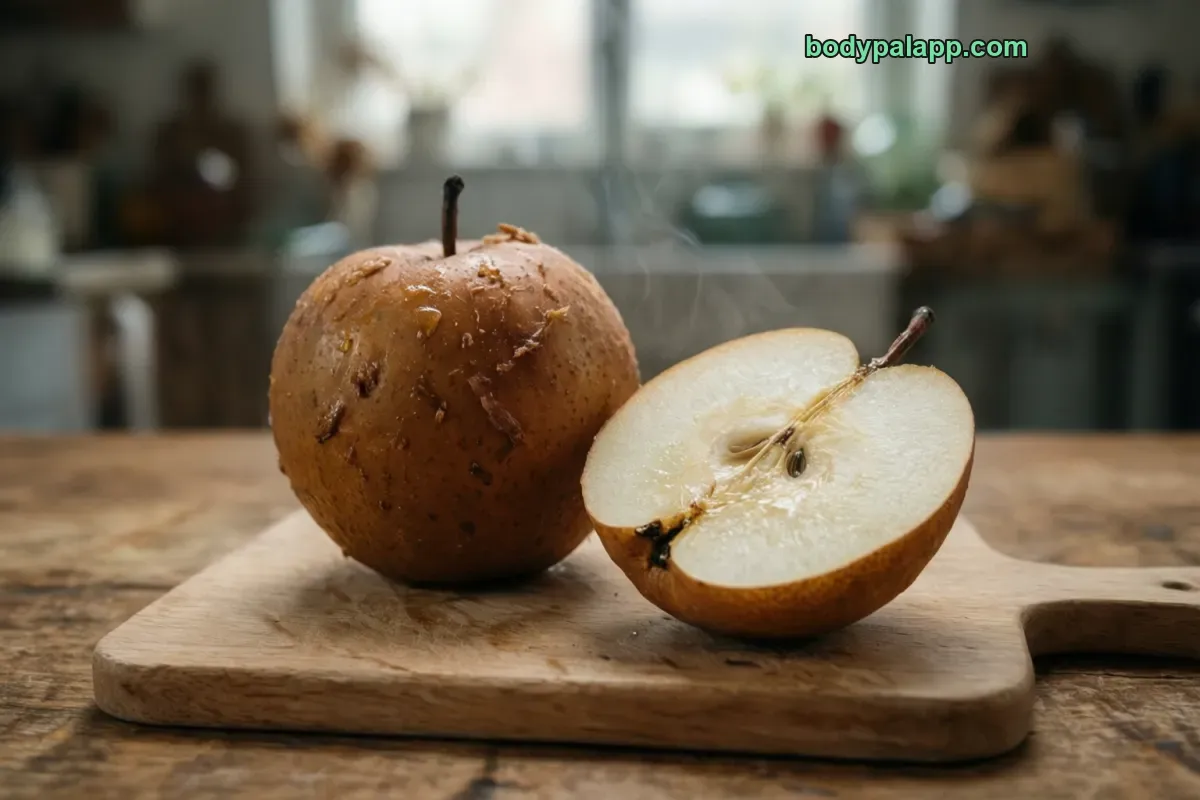
Asian pear calories come to 116 for one large fruit (275 g) and 42 per 100 g. Nearly all of that energy is carbohydrate, but a large pear also carries 9.9 g of fiber and no sodium. The size of the pear you pick moves the total far more than anything else.
116kcal
1 large Asian pear · 275 g, raw
4%protein
1.4 gProtein
29 gCarbs
0.6 gFat
How to burn off 116 kcal
—Walking, brisk
—Jogging
—Cycling, moderate
—Swimming
Skip the math. BodyPal counts these calories from your steps and workouts automatically.
Nutrition facts
Raw · per 275 g
Calories
116 kcal
Protein
1.4 g
Carbohydrate
29 g
Fat
0.6 g
Saturated fat
0 g
Cholesterol
0 mg
Sodium
0 mg
Potassium
333 mg
Iron
0 mg
Source: USDA FoodData Central
🛡️
Verified nutrition data
Numbers on this page come from USDA FoodData Central, the U.S. Department of Agriculture’s food composition database, and from manufacturer labels where a branded product is named. Last verified October 2026. How we verify our data →
Asian pear: calories, protein and sodium by serving
Percent of daily value uses the FDA reference of 2,000 kcal a day.
Serving
kcal
Protein
Carbs
Fat
Sodium
% DV kcal
1 large (275 g)
116
1.4 g
29.3 g
0.6 g
0 mg
6%
1 small (122 g)
51
0.6 g
13 g
0.3 g
0 mg
3%
1 cup (125 g)
53
0.6 g
13.3 g
0.3 g
0 mg
3%
100 g
42
0.5 g
10.7 g
0.2 g
0 mg
2%
3 × 1 large (275 g)
347
4.1 g
0 mg
5 × 1 large (275 g)
578
6.9 g
0 mg
A small pear is 51 calories, a large one is 116
Asian pears vary a lot in size, and the calorie count follows the scale. A small 122 g pear comes to 51 calories. A cup of slices at 125 g lands at 53. A large 275 g fruit reaches 116, more than double the small one, for the same crisp, round fruit.
Because the numbers stay low, multiples add up slowly. Two large pears total 231 calories across 550 g, three come to 347, and even five large pears reach only 578 calories at 1,375 g. Protein barely moves along the way: five pears still deliver just 6.9 g.
Against a 2000-calorie daily value, one large pear covers 6% of the day and a small one 3%. That makes it an easy snack to fit in. The catch is guessing size by eye. Large Asian pears look similar to medium ones, so weighing once tells you which row of the table you are actually eating.
Carbs supply 91% of the calories
The calorie split is lopsided: 91% from carbohydrate, 4% from protein and 4% from fat. Per 100 g that means 10.7 g of carbs, of which 7.1 g are sugars and 3.6 g are fiber, alongside 0.5 g of protein and 0.2 g of fat. Saturated fat is 0.
Scale that to a large pear and you get 29.3 g of carbs, 19.4 g of sugars and 9.9 g of fiber. The sugar number looks high on paper, but it arrives inside a whole fruit with a lot of fiber attached, not as a drink or a syrup.
Protein is the weak spot. A large pear gives 1.4 g, just 3% of the 50 g daily value, and a small one 0.6 g. On its own, an Asian pear is a light, sweet bite rather than a filling meal. It works best as one part of a plate that brings protein from somewhere else.
Fiber is the row worth reading
Most nutrition labels have a row to worry about. Here the notable row is a good one. A large Asian pear holds 9.9 g of fiber against a daily value of 28 g, and a small pear or a cup of slices still gives 4.4 g and 4.5 g. For a fruit with 116 calories at most, that is a solid return.
The rows people usually watch read zero. Sodium is 0 mg in every serving, cholesterol is 0 and saturated fat is 0. If you track sodium closely, an Asian pear adds nothing to that column, so it is a safe snack next to salty foods.
Potassium is present but modest at 121 mg per 100 g, set against a daily value of 4700 mg. Sugars are the one number to keep an eye on if you track them: 8.6 g in a small pear and 19.4 g in a large one. Choosing the small size halves the sugar without giving up the fruit.
Pair it with protein to make it stick
With so little protein and fat, an Asian pear pairs naturally with foods that supply what it lacks. Slices with cheese, yogurt, nuts or a handful of seeds turn a light snack into something that holds you longer. In a salad, its crunch works next to greens and a protein such as chicken or tofu.
The numbers on this page are for the raw, fresh fruit. Dried products like Wonder Fruit Dried Asian Pears are a different food with their own label, so log them from the package rather than from these rows.
If you track your intake, log by size or weight rather than as a generic pear, since a large fruit carries more than twice the calories of a small one. BodyPal can log an Asian pear from a photo, which helps when you are slicing one up for a snack and do not want to weigh it.
How does asian pear compare?
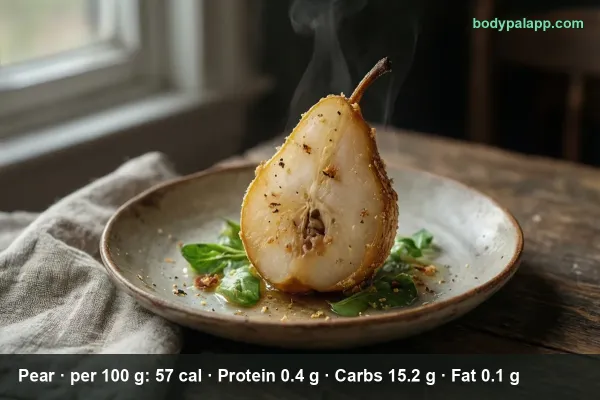
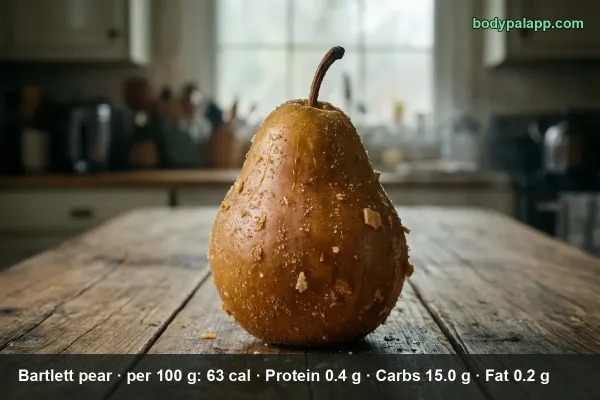
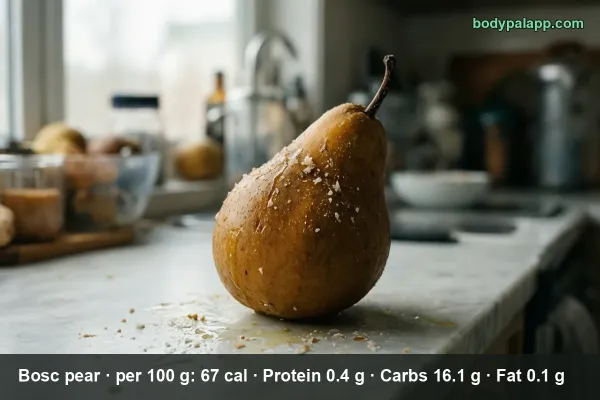
Here is how the raw Asian pear stacks up against regular, Bartlett and Bosc pears, per 100 g and per usual serving.
Verdict: For the fewest calories pick the Asian pear: 42 per 100 g against 57 for a regular pear and 67 for Bosc, which runs about 1.6 times higher. If you want a sweeter, denser bite, Bartlett at 63 and Bosc at 67 deliver more carbs per gram, with 15 g and 16.1 g per 100 g.
Most popular asian pear brands in the United States
Ranked by popularity in the BodyPal database
# Productkcal / 100 g
1Wonder Fruit Dried Asian Pears20 g240 kcal
Dried Asian pear has most of its water removed, so its label reads far higher per 100 g than the fresh fruit above. Source: manufacturer labels / USDA FoodData Central.
Asian pear FAQs
How many calories are in one Asian pear?
A large raw Asian pear (275 g) has about 116 calories, and a small one (122 g) has about 51.
Is Asian pear good for weight loss?
Asian pear has 42 calories and 3.6 g of fiber per 100 g, so a large pear gives 9.9 g of fiber for 116 calories.
Asian pear vs regular pear: which has fewer calories?
Raw Asian pear has 42 calories per 100 g, while a regular raw pear has 57 calories per 100 g.
How much sugar is in an Asian pear?
Asian pear has 7.05 g of sugar per 100 g, about 19.4 g in a large pear, with 29.3 g of total carbs.
How many calories are in a cup of sliced Asian pear?
A cup of sliced Asian pear (125 g) has 53 calories. It also gives 13.3 g of carbs, 8.8 g of sugars, 4.5 g of fiber and 0 mg of sodium, close to the numbers for one small pear.
How much fiber does an Asian pear have?
A large Asian pear (275 g) has 9.9 g of fiber, against a daily value of 28 g. A small pear gives 4.4 g, and 100 g of the fruit gives 3.6 g.
How many carbs are in a large Asian pear?
A large Asian pear (275 g) has 29.3 g of carbs, including 19.4 g of sugars and 9.9 g of fiber. Carbs make up 91% of its calories, while protein and fat are 4% each.
Does Asian pear have sodium or cholesterol?
No. An Asian pear has 0 mg of sodium and 0 cholesterol in every serving, from a small 122 g pear to a large 275 g one. It does carry 121 mg of potassium per 100 g.