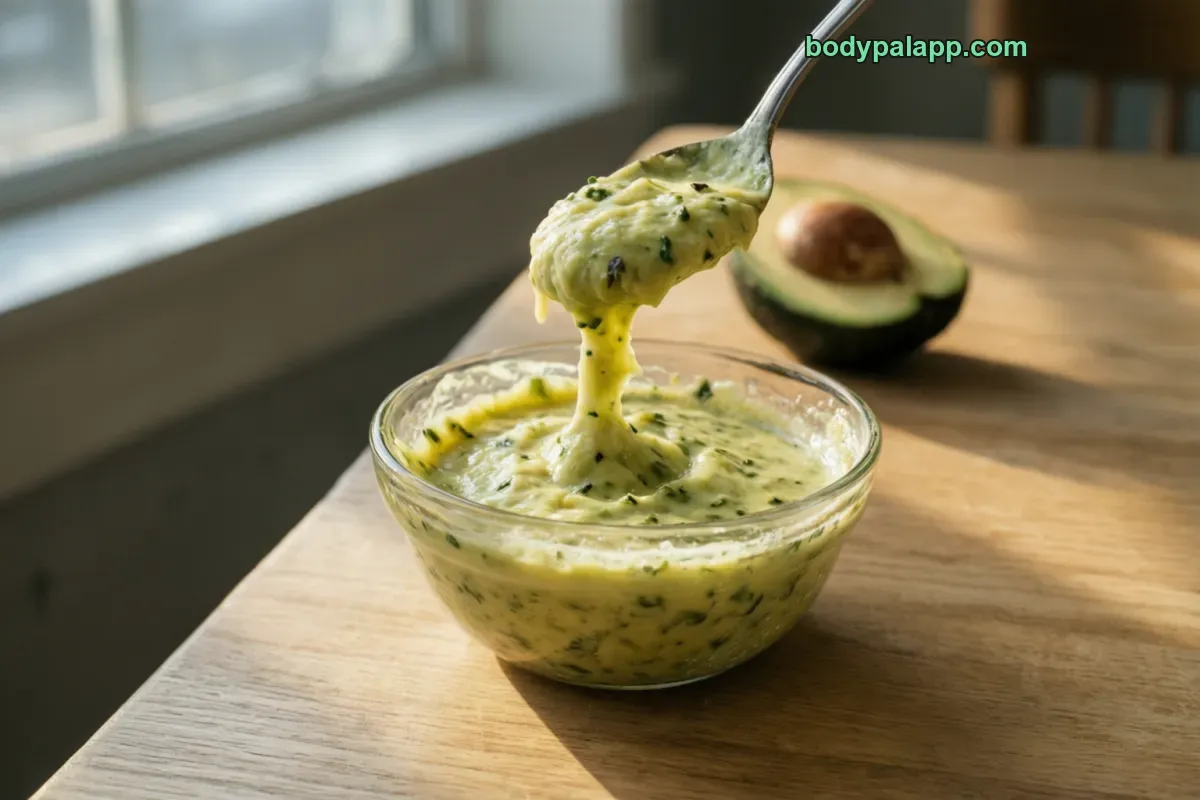
Avocado ranch dressing calories come to 130 for a 2 tbsp (30 g) serving and 433 per 100 g. Fat supplies 97% of those calories, so the total climbs with every extra pour. Sodium follows the same path: 190 mg per serving, or 8% of the daily value.
130kcal
1 2 tbsp serving · 30 g, packaged, per label
0%protein
0 gProtein
1 gCarbs
13 gFat
How to burn off 130 kcal
—Walking, brisk
—Jogging
—Cycling, moderate
—Swimming
Skip the math. BodyPal counts these calories from your steps and workouts automatically.
Nutrition facts
Packaged, per label · per 30 g
Calories
130 kcal
Protein
0 g
Carbohydrate
1 g
Fat
13 g
Saturated fat
1.5 g
Cholesterol
5 mg
Sodium
190 mg
Source: USDA FoodData Central
🛡️
Verified nutrition data
Numbers on this page come from USDA FoodData Central, the U.S. Department of Agriculture’s food composition database, and from manufacturer labels where a branded product is named. Last verified September 2026. How we verify our data →
Avocado ranch dressing: calories, protein and sodium by serving
Percent of daily value uses the FDA reference of 2,000 kcal a day.
Serving
kcal
Protein
Carbs
Fat
Sodium
% DV kcal
2 tbsp (30 g)
130
0 g
1 g
13 g
190 mg
6%
100 g
433
0 g
3.3 g
43.3 g
633 mg
22%
3 × 2 tbsp (30 g)
390
0 g
570 mg
5 × 2 tbsp (30 g)
650
0 g
950 mg
Two tablespoons is 130 calories, a heavy pour is 390
The label serving is 2 tbsp (30 g), and it holds 130 calories, about 6% of the daily value. That figure only means something if you actually measure. Most people pour dressing straight from the bottle, and a salad bowl hides how much went in.
Double the serving to 60 g and you are at 260 calories. Three servings, or 90 g, reach 390 calories, which is more than many salads contain before the dressing goes on. A generous dip cup for wings or fries can run to five servings: 150 g, 650 calories and 950 mg of sodium.
Measuring the first time you use a new bottle is the simplest fix. Pour 2 tbsp into a spoon, then into the bowl, and see how far it spreads. If it looks thin, toss the salad longer before adding more. Dressing coats better than it looks in the bottom of the bowl, and the calories stay at 130 instead of drifting toward 390.
Fat is 97% of every calorie
The calorie split is lopsided: 97% from fat, 3% from carbs and 0% from protein. Per 100 g that works out to 43.3 g of fat, 3.3 g of carbs and 0 g of protein. A 2 tbsp serving carries 13 g of fat and 1 g of carbs.
The avocado in the name does not change the basic profile. This is still an oil-based creamy dressing, and the per 100 g count of 433 calories sits right next to regular ranch. Saturated fat is 5 g per 100 g, against a daily value of 20 g, so most of the fat is the unsaturated kind found in the oils these dressings use.
What the dressing lacks matters as much as what it has. There is 0 g of fiber and 0 g of protein, so it adds calories without adding anything that keeps you full. Sugar is low at 1 g per serving and 3.3 g per 100 g, which puts it well below sweeter dressings. Treat it as a flavor ingredient, not a food that pulls its own weight.
Sodium is the second row to watch
Each 2 tbsp serving carries 190 mg of sodium, 8% of the daily value. That sounds modest until portions grow. At 60 g it is 380 mg, at 90 g it is 570 mg, and a five-serving dip cup reaches 950 mg.
Per 100 g the dressing has 633 mg of sodium, 28% of the daily value. The salad underneath often adds more: cheese, bacon bits, croutons and deli meat are common partners for ranch, and each brings its own salt. If you watch sodium, the dressing is the easiest piece to control because you decide the pour.
Cholesterol is low at 17 mg per 100 g, against a daily value of 300 mg. It is not the row that moves your day. Sodium and total calories are.
Let the salad carry the meal, not the dressing
Because avocado ranch brings 0 g of protein and 0 g of fiber, the rest of the plate has to supply both. Grilled chicken, beans, eggs or tuna add the protein. Leafy greens, cucumbers, peppers, tomatoes and shredded cabbage add volume and fiber for very few calories, so a single 2 tbsp serving goes further.
Raw vegetables are the best vehicle for it as a dip. Carrots, celery and snap peas give crunch and bulk, while chips and fries stack their own fat on top of a dressing that is already 97% fat. Thinning the dressing with a squeeze of lime or a spoon of plain yogurt stretches the flavor across more salad.
Brands such as Marzetti, Wish-Bone, Tessemae's and Good Foods all sell an avocado ranch, and the values on this page come from the Marzetti label. Check the label on your own bottle, and if you track meals, BodyPal can log the dressed salad from a photo.
How does avocado ranch dressing compare?
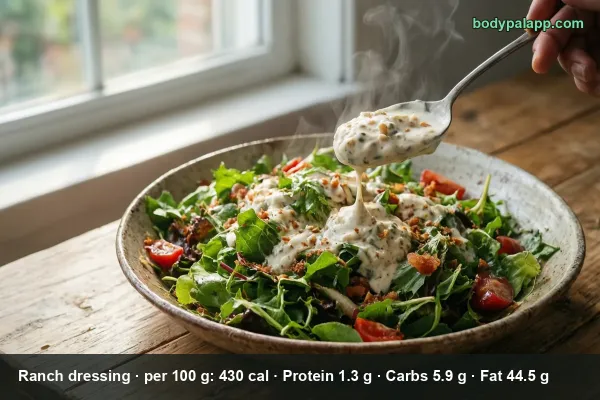
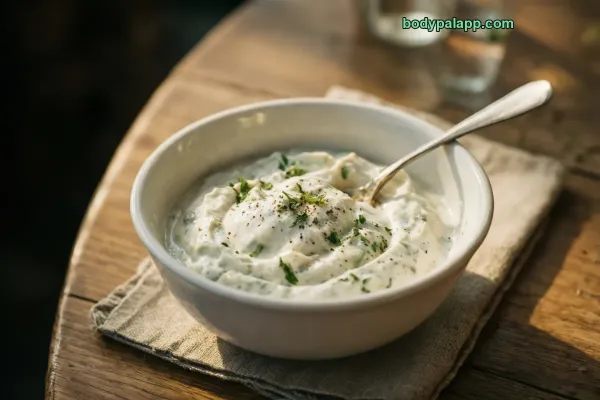
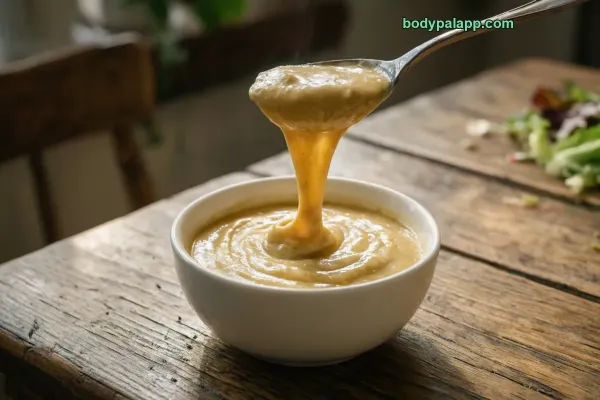
Here is how avocado ranch stacks up against ranch dressing, ranch dip and honey mustard dressing, per 100 g and per usual serving.
Verdict: On calories it is close to a tie: avocado ranch at 433 per 100 g sits beside ranch dressing at 430 and ranch dip at 432, and it edges out honey mustard at 139 per 2 tbsp. Pick avocado ranch over regular ranch if sodium is your concern, since it has 633 mg per 100 g against 810 mg, while honey mustard is lowest in sodium at 512 mg but carries 23.3 g of carbs.
Most popular avocado ranch dressing brands in the United States
About 130 calories in a 2 tbsp serving (30 g), or about 65 in one tablespoon.
Is avocado ranch dressing good for weight loss?
It is calorie-dense at 433 calories per 100 g, with 43.3 g of fat per 100 g. A 2 tbsp serving adds 130 calories.
Avocado ranch vs ranch dressing: which has fewer calories?
They are nearly the same: 130 calories per 2 tbsp for avocado ranch versus 129 for regular ranch (433 vs 430 per 100 g).
How much fat is in avocado ranch dressing?
A 2 tbsp serving has 13 g of fat, 1 g of carbs, 0 g of protein and 190 mg of sodium.
Does avocado ranch dressing have any protein?
No. Avocado ranch dressing has 0 g of protein per 2 tbsp serving and 0 g per 100 g. Fat supplies 97% of its calories and carbs the other 3%, so pair it with a protein food.
How much sodium is in avocado ranch dressing?
A 2 tbsp (30 g) serving has 190 mg of sodium, 8% of the daily value. Per 100 g it is 633 mg, or 28%. Three servings bring it to 570 mg.
How many calories are in a heavy pour of avocado ranch?
Three 2 tbsp servings, or 90 g, come to 390 calories. A large dip cup of five servings, 150 g, reaches 650 calories. Measuring the first serving keeps it at 130.
Is there sugar in avocado ranch dressing?
Very little. There is 1 g of sugar per 2 tbsp serving and 3.3 g per 100 g. That is far lower than honey mustard dressing, which has 23.3 g of carbs per 100 g.
Is avocado ranch dressing high in saturated fat?
It has 5 g of saturated fat per 100 g, against a daily value of 20 g. Total fat is much higher at 43.3 g per 100 g, so most of the fat is not saturated.