
How many calories are in an avocado?
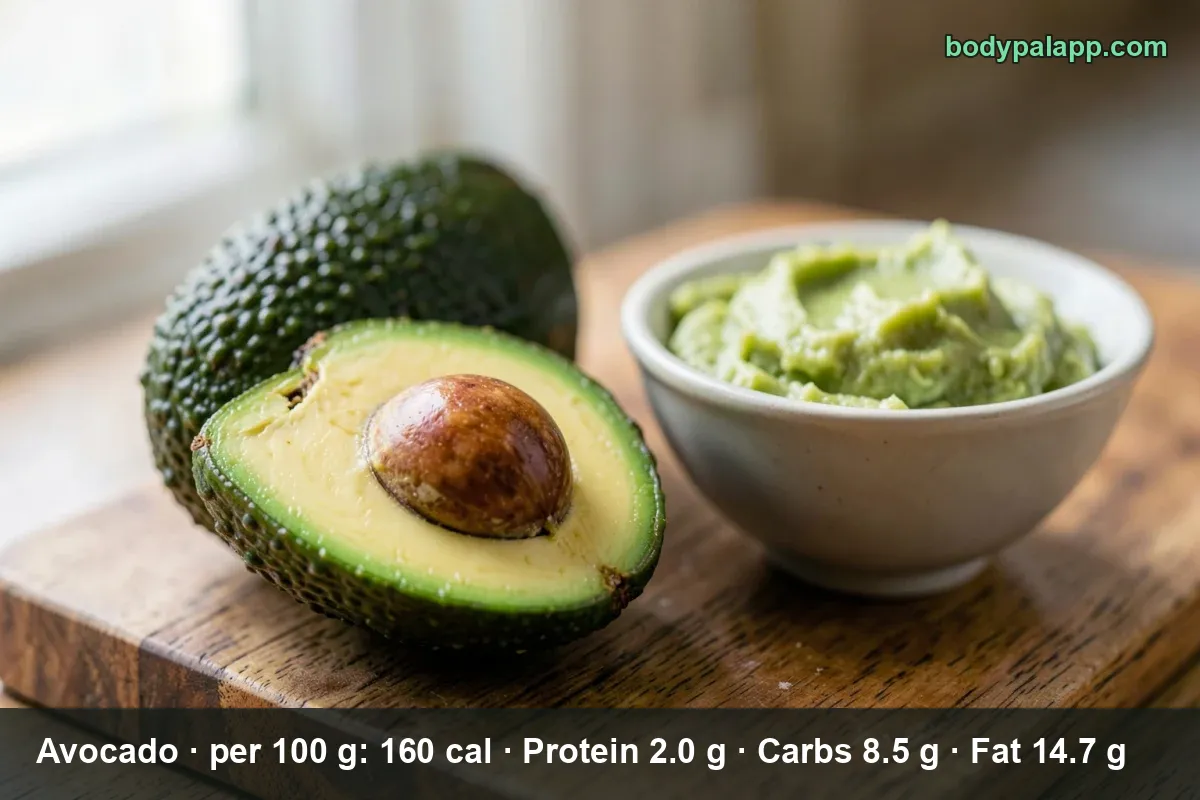
One whole avocado, skin and pit removed, weighs about 201 g and carries 322 calories. Per 100 g of flesh the number is 160 calories, so half a fruit lands near 161. Most of that comes from fat — 29.5 g in the fruit — and 13.5 g of the 17.1 g of carbohydrate is fiber.
On this page
- Avocado quick facts
- US servings, from one ounce to a cup of puree
- California vs Florida avocado
- Mashed, on a sandwich, in a roll
- Fiber and potassium are the rows that surprise people
- How does avocado compare?
- Most popular avocado brands
- FAQ
Avocado quick facts
The record that matches the fruit in your hand is SR Legacy 171705, "Avocados, raw, all commercial varieties". Supermarket avocados in the US are mostly Hass, but they are sold loose and unlabeled, and this weighted record carries the full profile: fiber, saturated fat, sodium and potassium in one place.
There is also a Foundation entry for Hass specifically. It calculates energy by Atwater factors and leaves fiber, saturated fat and sugars blank, so it cannot fill a label table. The two variety records, California and Florida, get their own section further down, because the gap between them is bigger than most people expect.
| Nutrient | Per 100 g | Per 1 avocado (201 g) | % Daily Value |
|---|---|---|---|
| Calories | 160 | 322 | — |
| Total fat | 14.66 g | 29.5 g | 38% |
| Saturated fat | 2.13 g | 4.3 g | 21% |
| Carbohydrate | 8.53 g | 17.1 g | 6% |
| Dietary fiber | 6.7 g | 13.5 g | 48% |
| Total sugars | 0.66 g | 1.3 g | — |
| Protein | 2 g | 4.0 g | 8% |
| Sodium | 7 mg | 14 mg | 1% |
| Cholesterol | 0 mg | 0 mg | 0% |
| Potassium | 485 mg | 975 mg | 21% |
% Daily Value is based on a 2,000-calorie diet.
Verified nutrition data
Numbers on this page come from USDA FoodData Central, the U.S. Department of Agriculture’s food composition database, and from manufacturer labels where a branded product is named. Last verified September 2026. How we verify our data →
There is no added sugars row here: the SR Legacy edition does not publish added sugars for this record, and a raw fruit has none by definition. The 1.3 g of total sugars in a whole avocado is all naturally occurring, which is why the Total sugars cell shows no %DV — the FDA Daily Value list sets a limit for added sugars only.
US servings, from one ounce to a cup of puree
| Serving | Weight | Calories |
|---|---|---|
| 1 oz | 28 g | 45 kcal |
| 1 NLEA serving, one third of a medium fruit | 50 g | 80 kcal |
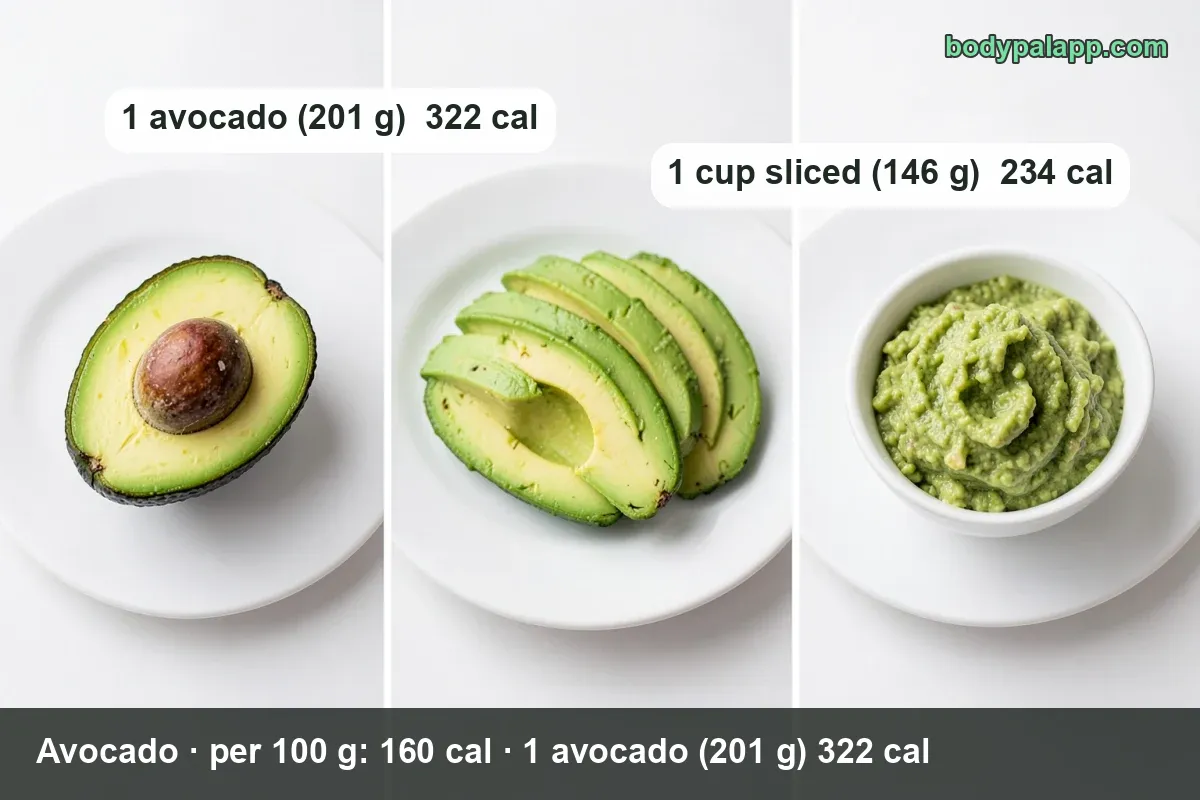
| 1 cup, sliced | 146 g | 234 kcal |
| 1 cup, cubes | 150 g | 240 kcal |
| One whole avocado, no skin or pit | 201 g | 322 kcal |
| 1 cup, mashed or pureed | 230 g | 368 kcal |
| Per 100 g | 100 g | 160 kcal |
Every weight above except the ounce is a USDA household measure attached to record 171705. The 1 oz line is our own arithmetic from the USDA 100 g figure, not a USDA serving, and it is the one worth memorizing: 45 calories an ounce makes mental math on a sandwich or a bowl easy.
The trap is the word "cup." A cup of sliced avocado is 146 g and 234 calories. A cup of the same fruit mashed is 230 g and 368 calories, because mashing removes the air between the slices. That is 134 calories of difference for a measure people log identically. If you mash, weigh; if you slice, a cup is close enough.
The NLEA serving — one third of a medium fruit, 50 g, 80 calories — is the number that appears on packaged avocado labels, which is why a nutrition panel can read "80 calories" for something that is 322 calories whole.
California vs Florida avocado
Florida avocados, the big smooth-skinned ones sometimes sold as slimcados, are the lighter fruit per gram: 120 calories per 100 g against 167 for California. Then you weigh them.
| Version | Per 100 g | Typical piece | Calories |
|---|---|---|---|
| California avocado | 167 kcal | 1 fruit, no skin or seed (136 g) | 227 kcal |
| Florida avocado | 120 kcal | 1 fruit, no skin or seeds (304 g) | 365 kcal |
| All commercial varieties | 160 kcal | 1 fruit (201 g) | 322 kcal |
A whole Florida avocado is 365 calories, a whole California one 227. The "lighter" variety costs you 138 calories more per fruit, because 304 g of watery flesh beats 136 g of oily flesh. Per gram Florida wins; per fruit it loses badly. Same story with fiber: 5.6 g per 100 g in Florida against 6.8 g in California, but the bigger fruit still delivers more of it.
If a recipe says "one avocado" and you bought the big one, the count is closer to 365 than to 322.
Mashed, on a sandwich, in a roll
Once the fruit leaves the cutting board, the numbers move for one reason only: how much avocado is actually in the portion, and what got added to it.
| Version | Per 100 g | Typical piece | Calories |
|---|---|---|---|
| Mashed or pureed | 160 kcal | 1 cup (230 g) | 368 kcal |
| Avocado on a sandwich | 160 kcal | guideline amount, regular sandwich (30 g) | 48 kcal |
| Avocado dressing | 427 kcal | 1 tablespoon (15.3 g) | 65 kcal |
| Avocado sushi roll | 93 kcal | 1 oz (28 g) | 26 kcal |
The sandwich line is the useful one. USDA's guideline amount for avocado on a regular sandwich is 30 g — 48 calories, about a seventh of a fruit. Deli slices of avocado are thin, and the mental image of "half an avocado on my sandwich" is usually three times what is actually on it.
Avocado dressing runs 427 calories per 100 g because oil and salt were added; a single tablespoon is 65 calories and 867 mg of sodium per 100 g of dressing, against 7 mg in the raw fruit. The sushi roll goes the other way — 93 calories per 100 g — since seasoned rice dilutes the fat, though it brings 361 mg of sodium per 100 g with it.
Packaged avocado behaves the same way. A cup of plain refrigerated avocado matches the raw record at 160 calories per 100 g, with a 50 g label serving at 80 calories, while a smashed-avocado mini cup with added ingredients can read 228 calories per 100 g, or 130 calories for a 57 g cup.
Fiber and potassium are the rows that surprise people
One avocado covers 48% of the Daily Value for fiber — 13.5 g against the FDA's 28 g reference — and 21% of the Daily Value for potassium at 975 mg. Sodium is 14 mg, 1% of the DV. The Dietary Guidelines for Americans name fiber and potassium among the nutrients Americans consistently under-consume, and this is one of the few foods that moves both rows at once.
The fat row reads scarier than it is. Total fat is 38% of the DV for one fruit, but saturated fat is only 4.3 g, or 21% of its own DV — most of the 29.5 g is monounsaturated. Half a fruit puts you at 19% of the fat DV and about 11% of the saturated fat DV.
Worth noting for anyone counting carbohydrate: of the 17.1 g in a whole avocado, 13.5 g is fiber and 1.3 g is sugar, leaving roughly 2.3 g of other carbohydrate by our own subtraction. MyPlate files avocado under fruit, which is where it counts toward a daily target even though it tastes nothing like the rest of that group.
How does avocado compare?
| Food | Per 100 g | US serving | Calories |
|---|---|---|---|
| Avocado | 160 kcal | 1 oz (28 g) | 45 kcal |
| Plantains, yellow, baked | 155 kcal | 1 oz (28 g) | 44 kcal |
| Plantains, green, raw | 152 kcal | 1 oz (28 g) | 43 kcal |
| Cranberry sauce, canned, sweetened | 159 kcal | 1 oz (28 g) | 45 kcal |
Our take: these four foods sit within 8 calories of each other per 100 g and behave nothing alike. Avocado gets roughly four-fifths of its calories from fat (14.66 g × 9, our arithmetic), while baked plantain carries 41.37 g of carbohydrate per 100 g and almost no fat, and cranberry sauce is mostly sugar. For satiety per calorie, avocado is the pick, because 6.7 g of fiber per 100 g does work the other three cannot match. For a smaller number on the day, the honest answer is portion size: one avocado is 322 calories, and no amount of good fat changes that.
Most popular avocado brands in the United States
Ranked by how widely each product appears among foods sold in the United States, from the BodyPal food database of over 3.3 million products. Calories are the figures printed on each Nutrition Facts label, checked against USDA FoodData Central.
| Product | Calories (per 100 g) |
|---|---|
| Suavo Organic Avocado | 160 cal |
| Wholly Avocado Smashed Avocado | 228 cal |
Brand popularity: BodyPal food database. Nutrition: manufacturer labels / USDA FoodData Central.
Avocado FAQs
How many calories are in an avocado?
322 calories in one whole avocado of 201 g with the skin and pit removed, which is 160 calories per 100 g of flesh. That fruit carries 29.5 g of fat, 13.5 g of fiber and 4.0 g of protein. A California fruit is smaller at 227 calories, a Florida one bigger at 365.
How many calories are in half an avocado?
About 161 calories. Half of the 201 g fruit is roughly 100.5 g, and USDA lists 160 calories per 100 g, so half lands right on the round number — that halving is our own arithmetic from the USDA figure, not a USDA serving. It brings about 14.7 g of fat and 6.7 g of fiber.
How many calories are in 1 cup of sliced avocado?
234 calories for one cup sliced, which USDA weighs at 146 g. A cup of cubes is slightly heavier at 150 g and 240 calories. A cup mashed or pureed is 230 g and 368 calories, because mashing packs out the air. Same word, 134 calories of difference.
How many carbs are in an avocado?
17.1 g of total carbohydrate in one 201 g avocado, or 8.53 g per 100 g. Of that, 13.5 g is fiber and only 1.3 g is sugar, leaving about 2.3 g of other carbohydrate by our own subtraction. That is 6% of the Daily Value for carbohydrate in a whole fruit.
How much fiber is in an avocado?
13.5 g in one 201 g avocado, which is 48% of the FDA Daily Value of 28 g. Per 100 g the figure is 6.7 g. A cup of slices at 146 g gives about 9.8 g. Florida avocados run slightly lower per gram at 5.6 g, California slightly higher at 6.8 g.
How much potassium is in an avocado?
975 mg in one 201 g fruit, or 485 mg per 100 g. That is 21% of the 4,700 mg Daily Value, and it arrives with just 14 mg of sodium. The Dietary Guidelines for Americans list potassium as a nutrient most people fall short on, so the ratio here is unusually favorable.
California vs Florida avocado: which has more calories?
California is denser at 167 calories per 100 g against 120 for Florida, but Florida fruits are far larger. A whole California avocado is 136 g and 227 calories; a whole Florida avocado is 304 g and 365 calories. Per gram Florida is lighter, per fruit it is 138 calories heavier.
Is avocado good for weight loss?
One whole avocado is 322 calories, more than most fruits, but 13.5 g of fiber makes it filling. It depends on the portion, not the fruit. If you are watching the daily total, the 50 g label serving at 80 calories or 30 g on a sandwich at 48 calories fits far more easily than half a fruit.
Similar foods
- Cranberry Sauce — 111 cal for 1/4 cup
- Medium Avocado — 227 cal per medium avocado
- Avocado (Hass) — 227 cal per avocado
- Hass Avocado — 114 cal for 1/2 avocado
- Chocolate Dipped Strawberry — 57 cal per dipped strawberry
- Chocolate Covered Strawberry — 33 cal per chocolate-covered strawberry
Count it without the math
Point the camera at the plate and BodyPal counts the avocado for you, slices, mash and all.


How long does it take to burn off avocado?
One whole avocado (201 g) is 322 kcal. Enter your weight and the amount you ate to see how long it takes you to burn that off:
lb
| Activity | Time to burn 322 kcal |
|---|---|
| Walking, brisk | 1 hr 4 min |
| Cycling, moderate | 40 min |
| Swimming, moderate | 46 min |
| Jogging | 38 min |
| Weight training, moderate | 1 hr 12 min |
Times are for a 155 lb adult at a steady pace; change the weight to see yours. The amount is set to the portion in the text (201 g); change it to what you actually ate. BodyPal works this out from your steps automatically.
Burning it off is one side of it. The other is knowing your number: work out how many calories you need a day, with macros and a goal date.