
How Many Calories in a Hass Avocado?
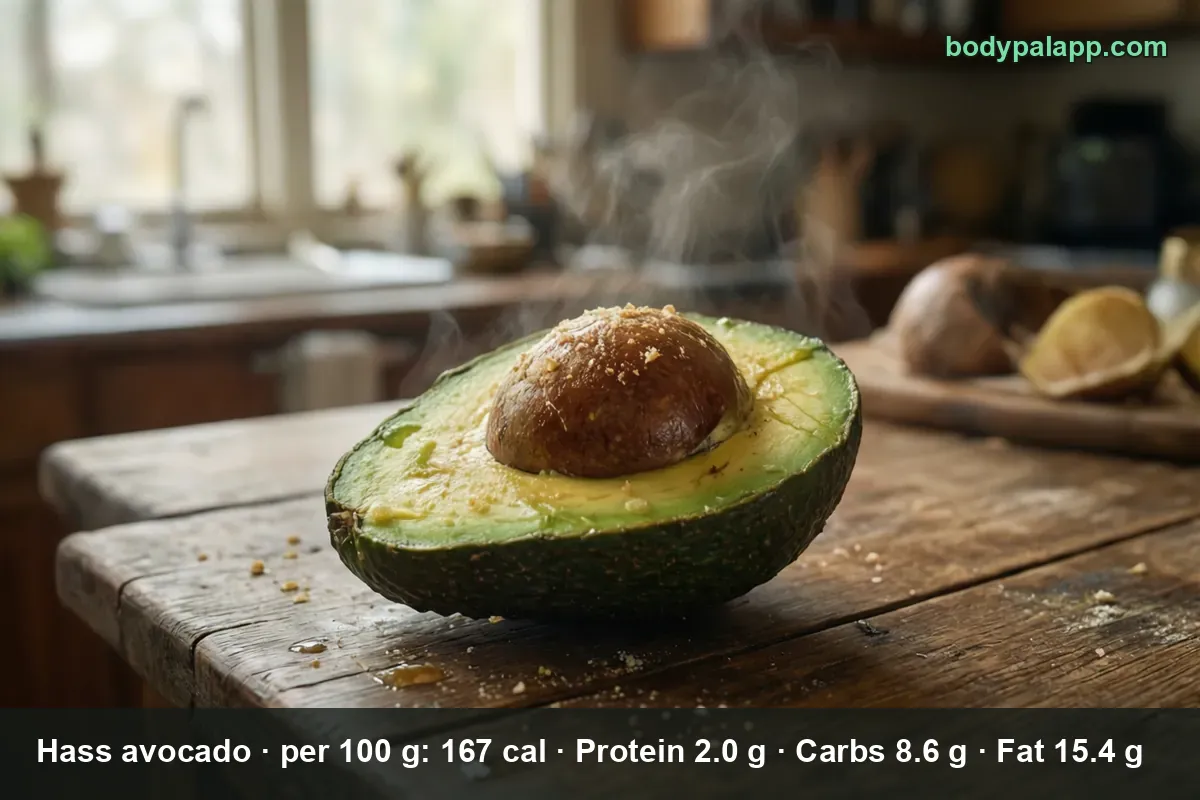
A whole Hass avocado is 227 calories once the skin and pit are gone: 136 g of flesh at 167 calories per 100 g. Half of one is 114. An ounce, roughly what fits on a slice of toast, is 47. And the figure most charts print for "an avocado" belongs to a different variety altogether.
On this page
- An ounce, a half, a whole one
- Hass avocado nutrition facts
- Hass, Florida and the fruit in the recipe
- Mashed avocado and the cup problem
- Guacamole is where the sodium arrives
- Fiber, potassium and the banana claim
- Hass avocado against the produce aisle
- Most popular hass avocado brands
- FAQ
An ounce, a half, a whole one
USDA weighs one Hass avocado at 136 g of edible flesh, skin and pit discarded, in its SR Legacy row for raw California avocado. California is the growing region that made Hass the default American avocado, and it is the row that describes the dark, pebbled fruit sold in every US grocery store.
| Serving | Weight | Calories |
|---|---|---|
| 1 oz, sliced | 28 g | 47 |
| Label serving, about a third of the fruit | 50 g | 84 |
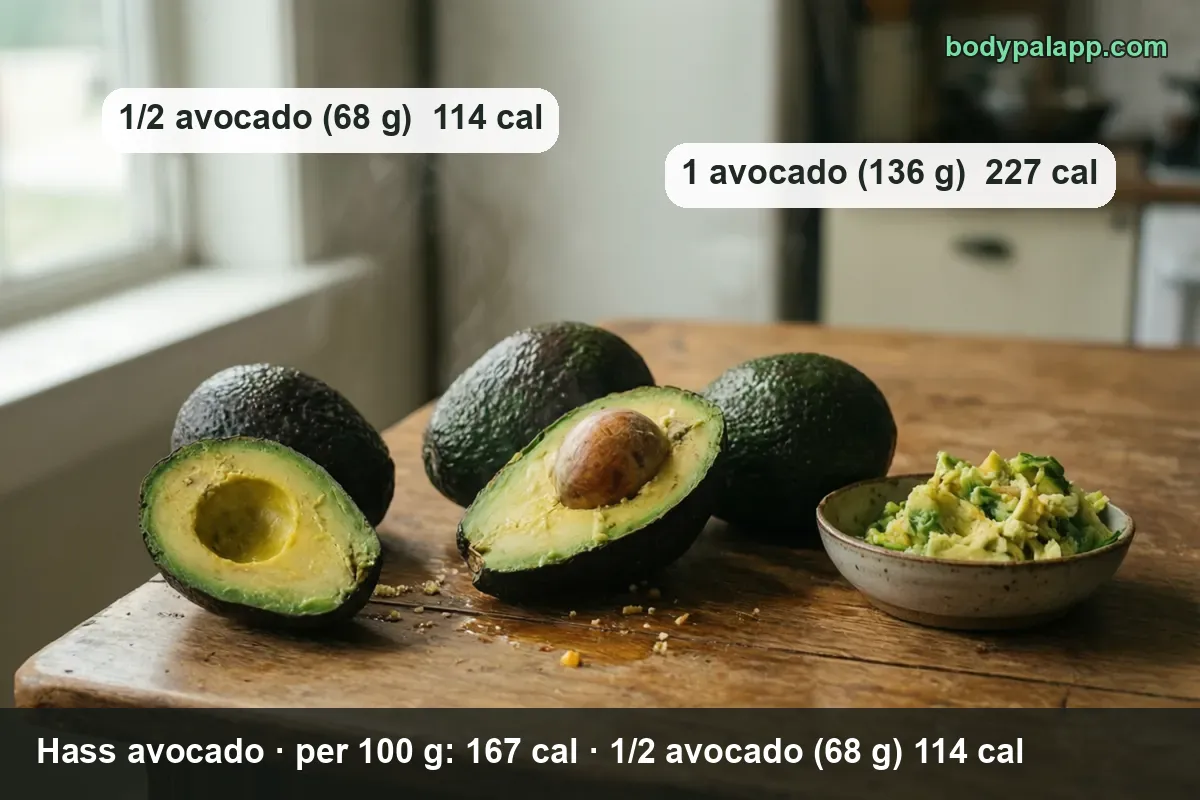
| Half an avocado | 68 g | 114 |
| One whole avocado | 136 g | 227 |
| 1 cup, mashed | 230 g | 384 |
The 50 g row is the one that quietly wrecks a food diary. That is the reference amount printed on packaged avocado labels, and it is about a third of the fruit. Nobody scoops a third of an avocado and puts the rest back in the refrigerator, so anyone logging "one serving" from a label is logging 84 calories against the 227 they actually ate.
Half is the honest unit here. USDA lists the 136 g fruit, so the 68 g half and its 114 calories are our own halving of that row. It is what a cut avocado gives you, it holds the pit for tomorrow, and at 114 calories it slots into a meal without much arithmetic.
Hass avocado nutrition facts
| Nutrient | Per 100 g | Per 1 avocado (136 g) | % Daily Value |
|---|---|---|---|
| Calories | 167 | 227 | – |
| Total fat | 15.41 g | 21.0 g | 27% |
| Saturated fat | 2.13 g | 2.9 g | 14% |
| Carbohydrate | 8.64 g | 11.8 g | 4% |
| Dietary fiber | 6.8 g | 9.2 g | 33% |
| Total sugars | 0.3 g | 0.4 g | – |
| Protein | 1.96 g | 2.7 g | 5% |
| Sodium | 8 mg | 11 mg | 0% |
| Potassium | 507 mg | 690 mg | 15% |
% Daily Value is based on a 2,000-calorie diet.
Verified nutrition data
Numbers on this page come from USDA FoodData Central, the U.S. Department of Agriculture’s food composition database, and from manufacturer labels where a branded product is named. Last verified September 2026. How we verify our data →
Two rows carry the whole table. Fat is 27% of the day in one fruit, which is why a Hass avocado is a calorie-dense food no matter how it is served. Fiber is 33%, which is why it does not behave like one.
The saturated share is small: 2.9 g out of 21 g of fat, or 14% of the Daily Value, with the rest almost entirely unsaturated. The Dietary Guidelines for Americans treat that split as the point of the food group rather than a footnote.
Sugar is the number that surprises people. A whole Hass avocado holds 0.4 g of total sugars, a rounding error on a nutrition label. It is a fruit that tastes rich and registers as almost nothing on the sugar line, and there is no added sugar row to report because raw fruit has none.
Hass, Florida and the fruit in the recipe
Three USDA rows answer to the word "avocado", and they are not close.
| USDA row | fdc_id | Calories, 100 g | One fruit | Calories |
|---|---|---|---|---|
| Hass, raw (California) | 171706 | 167 | 136 g | 227 |
| All commercial varieties, raw | 171705 | 160 | 201 g | 322 |
| Florida, raw | 171707 | 120 | 304 g | 365 |
Gram for gram, Hass is 39% heavier than a Florida avocado: 167 calories against 120. The Florida fruit is the smooth-skinned green one, larger and far more watery, and it carries 10.06 g of fat per 100 g where Hass carries 15.41. It also holds eight times the sugar, 2.42 g against 0.3 g, which is exactly what you would expect from more water and less oil.
Then the ranking flips. Per fruit, Florida wins the calorie count outright at 365, because a single one weighs 304 g. So a recipe that says "1 avocado" is asking for anything between 227 and 365 calories, and the label on the bin decides which.
The middle row deserves a warning. "All commercial varieties" at 160 calories per 100 g is a weighted blend of Hass and Florida fruit, useful when the variety is unknown and misleading when it is not. If the skin is dark and bumpy, use 167.
Mashed avocado and the cup problem
American recipes measure avocado in cups. American mouths eat it by the tablespoon. That gap is where the logging goes wrong.
USDA puts one cup of mashed or pureed avocado at 230 g, which is 384 calories with 35.4 g of fat and 15.6 g of fiber. That single cup is more than one and a half whole Hass avocados. Set it beside a 1 oz slice at 47 calories and the same food spans a factor of eight depending on which measuring tool is on the counter.
A packaged option makes it worse in a subtle way. One store-bought 100% Hass pulp in USDA's Branded database (fdc 520706) prints 60 calories on a 2 Tbsp (30 g) serving, which works back to 200 calories per 100 g rather than 167. That is label arithmetic rather than a denser avocado, but the practical effect is real: if you log the tub by its own label, use the tub's number, not the fruit's.
The rule that survives all of this is dull. Weigh, or count halves. A half is 68 g and 114 calories with no cup involved.
Guacamole is where the sodium arrives
Raw Hass avocado holds 8 mg of sodium per 100 g — 11 mg in a whole fruit, 0% of the Daily Value. It is one of the least salty things in the produce aisle.
Then it goes into a bowl. USDA's survey database lists guacamole, NFS at 344 mg of sodium per 100 g, which is 43 times the plain fruit. One individual container of guacamole, 70 g, carries 241 mg of sodium, about 10% of the FDA's 2,300 mg Daily Value. The same 70 g of plain avocado carries 5 mg.
Calories go the other way, which is the part nobody expects.
| Form | fdc_id | Calories, 100 g | Portion | Calories | Sodium |
|---|---|---|---|---|---|
| Hass avocado, raw | 171706 | 167 | 1/2 fruit (68 g) | 114 | 5 mg |
| Guacamole, NFS | 2709307 | 155 | 1 container (70 g) | 109 | 241 mg |
| Guacamole with tomatoes | 2709308 | 145 | 2 Tbsp (30 g) | 44 | 95 mg |
Guacamole is lighter than the fruit it is made from: 155 calories per 100 g against 167, and 145 once tomatoes join. Onion, tomato, lime and salt are mostly water, so they dilute the calories while adding sodium. A 2 Tbsp scoop of plain guacamole is 47 calories, our own scaling of the 100 g row rather than a USDA portion.
So the dip is not the calorie problem people assume it is. It is a sodium problem, and only if you eat the whole container.
Fiber, potassium and the banana claim
Half a Hass avocado delivers 4.6 g of fiber, 17% of the Daily Value, alongside 0.2 g of sugar. A medium banana, 118 g and 105 calories, gives 3.1 g of fiber and 14.4 g of sugar. Two fruits, two completely different jobs.
The potassium comparison is the one worth correcting. A whole Hass avocado holds 690 mg of potassium, 15% of the Daily Value, against 422 mg and 9% in a medium banana. Avocado wins that headline. It also costs 227 calories to the banana's 105, so per calorie the advantage disappears entirely. If potassium is the goal, the avocado is not a shortcut, it is simply a larger portion of food.
Where the fruit genuinely stands apart is fiber per gram of sugar: 9.2 g of fiber and 0.4 g of sugar in one whole avocado. That combination is rare enough in the fruit section that MyPlate counts it toward the daily fruit target while it behaves on a plate like a fat.
Hass avocado against the produce aisle
| Food | fdc_id | Calories, 100 g | US portion | Calories | P / C / F per 100 g |
|---|---|---|---|---|---|
| Hass avocado, raw | 171706 | 167 | 1 avocado (136 g) | 227 | 1.96 / 8.64 / 15.41 |
| Avocado, all commercial varieties | 171705 | 160 | 1 avocado (201 g) | 322 | 2.0 / 8.53 / 14.66 |
| Avocado, Florida, raw | 171707 | 120 | 1 fruit (304 g) | 365 | 2.23 / 7.82 / 10.06 |
| Guacamole, NFS | 2709307 | 155 | 1 container (70 g) | 109 | 1.95 / 8.45 / 14.18 |
| Banana, raw | 173944 | 89 | 1 medium (118 g) | 105 | 1.09 / 22.84 / 0.33 |
Our call: for the smallest number on that list, the banana takes it at 105 calories, and nothing about a Hass avocado will ever compete with a fruit that is 0.33 g of fat per 100 g. For anything you want to still be full an hour later, the half avocado is the better buy at 114 calories with 4.6 g of fiber, since half a banana gives you neither the fiber nor the staying power.
The Florida row is the trap in the table. It reads as the light option at 120 calories per 100 g and arrives as the heaviest item on the counter at 365 calories a fruit. Per 100 g flatters big watery produce; per fruit tells you what you ate.
Most popular hass avocado brands in the United States
Ranked by how widely each product appears among foods sold in the United States, from the BodyPal food database of over 3.3 million products. Calories are the figures printed on each Nutrition Facts label, checked against USDA FoodData Central.
| Product | Calories (per 100 g) |
|---|---|
| Wholly Avocado 100% Hand-Scooped Hass Avocados | 200 cal |
| Nature's Promise Organic Hass Avocados | 167 cal |
| Publix Hass Avocado Chunks | 157 cal |
| Wellsley Farms Hass Avocados | 160 cal |
Brand popularity: BodyPal food database. Nutrition: manufacturer labels / USDA FoodData Central.
Hass avocado FAQs
How many calories in a Hass avocado?
227 calories for one whole Hass avocado, which USDA weighs at 136 g of flesh without the skin and pit, at 167 calories per 100 g. Half is 114 calories and a 1 oz slice (28 g) is 47. The 50 g serving printed on packaged labels is 84 calories, about a third of the fruit.
How many calories in half a Hass avocado?
114 calories for half a Hass avocado, 68 g of flesh. That half carries 10.5 g of fat, 4.6 g of fiber and 0.2 g of sugar, so it is 17% of the Daily Value for fiber for a shade over a hundred calories. Half is the practical unit, since a cut avocado keeps better with the pit in the other side.
What are the nutrition facts for a Hass avocado?
One whole Hass avocado (136 g) holds 227 calories, 21.0 g of fat, 2.9 g of it saturated, 11.8 g of carbohydrate, 9.2 g of fiber, 0.4 g of sugars, 2.7 g of protein and 11 mg of sodium. Per 100 g that is 167 calories and 15.41 g of fat. Fiber is the standout at 33% of the Daily Value.
Hass or Florida avocado: which has fewer calories?
Per 100 g, Florida is lighter at 120 calories against 167 for Hass, because it holds more water and 10.06 g of fat instead of 15.41. Per fruit the answer reverses: a Florida avocado weighs 304 g and comes to 365 calories, while a whole Hass is 227. Florida also carries eight times the sugar, 2.42 g against 0.3 g per 100 g.
How much fiber is in a Hass avocado?
9.2 g in a whole Hass avocado and 4.6 g in half, from 6.8 g per 100 g. That puts one fruit at 33% of the 28 g Daily Value, next to 0.4 g of total sugars. A medium banana, by comparison, gives 3.1 g of fiber with 14.4 g of sugar.
How many calories in a cup of mashed avocado?
384 calories for one cup, which USDA weighs at 230 g of mashed or pureed Hass avocado, with 35.4 g of fat and 15.6 g of fiber. That is more than one and a half whole avocados in a single cup measure. A 2 Tbsp scoop of the same mash is closer to 50 calories.
Is guacamole higher in calories than plain avocado?
No — guacamole runs 155 calories per 100 g against 167 for raw Hass avocado, because tomato, onion and lime add water rather than energy. Sodium is the real difference: 344 mg per 100 g in guacamole against 8 mg in the fruit, so one 70 g container carries 241 mg, or 10% of the Daily Value.
Is Hass avocado good for weight loss?
It is calorie-dense at 167 per 100 g, so portion size decides the outcome. Half a Hass avocado is 114 calories and brings 4.6 g of fiber with almost no sugar, which makes it a reasonable fixture in a calorie target you are tracking. A whole one on top of a meal is 227 calories that are easy to forget to log.
Similar foods
- Medium Avocado — 227 cal per medium avocado
- Avocado (Hass) — 227 cal per avocado
- Avocado — 322 cal per avocado
- Cranberry Sauce — 111 cal for 1/4 cup
- Chocolate Dipped Strawberry — 57 cal per dipped strawberry
- Chocolate Covered Strawberry — 33 cal per chocolate-covered strawberry
Count it without the math
Point the camera at the half in your hand and BodyPal logs the calories, the fat and the fiber before you reach for the salt.


How long does it take to burn off a Hass avocado?
A whole avocado (136 g) is 227 kcal. Enter your weight and the amount you ate to see how long it takes you to burn that off:
lb
| Activity | Time to burn 227 kcal |
|---|---|
| Walking, brisk | 45 min |
| Cycling, moderate | 28 min |
| Swimming, moderate | 32 min |
| Jogging | 27 min |
| Weight training, moderate | 50 min |
Times are for a 155 lb adult at a steady pace; change the weight to see yours. The amount is set to the portion in the text (136 g); change it to what you actually ate. BodyPal works this out from your steps automatically.
One food is easy to picture; a whole day is harder. See how many calories you need a day and what a deficit actually looks like.