
How many calories are in a strip of bacon?
One medium strip of cooked pork bacon weighs 8 g and carries 37 calories. Cooked bacon runs 468 calories per 100 g, which sounds enormous until you remember how little a finished strip actually weighs. Three strips on a breakfast plate come to 112 calories. The fat is the headline; the sodium is the real story.
On this page
- Bacon strip quick facts
- US servings, from a thin strip to a full ounce
- Raw, oven-baked, microwaved and turkey bacon
- Sodium is the row that runs out first
- How does bacon compare?
- Most popular bacon strip brands
- FAQ
Bacon strip quick facts
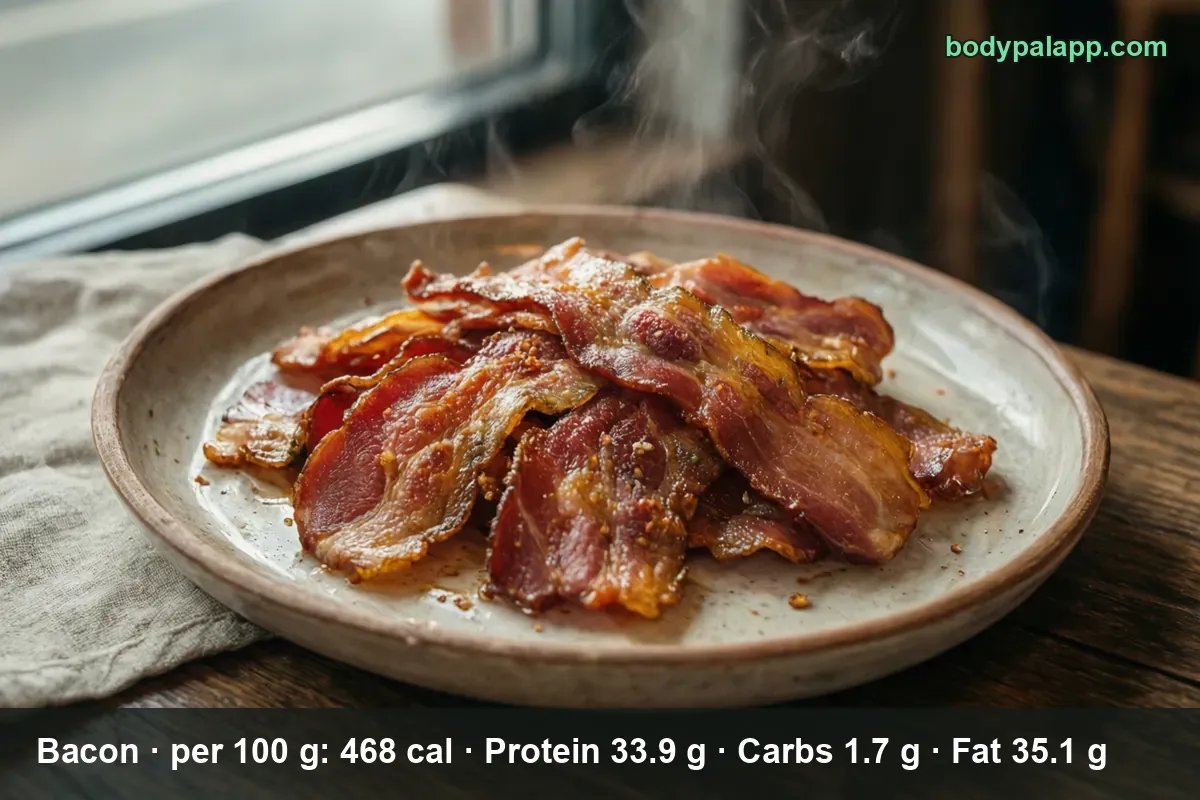
The record behind every number here is FNDDS 2705889, "Pork bacon, smoked or cured, cooked". That is the plain smoked or cured pork strip, cooked — the thing on the plate in the photo above, and the thing almost everyone means when they type "calories in bacon strip." The matching SR Legacy entry, 168322, pan-fried pre-sliced bacon, reports the identical profile, because it is the source measurement sitting underneath the FNDDS record. Only the FNDDS edition carries household measures for a thin, medium and thick slice, so that is the one worth quoting.
One point matters before you read the table: the 8 g is the weight of the strip after cooking, not the raw slice you pulled out of the package. A strip loses most of its water and a lot of its fat in the pan.
| Nutrient | Per 100 g | Per 1 medium slice (8 g) | % Daily Value |
|---|---|---|---|
| Calories | 468 | 37 | — |
| Total fat | 35.09 g | 2.8 g | 4% |
| Saturated fat | 11.964 g | 1.0 g | 5% |
| Carbohydrate | 1.7 g | 0.1 g | 0% |
| Dietary fiber | 0 g | 0 g | 0% |
| Total sugars | 0 g | 0 g | — |
| Protein | 33.92 g | 2.7 g | 5% |
| Sodium | 1684 mg | 135 mg | 6% |
% Daily Value is based on a 2,000-calorie diet.
Verified nutrition data
Numbers on this page come from USDA FoodData Central, the U.S. Department of Agriculture’s food composition database, and from manufacturer labels where a branded product is named. Last verified September 2026. How we verify our data →
Two rows you would see on a package label are missing here: added sugars and trans fat. The FNDDS edition does not publish either value for this record, so rather than guess, those lines stay off the table. Cholesterol and potassium are published: 99 mg and 499 mg per 100 g, which works out to 8 mg of cholesterol (3% DV) and 40 mg of potassium (1% DV) in a single medium strip. For the Daily Value figures behind those percentages, see the FDA's Daily Value reference.
US servings, from a thin strip to a full ounce
Bacon is one of the few foods where the household measure is genuinely useful, because nobody weighs it. USDA publishes three slice sizes, and the gap between them is wide enough to matter over a week of breakfasts.
| Serving | Weight | Calories |
|---|---|---|
| 1 thin slice, cooked | 5 g | 23 kcal |
| 1 medium slice, cooked | 8 g | 37 kcal |
| 1 thick slice, cooked | 12 g | 56 kcal |
| 3 medium slices | 24 g | 112 kcal |
| 1 oz, cooked | 28.35 g | 133 kcal |
| Per 100 g | 100 g | 468 kcal |
The three slice weights are USDA household measures for this record. The three-slice line and the ounce are our own arithmetic from the USDA 100 g figure, not USDA servings — three medium strips is simply 8 g times three.
Look at the top and bottom of the slice range. A thin strip and a thick strip differ by 33 calories, which is more than a whole thin strip. Thick-cut bacon is not a small upgrade; a three-strip plate of thick-cut lands at 168 calories against 112 for medium, again by our arithmetic from the 100 g value. If you cook bacon by the pan rather than by the slice, an ounce of finished strips — roughly three and a half medium ones — is the cleaner unit to log at 133 calories.
One thing bacon quietly does well: the ounce carries 9.6 g of protein. That is a real contribution for a food most people file under "treat," and it is why bacon shows up as a hunger-blunting add-on rather than a main event. MyPlate's protein foods guidance counts an ounce of cooked meat as one ounce-equivalent, so those strips are doing double duty.
Raw, oven-baked, microwaved and turkey bacon

Cooking method moves this food more than brand does. Here is what USDA records for each style, priced at a cooked ounce so the comparison is fair — except the raw row, which is priced at one raw slice.
| Version | Per 100 g | Typical piece | Calories |
|---|---|---|---|
| Raw (uncooked) bacon | 393 kcal | 1 slice raw, 28 g | 110 kcal |
| Pan-fried bacon (main record) | 468 kcal | 1 oz cooked, 28.35 g | 133 kcal |
| Microwaved bacon | 476 kcal | 1 oz cooked, 28.35 g | 135 kcal |
| Restaurant / diner bacon | 500 kcal | 1 oz cooked, 28.35 g | 142 kcal |
| Reduced-sodium bacon | 541 kcal | 1 oz cooked, 28.35 g | 153 kcal |
| Oven-baked bacon | 548 kcal | 1 oz cooked, 28.35 g | 155 kcal |
| Turkey bacon | 368 kcal | 1 oz cooked, 28.35 g | 104 kcal |
Raw versus cooked is the trap that ruins most people's bacon math. A raw slice weighs about 28 g and holds 110 calories. Cook it and it comes out around 8 g and 37 calories. The raw strip is lower in calories per 100 g — 393 against 468 — because it still holds water, but the piece in front of you shrinks roughly three and a half times, and the fat that left it is in the pan, not on your plate. Log the cooked strip, not the raw one.
Oven-baked bacon reads 17% higher per 100 g than pan-fried: 548 against 468. Nothing about the pork changed. Bacon on a sheet pan sits in its own rendered fat instead of letting it run off, so more of it stays in the strip. Microwaving does the opposite, driving fat out onto the paper towel and landing at 476 per 100 g with 39.01 g of protein per 100 g, well above the pan-fried record's 33.92 g.
Reduced-sodium bacon is not diet bacon. The USDA record cuts sodium from 1,684 mg to 1,030 mg per 100 g, about 39% less, while calories go up to 541 per 100 g. It is a swap for people managing blood pressure, not a swap for people managing calories.
Turkey bacon is the only cooked style here that comes in lighter than pan-fried pork: 368 calories per 100 g, 104 in a cooked ounce. Its sodium is worse, though — 2,021 mg per 100 g against pork's 1,684 mg. You trade calories for salt.
Store brands land where you would expect. Package labels from Hormel Black Label Thick Cut and Smithfield Single Sliced both come to 533 calories per 100 g, Sugardale and Patrick Cudahy to 500, Farmer John to 500 and Applegate Uncured Sunday Bacon to 429, all measured on cooked slices. All but Applegate's 429 sit at or above the USDA pan-fried record, so using 468 per 100 g is, if anything, the generous reading.
Sodium is the row that runs out first
Run the plate two ways. Three medium strips cost 112 calories — 6% of a 2,000-calorie day. The same three strips carry 404 mg of sodium, 18% of the 2,300 mg Daily Value, and 2.9 g of saturated fat, 14% of that day's limit. Bacon eats your sodium budget three times faster than it eats your calorie budget.
That ratio explains why bacon feels harmless on a food log and still causes trouble. Add two strips to a sandwich and you have spent 75 calories and 269 mg of sodium, both our own scaling from the USDA 100 g figure; the calories vanish into the day's noise while the salt stacks on top of bread, cheese and condiments that are already salty. The Dietary Guidelines for Americans put the sodium ceiling at 2,300 mg a day, and a diner side of bacon — four to five strips — can be a quarter to nearly a third of it before the eggs arrive.
If sodium is the number you watch, the reduced-sodium record is the honest lever, not portion-shaving. If calories are the number you watch, portion is everything: two thin strips at 46 calories flavor a plate about as effectively as two thick ones at 112.
How does bacon compare?
| Bacon record | Per 100 g | US serving | Calories |
|---|---|---|---|
| Pork bacon, cooked (main) | 468 kcal | 1 medium slice, 8 g | 37 kcal |
| Pork bacon, unprepared | 393 kcal | 1 slice raw, 28 g | 110 kcal |
| Bacon, NS as to type of meat, cooked | 484 kcal | 1 medium slice, 8 g | 39 kcal |
| Bacon, NS as to type of meat, reduced sodium, cooked | 253 kcal | 1 medium slice, 8 g | 20 kcal |
Our take: for logging purposes, the pork record at 37 calories a strip is the number to use, and the "NS as to type of meat" record at 39 is close enough that guessing which one applies is not worth the effort. The reduced-sodium FNDDS entry is the outlier — 253 calories per 100 g, roughly half the main record, because it pools leaner mixed-meat products under one code. Do not reach for it unless the package in your hand actually says reduced sodium. And treat the raw row as a warning label: 110 calories per slice is what the package implies, 37 is what ends up on the plate.
Most popular bacon strip brands in the United States
Ranked by how widely each product appears among foods sold in the United States, from the BodyPal food database of over 3.3 million products. Calories are the figures printed on each Nutrition Facts label, checked against USDA FoodData Central.
| Product | Calories (per 100 g) |
|---|---|
| Hormel Black Label Thick Cut Bacon | 533 cal |
| Smithfield Single Sliced Smoked Bacon | 533 cal |
| Sugardale Hickory Smoked Bacon | 500 cal |
| Patrick Cudahy Applewood Smoked Bacon | 500 cal |
| Farmer John Premium Bacon | 500 cal |
| Applegate Uncured Sunday Bacon | 429 cal |
Brand popularity: BodyPal food database. Nutrition: manufacturer labels / USDA FoodData Central.
Bacon strip FAQs
How many calories are in one strip of bacon?
37 calories in one medium cooked strip weighing 8 g, based on USDA's cooked pork bacon record at 468 calories per 100 g. A thin strip is 23 calories at 5 g, a thick-cut strip 56 calories at 12 g. That 8 g is the cooked weight, after the fat and water have rendered out.
How many calories in 2 slices of bacon?
75 calories for two medium cooked strips, 16 g together, scaled by our own arithmetic from the USDA 100 g figure. They also bring 5.4 g of protein and 269 mg of sodium, which is 12% of the 2,300 mg Daily Value. Two thick-cut strips would run 112 calories instead.
How many calories in 3 strips of bacon?
112 calories for three medium cooked strips, 24 g in total. That is only 6% of a 2,000-calorie day, but the same three strips carry 404 mg of sodium, 18% of the daily limit, plus 2.9 g of saturated fat, 14% of that limit, and 8.1 g of protein.
Is bacon high in protein?
Cooked bacon is 33.92 g of protein per 100 g, which is a high concentration, but one 8 g strip delivers only 2.7 g, or 5% of the Daily Value. A full cooked ounce gets you 9.6 g. Bacon is protein-dense by weight and protein-light by serving, because the servings are tiny.
How much sodium is in a slice of bacon?
135 mg of sodium in one medium cooked strip, 6% of the 2,300 mg Daily Value, from USDA's 1,684 mg per 100 g. That is roughly a sixteenth of a teaspoon of table salt per strip. Four strips reach 539 mg, and the sodium adds up faster than the calories do.
Does baking bacon have more calories than frying it?
Yes, by 17% per 100 g: USDA lists oven-baked bacon at 548 calories per 100 g against 468 for pan-fried. A cooked ounce is 155 calories baked, 133 fried. Bacon on a sheet pan sits in its own rendered fat, while a skillet lets more of that fat run off the strip.
How many calories in raw bacon vs cooked bacon?
Raw bacon is 393 calories per 100 g and cooked is 468, but the piece tells the opposite story. One raw slice weighs about 28 g and holds 110 calories; cooked, that same slice is around 8 g and 37 calories. It shrinks roughly three and a half times, so log the cooked strip.
Is turkey bacon lower in calories than pork bacon?
Yes: turkey bacon is 368 calories per 100 g against 468 for cooked pork, so a cooked ounce is 104 calories instead of 133. Sodium goes the other way, though, at 2,021 mg per 100 g versus 1,684 mg for pork. You save about 22% of the calories and pay for it in salt.
Similar foods
- Cooked Bacon — 54 cal per slice
- Bacon Fried — 54 cal per slice
- Beef Short Rib With The Bone — 1060 cal per braised short rib, meat only
- Crispy Chicken Skin — 129 cal per oz
- Bacon — 77 cal for 2 slices
- Landjaeger — 210 cal per stick
Count it without the math
Point the camera at the plate and BodyPal counts the strips for you, thick-cut or thin.


How long does it take to burn off a bacon strip?
One medium slice (8 g) is 37 kcal. Enter your weight and the amount you ate to see how long it takes you to burn that off:
lb
| Activity | Time to burn 37 kcal |
|---|---|
| Walking, brisk | 7 min |
| Cycling, moderate | 5 min |
| Swimming, moderate | 5 min |
| Jogging | 4 min |
| Weight training, moderate | 8 min |
Times are for a 155 lb adult at a steady pace; change the weight to see yours. The amount is set to the portion in the text (8 g); change it to what you actually ate. BodyPal works this out from your steps automatically.
Burning it off is one side of it. The other is knowing your number: work out how many calories you need a day, with macros and a goal date.