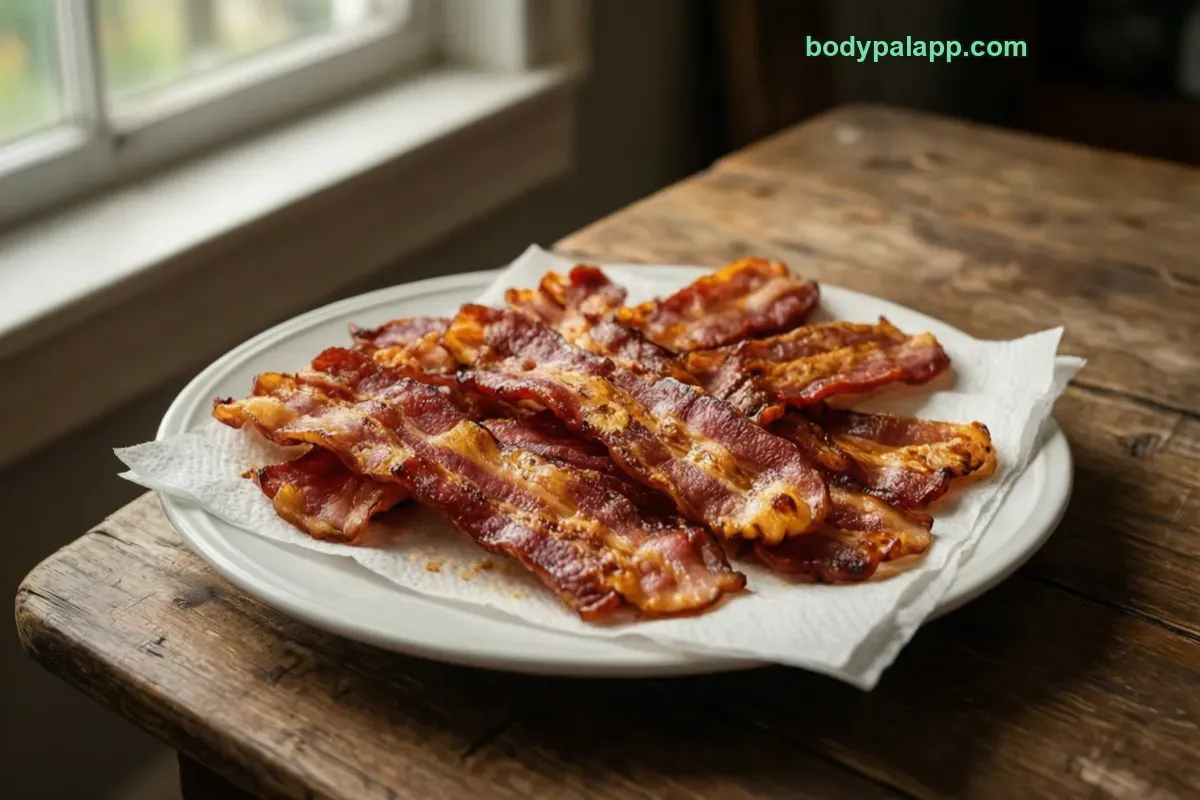
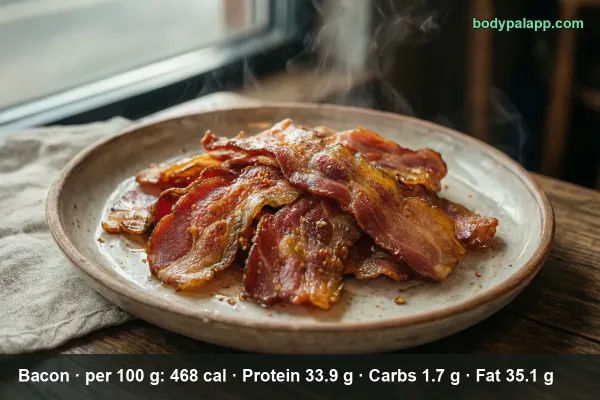
Cooked bacon calories come to 54 for one pan-fried slice (11.5 g) and 468 per 100 g. The thing to notice is the split: fat supplies 69% of those calories, and each slice also carries 194 mg of sodium. One strip is a small number. A plateful is not, because the total climbs with every slice you add.
54kcal
1 slice · 11 g, pre-sliced, pan-fried
30%protein
3.9 gProtein
0 gCarbs
4 gFat
How to burn off 54 kcal
—Walking, brisk
—Jogging
—Cycling, moderate
—Swimming
Skip the math. BodyPal counts these calories from your steps and workouts automatically.
Nutrition facts
Pre-sliced, pan-fried · per 11 g
Calories
54 kcal
Protein
3.9 g
Carbohydrate
0.2 g
Fat
4 g
Saturated fat
1.4 g
Cholesterol
11 mg
Sodium
194 mg
Potassium
57 mg
Iron
0.1 mg
Source: USDA FoodData Central
🛡️
Verified nutrition data
Numbers on this page come from USDA FoodData Central, the U.S. Department of Agriculture’s food composition database, and from manufacturer labels where a branded product is named. Last verified September 2026. How we verify our data →
Cooked bacon: calories, protein and sodium by serving
Percent of daily value uses the FDA reference of 2,000 kcal a day.
Serving
kcal
Protein
Carbs
Fat
Sodium
% DV kcal
1 slice (11.5 g)
54
3.9 g
0.2 g
4 g
194 mg
3%
100 g
468
33.9 g
1.7 g
35.1 g
1,684 mg
23%
3 oz portion (85 g)
398
28.8 g
1.4 g
29.8 g
1,431 mg
20%
Turkey, 1 slice (11 g)
40
3.2 g
0.5 g
2.8 g
222 mg
2%
3 × 1 slice (11.5 g)
161
11.7 g
581 mg
5 × 1 slice (11.5 g)
269
19.5 g
968 mg
Three slices make a 161-calorie side
A single pan-fried slice weighs about 11.5 g and lands at 54 calories, roughly 3% of a standard daily value. That looks harmless, and on its own it is. The catch is that almost nobody stops at one strip.
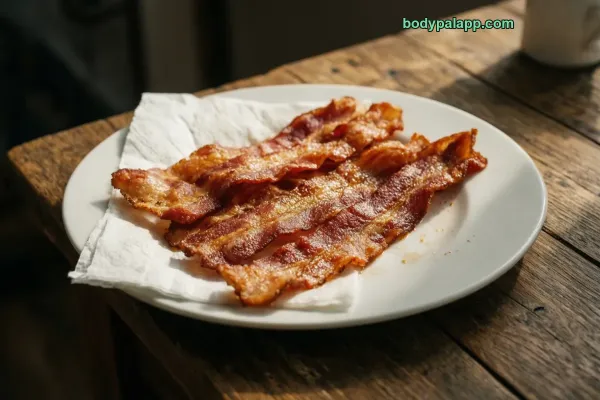
Two slices (23 g) come to 108 calories. Three slices (35 g) reach 161 calories with 11.7 g of protein, which is the most common diner-style side. Five slices (58 g), the kind of pile that ends up on a loaded breakfast plate or a club sandwich, add up to 269 calories and 19.5 g of protein. Every extra strip adds about the same 54 calories, so counting slices is the easiest way to track it.
The 3 oz portion (85 g) is where bacon stops being a garnish. It totals 398 calories, about 20% of the daily value, plus 28.8 g of protein and 29.8 g of fat. If you weigh food, that is the number to keep in mind when bacon is the main protein of a meal rather than a topping. If you would rather not weigh it, BodyPal can log bacon from a photo of the plate.
Fat supplies more than two thirds of the calories
Per 100 g, cooked bacon has 35.1 g of fat, 33.9 g of protein and only 1.7 g of carbs. In calorie terms that works out to 69% fat, 30% protein and 1% carbs. Sugars and fiber both read 0. This is a fat food with a solid protein side, not a protein food with a little fat.
Per slice the numbers are small: 4 g of fat, 3.9 g of protein and 0.2 g of carbs. That protein covers about 8% of the daily value, which is a fair return for 54 calories. Still, the fat grams run slightly ahead of the protein grams in every serving, and fat carries more calories per gram, so the calorie count follows the fat.
Saturated fat sits at 12 g per 100 g, and cholesterol at 99 mg. For a low-carb plan bacon fits neatly, since carbs barely register. For anyone tracking fat or calories closely, the strip count matters more than the cooking style.
Sodium is the row to watch
Bacon is cured, and the salt shows. Per 100 g it carries 1,684 mg of sodium, which is 73% of the daily value. Calories at the same weight cover only 23% of the daily value, so sodium runs about three times ahead of energy on a percentage basis.
One slice brings 194 mg, or 8% of the daily value. Three slices bring 581 mg and five slices 968 mg. A 3 oz portion reaches 1,431 mg, about 62% of the daily value in a single serving, before toast, cheese or anything else salty joins the plate.
If you watch sodium, the practical move is to cap the strip count and keep the rest of the meal low in salt. Fresh eggs, fruit, plain potatoes or vegetables leave room for the bacon. Pairing it with cured ham, sausage or processed cheese stacks sodium quickly. Bacon also brings 499 mg of potassium per 100 g, though that does not cancel out the salt.
Bacon works best as a flavor, not the base
Because a little bacon tastes like a lot, it does its best work as an accent. Two crumbled slices at 108 calories can season a salad, a bowl of beans or a pan of greens, giving smoky flavor and 7.8 g of protein without dominating the calorie count.
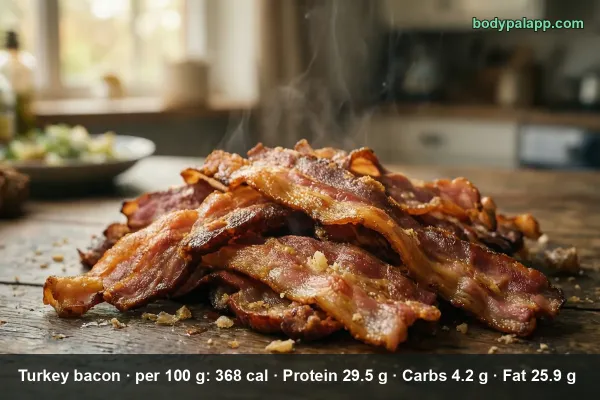
Turkey bacon is the usual swap. A turkey slice (11 g) has 40 calories, 3.2 g of protein and 2.8 g of fat, so it saves some calories per strip. It does not save salt: that slice holds 222 mg of sodium, 10% of the daily value, which is more than the pork slice. Brands such as Butterball and Oscar Mayer sell turkey versions, including lower sodium lines, so read the label if salt is your concern.
For a breakfast that stays balanced, build around bacon instead of on top of it. Eggs, whole-grain toast and fruit fill the plate, and three slices of bacon at 161 calories add flavor and protein. Doubling the bacon is where the totals for calories, fat and sodium jump.
How does cooked bacon compare?
This table compares cooked bacon with bacon strips, fried bacon and turkey bacon per 100 g and per usual serving.
Verdict: Bacon strip and fried bacon match cooked bacon at 468 calories per 100 g, so the name on the label changes nothing. For fewer calories pick turkey bacon at 368 per 100 g, but if you watch sodium stay with pork bacon, since turkey bacon carries 2,021 mg per 100 g against 1,684 mg.
Most popular cooked bacon brands in the United States
Ranked by popularity in the BodyPal database
# Productkcal / 100 g
1Butterball Original Turkey Bacon1 slice · 14 g179 kcal
Every labeled product here is turkey bacon, which is leaner than pork bacon, and most labels use the slice weight before frying, so they read lower than the 468 calories per 100 g above. Source: manufacturer labels / USDA FoodData Central.
Cooked bacon FAQs
How many calories are in one slice of cooked bacon?
About 54 calories for one pan-fried slice (11.5 g). Three slices come to 162 calories.
Is cooked bacon good for weight loss?
Bacon is calorie-dense at 468 calories per 100 g, but a slice is small: two slices are 108 calories with 7.8 g protein, while a 3 oz portion (85 g) is 398 calories.
Cooked bacon or turkey bacon: which has fewer calories?
Turkey bacon has 368 calories per 100 g against 468 for pork bacon. Per slice that is 40 calories (11 g) versus 54 calories (11.5 g).
How much protein is in cooked bacon?
33.9 g of protein per 100 g, or about 3.9 g in one slice, alongside 35.1 g of fat per 100 g.
What are the macros in one slice of bacon?
One pan-fried slice (11.5 g) has 3.9 g of protein, 4 g of fat and 0.2 g of carbs, for 54 calories. By calories, fat supplies 69%, protein 30% and carbs 1%.
How many calories are in 100 grams of bacon?
100 g of cooked bacon has 468 calories, with 33.9 g of protein, 35.1 g of fat and 1.7 g of carbs. That serving also carries 1,684 mg of sodium, 73% of the daily value.
What are the nutrition facts for a slice of bacon?
A slice of cooked bacon has 54 calories, 194 mg of sodium (8% of the daily value) and 0 g of sugars. It also gives 3.9 g of protein, 8% of the daily value, and 4 g of fat.
How many calories are in a 3 oz portion of pork bacon?
A 3 oz portion (85 g) of cooked pork bacon has 398 calories, about 20% of the daily value. It brings 28.8 g of protein, 29.8 g of fat and 1,431 mg of sodium.
How many calories are in five slices of bacon?
Five slices of cooked bacon (58 g) come to 269 calories. They provide 19.5 g of protein and 968 mg of sodium, so the salt adds up faster than the calories.