
How many calories are in turkey bacon?
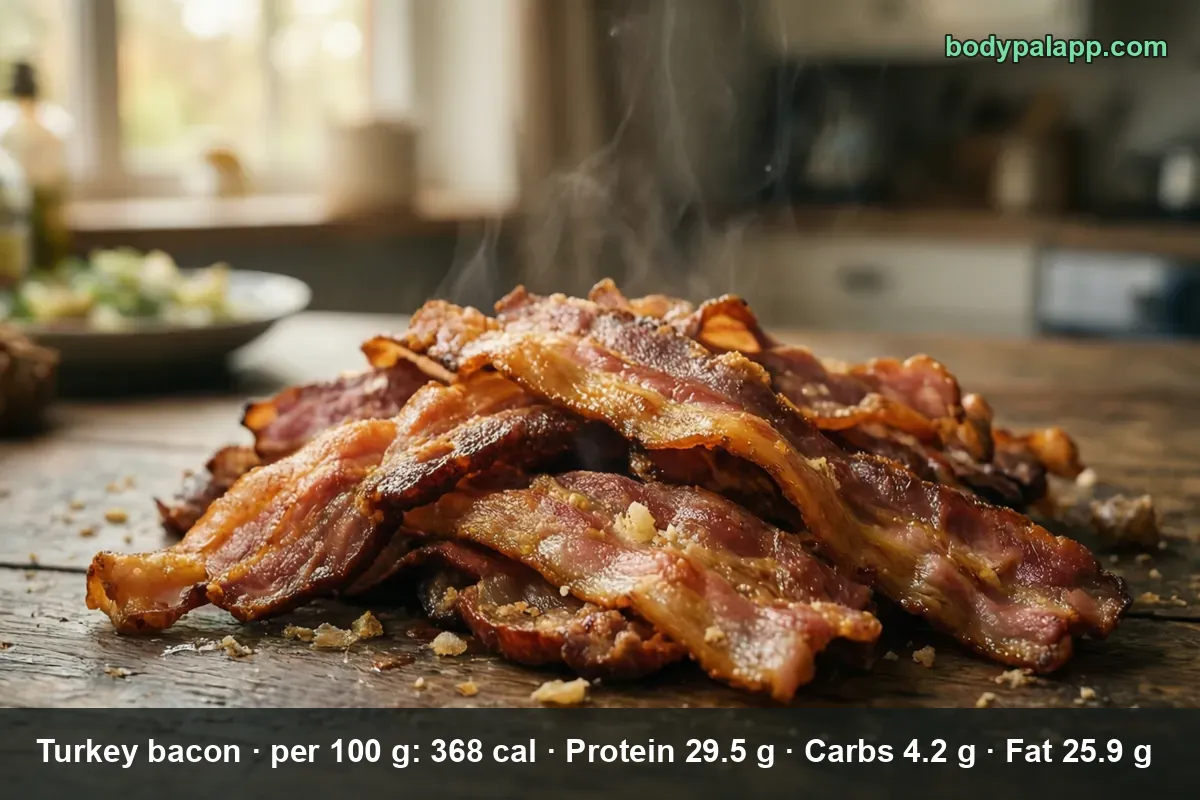
Two cooked slices of turkey bacon weigh 22 g and carry 81 calories. Per 100 g, cooked turkey bacon runs 368 calories, higher than the package label suggests, because frying drives off water and concentrates what is left. One medium slice is 40 calories. The number that surprises people, though, is the sodium: 445 mg in those two slices.
On this page
- Turkey bacon quick facts
- US servings, from one thin slice to a cup of pieces
- Reduced-sodium, pork, beef and package slices
- Why the package says 25 calories and USDA says 40
- Sodium is the row to watch
- How does turkey bacon compare?
- Most popular turkey bacon brands
- Turkey bacon FAQs
Turkey bacon quick facts
The record behind every number on this page is FNDDS 2706135, "Turkey bacon, cooked". It is the cooked entry, and that matters: almost nobody eats turkey bacon straight from the package, so the figure that belongs on your log is the one for strips that have already been in the pan.
The reduced-sodium product sits in its own record and gets its own section further down. It is a different formulation, not a different way of measuring the same food, so the two are never averaged together here.
| Nutrient | Per 100 g | Per 2 slices, cooked (22 g) | % Daily Value |
|---|---|---|---|
| Calories | 368 | 81 | — |
| Total fat | 25.87 g | 5.7 g | 7% |
| Saturated fat | 6.93 g | 1.5 g | 8% |
| Carbohydrate | 4.24 g | 0.9 g | 0% |
| Dietary fiber | 0 g | 0 g | 0% |
| Total sugars | 4.24 g | 0.9 g | — |
| Protein | 29.5 g | 6.5 g | 13% |
| Sodium | 2021 mg | 445 mg | 19% |
% Daily Value is based on a 2,000-calorie diet.
Verified nutrition data
Numbers on this page come from USDA FoodData Central, the U.S. Department of Agriculture’s food composition database, and from manufacturer labels where a branded product is named. Last verified September 2026. How we verify our data →
Two more rows are worth knowing: cholesterol comes to 34 mg per two slices, 11% of the Daily Value, and potassium to 147 mg, about 3%. USDA does not publish added sugars or trans fat for this cooked turkey bacon record, so those two rows are simply absent rather than zero. The small sugar figure, 0.9 g in a serving, is cure and glaze, not something added at the table.
US servings, from one thin slice to a cup of pieces
| Serving | Weight | Calories |
|---|---|---|
| 1 thin slice, cooked | 8 g | 29 kcal |
| 1 medium slice, cooked | 11 g | 40 kcal |
| 2 medium slices, cooked | 22 g | 81 kcal |
| 1 oz, cooked | 28.35 g | 104 kcal |
| 1 cup, pieces | 82 g | 302 kcal |
| Per 100 g | 100 g | 368 kcal |
Every weight in that table is a USDA household measure for this record, so the calorie column is a straight scaling of the 100 g figure rather than an invented portion. The one to treat with care is the cup. Crumbled turkey bacon packs densely, and 82 g of it is 302 calories, roughly the same as seven or eight medium cooked slices. On a salad, a tablespoon or two is the realistic amount.
Thickness moves the number more than anything else in your control. A thin slice at 8 g and a medium one at 11 g are 29 and 40 calories, a 38% spread on the same food. If your brand runs thick-cut, weigh a couple of cooked strips once and you will have a number you can reuse every morning.
Reduced-sodium, pork, beef and package slices
| Version | Per 100 g | Typical serving | Calories |
|---|---|---|---|
| Turkey bacon, cooked (this page) | 368 kcal | 2 medium slices (22 g) | 81 kcal |
| Reduced-sodium turkey bacon, cooked | 253 kcal | 2 slices (22 g) | 56 kcal |
| Pork bacon, smoked or cured, cooked | 468 kcal | 1 oz (28.35 g) | 133 kcal |
| Beef bacon, cooked | 449 kcal | 1 oz (28.35 g) | 127 kcal |
| Bacon, type not specified, cooked | 484 kcal | 1 oz (28.35 g) | 137 kcal |
| Butterball original, raw package slice | 179 kcal | 1 slice (14 g) | 25 kcal |
| Oscar Mayer original, raw package slice | 233 kcal | 1 slice (15 g) | 35 kcal |
Reduced-sodium turkey bacon is the genuine outlier at 253 calories per 100 g, and two slices land at 56. It also carries 900 mg of sodium per 100 g instead of 2,021, which is the whole point of the product. The trade is protein: 13.33 g per 100 g against 29.5 g for the standard cooked record, less than half. A wetter, lower-salt cure loses less water in the pan, and everything else in the strip is diluted along with it.
The other meats are the reason people buy turkey bacon in the first place. Cooked pork bacon is 468 calories per 100 g and beef bacon 449, so turkey undercuts pork by about 21% by weight. Saturated fat separates them more sharply than calories do: 6.93 g per 100 g for turkey against 12.13 g for pork and 14.2 g for beef, close to double for pork and just over double for beef.
The last two rows are label numbers from the freezer aisle, printed for a raw slice from the package. Butterball's original reads 25 calories on a 14 g slice and Oscar Mayer's 35 on a 15 g slice. They are not wrong, and they are not comparable to the cooked figures above them.
Why the package says 25 calories and USDA says 40
This is the gap that makes people think one of the two sources is lying. Neither is. The label counts a slice before it hits the pan; USDA counts meat that has already cooked. Water leaves, calories do not, so every remaining gram carries more of them.
The arithmetic closes the gap nicely. Take Butterball's 14 g raw slice at 25 calories. If it loses about half its weight in the pan, which is ordinary for a cured strip, you are left with roughly 7 g still holding 25 calories, and that works out to about 357 calories per 100 g, within a hair of USDA's 368. That last step is our own arithmetic from the label figure, not a USDA serving, but it shows the two numbers describing the same food from different sides.
There is a second consequence worth carrying to the kitchen scale. It takes about nine cooked medium slices to reach 100 g, but only about seven raw package slices, because the raw ones are heavier. Log by count and you will drift. Log by weight, cooked, and you will not.
Sodium is the row to watch
Two slices supply 445 mg of sodium, 19% of the Daily Value, for 81 calories. Four slices, still only 162 calories, reach 889 mg, or 39%. The Dietary Guidelines for Americans put the limit for adults at 2,300 mg a day, the same figure the FDA uses for the Daily Value on the Nutrition Facts label. A breakfast side has taken almost two fifths of it before the eggs and the toast.
Here is the part that rarely gets said out loud: per ounce, turkey bacon is the saltier meat. One cooked ounce carries about 573 mg of sodium against roughly 487 mg for the same weight of pork bacon, both scaled by us from the USDA 100 g figures. Swapping pork for turkey buys you fewer calories and less saturated fat, but not less salt. If sodium is what you are managing, the reduced-sodium record at 900 mg per 100 g is the switch that actually does something.
The protein side is the good news. Those two slices bring 6.5 g, 13% of the Daily Value, and three slices 9.7 g. As a protein food in the sense MyPlate uses the term, turkey bacon earns its place at breakfast, provided it is a side and not the main event.
How does turkey bacon compare?
| Bacon | Per 100 g | US serving | Calories |
|---|---|---|---|
| Turkey bacon, cooked | 368 kcal | 1 oz, cooked (28.35 g) | 104 kcal |
| Pork bacon, smoked or cured, cooked | 468 kcal | 1 oz, cooked (28.35 g) | 133 kcal |
| Beef bacon, cooked | 449 kcal | 1 oz, cooked (28.35 g) | 127 kcal |
| Reduced-sodium turkey bacon, cooked | 253 kcal | 1 oz, cooked (28.35 g) | 72 kcal |
Our take: the swap from pork to turkey is real but modest, worth 29 calories an ounce and just over half the saturated fat, and the only record in this table under 300 calories per 100 g is the reduced-sodium turkey. If you are counting calories, two or three cooked slices at 81 to 121 is an easy, high-protein side that fits almost any target. If you are watching blood pressure or salt, the ordinary product is the worst pick on the table per ounce, and the reduced-sodium version is the one to reach for. Turkey bacon is a calorie win, not a sodium win.
Most popular turkey bacon brands in the United States
Ranked by how widely each product appears among foods sold in the United States, from the BodyPal food database of over 3.3 million products. Calories are the figures printed on each Nutrition Facts label, checked against USDA FoodData Central.
| Product | Calories (per 100 g) |
|---|---|
| Butterball Original Turkey Bacon | 179 cal |
| Butterball Lower Sodium Turkey Bacon | 179 cal |
| Butterball Thin & Crispy Original Turkey Bacon | 194 cal |
| Oscar Mayer Original Turkey Bacon | 233 cal |
| Oscar Mayer Turkey Bacon | 222 cal |
| Jennie-O Turkey Bacon | 200 cal |
Brand popularity: BodyPal food database. Nutrition: manufacturer labels / USDA FoodData Central.
Turkey bacon FAQs
How many calories are in 2 slices of turkey bacon?
Two medium cooked slices weigh 22 g and come to 81 calories, using USDA's cooked turkey bacon record at 368 calories per 100 g. That pair also carries 6.5 g of protein and 445 mg of sodium, which is 19% of the Daily Value. Thin slices run lighter, around 29 calories each.
How many calories are in 1 slice of turkey bacon?
One medium cooked slice weighs 11 g and holds 40 calories. A thin slice at 8 g is 29 calories. Brand labels list lower numbers, and Butterball prints 25 calories per slice, because those are raw slices straight from the package, before frying removes water and shrinks the strip.
Is turkey bacon lower in calories than pork bacon?
Yes, but by less than most people expect: 368 calories per 100 g cooked against 468 for cooked pork bacon, about 21% lower. Slice for slice the gap looks bigger, since turkey strips are thinner. One ounce of cooked turkey bacon is 104 calories; one ounce of pork bacon is 133.
How much protein is in turkey bacon?
29.5 g per 100 g cooked, which works out to 6.5 g in two medium slices, or 13% of the Daily Value for 81 calories. That is a strong protein-to-calorie ratio for a breakfast meat. Three slices push it to 9.7 g. Reduced-sodium turkey bacon is a different product: 13.33 g per 100 g, less than half.
How much sodium is in turkey bacon?
445 mg in two cooked slices, 19% of the 2,300 mg Daily Value. Four slices reach 889 mg, or 39%, for only 162 calories. Per ounce, turkey bacon carries about 573 mg against roughly 487 mg for pork bacon, so the leaner meat is actually the saltier one.
Why does the package say fewer calories than USDA?
Because labels count a raw slice and USDA counts cooked meat. Butterball lists 25 calories for a 14 g raw slice; USDA's cooked record is 368 calories per 100 g. Frying removes water, not calories, so the same strip weighs less afterward and every gram counts for more. Weigh what lands on your plate, then use the cooked figure.
Is turkey bacon healthy for weight loss?
Two slices at 81 calories with 6.5 g of protein fit almost any calorie target, so the calories are rarely the problem. Sodium is: those same two slices are 19% of a day's limit. If you're watching salt, keep it to two or three slices, or switch to the reduced-sodium version at 900 mg per 100 g.
How many calories are in a cup of turkey bacon pieces?
One cup of cooked turkey bacon pieces weighs 82 g and holds 302 calories, a USDA household measure. Scaling the 100 g figures, that cup also carries about 1,657 mg of sodium, 72% of the Daily Value, which is why crumbled turkey bacon belongs on a salad by the tablespoon.
Similar foods
- Summer Sausage — 203 cal for 4 slices
- Beef Back Ribs — 306 cal for 3 oz cooked
- Salami — 102 cal for 3 slices
- Beer Brat — 240 cal per brat
- Pork Chorizo — 278 cal per link, medium
- Chorizo — 256 cal per link
Count it without the math
Point the camera at the plate and BodyPal counts the strips for you, thin-cut or thick.


How long does it take to burn off turkey bacon?
Two cooked slices (22 g) is 81 kcal. Enter your weight and the amount you ate to see how long it takes you to burn that off:
lb
| Activity | Time to burn 81 kcal |
|---|---|
| Walking, brisk | 16 min |
| Cycling, moderate | 10 min |
| Swimming, moderate | 12 min |
| Jogging | 10 min |
| Weight training, moderate | 18 min |
Times are for a 155 lb adult at a steady pace; change the weight to see yours. The amount is set to the portion in the text (22 g); change it to what you actually ate. BodyPal works this out from your steps automatically.
Burning it off is one side of it. The other is knowing your number: work out how many calories you need a day, with macros and a goal date.