
How Many Calories Are in Salami?
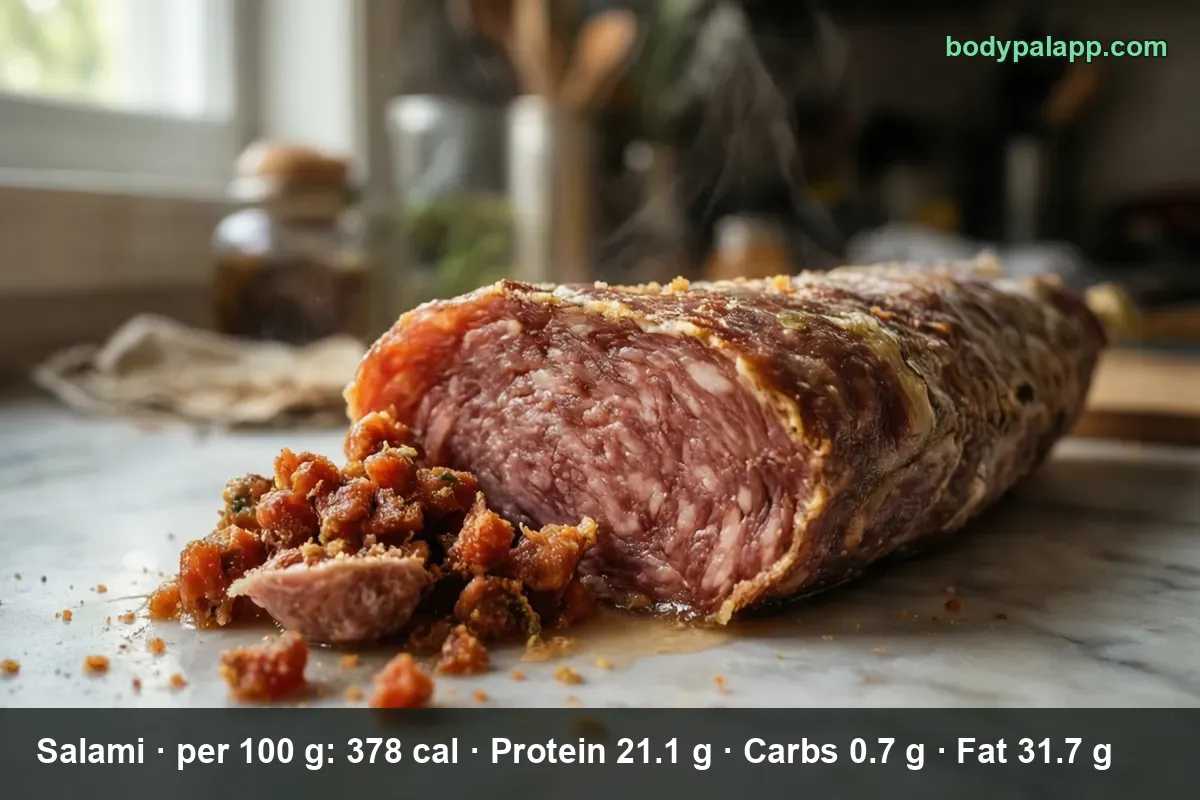
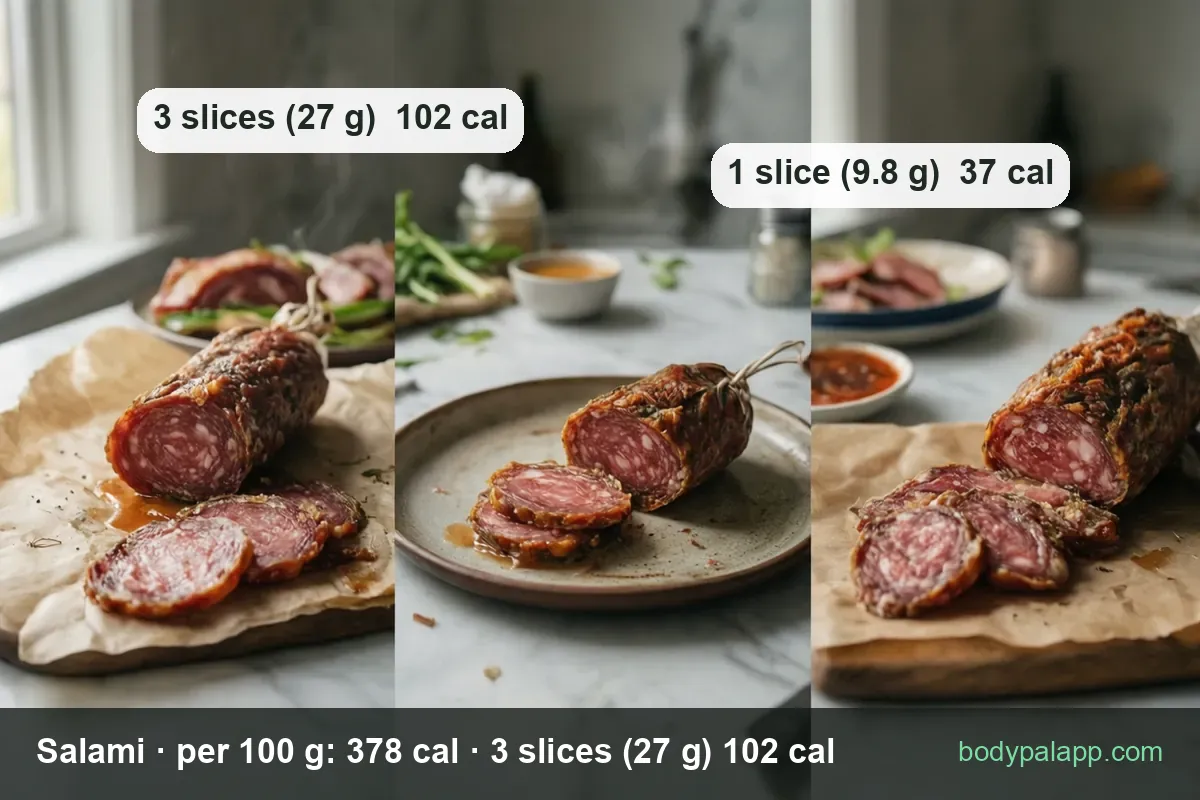
Three slices of dry salami — 27 g — are 102 calories, at 378 per 100 g. One thin slice is 37. An ounce is 106, and an ounce of salami is roughly three slices, not one. The calories in salami track how dry the sausage is: Genoa 425 per 100 g, turkey 172.
On this page
- Salami quick facts
- The slice is not a fixed unit
- Salami servings, slice by slice
- Genoa, hard, cotto and turkey
- Sodium is the number that runs out first
- The protein per calorie test
- How does salami compare?
- Most popular salami brands
- FAQ
Salami quick facts
The line behind every figure here is SR Legacy 174582, "Salami, dry or hard, pork, beef" — the generic American deli salami, pork and beef together, cured and dried until it slices thin enough to see light through. USDA files a serving of it as three slices, 27 g, which is close to what a deli hand lays across a sandwich.
| Nutrient | Per 100 g | Per 3 slices (27 g) | % Daily Value |
|---|---|---|---|
| Calories | 378 | 102 | — |
| Total fat | 31.65 g | 8.5 g | 11% |
| Saturated fat | 11.42 g | 3.1 g | 15% |
| Carbohydrate | 0.72 g | 0.2 g | 0% |
| Dietary fiber | 0 g | 0 g | 0% |
| Total sugars | 0.26 g | 0.1 g | — |
| Protein | 21.07 g | 5.7 g | 11% |
| Sodium | 1756 mg | 474 mg | 21% |
% Daily Value is based on a 2,000-calorie diet.
Verified nutrition data
Numbers on this page come from USDA FoodData Central, the U.S. Department of Agriculture’s food composition database, and from manufacturer labels where a branded product is named. Last verified September 2026. How we verify our data →
One label row is missing on purpose. The SR Legacy record carries no added sugars figure, and with total sugars at 0.26 g per 100 g there is nothing meaningful to split out anyway — salami is one of the few deli items where sugar is a rounding error. Total sugars themselves have no Daily Value on a US label, which is why that cell is blank. Trans fat does appear in this record: 0.48 g per 100 g, or 0.13 g in three slices.
Two rows sit outside the standard label and come from the same USDA line. Cholesterol is 108 mg per 100 g, 29 mg in three slices, about 10% of the 300 mg Daily Value. Potassium is 363 mg per 100 g, 98 mg in a serving, roughly 2% of the day.
Now look at the two columns side by side. Three slices are 102 calories — about 5% of a 2,000-calorie day. The same three slices are 21% of the sodium and 15% of the saturated fat. Salami takes four times more of your sodium budget than it takes of your calorie budget, and that ratio, not the calorie count, is the reason this page has a whole section on sodium.
The slice is not a fixed unit
Here is the trap, and it catches anyone who counts salami by the piece.
A slice of dry salami weighs 9.8 g and costs 37 calories. A slice of cotto beef salami weighs 26 g and costs 68. Per 100 g, cotto beef is the lighter meat by a wide margin — 261 against 378 — yet its slice carries nearly twice the calories, because it comes off a fatter, softer log that gets cut thick.
Dry salami is dried. Losing water concentrates everything left behind, so calories per gram go up while the physical slice gets thinner and smaller. Cotto salami keeps its moisture, so its numbers per 100 g drop while the slice you actually pick up grows. The two effects point in opposite directions and cancel your intuition.
The ounce is where it shows up in real life. One ounce of salami — 28 g — is 106 calories. Three slices, 27 g, are 102. So an ounce is about three slices, not one, and a deli order of "a quarter pound" is roughly twelve.
Stack six slices on a sandwich and you have crossed 2 oz: 56 g, 212 calories, and 42% of the day's sodium — that 2 oz figure is our own scaling of the USDA 100 g numbers, not a USDA serving. Nobody thinks of six thin slices as a large portion. The scale disagrees.
Salami servings, slice by slice
| Serving | Weight | Calories |
|---|---|---|
| One thin slice | 9.8 g | 37 |
| Three slices (USDA serving) | 27 g | 102 |
| One ounce | 28 g | 106 |
| Whole 100 g | 100 g | 378 |
Every weight in that table comes from the portion data attached to the same USDA record, so the slice is not an estimate — it is the slice USDA measured.
Three of these numbers are close enough to trade for each other in your head. If you log salami by the ounce, three slices is your ounce. If your slices come off a wider log than USDA's, weigh once and remember the answer; salami is dense enough that a gram or two of extra thickness moves the calorie count more than it looks like it should.
The one row people underestimate is the last. A hundred grams of salami is not a big pile — it is about ten slices, and it is 378 calories, more than a bakery muffin, from something eaten standing at the counter.
Genoa, hard, cotto and turkey
Salami is not one food with one number. USDA keeps separate lines for the dry ones, the cooked ones and the poultry ones, and the spread runs from 172 to 425 calories per 100 g. That is a range of preparations, not a disagreement between sources: drying concentrates, cooking keeps water in, and turkey simply starts with less fat.
| Type | 100 g | Typical serving | Per serving | Sodium, 100 g |
|---|---|---|---|---|
| Italian (Genoa), pork | 425 | 1 oz (28 g) | 119 | 1890 mg |
| Hard or dry, pork only | 407 | 1 slice (10 g) | 41 | 2260 mg |
| Dry or hard, pork and beef | 378 | 3 slices (27 g) | 102 | 1756 mg |
| Cotto, beef and pork | 336 | 1 round slice (12.3 g) | 41 | 1740 mg |
| Cotto, beef | 261 | 1 slice (26 g) | 68 | 1140 mg |
| Turkey | 172 | 1 serving (28 g) | 48 | 1107 mg |
Genoa is the top of the range. USDA's Italian pork salami runs 425 calories per 100 g with 37 g of fat, and an ounce of it is 119 calories. Genoa is aged longer and cut from a fattier mix, which is exactly why it tastes the way it does. If a deli counter offers you Genoa or a house dry salami and you are counting, the gap is about 47 calories per 100 g — real, but smaller than most people expect.
Hard pork salami is the sodium outlier. USDA's pork-only dry line is 407 calories per 100 g and 2,260 mg of sodium, the highest of any salami here. Its slice is cut thinner still, 10 g for 41 calories. The number that matters on that line is the package: a 4 oz pack, 113 g, is 460 calories and 111% of a day's sodium. One small pack, eaten over an afternoon, is the whole sodium allowance and then some.
Cotto is the cooked one. Cotto beef and pork is 336 calories per 100 g, and cotto beef drops to 261 with only 12.6 g of protein — the leanest-sounding of the pork and beef lines and the weakest on protein at the same time. Its round slices are the ones stacked in supermarket tubs.
Turkey salami is the real cut. USDA's cooked turkey salami is 172 calories per 100 g against 378 for the dry pork-and-beef line, with fat down from 31.65 g to 9.21 g and saturated fat from 11.42 g to 2.78 g. A 28 g serving is 48 calories.
Reduced-sodium salami cuts salt, not calories. A dry sliced Italian salami labeled 50% less sodium sits at 350 calories per 100 g with 936 mg of sodium, and USDA's generic reduced-sodium line is 378 calories with 1,317 mg. Calories barely move between them and the full-sodium version. What changes is the mineral, which is the point.
One caveat on the table above: USDA publishes no trans fat figure for the Genoa, pork-only dry, or cotto beef lines. Rather than borrow the 0.48 g from the main record and pretend it applies, those rows are simply absent from this page.
Sodium is the number that runs out first
Calories are why people search for salami. Sodium is the number that actually constrains the portion.
- Three slices, 27 g: 474 mg — 21% of the day
- Six slices, about 2 oz: 983 mg — 42%
- A 4 oz pack of hard pork salami, 113 g: 2,554 mg — 111%
The Daily Value is 2,300 mg, and the CDC's sodium guidance puts most American adults well above it already. Three slices of salami are about a fifth of a teaspoon of table salt, which sounds like nothing until you notice you have used a fifth of the day on a garnish.
The saturated fat runs on the same clock. Three slices carry 3.1 g, 15% of the Daily Value, and the Dietary Guidelines for Americans put the limit at under 10% of daily calories. A sandwich with six slices takes 6.4 g, close to a third of a day's saturated fat before the cheese arrives.
Turkey salami is where the two numbers separate. Calories fall 55%, from 378 to 172 per 100 g. Sodium falls only 37%, from 1,756 to 1,107 mg. A 28 g serving is 48 calories and 310 mg of sodium — 13% of the day. Swapping to turkey buys you a lot of calories back and a much smaller share of the salt, which is worth knowing before you treat it as the free option.
If sodium is the number you are watching, the reduced-sodium dry salami at 936 mg per 100 g does more for you than switching meats does, because it attacks the number directly instead of hoping a leaner cut drags it down.
The protein per calorie test
Salami reads like a protein food, and per 100 g it is one: 21.07 g, more than most cheeses. Per serving it is smaller than it sounds. Three slices deliver 5.7 g of protein, 11% of the Daily Value — the same 11% the fat row scores, from a food where fat supplies most of the calories.
Divide protein by calories and the ranking flips. Dry salami gives 5.6 g of protein per 100 calories. Turkey salami gives 11.2 g per 100 calories, exactly double, with almost the same protein per gram of meat. Cotto beef salami is the one to avoid on this measure: 12.6 g of protein per 100 g against 261 calories works out to 4.8 g per 100 calories, the worst on the list.
MyPlate counts cured meats in the protein group, and salami qualifies. It just earns its place at a price — 31.65 g of fat per 100 g, of which 11.42 g is saturated. Treat it as a flavor ingredient with protein attached rather than as your protein source, and the numbers stop arguing with you.
How does salami compare?
Same counter, same knife, five different lines in the USDA database:
| Salami | 100 g | Typical serving | Calories | Protein | Fat |
|---|---|---|---|---|---|
| Italian (Genoa), pork | 425 | 1 oz (28 g) | 119 | 6.1 g | 10.4 g |
| Dry or hard, pork and beef | 378 | 3 slices (27 g) | 102 | 5.7 g | 8.5 g |
| Cotto, beef | 261 | 1 slice (26 g) | 68 | 3.3 g | 5.8 g |
| Turkey | 172 | 1 serving (28 g) | 48 | 5.4 g | 2.6 g |
| Cotto, beef and pork | 336 | 1 round slice (12.3 g) | 41 | 2.7 g | 3.2 g |
Our take: for the same 28 g in your hand, turkey salami is 48 calories against 119 for Genoa — a 71-calorie gap on an object the same size, with 5.4 g of protein still on the plate. That is the pick if the sandwich has to fit a number. And if you want the taste that made you search for salami in the first place, take the Genoa and count slices instead of swapping meats; three of anything on this list is a snack, nine is a meal, and the difference between the lines is smaller than the difference between three slices and nine.
The bottom two rows are a warning about serving sizes, not a recommendation. Cotto beef and pork looks like the lightest salami in the table at 41 calories, but that is a 12.3 g slice — half the size of the cotto beef slice above it. Compare at the same weight or you will talk yourself into eating more.
Most popular salami brands in the United States
Ranked by how widely each product appears among foods sold in the United States, from the BodyPal food database of over 3.3 million products. Calories are the figures printed on each Nutrition Facts label, checked against USDA FoodData Central.
| Product | Calories (per 100 g) |
|---|---|
| Oscar Mayer Original Cotto Salami | 179 cal |
| Oscar Mayer Original Beef Cotto Salami | 214 cal |
| Oscar Mayer Original Turkey Cotto Salami | 143 cal |
| Oscar Mayer Original Hard Salami | 370 cal |
| Armour Sliced Hard Salami | 393 cal |
| Carando Genoa Salami | 393 cal |
Brand popularity: BodyPal food database. Nutrition: manufacturer labels / USDA FoodData Central.
Salami FAQs
How many calories are in salami?
378 calories per 100 g for dry or hard salami, which is 102 calories in a USDA serving of three slices weighing 27 g. One thin slice is 37 calories and one ounce is 106. Genoa is higher at 425 per 100 g; turkey salami is 172.
How many calories are in 1 slice of salami?
37 calories for one thin slice of dry salami, which USDA weighs at 9.8 g. Thicker slices cost more: a cotto beef slice is 26 g and 68 calories, and a hard pork salami slice is 10 g and 41. Weigh once if your deli cuts wide.
How many calories are in an ounce of salami?
106 calories in one ounce, 28 g, of dry or hard salami. That is almost identical to the 102 calories in three slices, because an ounce of salami is about three thin slices rather than one. Two ounces reaches 212 calories and 42% of the day's sodium.
How many calories are in Genoa salami?
425 calories per 100 g, the highest of any salami in the USDA database, and 119 calories in a one-ounce serving of 28 g. Genoa carries 37 g of fat per 100 g and 1,890 mg of sodium. It is aged longer than a house dry salami, which is where the extra fat and flavor come from.
Is turkey salami lower in calories than regular salami?
Yes — 172 calories per 100 g against 378, a drop of 55%. Fat falls from 31.65 g to 9.21 g and saturated fat from 11.42 g to 2.78 g. Sodium falls far less, from 1,756 mg to 1,107 mg, so a 28 g serving is 48 calories but still 310 mg of sodium.
How much sodium is in salami?
1,756 mg per 100 g, which is 474 mg in three slices — 21% of the 2,300 mg Daily Value from 102 calories. Hard pork salami is higher at 2,260 mg per 100 g, so a 4 oz pack carries 2,554 mg, or 111% of a day. Reduced-sodium versions run about 936 mg.
How much protein is in salami?
21.07 g per 100 g, or 5.7 g in three slices, which is 11% of the Daily Value. Per calorie it is modest: 5.6 g of protein per 100 calories, against 11.2 g for turkey salami. Most of salami's calories come from fat, not protein.
What is cotto salami and how many calories does it have?
Cotto is cooked rather than air-dried, so it keeps more water and fewer calories per gram: 336 per 100 g for beef and pork, 261 for beef only. Its slices are cut thicker, though — a 26 g beef cotto slice is 68 calories, nearly double a 9.8 g dry salami slice.
Similar foods
- Turkey Bacon — 81 cal for 2 slices, cooked
- Summer Sausage — 203 cal for 4 slices
- Beef Back Ribs — 306 cal for 3 oz cooked
- Prime Rib — 340 cal for 3 oz slice
- Pork Belly — 364 cal for 3 slices
- Beer Brat — 240 cal per brat
Count it without the math
Point the camera at the cutting board and BodyPal counts the slices, the ounces and the sodium without you weighing anything.


How long does it take to burn off salami?
A 3-slice serving (27 g) is 102 kcal. Enter your weight and the amount you ate to see how long it takes you to burn that off:
lb
| Activity | Time to burn 102 kcal |
|---|---|
| Walking, brisk | 20 min |
| Cycling, moderate | 13 min |
| Swimming, moderate | 15 min |
| Jogging | 12 min |
| Weight training, moderate | 23 min |
Times are for a 155 lb adult at a steady pace; change the weight to see yours. The amount is set to the portion in the text (27 g); change it to what you actually ate. BodyPal works this out from your steps automatically.
Want the bigger picture? Calculate your daily calorie needs — your maintenance figure, a target for losing or gaining, and the date you get there.