
How Many Calories in Prime Rib?
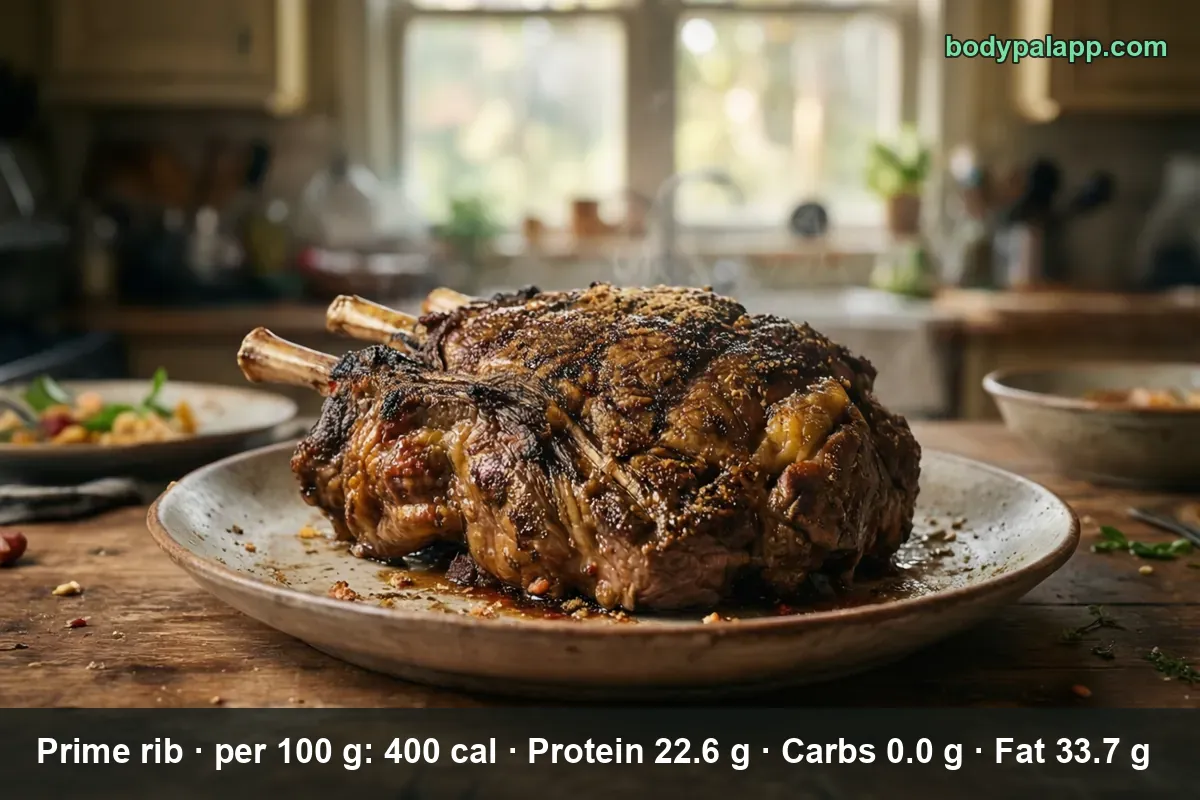
A 3 oz slice of roasted prime rib is 340 calories, from 400 calories per 100 g. Carve the thick end-of-table slab instead — 278 g of meat off the bone — and one serving reaches 1,112. What moves the number most is not the thickness of the slice. It is the grade of the beef.
On this page
- Prime rib quick facts
- The two meanings of prime
- Prime rib portions, ounce by ounce
- Roasted or broiled
- Which end of the roast your slice came from
- Raw weight is not cooked weight
- Saturated fat, not sodium
- How does prime rib compare?
- FAQ
Prime rib quick facts
The reference on this page is the meat itself, carved and on the plate: USDA SR Legacy 168679, beef rib, whole (ribs 6-12), lean and fat, trimmed to one-eighth inch, prime grade, cooked and roasted. No rub, no au jus, no horseradish cream. Just the slice.
| Nutrient | Per 100 g | Per 3 oz slice (85 g) | % Daily Value |
|---|---|---|---|
| Calories | 400 | 340 | — |
| Total fat | 33.7 g | 28.6 g | 37% |
| Saturated fat | 13.96 g | 11.9 g | 59% |
| Carbohydrate | 0 g | 0 g | 0% |
| Dietary fiber | 0 g | 0 g | 0% |
| Protein | 22.57 g | 19.2 g | 38% |
| Sodium | 65 mg | 55 mg | 2% |
% Daily Value is based on a 2,000-calorie diet.
Verified nutrition data
Numbers on this page come from USDA FoodData Central, the U.S. Department of Agriculture’s food composition database, and from manufacturer labels where a branded product is named. Last verified September 2026. How we verify our data →
Two rows carry the story, and they point in opposite directions. Sodium is almost nothing: 55 mg in a slice, 2% of the day. Saturated fat is the opposite — 11.9 g, or 59% of the FDA Daily Value, from a serving worth about 17% of a 2,000-calorie day.
Three rows you might expect are missing, and their absence is deliberate. Total sugars, added sugars and trans fat were never measured for these beef cuts in the SR Legacy release, so there is no value to print. A zero in those cells would claim a measurement nobody made.
The rest of the panel fills in around the edges. One slice carries 72 mg of cholesterol, 24% of the Daily Value, and the meat runs 304 mg of potassium per 100 g, about 6%.
The two meanings of prime
Here is where American menus and the American food database disagree, and it is worth ten minutes of anyone's calorie math.
On a menu, prime rib is a cut: the standing rib roast, ribs six through twelve, cooked whole and carved to order. In USDA's database, prime is a grade: the top marbling tier, above Choice and Select. The two words are unrelated, and most restaurants serving prime rib are serving Choice beef.
The gap that opens up is real money in calories. Graded Prime, roasted, is 400 calories per 100 g. The identical roast cooked the identical way at all grades is 351. That is 49 calories per 100 g — about 14% — bought entirely with marbling.
Translated to a plate: a 3 oz slice is 340 calories if the beef was graded Prime and 298 if it was not. So the honest range for a slice of prime rib is 298 to 340 calories, and nothing on the plate tells you which one you are eating. If you know the roast came from a warehouse club or a steakhouse advertising USDA Prime, log the higher figure. Otherwise the lower end is the better bet.
Prime rib portions, ounce by ounce
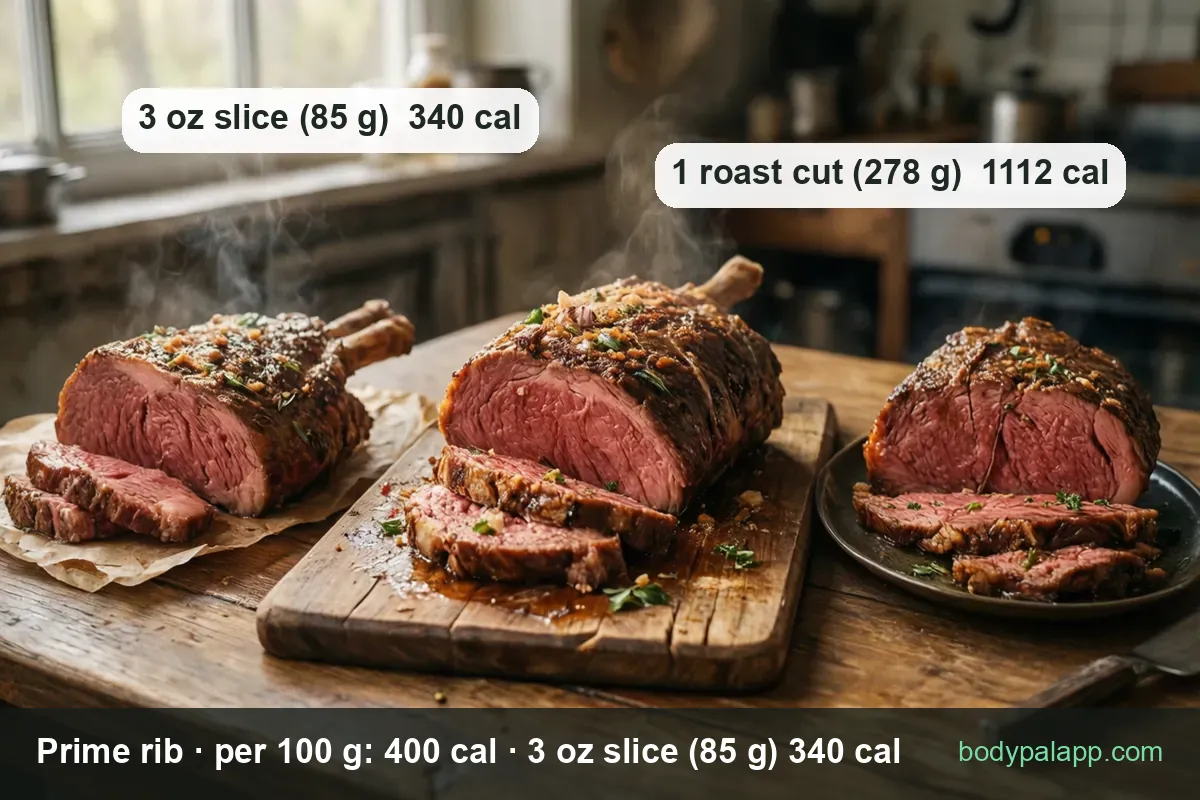
Everything below is built from 400 calories per 100 g, roasted:
| Portion | Weight | Calories |
|---|---|---|
| 1 oz cooked | 28 g | 112 |
| 3 oz slice | 85 g | 340 |
| 100 g cooked | 100 g | 400 |
| 8 oz restaurant cut | 227 g | 908 |
| One piece off the bone, from 1 lb raw | 278 g | 1112 |
The 3 oz slice is the household portion USDA publishes, and it is a genuinely modest piece of meat — roughly the size of a deck of cards, cut thin. Almost nobody eats prime rib that way.
The bottom row is what a holiday table actually looks like. USDA lists a second portion for this record: the cooked, boned-out yield from one pound of raw rib, and it weighs 278 g. At 400 calories per 100 g that single piece is 1,112 calories, more than three times the reference slice, and it arrives before the potatoes.
Steakhouse menus sit between the two. A cut sold as 8 oz is 227 g of meat and about 908 calories — our own scaling, since USDA publishes no 8 oz portion; the 12 oz version is four reference slices on one plate. Prime rib is not a food where portion size is a rounding error.
Roasted or broiled
Same rib, same grade, two heat sources, and USDA measured the difference.
| Whole rib, Prime grade | Per 100 g | Per 3 oz slice (85 g) |
|---|---|---|
| Roasted | 400 | 340 |
| Broiled | 386 | 328 |
Twelve calories a slice. That is the entire effect, and it goes the way you would guess: under a broiler the fat renders and drips, while a roast sits in its own drippings in the pan and keeps a little more of them.
It is a small enough gap that it should not drive any decision. Cook the roast the way it tastes best. The 14% swing from grade dwarfs the 3% swing from method.
Which end of the roast your slice came from
A standing rib roast is not uniform. The large end (ribs 6-9) sits toward the chuck and carries more connective tissue and interior fat pockets; the small end (ribs 10-12) runs toward the loin and is the section that gets cut into ribeye steaks. USDA measures them separately.
| Cut and method, Prime grade | Per 100 g | Per 3 oz slice (85 g) |
|---|---|---|
| Small end (ribs 10-12), roasted | 411 | 349 |
| Large end (ribs 6-9), broiled | 404 | 343 |
| Whole roast, roasted | 400 | 340 |
| Large end (ribs 6-9), roasted | 393 | 334 |
| Whole roast, broiled | 386 | 328 |
| Small end (ribs 10-12), broiled | 354 | 301 |
Read the first and last rows together. Both are Prime-grade rib, both from the small end, both a 3 oz slice. They are 48 calories apart, and the only variable is whether the heat came from above or below.
That range — 301 to 349 calories per slice — is the practical answer to what a slice of prime rib costs, and it explains why calorie charts for this food disagree so wildly with each other. They are all correct. They are describing different slices.
Two people at the same table, served from the same roast, can be 15 calories apart per slice depending on who got an end cut. Nobody needs to track that. It is worth knowing only so you stop chasing a single exact number that does not exist.
Raw weight is not cooked weight
This is the trap that costs the most, and it runs in both directions at once.
Per gram, raw is lighter. Raw prime rib is 355 calories per 100 g; roasted it is 400. Water leaves during cooking, so fat and protein concentrate into a smaller mass. Weigh a 4 oz raw slab (113 g) and you have 401 calories.
Per pound, cooked is far lighter, because there is much less of it. One pound of raw bone-in rib — 453.6 g on the butcher's scale — yields just 278 g of cooked meat once the bone and the rendered fat are gone. At the raw record that pound reads 1,610 calories, and the bone and rendered fat in it never reach a plate. What you actually eat is 1,112. Mixing the two stages overcounts by roughly 500 calories per pound.
The raw records split by end the same way the cooked ones do: the whole rib is 355 calories per 100 g, the large end 367 (415 for a 4 oz raw slab) and the small end 335 (379).
The rule is simple. Weigh the meat at one stage and use the record for that stage. If you weighed the roast before it went in the oven, use the raw number. If you weighed your slice on the plate, use the cooked one. Never carry a raw weight into a cooked figure.
Saturated fat, not sodium
Prime rib has a reputation as a salty food, and it earns none of it. The meat is 65 mg of sodium per 100 g. A slice is 55 mg, 2% of a 2,300 mg day — roughly a fortieth of a teaspoon of table salt.
The salt in a prime rib dinner arrives from outside the beef. It is in the rub, the au jus and the crust of coarse salt that makes the crust work. One prime rib seasoning rub in USDA's branded records runs 18,000 mg of sodium per 100 g of product. What goes on the roast decides the sodium; the roast itself contributes almost nothing.
The number that does bite is saturated fat.
- One 3 oz slice: 11.9 g, 59% DV
- Two slices: 23.8 g, 119% DV
- A 278 g roast cut: 38.8 g, 194% DV
The Dietary Guidelines for Americans cap saturated fat at 10% of daily calories, which is where the 20 g Daily Value comes from. A single generous serving of prime rib clears that on its own, which is a fair description of what a holiday roast is and not a reason to skip it.
Where the calories sit is unusual too. Fat supplies 33.7 g per 100 g, and at 9 calories a gram that is 303 of the 400 — about 76% of the energy in prime rib is fat. Protein contributes the other 90. There is no carbohydrate, no fiber and no sugar in the meat at all.
The protein side is strong. A 3 oz slice delivers 19.2 g, 38% of the Daily Value, and MyPlate counts 3 oz of cooked meat as three ounce-equivalents from the protein group. Two slices cover three quarters of a day's protein — and more than a full day's saturated fat.
How does prime rib compare?
Every row below is beef, cooked, with the same 3 oz (85 g) serving:
| Beef cut, cooked | Per 100 g | Per 3 oz (85 g) | Protein | Carbs | Fat |
|---|---|---|---|---|---|
| Prime rib roast, USDA Prime, roasted | 400 | 340 | 19.2 g | 0 g | 28.6 g |
| Rib roast, all grades, roasted | 351 | 298 | 19.4 g | 0 g | 23.9 g |
| Rib, whole, Choice, broiled | 352 | 299 | 18.9 g | 0 g | 24.2 g |
| Brisket, point half, braised | 358 | 304 | 20.0 g | 0 g | 24.2 g |
| Chuck blade roast, Choice, braised | 359 | 305 | 22.4 g | 0 g | 23.2 g |
Our take: prime rib is the most expensive slice on this list in both senses, and the 42-calorie premium over the same roast at a lower grade buys texture, not nutrition — the protein matches within two tenths of a gram. If you want beef with the best protein-per-calorie ratio, the chuck blade roast wins outright: 22.4 g of protein for 305 calories, 17% more protein than the Prime slice for 35 fewer calories, because braising a working muscle concentrates protein where marbling concentrates fat. Brisket and Choice rib land in the same band as each other, near 300 calories, and any of them can stand in for prime rib at a saving of about 40 calories per slice. Prime rib earns its place at a table where the point is the beef. It is a poor default for a Tuesday.
Prime rib FAQs
How many calories are in prime rib?
340 calories in a 3 oz (85 g) slice of roasted prime rib, from 400 calories per 100 g. That slice carries 19.2 g of protein, 28.6 g of fat and just 55 mg of sodium. A thicker restaurant cut of 8 oz comes to about 908 calories.
How many calories are in a slice of prime rib?
Between 301 and 349 calories for a 3 oz slice, depending on the cut and the cooking method. A slice from the small end roasted is 349; the same weight from the small end broiled is 301. The standard whole-roast figure sits in the middle at 340.
How many calories are in prime rib per ounce?
112 calories per ounce (28 g) of cooked, roasted prime rib, at 400 calories per 100 g. A 3 oz slice is 340 and an 8 oz restaurant cut, 227 g of meat, is about 908. Those figures are for USDA Prime; at a lower grade an ounce is closer to 98 calories.
How many calories are in 8 oz of prime rib?
About 908 calories for 8 oz (227 g) of roasted prime rib, scaled from 400 calories per 100 g. That serving brings 51 g of protein and 31.7 g of saturated fat, which is 158% of the Daily Value. At the all-grades figure of 351 per 100 g it drops to about 797.
Does prime rib have more calories than ribeye?
Slightly fewer, gram for gram: 400 calories per 100 g for the whole roast against 411 for a ribeye. A ribeye is cut from the small end of the same rib primal, and USDA's small-end Prime record roasted is 349 calories for a 3 oz slice, against 340 for the whole roast. The real difference is portion size, since steaks are served far larger than carved slices.
How much protein is in prime rib?
19.2 g in a 3 oz slice, which is 38% of the Daily Value, from 22.57 g per 100 g. An 8 oz cut reaches about 51 g. Grade barely touches it: the same roast at all grades holds 19.4 g per slice, so paying for Prime buys fat, not protein.
Should I weigh prime rib raw or cooked?
Weigh it at one stage and use the record for that stage: raw prime rib is 355 calories per 100 g and roasted is 400, because water leaves during cooking. One pound of raw bone-in rib yields only 278 g of cooked meat, which is 1,112 calories rather than the 1,610 the raw weight suggests.
Is prime rib healthy?
It is a dense protein food with one clear cost: a 3 oz slice gives 19.2 g of protein (38% DV) and only 55 mg of sodium (2% DV), with zero carbohydrate and zero sugar, alongside 11.9 g of saturated fat, or 59% of the Daily Value. The Dietary Guidelines cap saturated fat at 10% of daily calories, so serving size does the deciding.
Similar foods
- Pork Belly — 364 cal for 3 slices
- Beef Jerky — 115 cal per oz
- Salami — 102 cal for 3 slices
- Turkey Bacon — 81 cal for 2 slices, cooked
- Summer Sausage — 203 cal for 4 slices
- Beef Back Ribs — 306 cal for 3 oz cooked
Count it without the math
Point the camera at the carving board and BodyPal logs the slice, the au jus and the sides in one shot.


How long does it take to burn off prime rib?
A 3 oz slice is 340 kcal. Enter your weight and the amount you ate to see how long it takes you to burn that off:
lb
| Activity | Time to burn 340 kcal |
|---|---|
| Walking, brisk | 1 hr 8 min |
| Cycling, moderate | 42 min |
| Swimming, moderate | 49 min |
| Jogging | 40 min |
| Weight training, moderate | 1 hr 16 min |
Times are for a 155 lb adult at a steady pace; change the weight to see yours. The amount is set to the portion in the text (3 oz); change it to what you actually ate. BodyPal works this out from your steps automatically.
One food is easy to picture; a whole day is harder. See how many calories you need a day and what a deficit actually looks like.