
How many calories are in summer sausage?
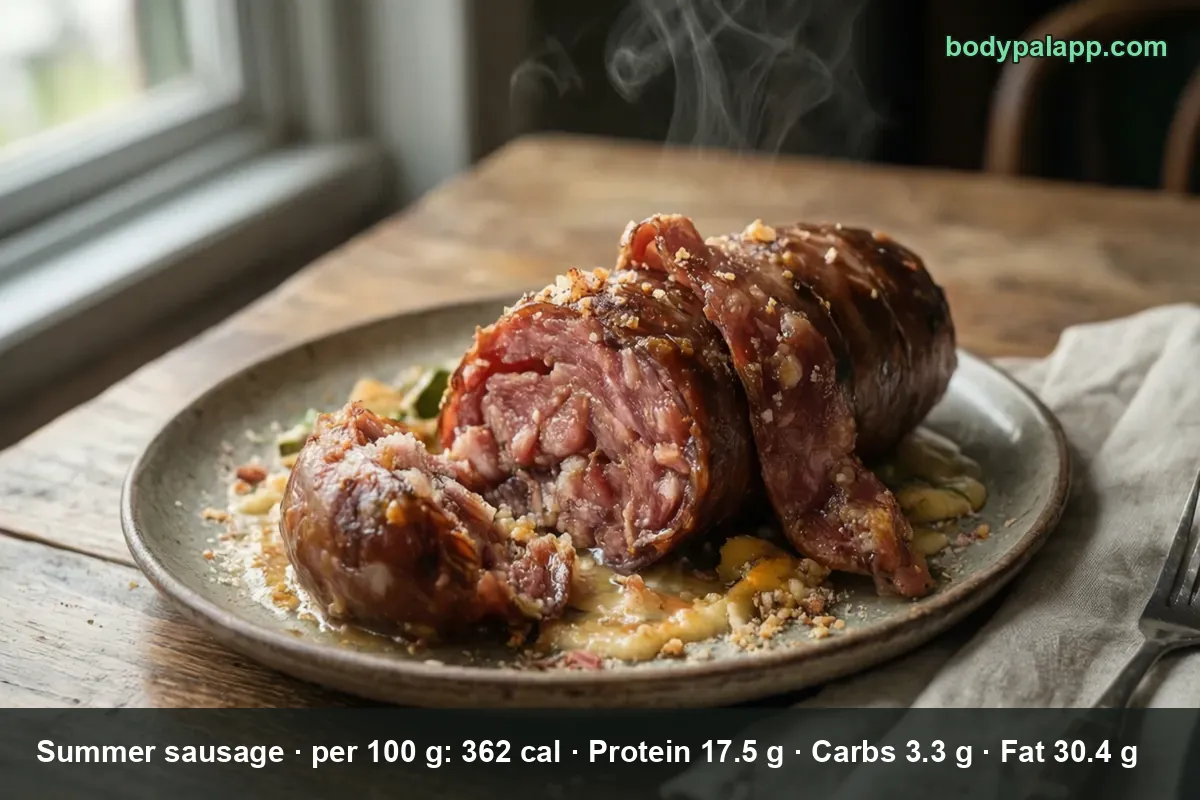
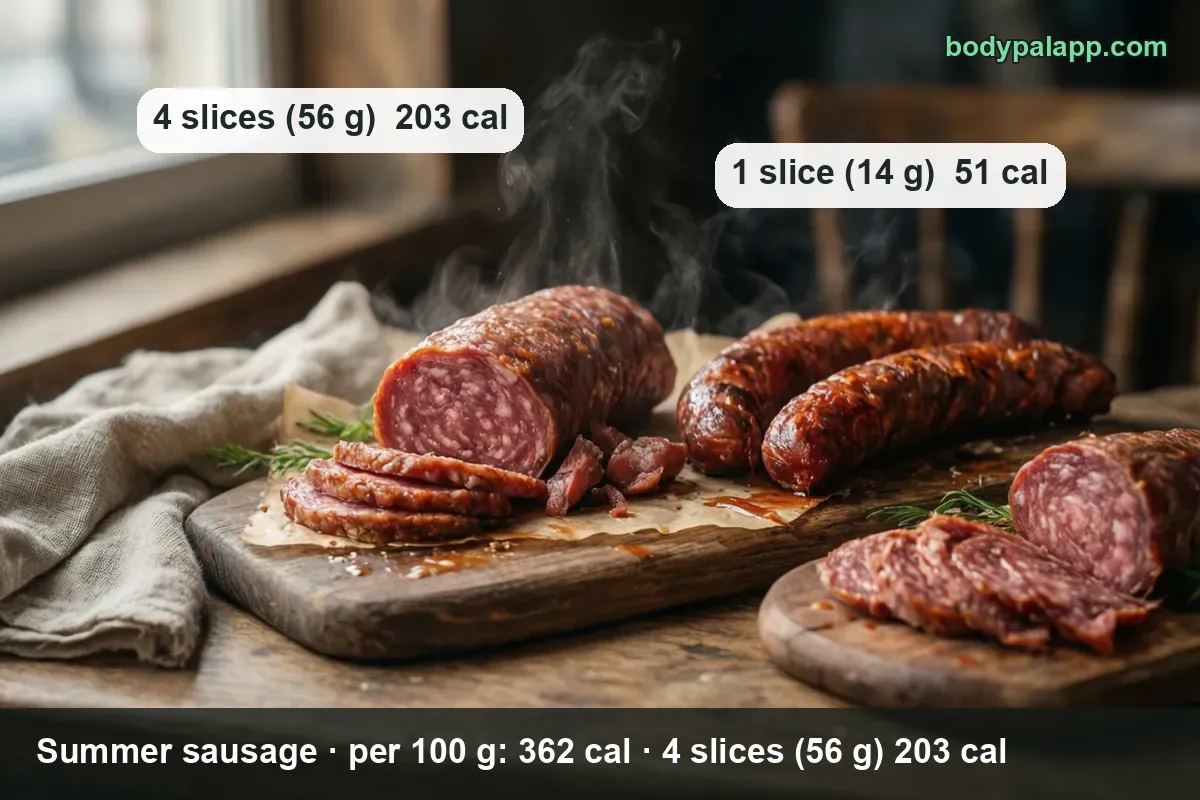
A 2 oz serving of summer sausage — about four thick slices, 56 g — is 203 calories. Per 100 g the roll runs 362 calories, most of it fat. That serving also carries 728 mg of sodium, which is the number that catches people out far more often than the calories do.
On this page
- Summer sausage quick facts
- US servings, from one slice to a quarter pound
- Beef, cheddar sticks and the brand spread
- Sodium is the row to watch
- How does summer sausage compare?
- Most popular summer sausage brands
- Summer sausage FAQs
Summer sausage quick facts
The record behind every number on this page is SR Legacy 172940, "Thuringer, cervelat, summer sausage, beef, pork". It is the plain slicing roll people actually buy for a snack board — the one you hold in your hand at the deli counter — and the only summer sausage entry in that data set with nothing else mixed into it. The cheddar-stick version sits in a separate record, and it is a different food once the cheese goes in.
It also comes with its own household portion, 2 oz, which is the same 56 g most US labels print. That makes the column below directly comparable to the panel on the wrapper.
| Nutrient | Per 100 g | Per 2 oz (56 g) | % Daily Value |
|---|---|---|---|
| Calories | 362 | 203 | — |
| Total fat | 30.43 g | 17.0 g | 22% |
| Saturated fat | 11.51 g | 6.4 g | 32% |
| Carbohydrate | 3.33 g | 1.9 g | 1% |
| Dietary fiber | 0 g | 0 g | 0% |
| Total sugars | 0.85 g | 0.5 g | — |
| Protein | 17.45 g | 9.8 g | 20% |
| Sodium | 1300 mg | 728 mg | 32% |
% Daily Value is based on a 2,000-calorie diet.
Verified nutrition data
Numbers on this page come from USDA FoodData Central, the U.S. Department of Agriculture’s food composition database, and from manufacturer labels where a branded product is named. Last verified September 2026. How we verify our data →
Two rows are absent on purpose. USDA does not publish added sugars or trans fat for this SR Legacy record, so there is nothing honest to put in those cells. Cholesterol and potassium do exist: 74 mg and 260 mg per 100 g, which works out to 41 mg of cholesterol (14% DV) and 146 mg of potassium (3% DV) in the 2 oz serving. The FDA Daily Value reference is what those percentages are measured against.
US servings, from one slice to a quarter pound
| Serving | Weight | Calories |
|---|---|---|
| 1 slice, about a quarter inch | 14 g | 51 kcal |
| 1 oz | 28 g | 103 kcal |
| 2 oz, USDA serving, about 4 slices | 56 g | 203 kcal |
| 3 oz | 85 g | 308 kcal |
| Quarter pound | 113 g | 409 kcal |
| Per 100 g | 100 g | 362 kcal |
Only the 2 oz line is a USDA household measure. The slice, the ounce, the 3 oz cut and the quarter pound are our own arithmetic from the USDA 100 g figure, not USDA servings, and the slice is the loosest of them — 14 g assumes a quarter-inch cut off a standard roll. Cut them thin for crackers and you land nearer 8 g and 29 calories; carve them like steak medallions and one slice can hit 25 g and 91.
That is the practical trap with this food. Nobody eats a weighed 2 oz portion off a snack board. They eat slices, and slices are whatever the knife decides. If you log by the piece, weigh the roll once, count the slices it makes, and reuse that number.
Beef, cheddar sticks and the brand spread
| Version | Per 100 g | Typical serving | Calories |
|---|---|---|---|
| Pork and beef, USDA record | 362 kcal | 2 oz (56 g) | 203 kcal |
| Beef summer sausage | 339 kcal | 2 oz (56 g) | 190 kcal |
| Hickory smoked | 339 kcal | 2 oz (56 g) | 190 kcal |
| Original, one national label | 357 kcal | 2 oz (56 g) | 200 kcal |
| A lighter label | 321 kcal | 2 oz (56 g) | 180 kcal |
| Lightest label found | 286 kcal | 2 oz (56 g) | 160 kcal |
| Sticks with cheddar cheese | 426 kcal | 1 oz (28 g) | 121 kcal |
All-beef and hickory smoked both read 339 per 100 g, so the beef version saves 13 calories on a 2 oz plate against the USDA pork-and-beef record. That is real but small. The bigger mover is the label itself: national brands run from 286 to 357 per 100 g, which turns the identical "2 oz" line on the wrapper into anything from 160 to 200 calories. Forty calories of difference, decided at the store shelf rather than at the cutting board.
Cheddar sticks are the genuine outlier. At 426 calories per 100 g they are the fattiest form of this food by a distance — 37.91 g of fat per 100 g against 30.43 g for the plain roll. One ounce of stick is 121 calories where one ounce of plain summer sausage is 103. Eat three sticks while you build the board and you have spent more than a slice-and-cracker serving.
Sodium is the row to watch
Saturated fat and sodium land on the same number here, and it is a large one: 6.4 g and 728 mg in a single 2 oz serving, each 32% of the Daily Value. The Dietary Guidelines for Americans put saturated fat at under 10% of calories, and CDC's sodium guidance leans on the same 2,300 mg ceiling the label uses. Two plates of this size across a day take you to 1,456 mg of sodium — roughly two thirds of the day — before any bread, cheese, mustard or pickles are counted. That is about two thirds of a teaspoon of table salt, from the meat alone.
The protein is respectable without being the reason to eat it. Nine point eight grams per serving is 20% of the Daily Value, but it arrives with 17 g of fat, so this is a fat-first food that happens to carry protein. If protein per calorie is what you are after, hard salami does it better; if you are watching sodium, a lower-sodium cured meat is the better pick and the calorie difference between them is trivial either way.
One thing that does not need adjusting: cooking. Summer sausage is cured, fermented and fully cooked before it reaches the store, so 362 calories per 100 g is what actually lands on the board. Fresh sausages are not like this. A raw bratwurst loses water and fat in the pan, so its raw and cooked numbers differ; summer sausage has no such step, and the weight you slice is the weight you eat.
How does summer sausage compare?
| Cured meat | Per 100 g | US serving | Calories |
|---|---|---|---|
| Summer sausage, pork and beef | 362 kcal | 2 oz (56 g) | 203 kcal |
| Salami, dry or hard | 378 kcal | 1 oz (28 g) | 107 kcal |
| Hard salami, one brand record | 368 kcal | 1 oz (28 g) | 104 kcal |
| Kielbasa, grilled | 337 kcal | 3 oz (85 g) | 286 kcal |
Our take: these four sit within 41 calories of each other per 100 g, and kielbasa is the only one under 340. That is close enough that the choice of meat barely matters — what matters is how much of it ends up on the plate. Summer sausage gets eaten in slices you can lose count of, kielbasa gets eaten as one visible link, and the second habit is much easier to log. If you want the protein density, hard salami leads at 21.07 g per 100 g against 17.45 g here. For a snack board where you plan to keep grazing, cut the roll into counted slices first.
Most popular summer sausage brands in the United States
Ranked by how widely each product appears among foods sold in the United States, from the BodyPal food database of over 3.3 million products. Calories are the figures printed on each Nutrition Facts label, checked against USDA FoodData Central.
| Product | Calories (per 100 g) |
|---|---|
| Armour Hickory Smoked Summer Sausage | 339 cal |
| Hillshire Farm Summer Sausage | 321 cal |
| Hillshire Farm Beef Summer Sausage | 339 cal |
| Johnsonville Summer Sausage | 321 cal |
| Klement's Original Summer Sausage | 357 cal |
| Cher-Make Original Summer Sausage | 286 cal |
Brand popularity: BodyPal food database. Nutrition: manufacturer labels / USDA FoodData Central.
Summer sausage FAQs
How many calories are in 2 oz of summer sausage?
203 calories in a 2 oz serving, which USDA lists as the standard portion for beef-and-pork summer sausage at 362 calories per 100 g. That is roughly four slices cut a quarter inch thick. It also brings 9.8 g of protein, 17 g of fat and 728 mg of sodium.
How many calories are in one slice of summer sausage?
About 51 calories for a 14 g slice off a standard roll. That weight is our own arithmetic from the USDA 100 g figure, not a USDA serving, since slices vary with how thick you cut. Four of them make the 2 oz serving and 203 calories.
Is summer sausage high in protein?
9.8 g of protein in a 2 oz serving, or 20% of the Daily Value, sits alongside 17 g of fat and 203 calories. Per gram it is a fat-first food: 17.45 g protein against 30.43 g fat per 100 g. Hard salami packs more protein per ounce.
How much sodium is in summer sausage?
728 mg in a 2 oz serving, 32% of the 2,300 mg Daily Value, and 1,300 mg per 100 g. Two plates of that size take you to 1,456 mg, roughly two thirds of the day, before bread, cheese or crackers join in.
Is beef summer sausage lower in calories than pork and beef?
Slightly: a beef summer sausage label reads 339 calories per 100 g and 190 per 2 oz, against 362 and 203 for the USDA pork-and-beef record. The 13-calorie gap per serving is smaller than the gap between brands, which runs from 160 to 200 for the same 2 oz.
Is summer sausage keto friendly?
3.33 g of carbohydrate per 100 g, or 1.9 g in a 2 oz serving, keeps it inside most low-carb plans, and 17 g of fat does the rest. The catch is not carbs but sodium: 728 mg per serving. Cheddar sticks push the fat to 37.91 g per 100 g.
Summer sausage vs salami: which has fewer calories?
Summer sausage, by 16 calories per 100 g: 362 against 378 for dry or hard salami. Per ounce that is 103 against 107, close enough to ignore. Hard salami carries more protein, 21.07 g per 100 g against 17.45 g, so it is the denser pick per bite.
Do you have to cook summer sausage?
No, and that is why the 362 calories per 100 g match what lands on the board. Summer sausage is cured, fermented and fully cooked before it is sold, so nothing cooks off at home. Fresh sausages like bratwurst lose water and weight in the pan, which shifts their numbers.
Similar foods
- Beef Back Ribs — 306 cal for 3 oz cooked
- Turkey Bacon — 81 cal for 2 slices, cooked
- Beer Brat — 240 cal per brat
- Pork Chorizo — 278 cal per link, medium
- Salami — 102 cal for 3 slices
- Chorizo — 256 cal per link
Count it without the math
Point the camera at the board and BodyPal counts the slices for you, cheese and crackers included.


How long does it take to burn off summer sausage?
A 2 oz (56 g) serving is 203 kcal. Enter your weight and the amount you ate to see how long it takes you to burn that off:
lb
| Activity | Time to burn 203 kcal |
|---|---|
| Walking, brisk | 41 min |
| Cycling, moderate | 25 min |
| Swimming, moderate | 29 min |
| Jogging | 24 min |
| Weight training, moderate | 45 min |
Times are for a 155 lb adult at a steady pace; change the weight to see yours. The amount is set to the portion in the text (56 g); change it to what you actually ate. BodyPal works this out from your steps automatically.
Burning it off is one side of it. The other is knowing your number: work out how many calories you need a day, with macros and a goal date.