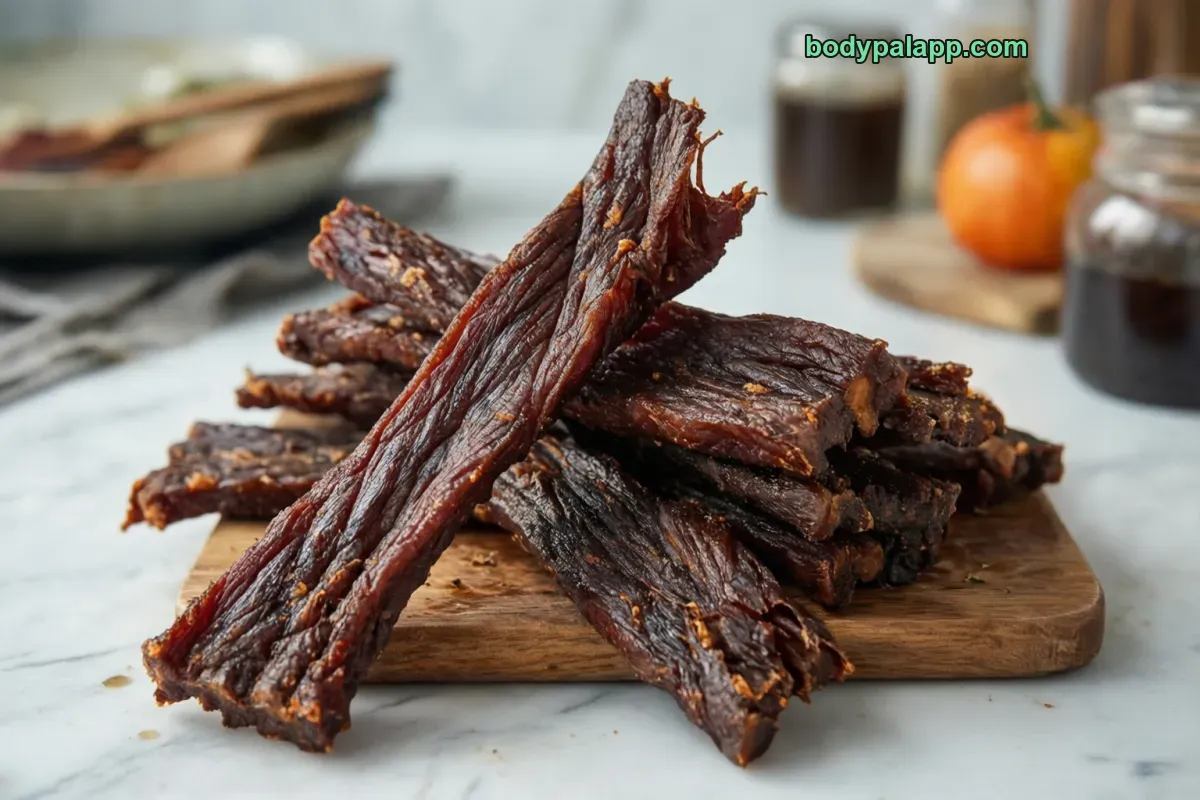
Beef jerky calories come to 115 for one ounce (28 g) and 410 per 100 g. The surprise is the split: fat supplies 57% of those calories, protein only 33%. And one ounce already carries 500 mg of sodium, 22% of the daily value, so the bag size decides how the snack lands in your day.
115kcal
1 ounce · 28 g, beef, chopped and formed
33%protein
9.3 gProtein
3 gCarbs
7.2 gFat
How to burn off 115 kcal
—Walking, brisk
—Jogging
—Cycling, moderate
—Swimming
Skip the math. BodyPal counts these calories from your steps and workouts automatically.
Nutrition facts
Beef, chopped and formed · per 28 g
Calories
115 kcal
Protein
9.3 g
Carbohydrate
3.1 g
Fat
7.2 g
Saturated fat
3 g
Cholesterol
13 mg
Sodium
500 mg
Potassium
167 mg
Iron
1.5 mg
Source: USDA FoodData Central
🛡️
Verified nutrition data
Numbers on this page come from USDA FoodData Central, the U.S. Department of Agriculture’s food composition database, and from manufacturer labels where a branded product is named. Last verified September 2026. How we verify our data →
Beef jerky: calories, protein and sodium by serving
Percent of daily value uses the FDA reference of 2,000 kcal a day.
Serving
kcal
Protein
Carbs
Fat
Sodium
% DV kcal
1 oz (28 g)
115
9.3 g
3.1 g
7.2 g
500 mg
6%
1 large piece (20 g)
82
6.6 g
2.2 g
5.1 g
357 mg
4%
100 g
410
33.2 g
11 g
25.6 g
1,785 mg
21%
3 × 1 oz (28 g)
344
27.9 g
1,499 mg
5 × 1 oz (28 g)
574
46.5 g
2,499 mg
One ounce is 115 calories, but bags rarely stop there
The standard label serving is one ounce (28 g), which works out to 115 calories, 9.3 g of protein and 7.2 g of fat. A single large piece of about 20 g is 82 calories. That is a modest snack, roughly 6% of a 2000-calorie day, and it is easy to account for.
The trouble is that jerky is eaten by the handful. Two ounces (56 g) bring you to 230 calories and 18.6 g of protein. Three ounces (84 g), a common share-size bag, land at 344 calories. Five ounces (140 g) reach 574 calories, which is a full meal's worth of energy from a snack you can finish in a car ride.
Sodium climbs even faster than calories. Two ounces carry 1,000 mg, three ounces 1,499 mg, and five ounces 2,499 mg. If you track anything about jerky, track the number of ounces, not the number of pieces, because piece sizes vary from bag to bag.
Fat, not protein, supplies most of the calories
Jerky is sold as a protein snack, and it does deliver: 33.2 g of protein per 100 g, or 66% of the daily value. But the calorie split tells a different story. Fat supplies 57% of the calories, protein 33% and carbohydrates 11%. Per 100 g that is 25.6 g of fat against 11 g of carbs.
Saturated fat is a meaningful part of that fat, at 10.9 g per 100 g. Against a 20 g daily value, that is more than half the day's allowance in a 100 g portion. Leaner cuts and leaner meats change this picture a lot, which is why turkey jerky reads so differently on the label.
The carbohydrates are mostly sugar. Of the 11 g of carbs per 100 g, 9 g are sugars, which come from the marinade rather than the meat. Sweet flavors such as teriyaki, the style sold by Jack Link's and World Kitchens, tend to lean on that marinade. Fiber is low at 1.8 g per 100 g, so jerky adds little bulk on its own.
Sodium is the row to watch
Curing and drying meat takes salt, and the numbers show it. Beef jerky has 1,785 mg of sodium per 100 g, which is 78% of the daily value. Calories at that same weight are only 21% of the daily value, so the sodium is far out of proportion to the energy you get.
At smaller portions it stays manageable. One large piece has 357 mg, or 16% of the daily value, and one ounce has 500 mg, or 22%. Those fit into most days. Three ounces at 1,499 mg take a big bite out of the allowance, and five ounces at 2,499 mg pass the full daily value on their own.
If you watch sodium, treat jerky as a measured snack rather than an open bag, and keep the rest of that day's meals lighter on salty foods. Jerky also brings 597 mg of potassium per 100 g, though it does not cancel out the sodium load.
Jerky works best as a small, planned snack
Jerky earns its place where convenience matters: hiking, travel, long workdays. It keeps without refrigeration, and one ounce gives 9.3 g of protein for 115 calories, which is a decent trade for a shelf-stable snack. The weak spots are fat, sugar from the marinade, and salt.
Pairing helps. Because jerky has almost no fiber, a piece of fruit or some raw vegetables alongside it adds volume and makes a single ounce feel like more. Water matters too after a salty snack. If you want a bigger protein hit, an extra ounce adds 115 calories and 500 mg of sodium, so decide on the portion before opening the bag.
Logging it is simple if you weigh or count ounces. BodyPal can also log jerky from a photo, which is handy when you are eating straight from a pouch and would otherwise lose track.
How does beef jerky compare?
Here is beef jerky next to turkey jerky, deli turkey and deli ham, per 100 g and per usual serving.
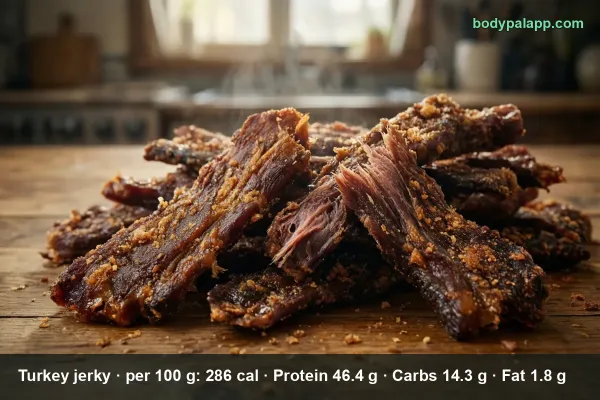
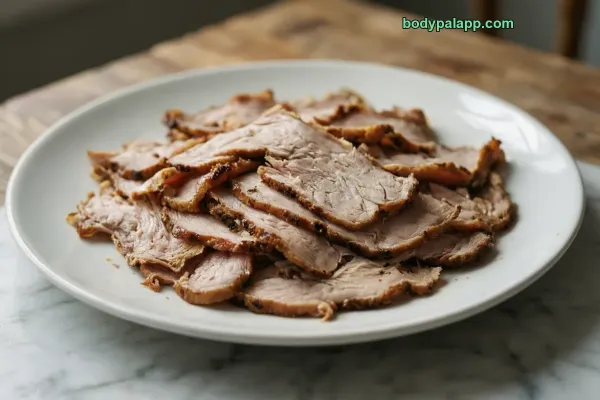
Verdict: For fewer calories and more protein, pick turkey jerky: 286 calories and 46.4 g of protein per 100 g, against 410 and 33.2 g for beef jerky. If sodium is your concern, deli turkey is the better pick at 772 mg per 100 g, since both jerkies sit near 1,750 to 1,785 mg.
Most popular beef jerky brands in the United States
Ranked by popularity in the BodyPal database
# Productkcal / 100 g
1World Kitchens Beef Jerky, Teriyaki1 oz · 28 g286 kcal
2Jack Link's Beef Jerky, Teriyaki1 oz · 28 g286 kcal
3Jack Link's Teriyaki Beef Jerky1 oz · 28 g286 kcal
Packaged jerky is lean whole-muscle strips with 3.6 to 6.3 g fat per 100 g, so the labels read lower than the chopped and formed number above. Source: manufacturer labels / USDA FoodData Central.
Beef jerky FAQs
How many calories are in beef jerky?
A 1 oz serving (28 g) is 115 calories and a large piece (20 g) is 82 calories. Per 100 g, beef jerky is 410 calories.
Is beef jerky good for weight loss?
An ounce is 115 calories and carries 9.3 g protein with 7.2 g fat and 2.5 g sugar. The same ounce also has 500 mg sodium.
Beef jerky vs turkey jerky: which has fewer calories?
Turkey jerky is 286 calories per 100 g against 410 for beef jerky, about 124 calories less.
How much protein is in beef jerky?
Beef jerky has 33.2 g protein per 100 g, which is 9.3 g in a 1 oz serving and 6.6 g in a large piece.
How many carbs are in beef jerky?
Beef jerky has 3.1 g of carbohydrates per ounce and 11 g per 100 g. Most of it is sugar from the marinade: 2.5 g per ounce, 9 g per 100 g. Fiber is just 0.5 g per ounce.
How much fat is in beef jerky?
One ounce of beef jerky has 7.2 g of fat, and 100 g has 25.6 g, including 10.9 g of saturated fat. Fat supplies 57% of jerky's calories, more than protein does.
What are the macros of beef jerky?
Per 100 g, beef jerky has 33.2 g of protein, 25.6 g of fat and 11 g of carbs for 410 calories. By calories, that is 57% fat, 33% protein and 11% carbohydrates.
How much sodium is in beef jerky?
One ounce of beef jerky has 500 mg of sodium, 22% of the daily value. Per 100 g it reaches 1,785 mg, or 78%, and five ounces add up to 2,499 mg.
How much sugar is in beef jerky?
Beef jerky has 2.5 g of sugars per ounce and 9 g per 100 g. The sugar comes from the marinade, so sweet flavors such as teriyaki tend to sit on the higher side.