
How many calories are in turkey jerky?
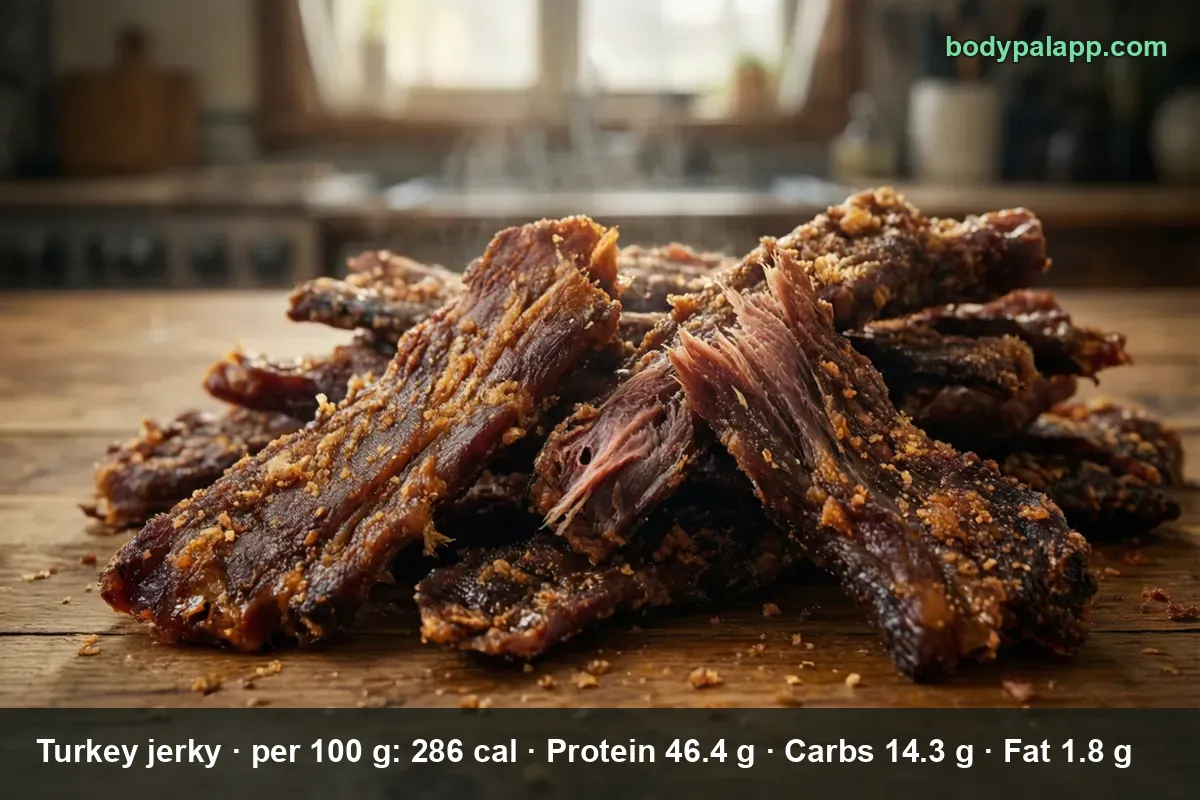
A 1 oz (28 g) serving of turkey jerky is 80 calories, and per 100 g it runs 286 calories. That ounce is 13.0 g of protein and half a gram of fat. Jerky is dried meat, so 100 g is more than a whole 3.25 oz bag, not a handful.
On this page
- Turkey jerky quick facts
- US servings, from one strip to the whole bag
- Teriyaki, peppered and original turkey jerky
- Sodium is the row to watch
- How does turkey jerky compare?
- Most popular turkey jerky brands
- FAQ
Turkey jerky quick facts
There is no Foundation, SR Legacy or FNDDS entry for turkey jerky. USDA's generic jerky records are beef, pork and venison, so the closest thing to a reference number is the label people are actually holding: USDA Branded 2658609, "TURKEY JERKY" from Jack Link's. It is the best-selling turkey jerky label in the country, it uses the standard 1 oz serving, and its 286 calories per 100 g sit right in the middle of the segment — nine of the fifteen US turkey jerky records land on that same figure.
The values below are that record, straight through. The %DV column uses the FDA Daily Values printed on every Nutrition Facts panel.
| Nutrient | Per 100 g | Per 1 oz (28 g) | % Daily Value |
|---|---|---|---|
| Calories | 286 | 80 | — |
| Total fat | 1.79 g | 0.5 g | 1% |
| Saturated fat | 0 g | 0 g | 0% |
| Carbohydrate | 14.29 g | 4.0 g | 1% |
| Dietary fiber | 0 g | 0 g | 0% |
| Total sugars | 14.29 g | 4.0 g | — |
| Protein | 46.43 g | 13.0 g | 26% |
| Sodium | 1750 mg | 490 mg | 21% |
% Daily Value is based on a 2,000-calorie diet.
Verified nutrition data
Numbers on this page come from USDA FoodData Central, the U.S. Department of Agriculture’s food composition database, and from manufacturer labels where a branded product is named. Last verified September 2026. How we verify our data →
Two rows are missing on purpose. The label does not declare added sugars, and it does not declare potassium, so neither number can be quoted honestly here. The saturated fat figure needs a footnote of its own: 0 g is the manufacturer's rounding, not an absence — total fat is 1.79 g per 100 g, and whatever share of it is saturated falls under the 0.5 g threshold that lets a label print zero. Cholesterol is declared: 71 mg per 100 g, which is 20 mg in an ounce, 7% of the Daily Value.
US servings, from one strip to the whole bag
| Serving | Weight | Calories |
|---|---|---|
| 1 large piece or strip | 20 g | 57 kcal |
| 1 small single-serve bag | 24 g | 69 kcal |
| 1 oz, the label serving | 28 g | 80 kcal |
| 1 cup, pieces | 90 g | 257 kcal |
| 1 bag, 3.25 oz | 92 g | 263 kcal |
| Per 100 g | 100 g | 286 kcal |
Only the 1 oz row is a USDA serving. The strip, the cup, the small bag and the 3.25 oz bag are our own arithmetic from the USDA 100 g figure of 286 calories, not USDA servings. Worth knowing, because Jack Link's own single-bag record lists that 24 g package at 80 calories rather than 69 — the small bag is measured at a slightly higher density than the big one, and both are correct on their own panels.
The cup is where people get caught. A cup of loose jerky pieces is around 90 g, roughly three and a quarter label servings, and 257 calories. Nobody eats jerky by the cup deliberately; they eat it out of the bag while driving, which comes to the same thing. If you log jerky at all, log it by the strip or by the ounce — those are the units your hand actually works in.
Teriyaki, peppered and original turkey jerky
| Version | Per 100 g | Typical piece | Calories |
|---|---|---|---|
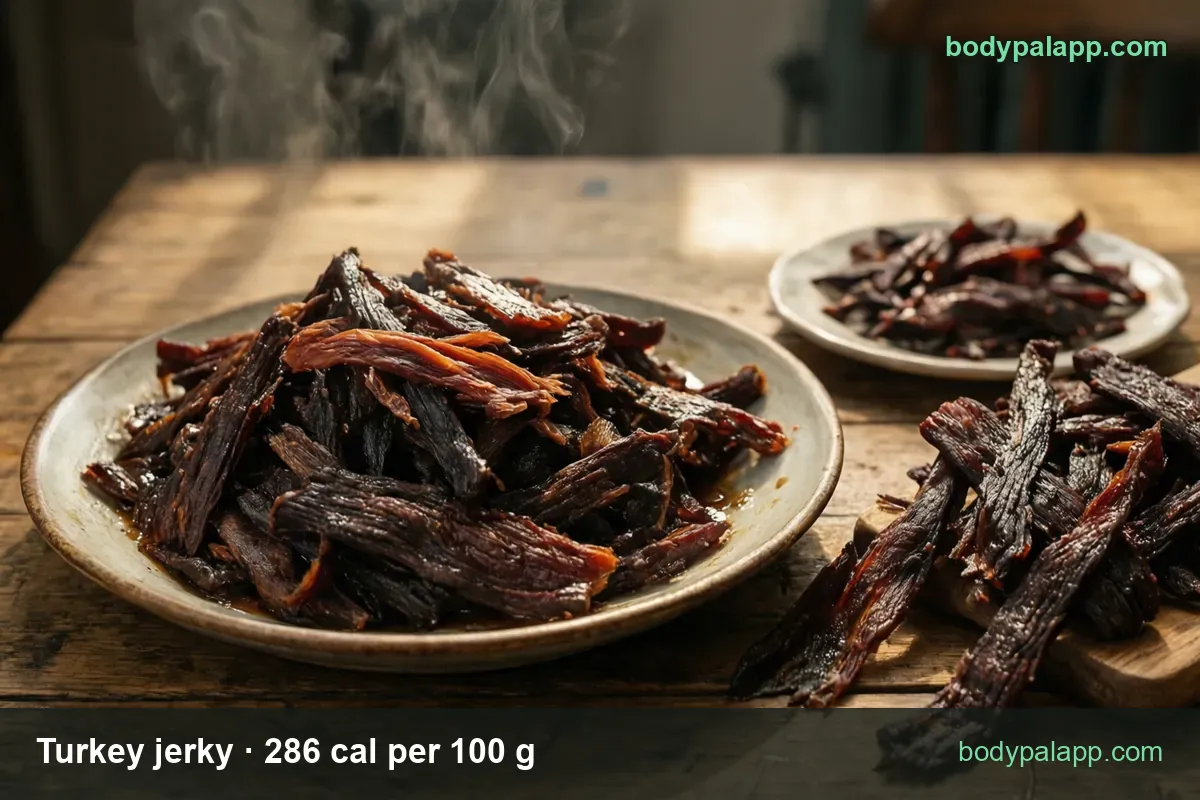
| Original turkey jerky (Jack Link's) | 286 kcal | 1 oz (28 g) | 80 kcal |
| Peppered turkey jerky (Pacific Gold, cracked peppercorn) | 286 kcal | 1 oz (28 g) | 80 kcal |
| Teriyaki turkey jerky (Oberto) | 286 kcal | 1 package (35 g) | 100 kcal |
| Original turkey jerky (lower-density label) | 250 kcal | 1 oz (28 g) | 70 kcal |
The calories barely move between flavors. The sugar does. Original turkey jerky is 14.29 g of total sugars per 100 g; the cracked peppercorn version is 25 g and the teriyaki 25.71 g, close to double, because a peppercorn glaze and a teriyaki marinade are both built on sweetener. In an ounce that is 4.0 g against 7.0 g and 7.2 g. A 35 g teriyaki package carries about 9.0 g of sugars on its own.
Protein moves in the opposite direction. The original runs 46.43 g per 100 g, the peppercorn 35.71 g and the teriyaki 37.14 g — the glaze takes up room the meat used to have. There is also a second original profile on the shelf, shared by Jack Link's larger label serving and by Signature Select's store brand, at 250 calories and 42.86 g of protein per 100 g. Same recipe family, slightly wetter product, 70 calories an ounce instead of 80. World Kitchens and Oberto both sit back on 286.
Sodium is the row to watch
An ounce of turkey jerky is 490 mg of sodium, 21% of the Daily Value, which is about a fifth of a teaspoon of table salt. That is defensible for a snack. The 3.25 oz bag is not: 1,610 mg, 70% of the day's 2,300 mg, from something most people finish in one sitting without registering it as a meal. The Dietary Guidelines for Americans put the ceiling at less than 2,300 mg a day for adults, so a bag leaves you 690 mg for everything else you eat.
Calories are not the problem here — 263 for a whole bag is less than most sandwiches. If you are watching sodium, the practical move is to pour out an ounce and put the bag away, rather than to switch brands: the six best-selling US turkey jerky labels run from 1,500 mg to 1,964 mg per 100 g, which is not a range worth shopping.
The upside is the protein. At 46.43 g per 100 g and 286 calories, turkey jerky delivers roughly 16 g of protein per 100 calories. Very little else in the snack aisle is that dense, and a single ounce covers 26% of the protein Daily Value.
How does turkey jerky compare?
| Jerky | Per 100 g | US serving | Calories |
|---|---|---|---|
| Turkey jerky | 286 kcal | 1 oz (28 g) | 80 kcal |
| Beef jerky | 410 kcal | 1 oz (28 g) | 115 kcal |
| Pork jerky | 412 kcal | 1 oz (28 g) | 115 kcal |
| Venison jerky | 398 kcal | 1 oz (28 g) | 111 kcal |
Our take: turkey is the lightest of the four by a clear margin, and the gap is entirely fat — 1.79 g per 100 g against 25.6 g for beef, with beef also carrying 10.85 g of saturated fat where the turkey label prints zero. Per ounce turkey gives you more protein (13.0 g versus 9.3 g) for 35 fewer calories, which is about twice the protein per calorie. Where turkey wins nothing is salt: 1,750 mg per 100 g against beef's 1,785 mg, essentially a tie. Choose turkey jerky for the fat and the protein density, not for the sodium, and never on the assumption that "leaner meat" means a lighter label overall.
Most popular turkey jerky brands in the United States
Ranked by how widely each product appears among foods sold in the United States, from the BodyPal food database of over 3.3 million products. Calories are the figures printed on each Nutrition Facts label, checked against USDA FoodData Central.
| Product | Calories (per 100 g) |
|---|---|
| Oberto Teriyaki Turkey Jerky | 286 cal |
| Pacific Gold Turkey Jerky Cracked Peppercorn | 286 cal |
| Signature Select Original Turkey Jerky | 250 cal |
| Jack Link's Turkey Jerky | 286 cal |
| Jack Link's Turkey Jerky Single Bag | 333 cal |
| World Kitchens Original Turkey Jerky | 286 cal |
Brand popularity: BodyPal food database. Nutrition: manufacturer labels / USDA FoodData Central.
Turkey jerky FAQs
How many calories are in turkey jerky?
One ounce of turkey jerky, the standard label serving, is 80 calories, and 100 g comes to 286 calories. That ounce carries 13.0 g of protein and 0.5 g of fat, which is why jerky lands so low for its protein: the water is gone but the fat never was.
How much protein is in 1 oz of turkey jerky?
A 1 oz (28 g) serving gives 13.0 g of protein, 26% of the Daily Value, for 80 calories. Per 100 g the figure is 46.43 g. Ounce for ounce that beats beef jerky, which delivers 9.3 g of protein in the same 28 g at 115 calories.
Is turkey jerky healthier than beef jerky?
Turkey jerky is 286 calories per 100 g against 410 for beef jerky, with 1.79 g of fat instead of 25.6 g and no saturated fat declared on the label. Sodium is the catch: 1,750 mg per 100 g versus 1,785 mg, so the salt is essentially identical in both.
How much sodium is in a bag of turkey jerky?
A 3.25 oz (92 g) bag holds about 1,610 mg of sodium, 70% of the 2,300 mg Daily Value, worked out from the USDA 100 g figure of 1,750 mg. One ounce on its own is 490 mg, or 21%. If you are watching salt, eat it by the strip.
Does turkey jerky have sugar?
Yes. Original turkey jerky carries 14.29 g of total sugars per 100 g, which is 4.0 g in a 1 oz serving. Peppered and teriyaki versions run 25 g and 25.71 g per 100 g, close to double, because the glaze and the marinade are both sweetened.
How many calories in a whole bag of turkey jerky?
A 3.25 oz (92 g) bag is about 263 calories, our own arithmetic from the USDA 100 g value of 286 rather than a USDA serving. It also brings roughly 42.7 g of protein and 13.1 g of sugars. A small 24 g single-serve bag is closer to 69 calories.
Is turkey jerky good for weight loss?
At 80 calories an ounce with 13.0 g of protein, turkey jerky is one of the densest protein-per-calorie snacks in the aisle, roughly twice the protein per calorie of beef jerky. The limit is salt rather than calories, so one or two ounces with water is the sensible stopping point.
How many calories in teriyaki turkey jerky?
Teriyaki turkey jerky is 286 calories per 100 g, the same as the original, and a 35 g package works out to 100 calories. The difference sits in the sugar: 25.71 g per 100 g against 14.29 g, so a single teriyaki package carries about 9.0 g of sugars.
Similar foods
- Chicken Patty — 172 cal per patty
- Chicken Schnitzel — 459 cal per schnitzel
- Beef Tongue — 241 cal per 3 oz
- Lamb Roast — 247 cal per 3 oz
- Ribeye Steak — 495 cal per 8 oz steak
- Chicken Kiev — 722 cal per breast
Count it without the math
Point the camera at the strips on the counter and BodyPal counts them for you, bag or no bag.


How long does it take to burn off turkey jerky?
A 1 oz (28 g) serving is 80 kcal. Enter your weight and the amount you ate to see how long it takes you to burn that off:
lb
| Activity | Time to burn 80 kcal |
|---|---|
| Walking, brisk | 16 min |
| Cycling, moderate | 10 min |
| Swimming, moderate | 11 min |
| Jogging | 9 min |
| Weight training, moderate | 18 min |
Times are for a 155 lb adult at a steady pace; change the weight to see yours. The amount is set to the portion in the text (28 g); change it to what you actually ate. BodyPal works this out from your steps automatically.
This table assumes you know your daily total. If you do not, the daily calorie calculator works it out from five numbers.