
How Many Calories Are in a Ribeye Steak?
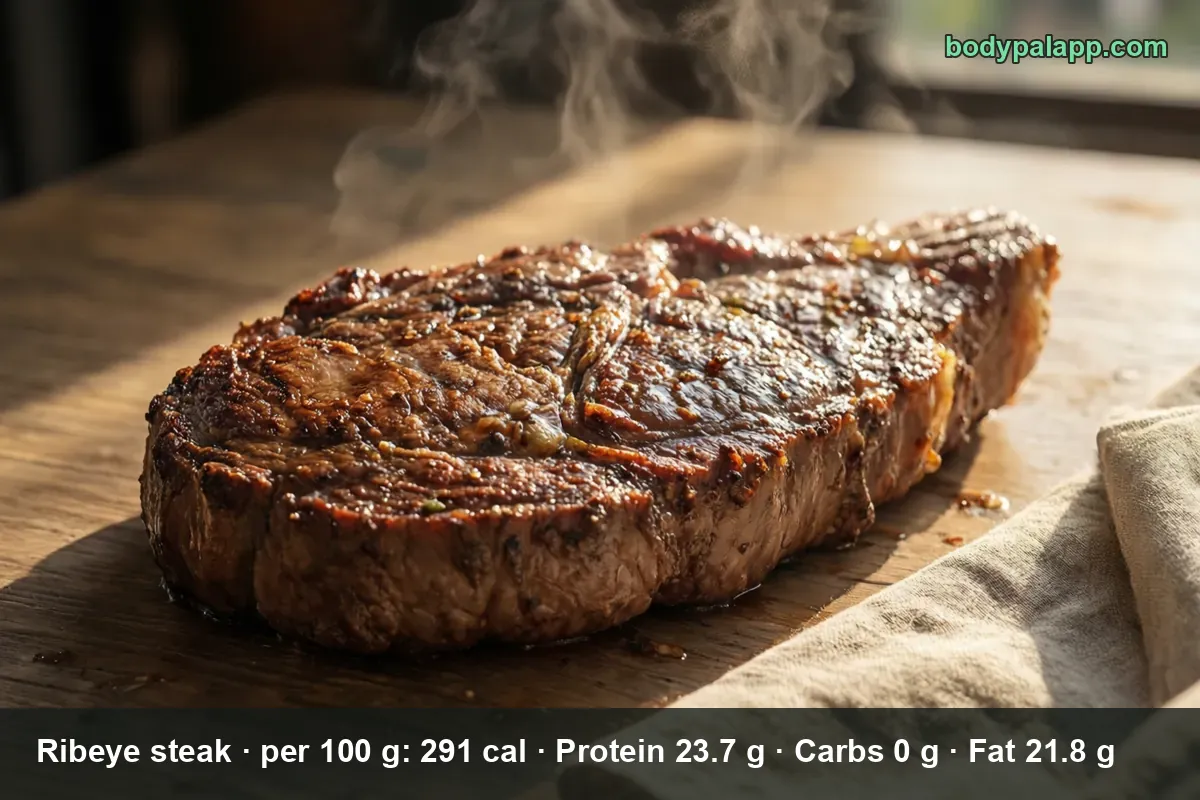
The steak you buy and the steak you eat are two different weights, which is why the calories in ribeye steak always arrive as a pair of numbers. An 8 oz boneless ribeye is 554 calories on the butcher's scale and 495 calories by the time it comes off the grill at about 6 oz. Per 100 g of cooked steak that is 291 calories, with 40 g of protein in the 8 oz portion and not a single gram of carbohydrate.
On this page
- Ribeye steak quick facts
- What an 8 oz ribeye really costs you
- Ribeye portions, from the package to the plate
- Should you cut off the fat cap?
- Choice, Select and the grade on the label
- Bone-in, cap steak and the rest of the rib
- The sodium in a steak is not from the steak
- Saturated fat, protein and a 12 oz problem
- How does ribeye compare with other steaks?
- Most popular ribeye steak brands
- Ribeye steak FAQs
Ribeye steak quick facts
These numbers are for a boneless ribeye, lip-on, trimmed to 1/8 inch of fat, grilled, eaten the way it arrives — marbling and fat cap included. USDA files it as rib eye steak, boneless, lip-on, separable lean and fat, all grades, cooked, grilled. The serving column is the 8 oz steak most people put in the cart, weighed after cooking.
| Nutrient | Per 100 g | Per 8 oz steak, grilled (170 g) | % Daily Value |
|---|---|---|---|
| Calories | 291 | 495 | — |
| Total fat | 21.8 g | 37.1 g | 48% |
| Saturated fat | 9.7 g | 16.5 g | 82% |
| Carbohydrate | 0 g | 0 g | 0% |
| Protein | 23.7 g | 40.3 g | 81% |
| Sodium | 54 mg | 92 mg | 4% |
| Cholesterol | 80 mg | 136 mg | 45% |
% Daily Value is based on a 2,000-calorie diet.
Verified nutrition data
Numbers on this page come from USDA FoodData Central, the U.S. Department of Agriculture’s food composition database, and from manufacturer labels where a branded product is named. Last verified September 2026. How we verify our data →
There is no fiber row and no sugar row here, and that is not an oversight. USDA records zero carbohydrate, zero fiber and zero sugars for beef, so three consecutive zeros would be pure noise.
Two rows carry the weight. Protein at 81% of the day is the reason people order this cut. Saturated fat at 82% is the reason to think about what goes next to it.
A second USDA database backs the headline up: the survey file, which records beef as Americans report eating it, lists steak, ribeye, lean and fat eaten at 289 calories per 100 g with 23.5 g of protein. Two independent datasets, less than 1% apart.
What an 8 oz ribeye really costs you
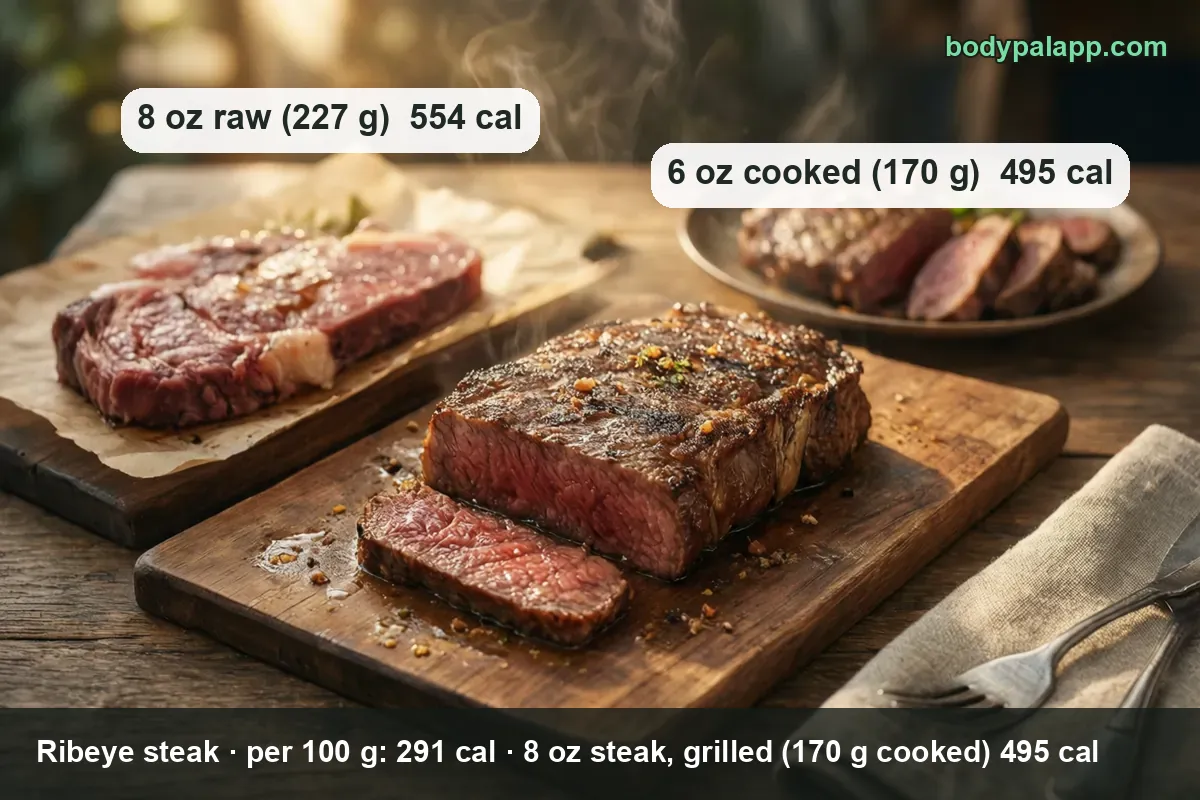
Every steak is sold by its raw weight. The package says 8 oz, the menu says 8 oz, and most calorie charts do their arithmetic on that 8 oz. But a ribeye loses about a quarter of its weight on the grill, mostly water and rendered fat dripping into the flames.
USDA documents that loss in its own portion data. The raw record lists one steak at 361 g; the grilled record lists the same steak at 291 g, a yield of 81%. A second entry spells it out in words, "one steak, yield from 295 g raw meat = 233 g", which is 79%. The survey database, built on longer-cooked home portions, is harsher at roughly 70%. Rare loses less, well done loses more, so the honest working figure is a loss of around a quarter.
So "calories in an 8 oz ribeye" has two correct answers:
- 554 calories — the meat you bought, 227 g raw at 244 calories per 100 g
- 495 calories — the meat you ate, about 170 g cooked at 291 calories per 100 g
The 59-calorie gap is not rounding, and it is not the steak shrinking into thin air. It is fat in the pan. Raw, those 227 g hold 42.5 g of fat and 42.8 g of protein. Cooked, the 170 g on the plate hold 37.1 g of fat and 40.3 g of protein. Multiply the missing 5.4 g of fat by 9 calories and the missing 2.5 g of protein by 4, and you get 59 calories almost exactly. The books balance.
Which number should you log? The cooked one, if the steak went on a grill or a rack where the drippings were lost. The raw one, if you cooked it in a skillet and spooned the fat back over it, or finished it in butter — then the calories never left the plate.
Ribeye portions, from the package to the plate
Steakhouse and supermarket sizes, with both numbers side by side. Cooked weights assume the usual 25% loss.
| Steak, as sold | Raw weight | Raw calories | Cooked weight | On the plate |
|---|---|---|---|---|
| 6 oz ribeye | 170 g | 415 | 128 g | 373 |
| 8 oz ribeye | 227 g | 554 | 170 g | 495 |
| 10 oz ribeye | 284 g | 692 | 213 g | 620 |
| 12 oz ribeye | 340 g | 830 | 255 g | 742 |
| 16 oz (1 lb) ribeye | 454 g | 1,107 | 340 g | 989 |
If you weigh your meat after cooking instead, work from these. The right-hand column is the same cut with the fat cap and visible marbling cut away, which is covered in the next section.
| Cooked portion | Weight | Lean and fat | Lean only |
|---|---|---|---|
| 1 oz | 28 g | 81 | 58 |
| 3 oz (the USDA serving) | 85 g | 247 | 176 |
| 6 oz | 170 g | 495 | 352 |
| A 100 g slab | 100 g | 291 | 207 |
The 3 oz row is the official serving size behind most protein-food guidance, including MyPlate, and it is about a third of a restaurant ribeye. Nobody eats 3 oz of ribeye.
USDA's survey portions describe the real thing better: a thin steak runs 180 g cooked (520 calories), a regular steak 240 g (694), a thick one 360 g (1,040). A cup of diced or sliced ribeye, the way it lands on a salad or in a bowl, is 135 g and 390 calories.
Should you cut off the fat cap?
Trimming works. It works less than the laboratory numbers suggest, and the difference between those two statements is worth about 40 calories a steak.
USDA's "separable lean only" figure is 207 calories per 100 g against 291 for lean and fat, a drop of 29%. That number comes from a technician separating every scrap of fat from the muscle with a scalpel. On a 6 oz cooked portion it looks like 495 calories falling to 352.
What happens at your table is different, and USDA measured that too. In the survey database, ribeye "lean and fat eaten" is 289 calories per 100 g and "lean only eaten" is 230 — a 20% drop, not 29%, because a knife and a fork cannot chase marbling through the middle of the muscle. For the same 6 oz portion that is 491 calories down to 391.
So cutting the fat cap off saves roughly 100 calories on a 6 oz steak, and it lifts the protein density from 23.69 g per 100 g to 27.97 g. Worth doing. If you want a bigger saving than that, buy a leaner cut rather than butchering an expensive one.
Choice, Select and the grade on the label
One word on the package moves the calories more than any brand does.
| USDA grade | Calories per 100 g, grilled | 8 oz steak, cooked (170 g) |
|---|---|---|
| Select | 273 | 464 |
| All grades (average) | 291 | 495 |
| Choice | 303 | 515 |
Choice against Select is an 11% difference, or about 51 calories on an 8 oz steak, and it comes entirely from marbling. Grading is a visual assessment of intramuscular fat, so a higher grade is by definition a fattier steak. That is why it tastes better and why it costs more.
Prime is where the data runs out. USDA's composition tables carry no Prime ribeye entry at all, so nobody can quote you a laboratory figure for one. The only honest source is a label, and Kroger's Private Selection Prime ribeye declares 339 calories per 100 g raw against USDA's 244 for an all-grades raw steak. On that label's own 4 oz (112 g) serving, that is 380 calories before the pan. Treat it as one product's number, not the value for all Prime beef.
Raw retail labels for ribeye run from about 211 to 339 calories per 100 g across the case. That spread is grade and trim, not marketing.
Bone-in, cap steak and the rest of the rib
The same rib section gives four or five steaks with different names, and the calories track the fat.
| Cut, cooked | Calories per 100 g | 6 oz cooked (170 g) |
|---|---|---|
| Bone-in ribeye (cowboy, tomahawk) | 309 | 525 |
| Boneless ribeye, 1/8" trim | 291 | 495 |
| Boneless ribeye, lip off, 0" trim | 271 | 461 |
| Rib eye small end, ribs 10 to 12 | 249 | 423 |
| Ribeye cap, the spinalis, lean only | 246 | 418 |
| Ribeye filet, lean only | 199 | 338 |
Bone-in reads highest, but USDA is measuring meat and the bone is not food, so a 20 oz tomahawk is not 20 oz of steak. Weigh what you cut off the bone.
The two cuts worth knowing are at the bottom. The cap, that crescent of spinalis muscle steak people fight over, is 246 calories per 100 g as USDA trims it; the ribeye filet, the round eye in the middle, is 199. The eye is the leanest thing in the whole rib primal, close to a top sirloin, and it sits inside the fattiest steak on the menu.
Grass-fed changes the arithmetic slightly. Imported Australian grass-fed ribeye is 217 calories per 100 g raw against 244 for the domestic grain-fed cut, so an 8 oz raw steak drops from 554 to about 493. USDA has no cooked entry for it, so that is a raw-to-raw comparison.
The sodium in a steak is not from the steak
Beef muscle holds 54 mg of sodium per 100 g, which is 2% of the Daily Value. A whole 8 oz steak, unseasoned, carries 92 mg. Now the same steak as it is cooked and eaten in American kitchens, salted before and after the sear:
| As eaten | Weight | Calories | Sodium | Sodium %DV |
|---|---|---|---|---|
| 1 cup, diced | 135 g | 390 | 487 mg | 21% |
| 1 thin steak | 180 g | 520 | 650 mg | 28% |
| 1 regular steak | 240 g | 694 | 866 mg | 38% |
| 1 thick steak | 360 g | 1,040 | 1,300 mg | 57% |
That is 361 mg of sodium per 100 g instead of 54, nearly seven times as much, so about 85% of the sodium in a cooked steak was added by whoever held the salt. The FDA's Daily Value for sodium is 2,300 mg, and a regular restaurant ribeye takes more than a third of that before the fries and the sauce.
The refrigerated case makes the same point from the other side: one fully cooked, vacuum-packed ribeye product lists 560 mg of sodium per 100 g, ten times the raw meat next to it. Season the steak yourself and you own that whole number.
Saturated fat, protein and a 12 oz problem
A ribeye is not an unhealthy food. It is a large one, and size is what pushes it past the lines on the label.
| Steak, as sold | Cooked | Calories | Protein %DV | Saturated fat %DV |
|---|---|---|---|---|
| 6 oz | 128 g | 373 | 61% | 62% |
| 8 oz | 170 g | 495 | 81% | 82% |
| 10 oz | 213 g | 620 | 101% | 103% |
| 12 oz | 255 g | 742 | 121% | 123% |
| 16 oz | 340 g | 989 | 161% | 165% |
The two columns rise together, and they cross the 100% line at almost the same size. A 10 oz ribeye is a full day of protein and a full day of saturated fat in one object. A 12 oz is 123% of the saturated fat Daily Value, and the Dietary Guidelines for Americans ask for less than 10% of daily calories from saturated fat.
Our take: a 6 oz to 8 oz ribeye is a genuinely good high-protein dinner, and the 16 oz is a special occasion, not a Tuesday. If you eat ribeye often, the lever with the most travel is not trimming the fat cap, it is ordering the smaller steak. The other gap is fiber: a ribeye contributes zero against a Daily Value of 28 g, so whatever else is on the plate is doing all of that work.
How does ribeye compare with other steaks?
All five are USDA cooked entries, lean and fat, scaled to the same 6 oz cooked portion so the comparison is honest.
| Cut, grilled or broiled | Calories per 100 g | 6 oz cooked (170 g) | Protein | Fat |
|---|---|---|---|---|
| Ribeye steak | 291 | 495 | 40.3 g | 37.1 g |
| Filet mignon (tenderloin) | 267 | 454 | 45.0 g | 29.1 g |
| New York strip (top loin) | 264 | 449 | 44.9 g | 28.5 g |
| Top sirloin | 243 | 413 | 45.8 g | 24.2 g |
| Flank steak | 192 | 326 | 47.0 g | 14.0 g |
Ribeye is the highest-calorie steak on the list and, at the same time, the lowest-protein one — every other cut delivers more protein in fewer calories. Flank steak is the extreme case: 47 g of protein for 326 calories, against ribeye's 40.3 g for 495. Per 100 calories eaten, flank gives you 14.4 g of protein and ribeye gives 8.1 g.
Our take: if the goal is protein per calorie, flank or top sirloin wins outright and it is not close. If the goal is a steak that eats like a steak, order the ribeye at 6 oz or 8 oz rather than a 12 oz sirloin — the smaller ribeye still lands lower on calories and you get the marbling you paid for. The New York strip is the sensible middle: it costs 46 fewer calories than a ribeye at the same weight and carries 4.6 g more protein.
Most popular ribeye steak brands in the United States
Ranked by how widely each product appears among foods sold in the United States, from the BodyPal food database of over 3.3 million products. Calories are the figures printed on each Nutrition Facts label, checked against USDA FoodData Central.
| Product | Calories (per 100 g raw) |
|---|---|
| Private Selection Prime Beef Ribeye Steak (Kroger) | 339 cal |
| Simply Balanced Rib-Eye Steak (Target) | 312 cal |
| Simple Truth Angus Beef Ribeye Steak (Kroger) | 250 cal |
| Weis Organic Ribeye Steaks | 218 cal |
| Simple Truth Organic Beef Ribeye Steak (Kroger) | 214 cal |
| Rastelli’s Beef Ribeye Steak | 211 cal |
Brand popularity: BodyPal food database. Nutrition: manufacturer labels / USDA FoodData Central.
Ribeye steak FAQs
How many calories are in a ribeye steak?
A grilled boneless ribeye is 291 calories per 100 g. The 8 oz steak most people buy weighs about 170 g once cooked, so it lands at 495 calories with 40.3 g of protein. Weighed raw at its 8 oz package weight, the same steak is 554 calories.
How many calories are in an 8 oz ribeye steak?
495 calories on the plate. An 8 oz steak is 227 g raw, which is 554 calories, and it comes off the grill at roughly 170 g, which is 495. The 59-calorie difference is fat and water lost during cooking, so log 495 unless you cooked it in a skillet and kept the drippings.
How many calories are in a 10 oz ribeye steak?
620 calories once grilled. Ten ounces raw is 284 g and 692 calories; after cooking it weighs about 213 g. That portion carries 50.5 g of protein, 101% of the Daily Value, and 20.6 g of saturated fat, which is 103% of the Daily Value.
How many calories are in a 12 oz ribeye steak?
742 calories cooked, from 830 calories of raw steak. A 12 oz ribeye is 340 g raw and about 255 g on the plate. It delivers 60.4 g of protein (121% DV) and 24.7 g of saturated fat (123% DV), so one steak covers a full day of both.
Does a ribeye have more calories raw or cooked?
Per 100 g, cooked is higher: 291 calories against 244 raw, because water leaves the meat and concentrates what is left. Per steak, cooked is lower: an 8 oz ribeye falls from 554 calories to 495. The steak loses about a quarter of its weight, mostly water plus 5.4 g of rendered fat.
How much protein is in a ribeye steak?
40.3 g in an 8 oz steak, cooked, which is 81% of the Daily Value. That works out to 23.7 g per 100 g of grilled ribeye. Trim the fat cap and the density rises to 27.97 g per 100 g, though the total protein on the plate goes down because you removed weight.
Is ribeye steak healthy?
One 8 oz ribeye gives 81% of the Daily Value for protein and 82% for saturated fat, with zero carbohydrate and zero fiber. The Dietary Guidelines for Americans ask for under 10% of calories from saturated fat, and a 12 oz steak alone is 123% of the Daily Value. Portion size decides this one, not the cut.
Which is leaner, ribeye, New York strip or filet mignon?
New York strip, narrowly. At the same 6 oz cooked portion, strip is 449 calories, filet mignon is 454 and ribeye is 495. Both leaner cuts also carry about 4.5 g more protein than the ribeye. Flank steak beats all three at 326 calories with 47 g of protein.
Similar foods
- Lamb Roast — 247 cal per 3 oz
- Chicken Strip — 315 cal for 3 strips
- Pork Shoulder Roast — 248 cal for 3 oz cooked
- Lamb — 250 cal for 3 oz cooked
- Chicken Wings — 250 cal per 3 oz portion
- Chicken Patty — 172 cal per patty
Count it without the math
Point the camera at the steak and BodyPal logs the calories, the protein and the sodium before it stops resting.


How long does it take to burn off ribeye steak?
An 8 oz steak, grilled is 495 kcal. Enter your weight and the amount you ate to see how long it takes you to burn that off:
lb
| Activity | Time to burn 495 kcal |
|---|---|
| Walking, brisk | 1 hr 39 min |
| Cycling, moderate | 1 hr 2 min |
| Swimming, moderate | 1 hr 11 min |
| Jogging | 58 min |
| Weight training, moderate | 1 hr 50 min |
Times are for a 155 lb adult at a steady pace; change the weight to see yours. The amount is set to the portion in the text (8 oz); change it to what you actually ate. BodyPal works this out from your steps automatically.
This table assumes you know your daily total. If you do not, the daily calorie calculator works it out from five numbers.