
How many calories are in a pork shoulder roast?
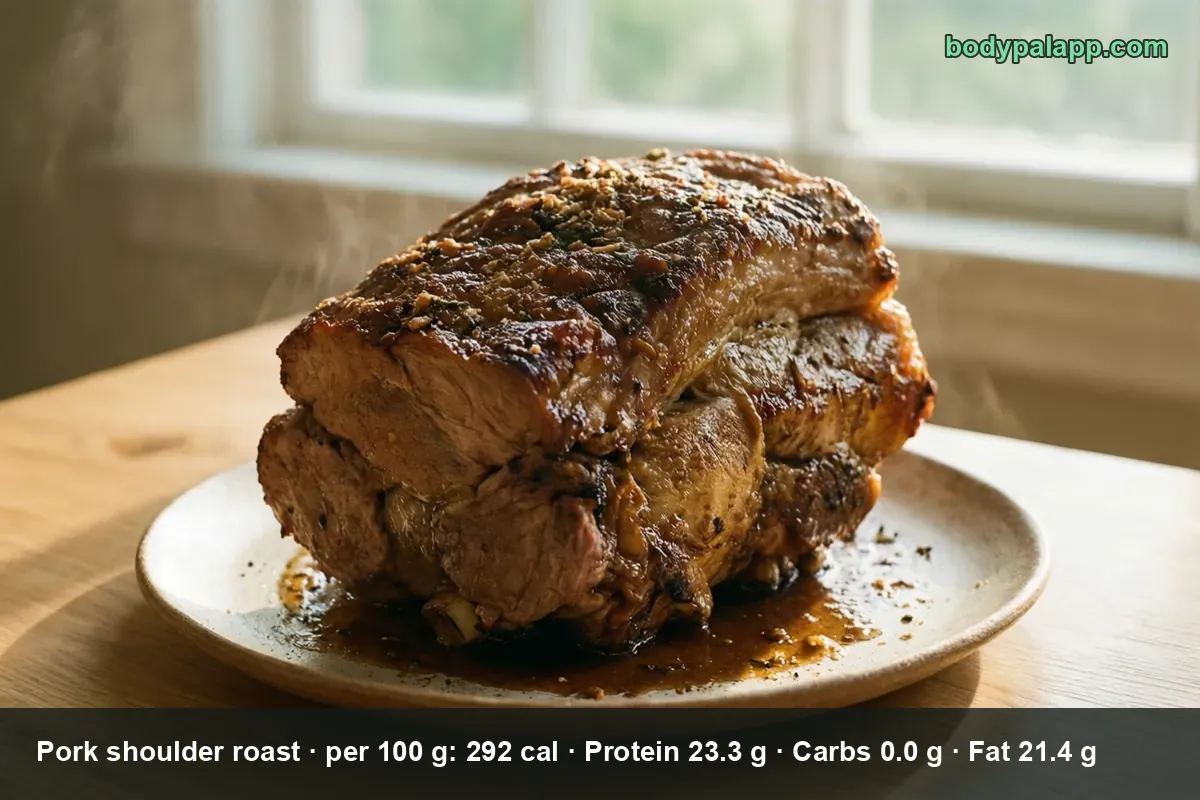
A 3 oz cooked serving of pork shoulder roast carries 248 calories, and the meat runs 292 calories per 100 g with the fat left on. Shoulder is marbled all the way through rather than trimmed at the edge, which is why it beats loin so easily. Cut the visible fat away and that same 3 oz slice falls to 196.
On this page
- Pork shoulder roast quick facts
- US servings, from one ounce to a whole cup
- Boston butt, picnic shoulder and the trimmed versions
- Saturated fat and sodium are the rows to watch
- How does pork shoulder roast compare?
- Most popular pork shoulder roast brands
- Pork shoulder roast FAQs
Pork shoulder roast quick facts
When an American says "pork shoulder roast," the plate almost always holds fresh whole shoulder that went into the oven and came out with its fat cap intact. That is the record used here: SR Legacy 167844, "Pork, fresh, shoulder, whole, separable lean and fat, cooked, roasted". It is the only shoulder entry that carries both household measures a home cook actually uses, a 3 oz cooked slice and a cup of diced meat.
Everything below is measured cooked. That matters more with shoulder than with almost any other cut, because a roast sheds fat and water for hours in the oven. The standard kitchen rule is that 4 oz of raw meat lands near 3 oz on the plate, so a raw weight from the butcher paper is not the number to log.
| Nutrient | Per 100 g | Per 3 oz cooked (85 g) | % Daily Value |
|---|---|---|---|
| Calories | 292 | 248 | — |
| Total fat | 21.39 g | 18.2 g | 23% |
| Saturated fat | 7.86 g | 6.7 g | 33% |
| Carbohydrate | 0 g | 0 g | 0% |
| Dietary fiber | 0 g | 0 g | 0% |
| Total sugars | 0 g | 0 g | — |
| Protein | 23.28 g | 19.8 g | 40% |
| Sodium | 68 mg | 58 mg | 3% |
| Cholesterol | 90 mg | 77 mg | 26% |
| Potassium | 329 mg | 280 mg | 6% |
% Daily Value is based on a 2,000-calorie diet.
Verified nutrition data
Numbers on this page come from USDA FoodData Central, the U.S. Department of Agriculture’s food composition database, and from manufacturer labels where a branded product is named. Last verified September 2026. How we verify our data →
There is no added sugars row and no trans fat row on this page because USDA does not publish either value for fresh pork in the SR Legacy edition. Nothing is lost in practice: an unglazed, unmarinated roast has no added sugar to report, and the carbohydrate line is a flat zero. If your roast went into the oven under a brown-sugar rub or came out under a bottled barbecue sauce, those calories are on the sauce label, not here.
US servings, from one ounce to a whole cup
| Serving | Weight | Calories |
|---|---|---|
| 1 oz cooked | 28 g | 82 kcal |
| 3 oz cooked | 85 g | 248 kcal |
| 4 oz cooked | 113 g | 330 kcal |
| 1 cup, diced | 135 g | 394 kcal |
| 6 oz cooked | 170 g | 496 kcal |
| Per 100 g | 100 g | 292 kcal |
The 3 oz slice and the 1 cup of diced meat are USDA household measures. The 1 oz, 4 oz and 6 oz rows are our own arithmetic from the USDA 100 g figure, not USDA servings, scaled straight off 292 calories per 100 g.
Here is the trap worth remembering. A cup of diced roast weighs 135 g and comes to 394 calories — 146 more than the 3 oz slice, even though both get logged as "a serving of pork." Diced meat packs. If you shred a shoulder for tacos and scoop it by the cup, you are eating closer to a 6 oz portion than a 3 oz one. Scaled from the same 100 g row, that cup also holds 28.9 g of fat and 31.4 g of protein.
A whole roast rarely arrives in single servings, either. A pound of cooked meat, 454 g, works out to about 1,326 calories by our own arithmetic from the USDA figure. That is the number to divide across the table, not to log for yourself.
Boston butt, picnic shoulder and the trimmed versions
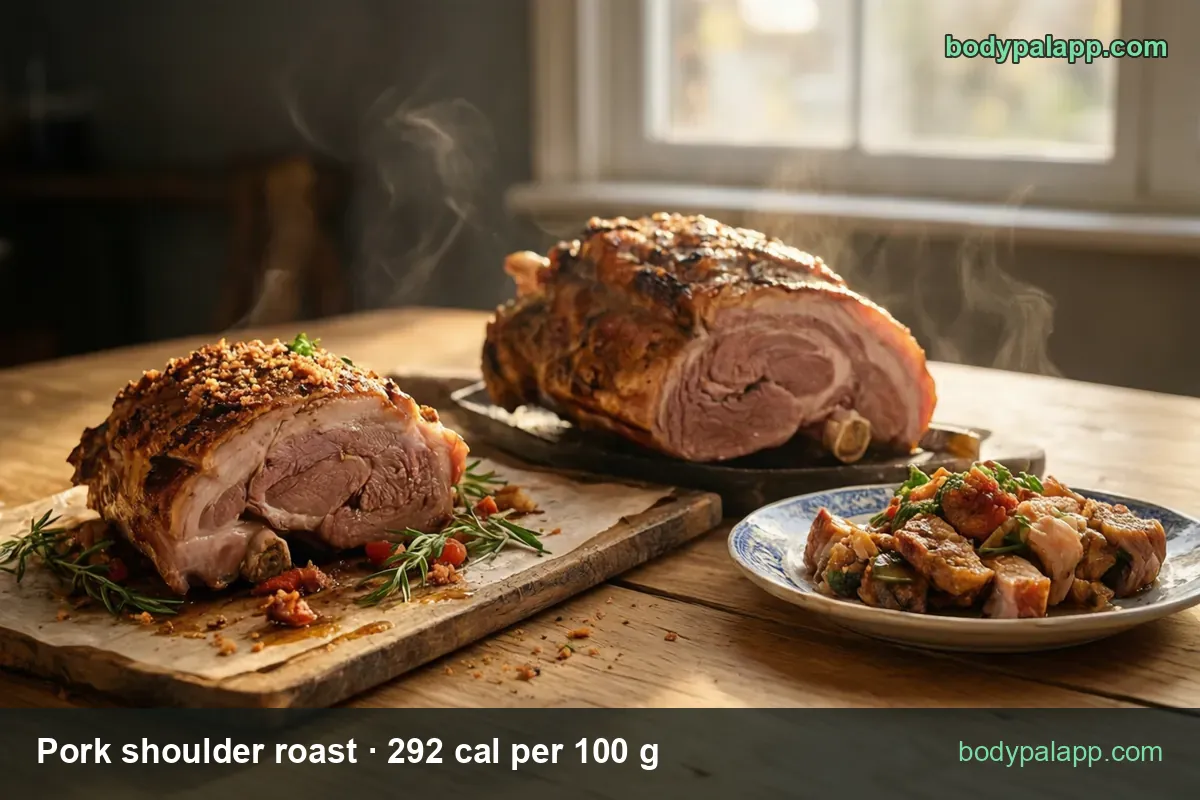
The shoulder is sold in two halves and in two states of trim, and the four combinations spread across 89 calories per 100 g. Boston butt is the upper blade section, the one that goes into pulled pork. Picnic shoulder is the lower arm, cheaper and fattier. Both are "pork shoulder roast" at the meat counter.
| Version | Per 100 g | Typical serving | Calories |
|---|---|---|---|
| Whole shoulder, lean and fat (main row) | 292 kcal | 3 oz cooked (85 g) | 248 kcal |
| Boston butt, lean and fat | 269 kcal | 3 oz cooked (85 g) | 229 kcal |
| Boston butt, lean only | 232 kcal | 3 oz cooked (85 g) | 197 kcal |
| Whole shoulder, lean only (trimmed) | 230 kcal | 3 oz cooked (85 g) | 196 kcal |
| Picnic shoulder, lean and fat | 317 kcal | 3 oz cooked (85 g) | 269 kcal |
| Picnic shoulder, lean only | 228 kcal | 3 oz cooked (85 g) | 194 kcal |
| Cured smoked picnic, lean only | 170 kcal | 1 cup (140 g) | 238 kcal |
Picnic shoulder with its fat is the heaviest of the eight USDA shoulder records at 317 calories per 100 g, and Boston butt with its fat is the lightest of the untrimmed ones at 269. Between the two, buying the blade end instead of the arm end saves 48 calories per 100 g before you do anything else in the kitchen.
Trimming does far more. Whole shoulder falls from 292 to 230 calories per 100 g once the visible fat comes off, a drop of 62, while protein climbs from 23.28 g to 25.33 g. That is the rare swap that costs nothing: fewer calories, more of the nutrient you were buying meat for. Cutting the fat cap off after roasting keeps the flavor it gave the meat and still lands you near the trimmed number.
The last row is a different animal. Cured smoked picnic shoulder, lean only, reads as the lightest thing on the page at 170 calories per 100 g, but the curing brine is what makes it lean-looking, and the sodium bill is enormous. More on that below.
Saturated fat and sodium are the rows to watch
A 3 oz serving delivers 6.7 g of saturated fat, 33% of the Daily Value on the FDA Nutrition Facts label, plus 77 mg of cholesterol at 26% DV. The Dietary Guidelines for Americans suggest keeping saturated fat under 10% of daily calories, and one modest slice of shoulder takes a third of that budget. Two slices and a side of cheese and the day is spent.
Protein pulls the other way, and it pulls hard. Those same 3 oz carry 19.8 g of protein, 40% DV, which is why shoulder shows up so often in MyPlate protein-food advice even in its richer cuts. If you are choosing between shoulder and a leaner cut for satiety, shoulder wins on staying power and loses on the saturated fat line.
Sodium is where the fresh and the cured versions part company. Fresh roasted shoulder holds 68 mg of sodium per 100 g, about 3% DV, which is nothing — it is unsalted meat. The cured, roasted picnic shoulder holds 1,231 mg per 100 g, 54% DV, before anyone reaches for the salt shaker. That is roughly half a teaspoon of table salt in a small portion. If you are watching sodium, fresh shoulder is the pick and the smoked picnic is not.
How does pork shoulder roast compare?
| Cut | Per 100 g | US serving | Calories |
|---|---|---|---|
| Pork shoulder roast, whole, lean and fat | 292 kcal | 3 oz cooked (85 g) | 248 kcal |
| Pork sirloin chop, boneless, braised | 171 kcal | 3 oz cooked (85 g) | 145 kcal |
| Pork center loin chop, bone-in, raw | 170 kcal | 4 oz raw (113 g) | 192 kcal |
| Pickled pork hocks | 171 kcal | 3 oz cooked (85 g) | 145 kcal |
Note the third row carefully: it is measured raw, because that is how a bone-in chop is sold. Four ounces raw is roughly the three ounces that reach the plate, which is why its 192 calories sit between the cooked figures rather than below them. Comparing a raw weight to a cooked one is the single most common way pork gets mislogged.
Our take: shoulder is the flavor cut and the loin is the calorie cut, and the gap is not small — 248 against 145 for the same 3 oz. If you are eating for a calorie target, braised sirloin chop does the job at 171 calories per 100 g with 28.41 g of protein, the best protein-per-calorie deal in the table. If you are cooking a roast for a crowd and want meat that survives four hours in the oven, shoulder is the right cut and the trimmed row is the honest way to log it, at 196 calories per 3 oz. Reserve the untrimmed 292 for the days you actually eat the crust.
Most popular pork shoulder roast brands in the United States
Ranked by how widely each product appears among foods sold in the United States, from the BodyPal food database of over 3.3 million products. Calories are the figures printed on each Nutrition Facts label, checked against USDA FoodData Central.
| Product | Calories (per 100 g) |
|---|---|
| Adaptable Meals Carnitas Boneless Pork Shoulder Roast | 196 cal |
| Prairie Fresh Signature Pork Shoulder Roast Boneless | 205 cal |
| Prairie Fresh Signature Pork Shoulder Roast Boneless (second lot) | 196 cal |
| Hormel Southwestern Style Pork Shoulder Roast | 170 cal |
Brand popularity: BodyPal food database. Nutrition: manufacturer labels / USDA FoodData Central.
Pork shoulder roast FAQs
How many calories are in a pork shoulder roast?
A 3 oz cooked serving is 248 calories, and 100 g of the roasted meat with its fat is 292 calories. A cup of diced roast comes to 394. The USDA record covers fresh whole shoulder, roasted, lean and fat together, with no rub, glaze or sauce added.
Is pork shoulder the same as Boston butt?
Not quite, and the difference is 23 calories per 100 g. Boston butt is the upper blade section at 269 calories per 100 g, while whole shoulder with its fat is 292. The lower half, the picnic shoulder, is the fattiest at 317. All three are sold as roasts.
How much protein is in pork shoulder roast?
A 3 oz cooked serving carries 19.8 g of protein, 40% of the Daily Value. Per 100 g the roast holds 23.28 g. Trim the visible fat and protein rises to 25.33 g per 100 g while calories fall from 292 to 230, so trimming improves both numbers at once.
How many calories in 1 cup of diced roasted pork shoulder?
One cup of diced roast weighs 135 g and comes to 394 calories, 146 more than a 3 oz slice. Scaled from the USDA 100 g row it also holds 28.9 g of fat and 31.4 g of protein. Diced meat packs tightly, so weighing beats scooping.
Does trimming the fat lower pork shoulder calories?
Yes, by 62 calories per 100 g. Whole shoulder with the fat is 292 calories per 100 g; the same cut with visible fat removed is 230. Saturated fat drops from 7.86 g to 4.79 g, and protein climbs from 23.28 g to 25.33 g. A 3 oz slice falls from 248 to 196.
How many calories in a pound of cooked pork shoulder?
A pound of cooked roast, 454 g, works out to about 1,326 calories. That is our own arithmetic from the USDA 100 g figure rather than a USDA serving. Trimmed of visible fat, the same pound is about 1,044. A roast this size is shared, so weigh your own plate.
Is smoked picnic shoulder high in sodium?
Yes, 1,231 mg of sodium per 100 g, 54% of the Daily Value. That is cured, roasted picnic shoulder, lean only, against 68 mg for the fresh roast. It looks lighter at 170 calories per 100 g, but the curing brine is doing that work, not the cut itself.
Is pork shoulder roast healthy?
A 3 oz serving gives 19.8 g of protein for 248 calories, a fair trade, but it also brings 6.7 g of saturated fat at 33% of the Daily Value and 77 mg of cholesterol. Trimmed shoulder, 196 calories per 3 oz, keeps the protein and cuts saturated fat to 4.1 g.
Similar foods
- Chicken Strip — 315 cal for 3 strips
- Lamb Roast — 247 cal per 3 oz
- Ribeye Steak — 495 cal per 8 oz steak
- Lamb — 250 cal for 3 oz cooked
- Chicken Wings — 250 cal per 3 oz portion
- Chicken Patty — 172 cal per patty
Count it without the math
Point the camera at the carving board and BodyPal counts the slice for you, fat cap and all.


How long does it take to burn off 248 kcal of pork shoulder roast?
A 3 oz (85 g) cooked serving is 248 kcal. Enter your weight and the amount you ate to see how long it takes you to burn that off:
lb
| Activity | Time to burn 248 kcal |
|---|---|
| Walking, brisk | 50 min |
| Cycling, moderate | 31 min |
| Swimming, moderate | 35 min |
| Jogging | 29 min |
| Weight training, moderate | 55 min |
Times are for a 155 lb adult at a steady pace; change the weight to see yours. The amount is set to the portion in the text (85 g); change it to what you actually ate. BodyPal works this out from your steps automatically.
Burning it off is one side of it. The other is knowing your number: work out how many calories you need a day, with macros and a goal date.