
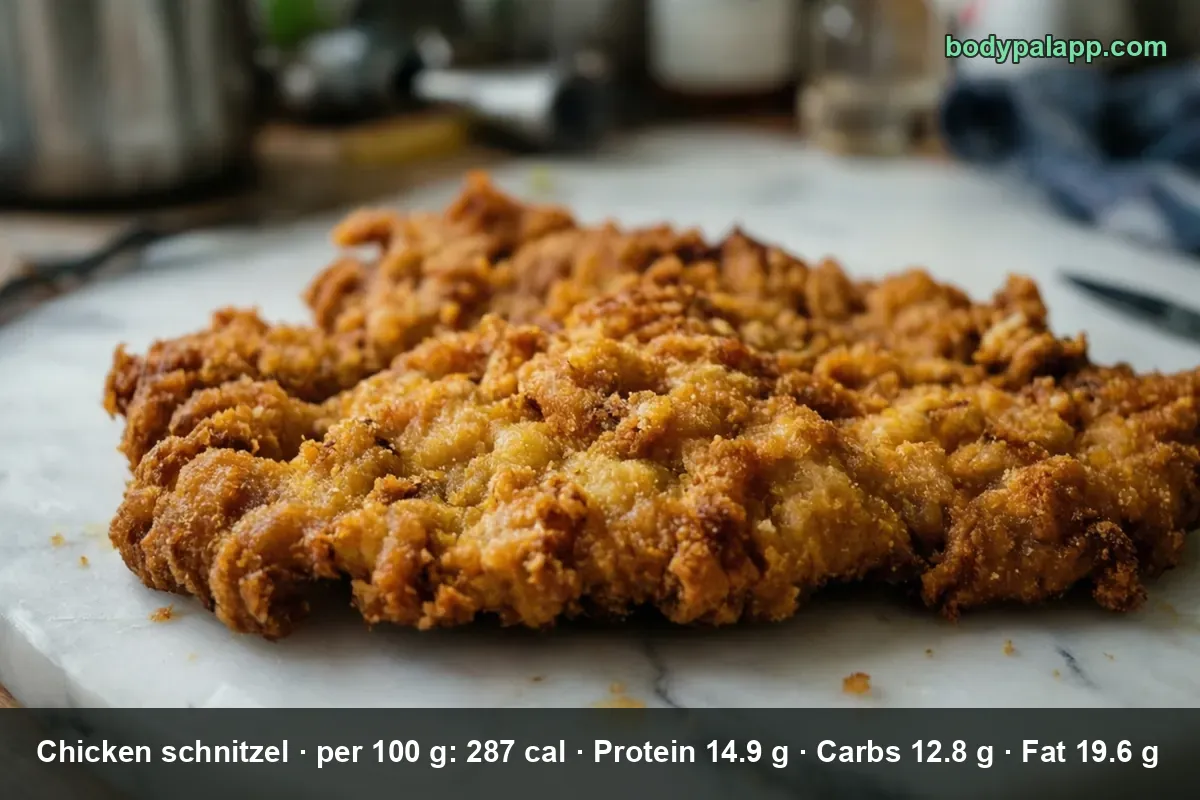
How many calories are in a chicken schnitzel?
A restaurant-size breaded chicken schnitzel of 160 g carries 459 calories, and the cutlet runs 287 calories per 100 g. A small frozen breaded patty of 75 g is only 215. The meat is lean; the crumb coating and the oil it soaks up are what move the number.
On this page
- Chicken schnitzel quick facts
- US servings, from one ounce to a whole cutlet
- Frozen patties, tenders and the baked school-lunch version
- Sodium and saturated fat are the rows to watch
- How does chicken schnitzel compare?
- FAQ
Chicken schnitzel quick facts
USDA does not publish a record called "schnitzel." The closest match, and the one used across this page, is FNDDS 2706088, "Chicken patty, breaded" — a breaded, fried piece of chicken served on its own, with no potatoes, no sauce and no school recipe attached. That is what a schnitzel is on the plate: a pounded cutlet, floured, egged, crumbed and shallow-fried.
Two other candidates exist and both describe something else. One is a frozen meal where potatoes and vegetables dilute every value; the other is a whole-grain school-lunch patty built to a federal recipe and baked rather than fried. They appear further down as variants, not as the headline number.
| Nutrient | Per 100 g | Per 1 schnitzel (160 g) | % Daily Value |
|---|---|---|---|
| Calories | 287 | 459 | — |
| Total fat | 19.58 g | 31.3 g | 40% |
| Saturated fat | 3.66 g | 5.9 g | 29% |
| Carbohydrate | 12.84 g | 20.5 g | 7% |
| Dietary fiber | 0.3 g | 0.5 g | 2% |
| Total sugars | 0 g | 0 g | — |
| Protein | 14.85 g | 23.8 g | 48% |
| Sodium | 532 mg | 851 mg | 37% |
% Daily Value is based on a 2,000-calorie diet.
Verified nutrition data
Numbers on this page come from USDA FoodData Central, the U.S. Department of Agriculture’s food composition database, and from manufacturer labels where a branded product is named. Last verified September 2026. How we verify our data →
Two rows you might expect are absent: added sugars and trans fat. This edition of FNDDS does not carry either value for this record, so guessing them would be worse than leaving them out. Cholesterol and potassium do exist here — 69 mg (23% DV) and 418 mg (9% DV) in one 160 g cutlet.
The 160 g weight is our own estimate of a large restaurant or homemade schnitzel, scaled from the USDA 100 g figures rather than taken from a USDA household measure. If yours comes off the pan lighter, scale down: every 10 g is 29 calories.
US servings, from one ounce to a whole cutlet
| Serving | Weight | Calories |
|---|---|---|
| 1 oz | 28 g | 80 kcal |
| 1 cubic inch, cut | 17 g | 49 kcal |
| One frozen breaded patty | 75 g | 215 kcal |
| 4 oz cutlet | 113 g | 324 kcal |
| One schnitzel, restaurant size | 160 g | 459 kcal |
| Per 100 g | 100 g | 287 kcal |
The 75 g patty and the single cubic inch are USDA household measures for this record. The 1 oz, 4 oz and 160 g lines are our own arithmetic from the USDA 100 g figure, not USDA servings — useful because a schnitzel is almost never a round number on the scale.
That spread is the single most useful fact on this page. The same food, at one unchanging 287 calories per 100 g, lands anywhere from 215 to 459 calories depending only on how big the cutlet is. That is a 2.1-fold difference with nothing changed in the kitchen. Logging "one schnitzel" without a weight is the most common way people miss 200 calories at dinner.
If you cook them at home, weigh the raw cutlet before breading and again after frying only if you want to be precise; otherwise weigh the finished piece, which is what these numbers describe.
Frozen patties, tenders and the baked school-lunch version
| Version | Per 100 g | Typical piece | Calories |
|---|---|---|---|
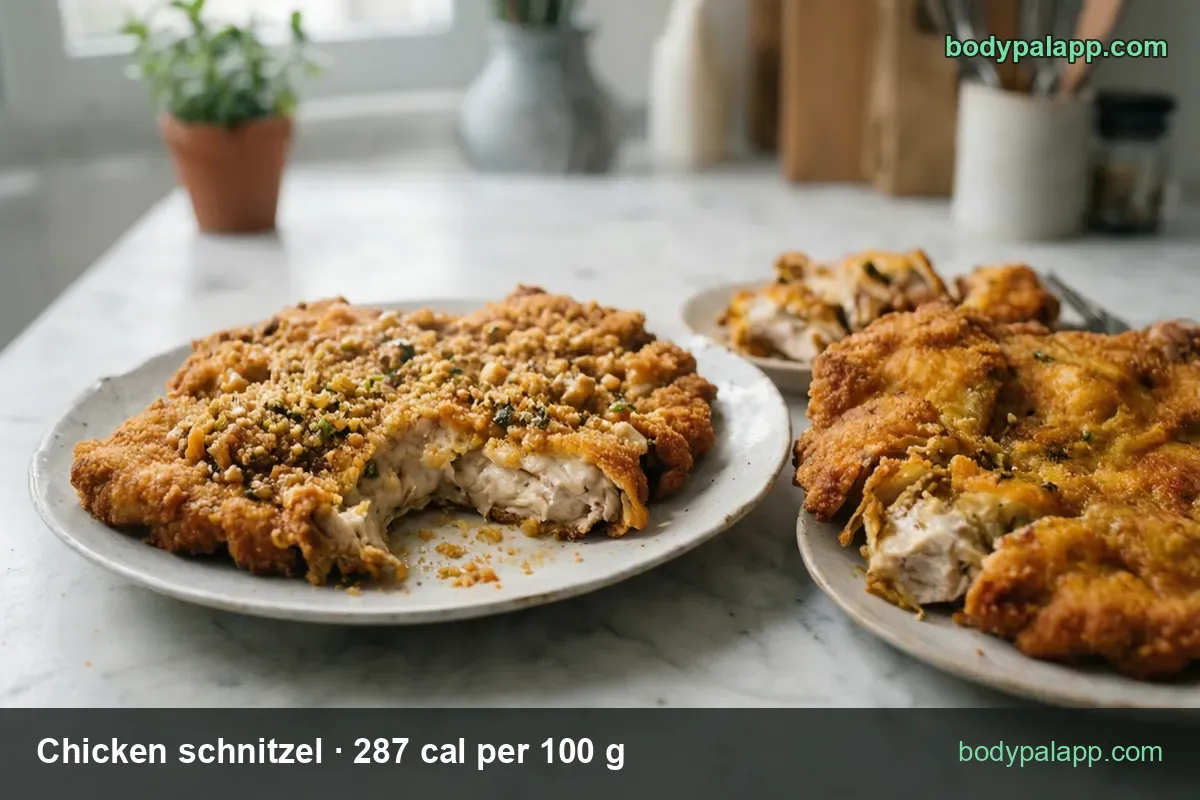
| Chicken schnitzel, breaded and fried | 287 kcal | 1 schnitzel, 160 g | 459 kcal |
| Breaded chicken tenders, restaurant | 283 kcal | 3 oz, 85 g | 241 kcal |
| Chicken tenders or strips, unspecified | 271 kcal | 3 oz, 85 g | 230 kcal |
| Chicken nuggets, from frozen | 298 kcal | 3 oz, 85 g | 253 kcal |
| School-lunch whole-grain breaded patty | 246 kcal | 1 patty, 86 g | 212 kcal |
| Breaded chicken patty frozen meal with sides | 175 kcal | 1 meal, 191 g | 334 kcal |
Read that table by the middle column, not the last one. Per 100 g these six sit inside a narrow band from 175 to 298 calories, and the only real outlier is the frozen dinner — its 175 is low because potatoes and vegetables share the weight, not because the chicken is leaner.
The baked school-lunch patty is the one worth borrowing from. At 246 calories per 100 g it is 41 calories lighter than the fried cutlet, with 13.93 g of fat against 19.58 g and 2.3 g of fiber from the whole-grain crumb against 0.3 g. That is roughly what happens when a schnitzel goes into the oven or the air fryer instead of a pan of oil: the coating stays, the absorbed fat mostly does not.
Store-bought breaded cutlets sit closest to the frozen patty line. USDA's branded database has no complete nutrition record for a retail schnitzel, so use the label on the box for those rather than any number here.
Sodium and saturated fat are the rows to watch
One schnitzel delivers 851 mg of sodium — 37% of the 2,300 mg Daily Value, or about a third of a teaspoon of table salt. Chicken breast itself is nearly sodium-free, so essentially all of it arrives with the brine, the seasoned flour and the crumb. FDA's guidance on sodium in the diet puts most Americans well above that daily figure already, and a schnitzel plus a side of fries can spend half a day's allowance in one sitting.
Fat is the other row. At 19.58 g per 100 g against 14.85 g of protein, this is one of the few chicken preparations where fat outweighs protein by weight. One cutlet is 31.3 g of fat, 40% DV, with 5.9 g saturated, 29% DV. The Dietary Guidelines cap saturated fat at under 10% of daily calories, which is about 20 g on a 2,000-calorie day — so a single schnitzel takes nearly a third of it before anything else on the plate.
The good news is the protein: 23.8 g in one cutlet, 48% of the Daily Value, which is most of what an adult meal should contribute. Chicken counts toward the MyPlate protein foods group whether it is breaded or not. If you are watching sodium, the baked whole-grain patty at 467 mg per 100 g is the better pick; if you want the protein density, plain grilled chicken beats any breaded version.
How does chicken schnitzel compare?
| Breaded chicken | Per 100 g | US serving | Calories |
|---|---|---|---|
| Chicken schnitzel, breaded and fried | 287 kcal | one cutlet, 160 g | 459 kcal |
| Breaded chicken tenders, restaurant | 283 kcal | 3 oz, 85 g | 241 kcal |
| Chicken nuggets, from frozen | 298 kcal | 3 oz, 85 g | 253 kcal |
| School-lunch whole-grain breaded patty | 246 kcal | 3 oz, 85 g | 209 kcal |
Our take: per gram there is barely a menu here. Nuggets are the heaviest at 298 calories per 100 g, the baked school-lunch patty the lightest at 246, and the schnitzel sits between them at 287 — a range of 52 calories across four foods that look nothing alike. What separates them on a plate is portion size, and the schnitzel loses that fight badly, because nobody serves a cutlet in 3 oz pieces. Match the servings and the gap closes: 3 oz of schnitzel is 244 calories by our own arithmetic, three calories from the tenders. Tenders also carry the most protein per 100 g of the four, 18.82 g against the schnitzel's 14.85 g. If dinner has to be breaded chicken, the lever that actually works is the size of the cutlet, then the oven instead of the pan.
Chicken schnitzel FAQs
How many calories are in a chicken schnitzel?
A 160 g restaurant-size chicken schnitzel is 459 calories, based on the USDA breaded chicken patty record at 287 calories per 100 g. The 160 g weight is our own estimate for a large cutlet, not a USDA serving. A smaller 4 oz (113 g) schnitzel comes to 324 calories.
How many calories in a homemade chicken schnitzel?
Weigh it and multiply by 2.87: at 287 calories per 100 g, a homemade 160 g schnitzel lands at 459 calories. The USDA record describes exactly this method, breaded and shallow-fried. Pounding the cutlet thinner spreads more crumb and more oil over the same piece of chicken.
How much protein is in chicken schnitzel?
One 160 g schnitzel gives 23.8 g of protein, 48% of the 50 g Daily Value. Per 100 g the cutlet holds 14.85 g, modest for chicken because the coating adds carbohydrate and oil but no meat. Breaded restaurant tenders run higher at 18.82 g per 100 g.
How many carbs are in chicken schnitzel?
A 160 g schnitzel carries 20.5 g of carbohydrate, 7% of the Daily Value, plus 0.5 g of fiber. Per 100 g that is 12.84 g. All of it comes from the flour and breadcrumbs, and the USDA record lists 0 g of total sugars for this cutlet.
How much sodium is in chicken schnitzel?
One 160 g schnitzel carries 851 mg of sodium, 37% of the 2,300 mg Daily Value, or about a third of a teaspoon of table salt. Per 100 g it is 532 mg. The brine and the seasoned coating supply nearly all of it, not the chicken.
Baked or air-fried chicken schnitzel calories?
USDA has no air-fryer record, but the closest baked proxy is the whole-grain breaded school-lunch chicken patty at 246 calories per 100 g, or 212 calories for an 86 g patty. That is 41 calories per 100 g below the fried cutlet's 287, with 13.93 g of fat instead of 19.58 g.
Chicken schnitzel vs chicken tenders calories?
Per 100 g they are nearly level: 287 calories for the breaded schnitzel against 283 for restaurant breaded tenders. Portion decides it. A 3 oz (85 g) order of tenders is 241 calories, while a full 160 g schnitzel is 459. Tenders also hold more protein, 18.82 g per 100 g.
Is chicken schnitzel healthy?
It is a protein food with a fat problem: 31.3 g of fat in a 160 g cutlet, 40% of the Daily Value, and 5.9 g of that saturated. The protein is real at 23.8 g. Baking instead of frying cuts fat per 100 g by nearly 30%, from 19.58 g to 13.93 g.
Similar foods
- Chicken Patty — 172 cal per patty
- Turkey Jerky — 80 cal per oz
- Beef Tongue — 241 cal per 3 oz
- Lamb Roast — 247 cal per 3 oz
- Ribeye Steak — 495 cal per 8 oz steak
- Chicken Strip — 315 cal for 3 strips
Count it without the math
Point the camera at the plate and BodyPal counts the schnitzel for you, crumb coating and all.


How long does it take to burn off 459 kcal of chicken schnitzel?
One schnitzel (160 g) is 459 kcal. Enter your weight and the amount you ate to see how long it takes you to burn that off:
lb
| Activity | Time to burn 459 kcal |
|---|---|
| Walking, brisk | 1 hr 32 min |
| Cycling, moderate | 57 min |
| Swimming, moderate | 1 hr 6 min |
| Jogging | 54 min |
| Weight training, moderate | 1 hr 42 min |
Times are for a 155 lb adult at a steady pace; change the weight to see yours. The amount is set to the portion in the text (160 g); change it to what you actually ate. BodyPal works this out from your steps automatically.
Want the bigger picture? Calculate your daily calorie needs — your maintenance figure, a target for losing or gaining, and the date you get there.