
How Many Calories Are in Bacon?
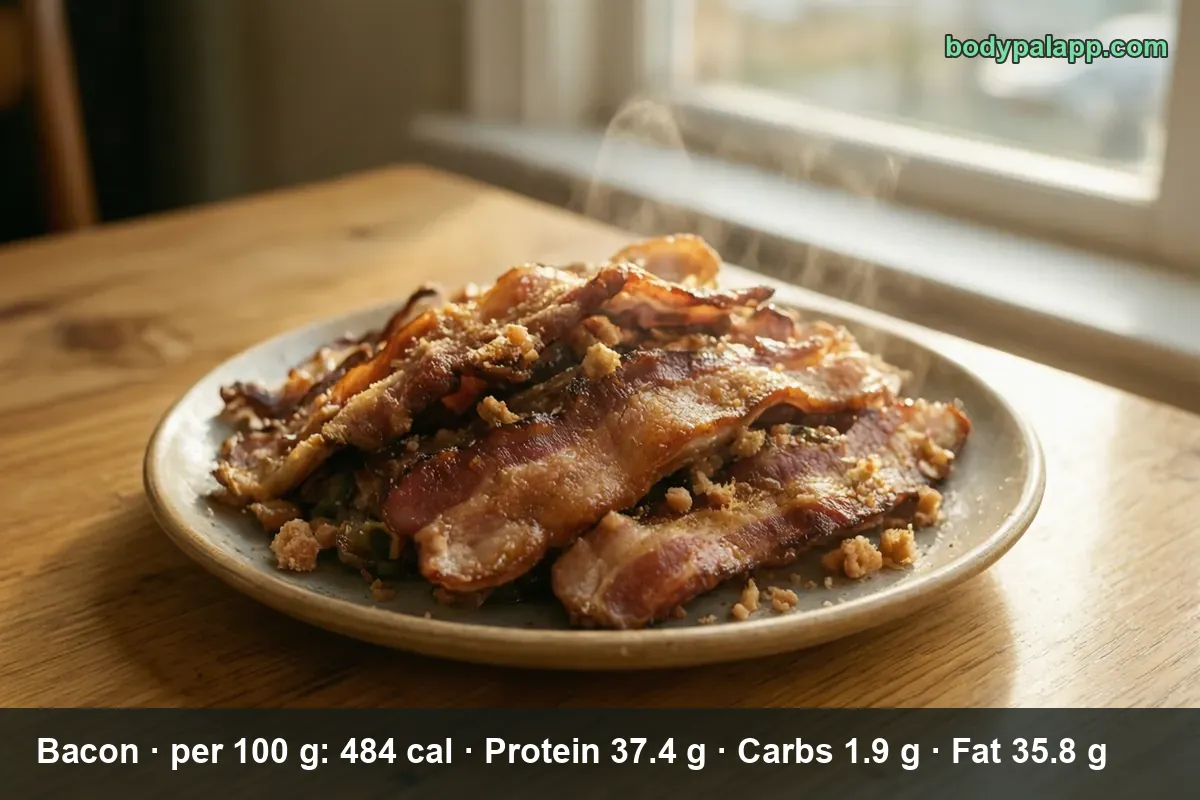
Two medium slices of cooked bacon are 77 calories, and cooked bacon runs 484 calories per 100 g. Most of that is fat: 5.7 g in the two slices. Bacon looks heavy on the per-100-g line because frying strips the water out, which is exactly what makes the slice itself small.
On this page
- Bacon quick facts
- Bacon servings from one slice to a cup of pieces
- Turkey and Canadian bacon and the raw slice
- Sodium beats fat as the number to watch
- How does bacon compare?
- Most popular bacon brands
- FAQ
Bacon quick facts
The record behind these numbers is FNDDS 2705885, "Bacon, NS as to type of meat, cooked". It is the cooked entry that carries the full set of household weights people actually use — thin slice, medium slice, thick slice, and a cup of crumbled pieces — so it answers the question the way it gets asked at the stove. Its profile is identical to the pork-specific FNDDS record, which is the reassuring part: no averaging was needed.
Everything below is per cooked bacon, drained the way a home skillet leaves it. If you are weighing strips out of the package instead, jump to the raw comparison further down, because that swap changes the number more than any brand choice does.
| Nutrient | Per 100 g | Per 2 medium slices (16 g) | % Daily Value |
|---|---|---|---|
| Calories | 484 | 77 | — |
| Total fat | 35.8 g | 5.7 g | 7% |
| Saturated fat | 12.28 g | 2.0 g | 10% |
| Carbohydrate | 1.9 g | 0.3 g | 0% |
| Dietary fiber | 0 g | 0 g | 0% |
| Total sugars | 1.57 g | 0.3 g | — |
| Protein | 37.41 g | 6.0 g | 12% |
| Sodium | 1757 mg | 281 mg | 12% |
| Cholesterol | 99 mg | 16 mg | 5% |
| Potassium | 528 mg | 84 mg | 2% |
% Daily Value is based on a 2,000-calorie diet.
Verified nutrition data
Numbers on this page come from USDA FoodData Central, the U.S. Department of Agriculture’s food composition database, and from manufacturer labels where a branded product is named. Last verified September 2026. How we verify our data →
Two rows you would see on a package are missing here: added sugars and trans fat. USDA does not publish either value for this record, so guessing them would be worse than leaving them out. The cure on most bacon does add a little sugar, which is where the 1.57 g of total sugars per 100 g comes from, but only the label on your own pack can tell you how much of it was added.
Bacon servings from one slice to a cup of pieces
| Serving | Weight | Calories |
|---|---|---|
| 1 medium slice, cooked | 8 g | 39 kcal |
| 1 thick slice, cooked | 12 g | 58 kcal |
| 2 medium slices, cooked | 16 g | 77 kcal |
| 1 oz, cooked | 28 g | 137 kcal |
| 1 cup, pieces | 80 g | 387 kcal |
| Per 100 g | 100 g | 484 kcal |
Every weight in that table is a USDA household measure for this record, not a guess at what a slice ought to weigh. The number that surprises people is the first one: a cooked medium slice is 8 g. That is a strip roughly the length of your hand, shrunk and curled, and it is why two of them land at 77 calories instead of the three-figure total most people expect from something that fries in its own fat.
The cup is where a breakfast quietly doubles. Eighty grams of crumbled pieces on a salad or in a carbonara is 387 calories, the same as about ten medium slices, and nobody counts to ten while spooning. If bacon is a topping rather than the main event, weigh it or count strips before they hit the pan; a cup measure and a slice count are not the same accounting.
Thickness matters more than brand. A thick-cut slice is 12 g and 58 calories, half again as much as the medium strip, so a three-slice plate is 174 calories thick-cut against 117 for three mediums. Retail labels track this: Oscar Mayer Original lists 2 skillet slices at 19 g and 90 calories, which is heavier per slice than the USDA medium and lighter than anything you would call thick-cut.
Turkey and Canadian bacon and the raw slice
| Version | Per 100 g | Typical piece | Calories |
|---|---|---|---|
| Pork bacon, cooked | 484 kcal | 2 medium slices, 16 g | 77 kcal |
| Turkey bacon, cooked | 368 kcal | 1 slice, 8.1 g | 30 kcal |
| Turkey bacon, low sodium | 253 kcal | 1 serving, 15 g | 38 kcal |
| Canadian bacon | 146 kcal | 1 oz, 28 g | 41 kcal |
| Raw pork bacon | 393 kcal | 1 oz raw, 28 g | 111 kcal |
| Reduced-sodium pork bacon | 541 kcal | 1 medium slice, 8 g | 43 kcal |
| Meatless bacon strips | 309 kcal | 1 oz, 28 g | 88 kcal |
The Canadian bacon, raw pork, reduced-sodium and meatless figures in that last column are our own arithmetic from the USDA 100 g values, not USDA serving sizes. The pork and turkey slice weights are USDA measures.
Turkey bacon is the swap most people make, and it works on calories: 368 per 100 g against 484, with a single cooked slice at 30 calories. Slices run thinner, so three turkey strips come to about 90 calories, roughly what you would spend on two and a half pork mediums. Retail labels sit lower still because they are weighed uncooked — Butterball Original Turkey Bacon lists 25 calories for a 14 g raw slice.
Canadian bacon is the outlier that barely belongs in the same table. At 146 calories per 100 g it is loin, not belly, with 2.78 g of fat per 100 g against 35.8 g. An ounce is 41 calories, and it is the only version here that behaves like lean deli meat.
Reduced-sodium pork bacon deserves a warning. It is 541 calories per 100 g, the highest number on this page, because the cut used for it is fattier. You save on sodium and pay in fat, so read it as a trade rather than a lighter option.
Sodium beats fat as the number to watch
Two slices deliver 7% of the Daily Value for fat and 12% for sodium. That ratio holds all the way up the serving ladder, and it flips the usual assumption about what bacon costs you. A cup of pieces carries 1,406 mg of sodium, 61% of the 2,300 mg Daily Value the FDA sets — about two-thirds of a teaspoon of table salt, from one topping.
The turkey swap makes this worse, not better. Turkey bacon is 2,021 mg of sodium per 100 g against 1,757 mg for pork, so trading down on calories trades up on salt unless you buy a lower-sodium line. The Dietary Guidelines for Americans put cured meats among the main sodium contributors in the US diet for exactly this reason.
Saturated fat is the second row worth a glance: 2.0 g in two slices, 10% of the 20 g Daily Value, which is modest for a food this rich. Protein is the pleasant surprise — 6.0 g in those same two slices, 12% of the Daily Value, because frying concentrates what is left. MyPlate still counts bacon as a fat rather than a protein food, and the 35.8 g of fat per 100 g against 37.41 g of protein is why.
How does bacon compare?
| Version | Per 100 g | US serving | Calories |
|---|---|---|---|
| Bacon, cooked | 484 kcal | 2 medium slices, 16 g | 77 kcal |
| Raw pork bacon | 393 kcal | 1 oz raw, 28 g | 111 kcal |
| Turkey bacon, microwaved | 368 kcal | 1 slice, 8.1 g | 30 kcal |
| Canadian bacon, pan-fried | 146 kcal | 1 oz, 28 g | 41 kcal |
Our take: if you want the flavor and the smallest calorie bill, two medium pork slices at 77 calories is a better buy than most people assume, and it beats an ounce of anything on this page except Canadian bacon. If you are building a sandwich rather than a garnish, Canadian bacon is the only version here under 200 calories per 100 g and the only one that gives you protein without a fat bill. Turkey bacon wins on calories per slice and loses on sodium. And if you are watching salt above all else, none of these is a free swap — measure the pieces instead of the pan.
Most popular bacon brands in the United States
Ranked by how widely each product appears among foods sold in the United States, from the BodyPal food database of over 3.3 million products. Calories are the figures printed on each Nutrition Facts label, checked against USDA FoodData Central.
| Product | Calories (per 100 g) |
|---|---|
| Butterball Original Turkey Bacon | 179 cal |
| Butterball Lower Sodium Turkey Bacon | 179 cal |
| Butterball Thin & Crispy Original Turkey Bacon | 194 cal |
| Butterball Original Fully Cooked Turkey Bacon | 273 cal |
| Oscar Mayer Turkey Bacon | 222 cal |
| Oscar Mayer Original Bacon | 474 cal |
Brand popularity: BodyPal food database. Nutrition: manufacturer labels / USDA FoodData Central.
Bacon FAQs
How many calories are in one slice of bacon?
One medium cooked slice is 39 calories and weighs 8 g. That is the cooked weight, not the raw strip you pull out of the pack, which is why the number looks small. A thick-cut slice comes to 12 g and 58 calories. Cooked bacon is 484 calories per 100 g.
How many calories are in 2 slices of bacon?
Two medium slices are 77 calories, the amount USDA treats as a standard serving. Together they weigh 16 g and bring 6.0 g of protein, 5.7 g of fat and 281 mg of sodium. Fat supplies most of those calories, so the number moves with slice thickness more than anything else.
How much protein is in bacon?
Two medium slices carry 6.0 g of protein, 12% of the Daily Value. Per 100 g cooked bacon is 37.41 g of protein, higher than many cooked meats because frying drives off the water. The catch is that the same 100 g also brings 35.8 g of fat and 484 calories.
How much sodium is in bacon?
Two slices hold 281 mg of sodium, 12% of the 2,300 mg Daily Value. A cup of cooked pieces is 1,406 mg, or 61%. Turkey bacon is saltier per 100 g at 2,021 mg against 1,757 mg for pork, so switching for the calories can cost you on sodium.
Is bacon keto friendly?
Two slices contain 0.3 g of carbohydrate, and 100 g of cooked bacon only 1.9 g, so bacon fits a low-carb pattern easily. Its calories come almost entirely from fat, 35.8 g per 100 g. On a keto day it is portion size, not carbohydrate, that moves your total.
Turkey bacon vs pork bacon: which is lower in calories?
Turkey bacon is 368 calories per 100 g against 484 for pork, and one cooked turkey slice is 30 calories. Slices are thinner, so three of them run about 90. Sodium goes the other way: 2,021 mg per 100 g for turkey against 1,757 mg for pork bacon.
Do raw and cooked bacon have the same calories?
No. Raw pork bacon is 393 calories per 100 g and cooked bacon is 484, but 100 g of raw strips shrinks to roughly 35 g in the pan. Weighed raw, one ounce is 111 calories. The water and fat lost while frying are what change the per-gram figure.
How many calories are in Canadian bacon?
Canadian bacon is 146 calories per 100 g, and a 1 oz slice works out to 41 calories by our own arithmetic from that figure. It is cut from the loin rather than the belly, so it carries 2.78 g of fat per 100 g against 35.8 g in regular pork bacon.
Similar foods
- Landjaeger — 210 cal per stick
- Beef Short Rib With The Bone — 1060 cal per braised short rib, meat only
- Cooked Bacon — 54 cal per slice
- Bacon Fried — 54 cal per slice
- Strip Of Bacon — 37 cal per medium slice
- Pepperoni — 81 cal for 8 slices
Count it without the math
Point the camera at the plate and BodyPal counts the strips for you, thick-cut or not.


How long does it take to burn off bacon?
Two medium slices (16 g) is 77 kcal. Enter your weight and the amount you ate to see how long it takes you to burn that off:
lb
| Activity | Time to burn 77 kcal |
|---|---|
| Walking, brisk | 15 min |
| Cycling, moderate | 10 min |
| Swimming, moderate | 11 min |
| Jogging | 9 min |
| Weight training, moderate | 17 min |
Times are for a 155 lb adult at a steady pace; change the weight to see yours. The amount is set to the portion in the text (16 g); change it to what you actually ate. BodyPal works this out from your steps automatically.
This table assumes you know your daily total. If you do not, the daily calorie calculator works it out from five numbers.