
How many calories are in pepperoni?
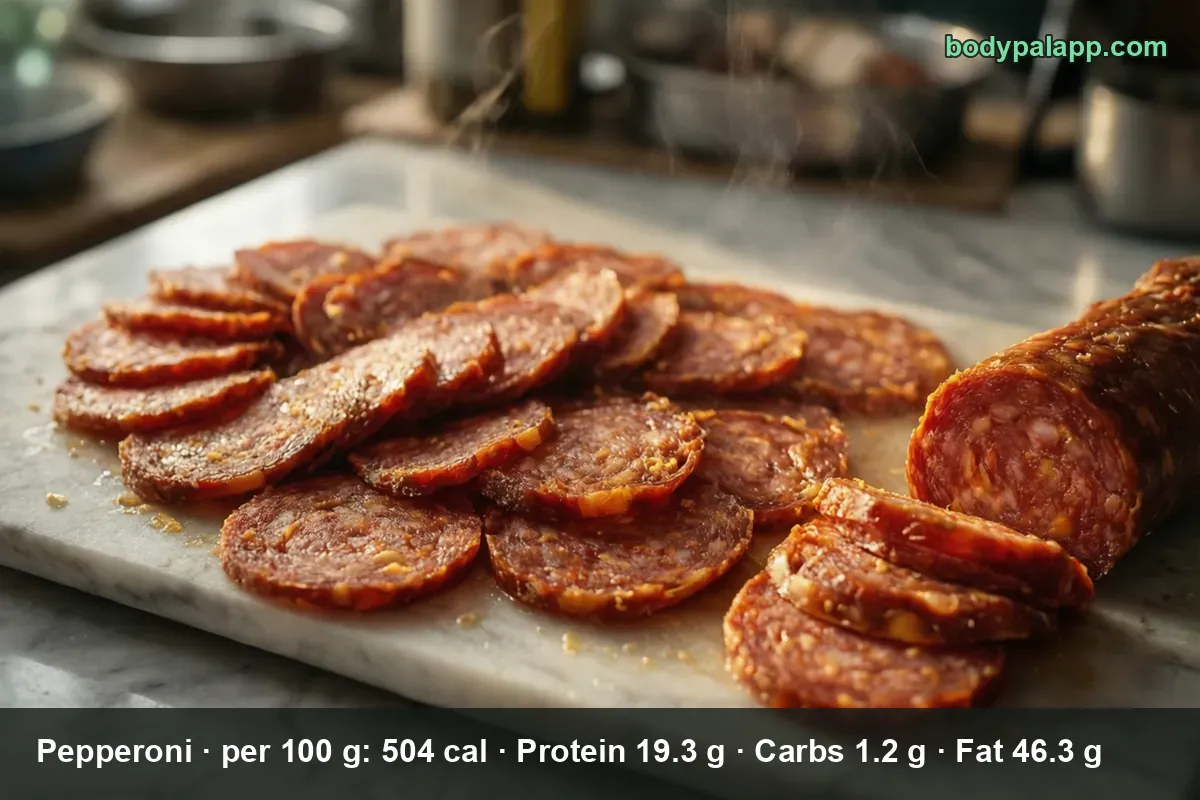
A 1-ounce serving of sliced pepperoni, roughly 15 thin rounds, is 141 calories, and per 100 g the salami runs 504 calories. One slice on its own is about 10. Fat does almost all of that work: 46.28 g per 100 g, more than salami, beef jerky or Spam carry.
On this page
- Pepperoni quick facts
- US servings, from one slice to a whole stick
- Reduced-fat, reduced-sodium and turkey pepperoni
- Pepperoni on a pizza slice is a different food
- Sodium is the row to watch
- How does pepperoni compare?
- Most popular pepperoni brands
- Pepperoni FAQs
Pepperoni quick facts
The record behind this page is USDA SR Legacy 174575, "Pepperoni, beef and pork, sliced". That is the food you actually hold: a stick of cured beef and pork, sliced into rounds. USDA also publishes an FNDDS re-issue of the same profile (2706185) with identical values, so nothing changes if your app shows that one instead.
The per-ounce column below is the USDA household measure, not a scaled guess. Ounces matter here more than with most foods, because pepperoni is eaten in counted rounds rather than spoonfuls, and the rounds are tiny.
| Nutrient | Per 100 g | Per 1 oz (28 g) | % Daily Value |
|---|---|---|---|
| Calories | 504 | 141 | — |
| Total fat | 46.28 g | 13.0 g | 17% |
| Saturated fat | 17.71 g | 5.0 g | 25% |
| Carbohydrate | 1.18 g | 0.3 g | 0% |
| Dietary fiber | 0 g | 0 g | 0% |
| Total sugars | 0 g | 0 g | — |
| Protein | 19.25 g | 5.4 g | 11% |
| Sodium | 1582 mg | 443 mg | 19% |
| Cholesterol | 97 mg | 27 mg | 9% |
| Potassium | 274 mg | 77 mg | 2% |
% Daily Value is based on a 2,000-calorie diet.
Verified nutrition data
Numbers on this page come from USDA FoodData Central, the U.S. Department of Agriculture’s food composition database, and from manufacturer labels where a branded product is named. Last verified September 2026. How we verify our data →
There is no added sugars row on this page, because the SR Legacy edition does not publish added sugars for cured meat records. It hardly matters: total sugars are 0 g, so there is nothing to add. One row you will not see on the package either is trans fat, which USDA records at 1.53 g per 100 g, or 0.43 g in an ounce. Most of that is the ruminant fat that comes with beef, and the label rounding on small servings can hide it.
Percentages here follow the FDA Daily Values printed on the Nutrition Facts label.
US servings, from one slice to a whole stick
| Serving | Weight | Calories |
|---|---|---|
| 1 slice | 2 g | 10 kcal |
| 8 slices | 16 g | 81 kcal |
| 1 oz, about 15 slices | 28 g | 141 kcal |
| 20 slices | 40 g | 202 kcal |
| 3 oz | 85 g | 428 kcal |
| Per 100 g | 100 g | 504 kcal |
The 1-slice, 1-ounce and 3-ounce lines are USDA household measures. The 8-slice and 20-slice lines are our own arithmetic from the USDA 100 g figure, not USDA servings, but they are the ones people actually reach for: eight rounds is a standard homemade-pizza scatter, twenty is what a generous hand puts on.
Two traps live in this table. The first is the slice itself. A deli round weighs about 2 g, so ten of them is only 20 g and 101 calories, but a thick hand-cut round off a whole stick can weigh double, and ten of those pass an ounce. Weigh your own once and the count stops being a guess.
The second is the cup. A cup of sliced pepperoni is 140 g, which comes to 706 calories by our own scaling from the 100 g record. Nothing about pepperoni suggests a cup-sized portion, but recipes call for it, and a cup poured over a sheet pan is more than most people budget for a whole lunch. The whole 10-1/4 inch stick, 251 g, is 1,265 calories.
Reduced-fat, reduced-sodium and turkey pepperoni
| Version | Per 100 g | Typical serving | Calories | Sodium per oz |
|---|---|---|---|---|
| Pepperoni, sliced | 504 kcal | 1 oz (28 g) | 141 kcal | 443 mg |
| Reduced-fat pepperoni | 378 kcal | 1 oz (28 g) | 106 kcal | 492 mg |
| Reduced-sodium pepperoni | 504 kcal | 1 oz (28 g) | 141 kcal | 332 mg |
| Turkey pepperoni | 243 kcal | 1 oz (28 g) | 68 kcal | 520 mg |
| Cup of sliced pepperoni | 504 kcal | 1 cup (140 g) | 706 kcal | 443 mg |
| Whole pepperoni stick | 504 kcal | 1 sausage, 10-1/4 in (251 g) | 1265 kcal | 443 mg |
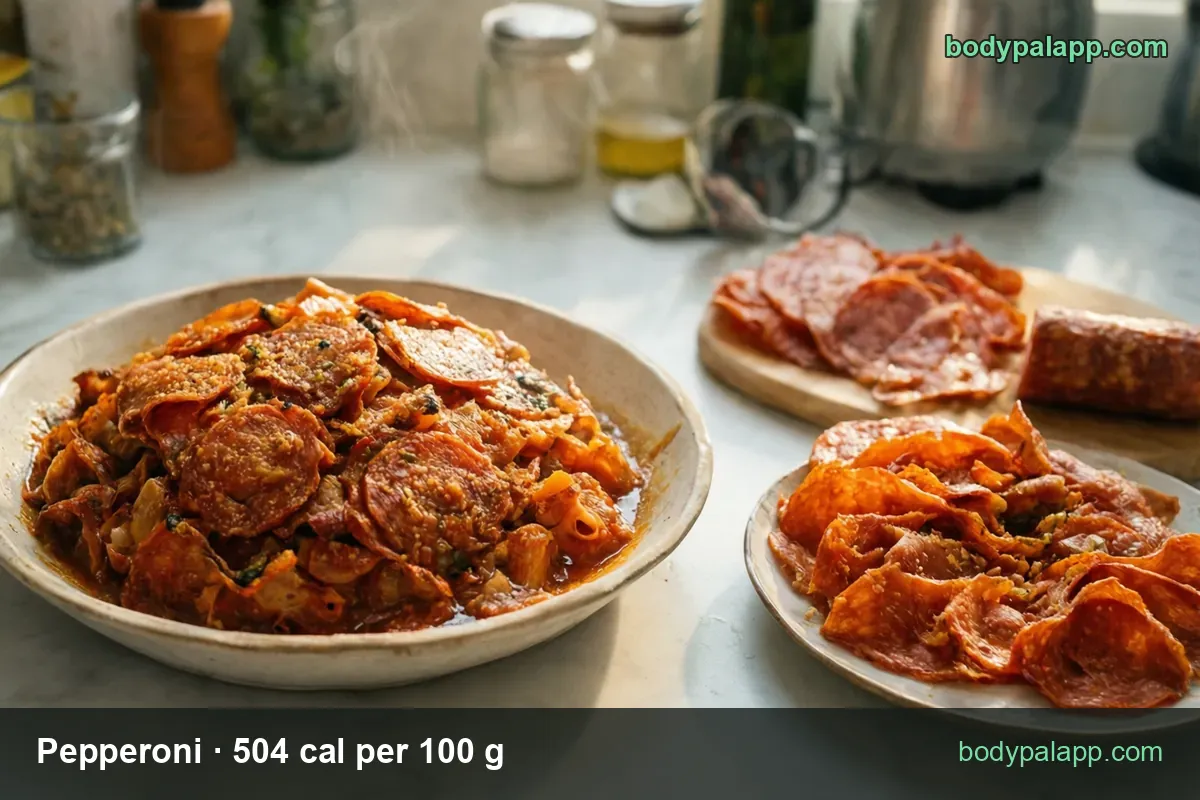
Sodium per ounce for the leaner versions is our own scaling from each USDA 100 g figure. Here is the thing the packaging does not tell you. Reduced-fat pepperoni saves 126 calories per 100 g, dropping 504 to 378, but its sodium climbs from 1,582 mg to 1,756 mg. Leaner does not mean less salty. Turkey pepperoni is the biggest calorie cut of the three, less than half the 141 calories in an ounce of the original, and it carries 30.99 g of protein per 100 g against 19.25 g, but it is the saltiest record of the lot at 1,858 mg per 100 g.
If salt is what you are managing, the reduced-sodium record is the only one that moves that number: 1,187 mg per 100 g, 332 mg an ounce, with calories untouched at 141. Pick the swap that matches the number you are actually chasing, because no single version wins both columns.
Crisping pepperoni in a dry pan renders fat out, and the puddle left behind is real. USDA does not publish a cooked-pepperoni record, so there is no honest number to put on the page for it, and we are not going to invent one. Blot the rounds if you want the effect; log the raw weight if you want the arithmetic to stay defensible.
Pepperoni on a pizza slice is a different food
People searching for pepperoni calories are often really asking about pizza, and the two numbers are nowhere near each other. A slice of thick-crust pepperoni pizza is 287 calories per 100 g, and a large slice weighing 139 g comes to 399 calories. Restaurant pepperoni pizza with unspecified crust sits at 282 calories per 100 g, frozen thick-crust at 276, and stuffed crust at 296.
Every one of those is roughly half the density of the pepperoni itself, because crust and cheese dilute the meat. The pepperoni on a slice is a small share of it: ten rounds at 10 calories each is about 100 calories, our own arithmetic from the USDA per-slice weight. The dough is the expensive part, not the topping.
Sodium behaves the same way. A pizza slice record runs 620 mg per 100 g at restaurant level, well under the 1,582 mg in the meat, but the slice weighs far more than an ounce, so the plate total still lands high.
Sodium is the row to watch
Saturated fat is the headline most people expect, and an ounce does deliver 5.0 g, 25% of the 20 g Daily Value. Sodium is the row that moves faster. One ounce is 443 mg, 19% of the 2,300 mg Daily Value, so a plain snack of fifteen rounds spends nearly a fifth of the day's allowance on something that fits in a palm.
Scale it up and it gets loud. That cup of slices carries 2,215 mg by our own arithmetic from the 100 g record, about 96% of a full day, which is roughly one teaspoon of table salt. CDC guidance on sodium puts most American intake above the limit already, mainly from processed and restaurant foods, and cured meat is squarely in that group.
None of that makes pepperoni off-limits. It makes portion size the whole game: an ounce is a seasoning, a cup is a meal's worth of salt. If you are watching blood pressure, the reduced-sodium record is the swap that actually helps.
How does pepperoni compare?
| Cured meat | Per 100 g | US serving | Calories |
|---|---|---|---|
| Pepperoni | 504 kcal | 1 oz (28 g) | 141 kcal |
| Beef jerky | 410 kcal | 1 oz (28 g) | 115 kcal |
| Salami | 378 kcal | 1 oz (28 g) | 106 kcal |
| Spam | 315 kcal | 1 oz (28 g) | 88 kcal |
Our take: pepperoni is the densest of the four, per 100 g and per ounce, and there is no version of the arithmetic that makes it a light food. For weight loss, jerky is the better ounce-for-ounce trade, with 33.2 g of protein per 100 g against pepperoni's 19.25 g and 94 fewer calories. For satiety at a fixed calorie budget, jerky wins again for the same reason. Where pepperoni earns its place is flavor per gram: eight rounds cost 81 calories and season an entire pizza, which is a better deal than a bigger pile of anything blander.
Most popular pepperoni brands in the United States
Ranked by how widely each product appears among foods sold in the United States, from the BodyPal food database of over 3.3 million products. Calories are the figures printed on each Nutrition Facts label, checked against USDA FoodData Central.
| Product | Calories (per 100 g) |
|---|---|
| Wilson Pepperoni Slices | 464 cal |
| Field Roast Classic Pizzeria Plant-Based Pepperoni Slices | 259 cal |
| Market Pantry Pepperoni Slices | 467 cal |
| Oscar Mayer Pepperoni Slices | 464 cal |
| Mama Mary's Gourmet Pepperoni Slices | 464 cal |
| Hannaford Pepperoni Slices | 500 cal |
Brand popularity: BodyPal food database. Nutrition: manufacturer labels / USDA FoodData Central.
Pepperoni FAQs
How many calories are in one slice of pepperoni?
One thin slice weighs about 2 g and carries 10 calories. That is the standard deli-cut round you would layer on a homemade pizza. Eight slices come to 81 calories at 16 g, our own arithmetic from the USDA 100 g figure of 504 calories. Twenty slices reach 202.
How many calories are in 1 oz of pepperoni?
An ounce, 28 g, is 141 calories. That single ounce also brings 13.0 g of fat, 5.0 g of it saturated, 5.4 g of protein and 443 mg of sodium, which is 19% of the FDA Daily Value. Pepperoni is the densest of the common cured meats.
How many pepperoni slices are in an ounce?
About 15 thin slices make one ounce, 28 g and 141 calories, since a single deli round weighs roughly 2 g. Thicker rounds cut by hand off a whole stick can weigh double that, so ten of those already pass an ounce. Weigh once and you will know your own count.
Is pepperoni high in sodium?
Yes: 1,582 mg per 100 g, and 443 mg in a single ounce, 19% of the 2,300 mg Daily Value. A cup of sliced pepperoni, 140 g, reaches 2,215 mg, about 96% of a day. That last figure is our own arithmetic scaled from the USDA 100 g record.
How many calories does turkey pepperoni have?
Turkey pepperoni is 243 calories per 100 g, so an ounce is 68 calories, less than half the 141 in regular beef and pork pepperoni. It also carries 30.99 g of protein per 100 g against 19.25 g. The trade is sodium: 1,858 mg per 100 g, higher than the original.
Is reduced-fat pepperoni healthier?
Reduced-fat pepperoni is 378 calories per 100 g, 126 fewer than the 504 in the regular record, and 106 calories an ounce. Sodium goes the other way, from 1,582 mg to 1,756 mg per 100 g. If you are watching salt rather than calories, the reduced-sodium record at 1,187 mg is the better pick.
How many calories does pepperoni add to a pizza slice?
A thick-crust pepperoni slice off a large pizza weighs 139 g and totals 399 calories, at 287 calories per 100 g. The meat itself is a small share: ten rounds at 10 calories each is about 100, our own arithmetic from the USDA per-slice weight. Crust and cheese carry the rest.
Is pepperoni keto-friendly?
Pepperoni has 1.18 g of carbohydrate per 100 g, 0.3 g in an ounce, and no sugars at all, so it fits a very low-carb pattern easily. The limits sit elsewhere: 443 mg of sodium and 5.0 g of saturated fat per ounce, a quarter of the 20 g Daily Value.
Similar foods
- Landjaeger — 210 cal per stick
- Bacon — 77 cal for 2 slices
- Beef Short Rib With The Bone — 1060 cal per braised short rib, meat only
- Cooked Bacon — 54 cal per slice
- Bacon Fried — 54 cal per slice
- Strip Of Bacon — 37 cal per medium slice
Count it without the math
Point the camera at the board and BodyPal counts the rounds for you, stick or slices.


How long does it take to burn off pepperoni?
A 1 oz (28 g) serving is 141 kcal. Enter your weight and the amount you ate to see how long it takes you to burn that off:
lb
| Activity | Time to burn 141 kcal |
|---|---|
| Walking, brisk | 28 min |
| Cycling, moderate | 18 min |
| Swimming, moderate | 20 min |
| Jogging | 17 min |
| Weight training, moderate | 31 min |
Times are for a 155 lb adult at a steady pace; change the weight to see yours. The amount is set to the portion in the text (28 g); change it to what you actually ate. BodyPal works this out from your steps automatically.
One food is easy to picture; a whole day is harder. See how many calories you need a day and what a deficit actually looks like.