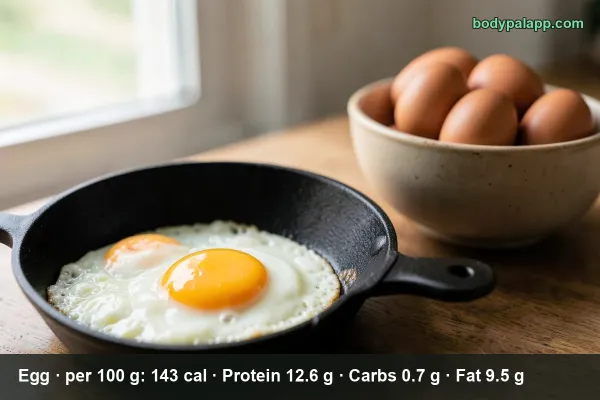
Baked egg calories come to 72 for one 50 g egg and 143 per 100 g, with no fat added to the dish. The number to notice is where those calories come from: fat supplies 63% of them, and baking the egg with fat lifts a single serving to 102.
72kcal
1 egg · 50 g, baked, no added fat
35%protein
6.2 gProtein
0 gCarbs
5 gFat
How to burn off 72 kcal
—Walking, brisk
—Jogging
—Cycling, moderate
—Swimming
Skip the math. BodyPal counts these calories from your steps and workouts automatically.
Nutrition facts
Baked, no added fat · per 50 g
Calories
72 kcal
Protein
6.2 g
Carbohydrate
0.5 g
Fat
5 g
Saturated fat
1.6 g
Cholesterol
205 mg
Sodium
122 mg
Potassium
66 mg
Iron
0.8 mg
Source: USDA FoodData Central
🛡️
Verified nutrition data
Numbers on this page come from USDA FoodData Central, the U.S. Department of Agriculture’s food composition database, and from manufacturer labels where a branded product is named. Last verified October 2026. How we verify our data →
Baked egg: calories, protein and sodium by serving
Percent of daily value uses the FDA reference of 2,000 kcal a day.
Serving
kcal
Protein
Carbs
Fat
Sodium
% DV kcal
1 egg (50 g)
72
6.2 g
0.5 g
5 g
122 mg
4%
Baked with fat (55 g)
102
6.4 g
0.5 g
8.3 g
136 mg
5%
1 cup (135 g)
193
16.7 g
1.3 g
13.4 g
329 mg
10%
100 g
143
12.4 g
1 g
9.9 g
244 mg
7%
3 × 1 egg (50 g)
215
18.5 g
366 mg
5 × 1 egg (50 g)
358
30.9 g
610 mg
Two baked eggs are a 143-calorie plate
One baked egg weighs about 50 g and carries 72 calories, 6.2 g of protein and 122 mg of sodium. That is 4% of a standard daily calorie budget, small enough that a single egg rarely decides whether breakfast is light or heavy. The number of eggs does.
Two eggs make 100 g, which lands on 143 calories, 12.4 g of protein and 244 mg of sodium. Three eggs come to 215 calories and 18.5 g of protein. A five-egg bake, for sharing or for one very hungry person, reaches 358 calories, 30.9 g of protein and 610 mg of sodium.
If you bake eggs in a casserole dish and scoop them out, think in cups instead. A 135 g cup holds 193 calories and 16.7 g of protein, about 10% of daily calories and 33% of the protein daily value. Weighing your usual scoop once on a kitchen scale tells you how many eggs it really is.
Fat supplies 63% of the calories
Per 100 g, a baked egg has 9.9 g of fat, 12.4 g of protein and 1 g of carbohydrate. Fat carries more energy per gram, so it ends up with 63% of the calories, protein with 35% and carbs with just 3%.
That makes the baked egg a protein food with a fat-driven calorie count. Each egg brings 6.2 g of protein, 12% of the daily value, for 72 calories. Saturated fat runs 3.2 g per 100 g against a daily value of 20 g, so it is a row worth glancing at if you eat several eggs a day.
The carb side is close to nothing: 0.2 g of sugars per 100 g and 0 g of fiber. If you count carbs, baked eggs barely register. If you need fiber, it has to come from whatever sits next to them on the plate.
Baking with fat takes one egg from 72 to 102
The 72-calorie figure assumes no added fat, matching the USDA row for a whole egg baked without it. Grease the ramekin or add a pat of fat on top and the USDA row for a baked egg with fat puts one serving at 55 g and 102 calories.
Nearly all of that jump is fat. It rises from 5 g to 8.3 g per egg, while protein barely moves, from 6.2 g to 6.4 g, and carbs stay at 0.5 g. Sodium creeps from 122 mg to 136 mg. You get essentially the same egg with a richer calorie bill.
In a dish of several eggs, that difference repeats with every egg. A light spray or a nonstick pan keeps you close to the plain number. Cream, cheese or extra butter add calories that neither USDA row includes, so log those toppings separately.
Cholesterol and sodium are the rows to watch
Baked egg lists 410 mg of cholesterol per 100 g, more than the 300 mg daily value used on this page. Two eggs make that 100 g, so if you follow cholesterol closely, the egg count matters more here than the calories do.
Sodium sits at 244 mg per 100 g, 11% of the 2300 mg daily value. That is higher than the plain egg page at 142 mg per 100 g. If you watch sodium, go light on salt before baking and season at the table instead.
With 0 g of fiber and very few carbs, baked eggs leave room on the plate. Vegetables, beans, fruit or whole-grain toast add the fiber and volume the egg lacks. BodyPal can log a baked egg from a photo, which makes it easy to keep the extras honest too.
How does baked egg compare?
Here is how baked egg stacks up against a plain egg and a soft egg, per 100 g and per usual serving.
Verdict: Calories do not separate them: all three sit at 143 per 100 g, so pick by sodium, where the soft egg is lowest at 129 mg against 244 mg for baked. For a sliver more protein the plain egg edges ahead at 12.6 g, but baked egg at 12.4 g is close enough that you should choose the method you will actually cook without added fat.
Most popular baked egg brands in the United States
5Hormel Eggs, Ham, Bell Peppers & 3 Cheeses Oven-Baked Egg Bites1 package · 119 g202 kcal
Packaged egg rolls and egg bites include added ingredients such as cheese and meat, so they read higher per 100 g than a plain baked egg. Source: manufacturer labels / USDA FoodData Central.
Baked egg FAQs
How many calories are in one baked egg?
About 72 calories for one baked egg (50 g) with no added fat, or 102 calories when baked with fat (55 g).
Is baked egg good for weight loss?
One baked egg without added fat has 72 calories, 6.2 g of protein and 0.5 g of carbs.
Baked egg vs hard-boiled egg: which has fewer calories?
A baked egg has 143 calories per 100 g and a hard-boiled egg has 155, so the baked egg is slightly lower.
How much protein is in a baked egg?
One baked egg (50 g) has 6.2 g of protein, which is 12.4 g per 100 g.
How many calories are in 2 baked eggs?
Two baked eggs, about 100 g, have 143 calories. They also give you 12.4 g of protein and 244 mg of sodium, assuming they are baked with no added fat.
How many calories are in 3 baked eggs?
Three baked eggs weigh about 150 g and come to 215 calories, with 18.5 g of protein and 366 mg of sodium. Baking them with fat raises the total, since each egg climbs from 72 to 102 calories.
How many calories does a baked egg have when cooked with fat?
A baked egg made with fat has 102 calories for a 55 g serving, versus 72 for a plain 50 g baked egg. Fat rises to 8.3 g, while protein stays near 6.4 g.
How much sodium is in a baked egg?
One baked egg has 122 mg of sodium, 5% of the daily value. Per 100 g it is 244 mg, or 11%, which is more than the 142 mg listed for a plain egg.
How many calories are in a cup of baked egg?
A 135 g cup of baked egg has 193 calories, 10% of the daily value. The same cup holds 16.7 g of protein and 13.4 g of fat, with only 1.3 g of carbs.