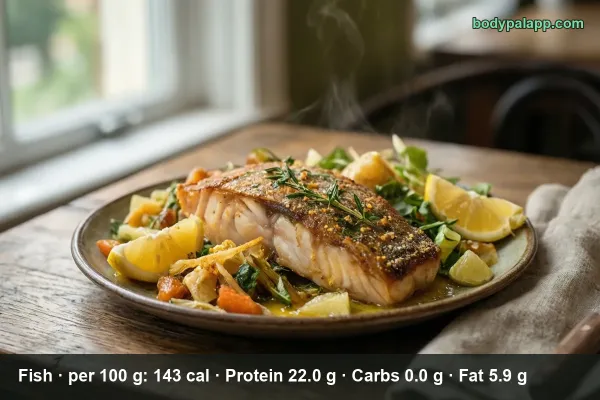
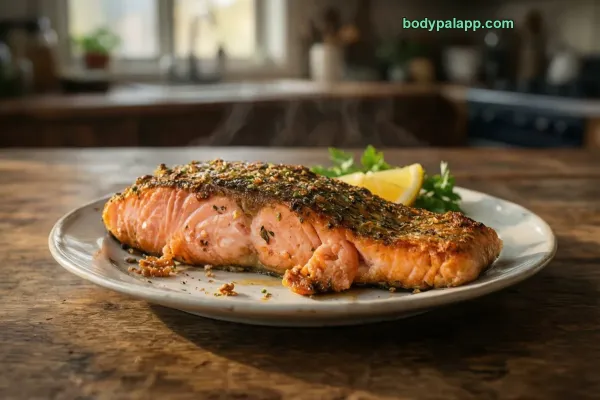
Baked fish calories come to 187 for one 90 g fillet and 208 per 100 g. The number worth noticing is fat. At 12.4 g per 100 g it supplies 55 percent of the calories, more than the 23 g of protein does, so this plate is richer than many people expect from fish.
187kcal
1 regular fillet · 90 g, baked, type not specified
45%protein
21 gProtein
0 gCarbs
11.2 gFat
How to burn off 187 kcal
—Walking, brisk
—Jogging
—Cycling, moderate
—Swimming
Skip the math. BodyPal counts these calories from your steps and workouts automatically.
Nutrition facts
Baked, type not specified · per 90 g
Calories
187 kcal
Protein
21 g
Carbohydrate
0 g
Fat
11.2 g
Saturated fat
2.7 g
Cholesterol
61 mg
Sodium
276 mg
Potassium
357 mg
Iron
0.4 mg
Source: USDA FoodData Central
🛡️
Verified nutrition data
Numbers on this page come from USDA FoodData Central, the U.S. Department of Agriculture’s food composition database, and from manufacturer labels where a branded product is named. Last verified October 2026. How we verify our data →
Baked fish: calories, protein and sodium by serving
Percent of daily value uses the FDA reference of 2,000 kcal a day.
Serving
kcal
Protein
Carbs
Fat
Sodium
% DV kcal
1 fillet (90 g)
187
20.7 g
0 g
11.2 g
276 mg
9%
Large fillet (135 g)
281
31.1 g
0 g
16.7 g
414 mg
14%
3 oz portion (85 g)
177
19.6 g
0 g
10.5 g
261 mg
9%
100 g
208
23 g
0 g
12.4 g
307 mg
10%
3 × 1 fillet (90 g)
562
62.1 g
829 mg
5 × 1 fillet (90 g)
936
103.5 g
1,382 mg
One fillet is a 187-calorie plate, a large one is 281
The standard serving here is one fillet of 90 g, which lands at 187 calories and 9 percent of a 2,000-calorie day. A 3 oz portion of 85 g is nearly the same at 177 calories. The jump comes with a large fillet. At 135 g it reaches 281 calories, or 14 percent of the daily reference, and it carries 31.1 g of protein.
Portion size is where the total really moves, because the fillet is the whole story. There are no carbs, no sugar and no fiber to add or subtract, so calories rise in a straight line with weight. Two 90 g fillets come to 374 calories and 41.4 g of protein. Three come to 562 calories and 62.1 g of protein.
If you cook for the family and serve yourself from the pan, the eyeball estimate is the weak link. A fillet that looks average can easily be the large size. Weigh it once or twice, learn what 90 g and 135 g look like on your plate, and your log will stay honest for weeks.
Fat supplies more of the calories than protein
Per 100 g, baked fish carries 23 g of protein, 12.4 g of fat and 0 g of carbohydrate. That works out to a split of 45 percent protein and 55 percent fat. For a food most people file under lean protein, fat taking the larger share is the surprise.
The reason sits in the data source. The values come from the USDA row for fish not specified as to type, baked or broiled, so the figure blends species and cooking styles rather than describing one lean white fillet. Of the 12.4 g of fat, 3 g is saturated. That is a modest amount, but it is worth knowing if you track saturated fat against the daily value of 20 g.
The protein side is still strong. One 90 g fillet delivers 20.7 g, which is 41 percent of the daily value of 50 g. A large fillet covers 62 percent. Few common foods give that much protein with zero carbs, which is why fish works so well as the anchor of a meal.
Sodium is the row to watch on bigger portions
Baked fish lists 307 mg of sodium per 100 g, or 13 percent of the daily value. One 90 g fillet carries 276 mg, which is 12 percent. That is moderate for a single serving, and part of it reflects seasoning built into the USDA estimate rather than the fish alone.
The number grows quickly with portions. A large fillet reaches 414 mg, or 18 percent of the daily value. Two fillets come to 553 mg, and three come to 829 mg. Add a salty sauce, a seasoning blend or a side of fries and the plate can climb far beyond what the fish itself contributes. If you watch sodium, season with lemon, herbs and pepper and keep the salt shaker for the table.
Two other rows deserve a mention. Cholesterol is 68 mg per 100 g against a daily value of 300 mg. Potassium is 397 mg per 100 g, a useful contribution toward the daily value of 4,700 mg.
Baked fish needs carbs and fiber from the sides
Because baked fish has 0 g of carbs and 0 g of fiber, the sides decide what kind of meal you end up with. Roasted vegetables, a green salad or steamed greens add volume and fiber for few calories. Rice, potatoes or bread turn it into a fuller plate that keeps you going through a long afternoon.
Watch the extras more than the fish. Butter, tartar sauce and creamy dressings can add as much as the fillet itself, while lemon, salsa or a yogurt-herb sauce keep things light. If the goal is a smaller total, one 90 g fillet with a big pile of vegetables is a strong dinner at 187 calories before the sides.
Logging is simplest when you split the plate into parts: the fish by weight, then each side on its own. BodyPal can log the meal from a photo, which helps when the fillet came out of a shared pan and you never weighed it.
How does baked fish compare?
Here is baked fish next to plain fish, baked salmon fillet and canned tuna fish, compared per 100 g and per usual serving.
Verdict: For the leanest plate pick tuna fish at 85 calories and 0.9 g of fat per 100 g, while plain fish at 143 still undercuts baked fish at 208. Baked salmon fillet matches it almost gram for gram at 206 calories, so choose salmon when you want the same energy with far less sodium, 61 mg against 307.
Baked fish FAQs
How many calories are in a baked fish fillet?
About 187 calories in a regular 90 g fillet and 281 calories in a large 135 g fillet.
Is baked fish good for weight loss?
A regular 90 g fillet has 187 calories with 20.7 g of protein and 11.2 g of fat. Lean types are lower, with baked cod at 126 calories per 100 g.
Baked fish vs baked salmon: which has fewer calories?
They are close: baked fish averages 208 calories per 100 g and a baked salmon fillet 206. Baked tilapia is lower at 160 per 100 g.
How much protein is in baked fish?
23 g per 100 g, so a regular 90 g fillet has 20.7 g and a large 135 g fillet about 31 g.
How many calories are in 100 g of baked fish?
100 g of baked fish has 208 calories. It brings 23 g of protein, 12.4 g of fat and 0 g of carbs, plus 307 mg of sodium, which is 13 percent of the daily value.
How many calories are in a 3 oz portion of baked fish?
A 3 oz portion of 85 g has 177 calories, or 9 percent of a 2,000-calorie day. It provides 19.6 g of protein, 10.5 g of fat and 261 mg of sodium.
How many calories are in a large baked fish fillet?
A large fillet of 135 g has 281 calories. It carries 31.1 g of protein, which is 62 percent of the daily value, and 414 mg of sodium, or 18 percent.
How many calories are in two baked fish fillets?
Two 90 g fillets, 180 g in total, come to 374 calories. They supply 41.4 g of protein and 553 mg of sodium, with no carbs or sugar.
Does baked fish have any carbs or sugar?
Baked fish has 0 g of carbs, 0 g of sugar and 0 g of fiber per 100 g. All 208 calories come from protein and fat, split 45 percent and 55 percent.