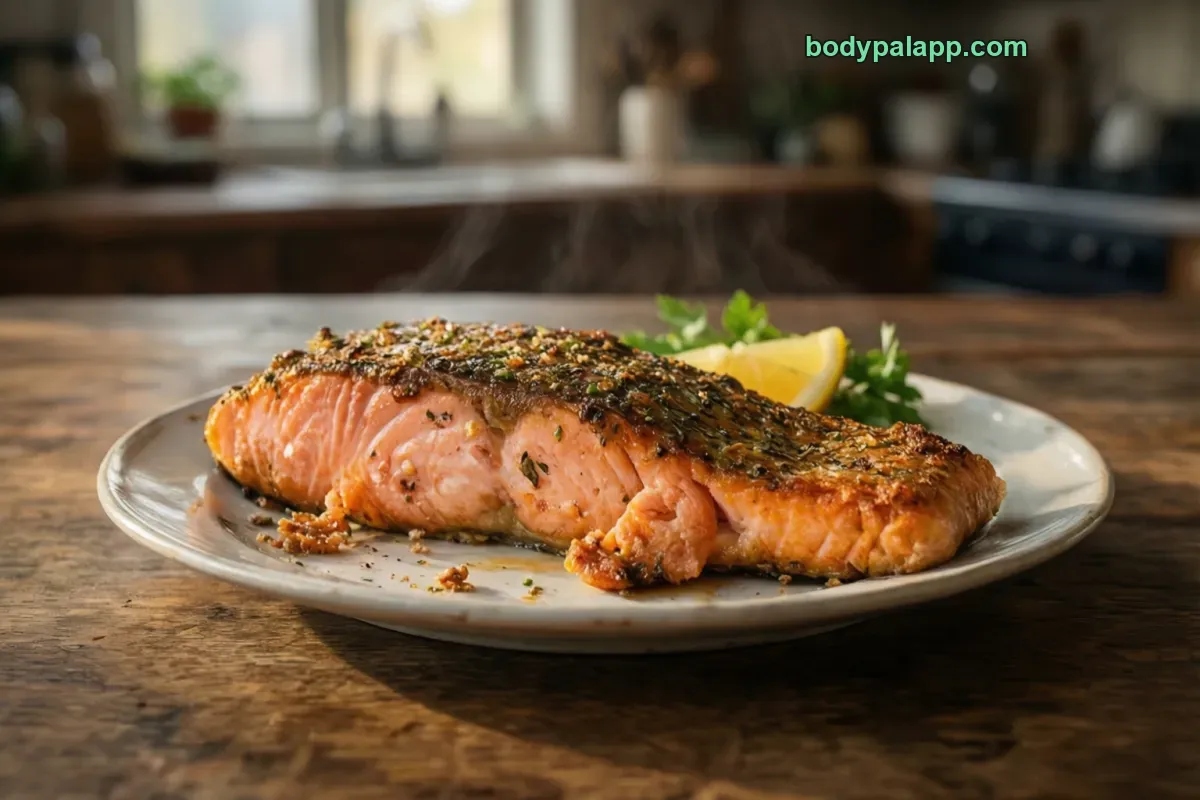
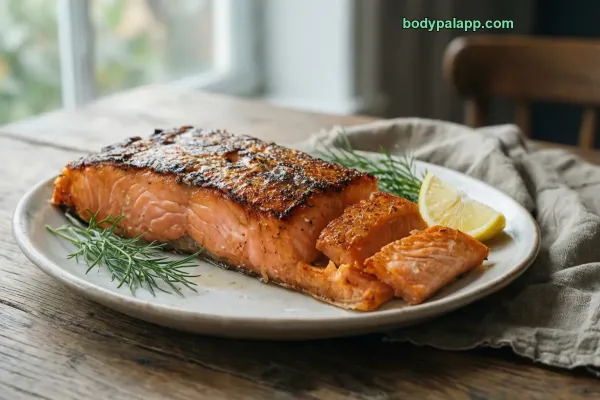
Baked salmon fillet calories come to 367 for one 178 g fillet and 206 per 100 g, using the USDA row for farmed Atlantic salmon cooked with dry heat. Fat supplies 56% of those calories and protein 44%, with zero carbs, so the size of the piece on your plate decides almost everything.
367kcal
1 fillet · 178 g, farmed Atlantic, baked
44%protein
39 gProtein
0 gCarbs
22 gFat
How to burn off 367 kcal
—Walking, brisk
—Jogging
—Cycling, moderate
—Swimming
Skip the math. BodyPal counts these calories from your steps and workouts automatically.
Nutrition facts
Farmed atlantic, baked · per 178 g
Calories
367 kcal
Protein
39 g
Carbohydrate
0 g
Fat
22 g
Saturated fat
4.3 g
Cholesterol
112 mg
Sodium
109 mg
Potassium
684 mg
Iron
0.6 mg
Source: USDA FoodData Central
🛡️
Verified nutrition data
Numbers on this page come from USDA FoodData Central, the U.S. Department of Agriculture’s food composition database, and from manufacturer labels where a branded product is named. Last verified September 2026. How we verify our data →
Baked salmon fillet: calories, protein and sodium by serving
Percent of daily value uses the FDA reference of 2,000 kcal a day.
Serving
kcal
Protein
Carbs
Fat
Sodium
% DV kcal
1 fillet (178 g)
367
39.3 g
0 g
22 g
109 mg
18%
3 oz portion (85 g)
175
18.8 g
0 g
10.5 g
52 mg
9%
Wild Atlantic fillet (154 g)
280
39.2 g
0 g
12.5 g
86 mg
14%
100 g
206
22.1 g
0 g
12.4 g
61 mg
10%
3 × 1 fillet (178 g)
1,100
118 g
326 mg
5 × 1 fillet (178 g)
1,833
196.7 g
543 mg
A full fillet is 367 calories, a 3 oz portion is 175
The standard fillet in the USDA data weighs 178 g and comes to 367 calories, about 18% of the daily calorie value used on this page. That is a generous restaurant-style piece. The textbook 3 oz portion weighs 85 g and lands at 175 calories, 9% of the daily value, with 18.8 g of protein.
That gap matters more than any seasoning choice. Store fillets vary a lot in size, so a piece that looks like one serving can easily be two 3 oz portions. If you track closely, weigh the cooked fish once or twice until your eye learns what 85 g and 178 g look like.
Totals climb fast when you cook for the week. Two fillets (356 g) reach 733 calories, three fillets (534 g) reach 1,100, and five fillets (890 g) come to 1,833 calories with 196.7 g of protein. Split a batch into portions before it goes into the fridge, and you log what you actually eat instead of guessing from the tray.
Fat edges out protein, at 56% of the calories
Salmon is often filed with lean proteins, but the numbers say otherwise. Per 100 g, baked farmed salmon carries 22.1 g of protein and 12.4 g of fat, with 0 g of carbs, sugar or fiber. Because fat is denser in energy, it ends up supplying 56% of the calories against 44% from protein.
A whole fillet still delivers 39.3 g of protein, 79% of the daily value, alongside 22 g of fat. So this is a filling, protein-rich main course that also brings a real fat load. Of the fat, only 2.4 g per 100 g is saturated, a modest share of the total.
Two other rows stand out per 100 g. Cholesterol is 63 mg, against a daily value of 300 mg, and potassium is 384 mg, against a daily value of 4700 mg. Neither swings the calorie count, but both are worth a glance if you track them.
A wild Atlantic fillet trims the fat, not the protein
The card's comparison row for wild Atlantic salmon shows how much the fish itself matters. A 154 g wild fillet comes to 280 calories, 14% of the daily value, with 39.2 g of protein and 12.5 g of fat. The farmed fillet has 39.3 g of protein but 22 g of fat.
In other words, the protein barely moves while the fat drops by close to half. If calories are your main concern and you can find wild fish, it is the leaner pick. If you prefer the richer texture of farmed salmon, a smaller piece gets you to a similar total.
Sodium stays low either way. The farmed fillet has 109 mg, just 5% of the daily value, and the wild fillet has 86 mg. Those figures cover the fish only. Salt, soy glazes and butter you add in the kitchen are not in these numbers, so log them separately.
Zero carbs and zero fiber means the sides do the work
A baked fillet brings protein and fat but no carbs and no fiber at all. That makes it easy to build around. Roasted vegetables, a leafy salad or a scoop of whole grains add the fiber the fish lacks, and you can size the starch to your own goals.
Watch the add-ons more than the salmon. A pat of butter, an oil drizzle before baking or a creamy sauce can push a 367-calorie fillet well past what you planned. A squeeze of lemon, herbs or mustard add flavor with little effect on the count.
If you eat the full 178 g fillet, you are already getting most of a day's protein in one meal. Some people prefer the 85 g portion and a bigger pile of vegetables instead. Either way, BodyPal can log the meal from a photo so the fish and the sides land in your diary together.
How does baked salmon fillet compare?
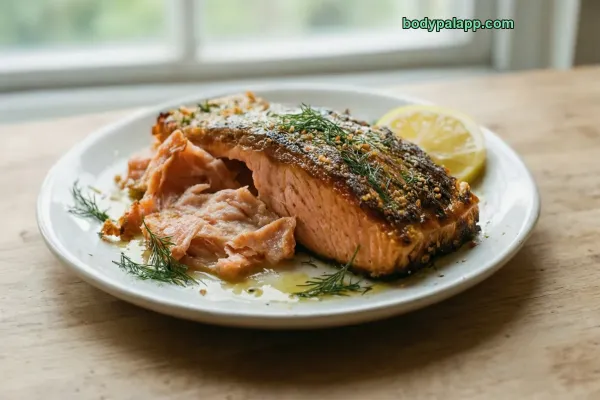
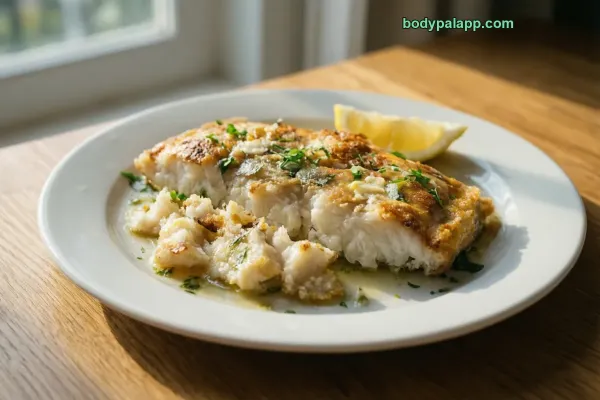
Here is how baked salmon fillet stacks up against cooked salmon, seasoned baked salmon and baked cod, per 100 g and per usual serving.
Verdict: For the fewest calories pick baked cod fillet, at 105 per 100 g and 189 per fillet with 22.8 g of protein, about half of this salmon. If you watch sodium, choose this plain fillet at 61 mg per 100 g over the seasoned baked salmon at 294 mg.
Most popular baked salmon fillet brands in the United States
Ranked by popularity in the BodyPal database
# Productkcal / 100 g
1Tampa Bay Fisheries Salmon Fillets5.6 oz · 159 g283 kcal
2Wild Alaskan Sockeye Salmon Fillet4 oz · 113 g150 kcal
3The Great Fish Co Salmon Fillets4 oz · 113 g88 kcal
4Sea Best Salmon Fillet4 oz · 112 g205 kcal
5Natural Sea Premium Salmon Fillet6 oz · 170 g118 kcal
Label numbers are for raw fillets as sold and vary by species (lean wild sockeye vs. fatty farmed Atlantic), while the page's main number is for farmed Atlantic salmon after baking, when moisture loss concentrates calories per 100 g. Source: manufacturer labels / USDA FoodData Central.
Baked salmon fillet FAQs
How many calories are in one baked salmon fillet?
About 367 calories for a 178 g baked farmed Atlantic fillet, or 175 calories for a 3 oz portion.
Is baked salmon good for weight loss?
A 3 oz portion of baked salmon has 175 calories and 18.8 g of protein, with 0 g of carbs.
Does wild salmon have fewer calories than farmed?
Yes. Cooked farmed Atlantic salmon has 206 calories per 100 g, wild Atlantic has 182, wild sockeye 156 and wild coho 139.
How much protein is in a baked salmon fillet?
A 178 g fillet has 39.3 g of protein and 22 g of fat. Per 100 g it has 22.1 g of protein.
How many calories are in 3 oz of baked salmon?
A 3 oz portion of baked salmon (85 g) has 175 calories. It also gives you 18.8 g of protein, 10.5 g of fat and 0 g of carbs, which is 9% of the daily calorie value.
How many calories are in 100 g of baked salmon?
There are 206 calories in 100 g of baked farmed Atlantic salmon. That weight carries 22.1 g of protein, 12.4 g of fat, 2.4 g of saturated fat and no carbs.
How much fat is in a baked salmon fillet?
A 178 g baked salmon fillet has 22 g of fat. Fat supplies 56% of its calories, more than protein at 44%, though only 2.4 g per 100 g of that fat is saturated.
How many calories are in two baked salmon fillets?
Two baked salmon fillets (356 g) come to 733 calories. Together they hold 78.7 g of protein and 217 mg of sodium, before any butter, oil or salt you add.
Is baked salmon high in sodium?
No. A plain baked fillet has 109 mg of sodium, only 5% of the daily value, and 61 mg per 100 g. Seasonings, glazes and brines can raise that figure considerably.