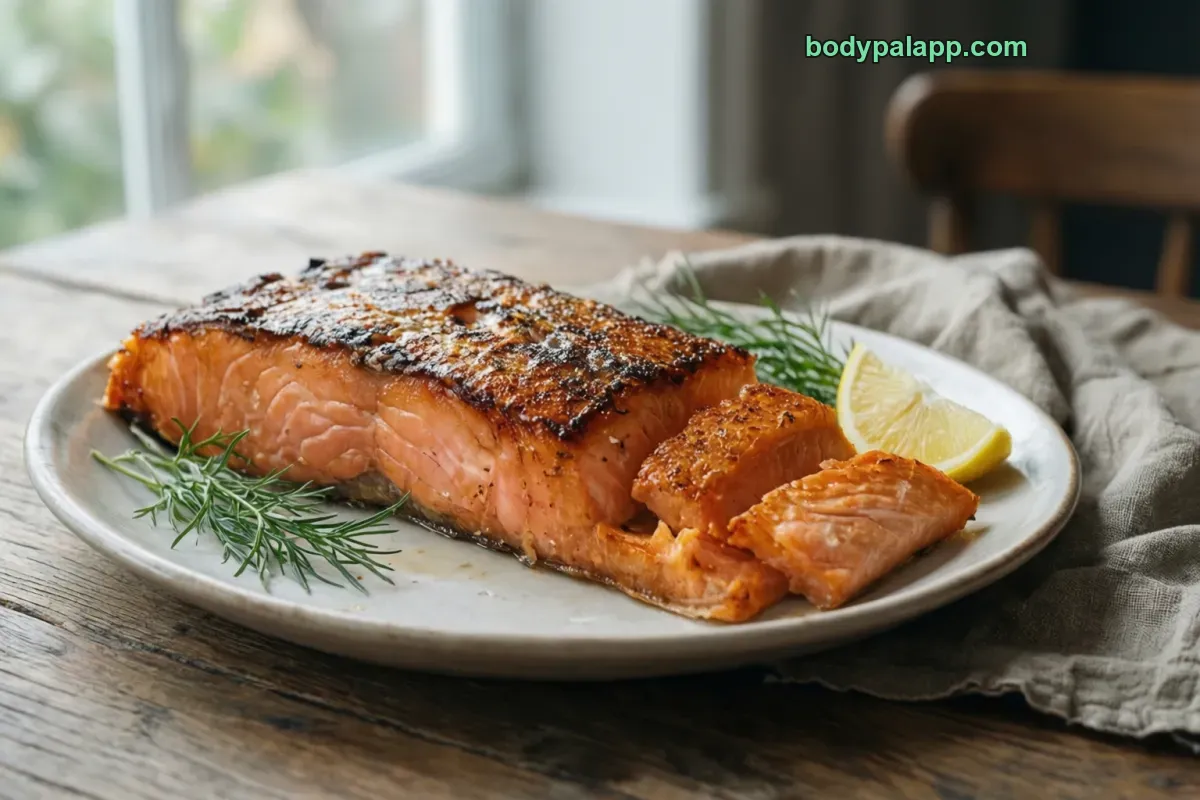
Cooked salmon fillet calories come to 367 for one 178 g fillet, or 206 per 100 g of farmed Atlantic salmon, baked or grilled. Fat supplies 56% of those calories and protein the other 44%, with no carbs at all. Portion size and salmon type move the total most: a wild sockeye fillet is 242.
367kcal
1 fillet · 178 g, farmed Atlantic, baked or grilled
44%protein
39 gProtein
0 gCarbs
22 gFat
How to burn off 367 kcal
—Walking, brisk
—Jogging
—Cycling, moderate
—Swimming
Skip the math. BodyPal counts these calories from your steps and workouts automatically.
Nutrition facts
Farmed atlantic, baked or grilled · per 178 g
Calories
367 kcal
Protein
39 g
Carbohydrate
0 g
Fat
22 g
Saturated fat
4.3 g
Cholesterol
112 mg
Sodium
109 mg
Potassium
684 mg
Iron
0.6 mg
Source: USDA FoodData Central
🛡️
Verified nutrition data
Numbers on this page come from USDA FoodData Central, the U.S. Department of Agriculture’s food composition database, and from manufacturer labels where a branded product is named. Last verified September 2026. How we verify our data →
Cooked salmon fillet: calories, protein and sodium by serving
Percent of daily value uses the FDA reference of 2,000 kcal a day.
Serving
kcal
Protein
Carbs
Fat
Sodium
% DV kcal
1 fillet (178 g)
367
39.3 g
0 g
22 g
109 mg
18%
Wild sockeye fillet (155 g)
242
41 g
0 g
8.6 g
143 mg
12%
3 oz portion (85 g)
175
18.8 g
0 g
10.5 g
52 mg
9%
100 g
206
22.1 g
0 g
12.4 g
61 mg
10%
3 × 1 fillet (178 g)
1,100
118 g
326 mg
5 × 1 fillet (178 g)
1,833
196.7 g
543 mg
One fillet is 367 calories, two are 733
A standard farmed Atlantic fillet weighs 178 g and lands at 367 calories, about 18% of the daily value. It also carries 39.3 g of protein, which covers 79% of the daily value in one piece. That makes a single fillet a full dinner portion of protein on its own, before anything else touches the plate.
A 3 oz portion (85 g) is roughly half a fillet. It comes to 175 calories, 18.8 g of protein and 10.5 g of fat, or 9% of the daily calorie value. If you split a fillet with someone, or cut it into two meals, this is the number to log.
Cooking for a family changes the math quickly. Two fillets total 733 calories and 78.7 g of protein. Three come to 1,100 calories, and five reach 1,833 calories with 196.7 g of protein. When fillets vary in size, weigh the cooked piece: every 100 g adds 206 calories, and BodyPal can log it from a photo if the scale is out of reach.
Fat, not protein, supplies most of the calories
Salmon is often filed under lean protein, but the farmed Atlantic numbers say otherwise. Per 100 g there are 22.1 g of protein and 12.4 g of fat, and because fat is denser in energy, it ends up supplying 56% of the calories. Protein accounts for 44%. Carbs, fiber and sugars are all 0.
That split is the reason a salmon fillet costs more calories than a white fish fillet of similar size. The protein is generous, but the fat comes along with it. Of that fat, 2.4 g per 100 g is saturated, measured against a daily value of 20 g, so most of the fat is the unsaturated kind.
In practice, salmon behaves like a protein and a fat source in one. If your plate already has butter, cream sauce or cheese, the fat adds up faster than you might expect. If it doesn't, the fillet fills both roles and the sides can stay simple.
Wild sockeye trims the fat, not the protein
The card's second serving row is a wild sockeye fillet of 155 g, and it tells a different story. It comes to 242 calories, 12% of the daily value, against 367 for the farmed Atlantic fillet. The gap is almost entirely fat: 8.6 g in the sockeye fillet versus 22 g in the farmed one.
Protein does not drop with it. The sockeye fillet delivers 41 g of protein, 82% of the daily value, slightly more than the 39.3 g in the larger farmed fillet. Per calorie, wild sockeye is the leaner, more protein-dense choice.
The trade-off is sodium, which is a little higher in the sockeye row at 143 mg, or 6% of the daily value, compared with 109 mg in the farmed fillet. Both numbers are small. If you are tracking calories closely, the species on the label matters more than the cooking method, so check whether the package says farmed Atlantic or wild sockeye before you log it.
Sodium is low, so the sides decide the rest
Plain cooked salmon is light on sodium: 61 mg per 100 g and 109 mg per fillet, just 5% of the 2300 mg daily value. Cholesterol sits at 63 mg per 100 g against a daily value of 300 mg, and potassium reaches 384 mg per 100 g. None of these rows is a red flag on its own.
The rows change once seasoning enters. Teriyaki glazes, blackening rubs and soy marinades add sodium and sometimes sugar that the plain fillet does not have, so flavored products from brands like Sea Cuisine or C. Wirthy & Co. are worth logging from their own labels rather than from this page.
Because the fillet has no carbs and no fiber, pairing does the work of balancing the plate. Roasted vegetables, a leafy salad, rice or potatoes all slot in easily. If you are watching calories, keep added fat modest, since the fillet already brings 22 g of its own.
How does cooked salmon fillet compare?
Here is how cooked salmon fillet stacks up against other cooked seafood on our site, per 100 g and per usual serving.
Verdict: For the fewest calories pick tilapia, at 111 per fillet and 128 per 100 g with just 2.7 g of fat. If you want to stay with salmon but cut fat, the cooked salmon page at 156 per 100 g and 5.6 g of fat is the trimmer pick, while scallops are low in calories but carry 415 mg of sodium per 100 g.
Most popular cooked salmon fillet brands in the United States
Ranked by popularity in the BodyPal database
# Productkcal / 100 g
1Member's Mark Atlantic Salmon Fillet Portions113 g204 kcal
2Tampa Bay Fisheries Salmon Fillets5.6 oz · 159 g283 kcal
8365 Everyday Value Wild-Caught Sockeye Salmon Fillets4 oz · 113 g133 kcal
Most packaged fillets are labeled per raw weight and some are wild species, so they read lower than the cooked farmed number above. Source: manufacturer labels / USDA FoodData Central.
Cooked salmon fillet FAQs
How many calories are in one cooked salmon fillet?
About 367 calories for a 178 g farmed Atlantic fillet, or 242 for a 155 g wild sockeye fillet.
Is salmon good for weight loss?
A 3 oz portion (85 g) of cooked farmed salmon has 175 calories and 18.8 g protein, with 0 g carbs.
Salmon vs tilapia: which has fewer calories?
Cooked farmed Atlantic salmon has 206 calories per 100 g versus 128 for cooked tilapia. Wild sockeye sits in between at 156.
How much protein is in a salmon fillet?
A 178 g farmed fillet has 39.3 g protein and 22.0 g fat. A 155 g wild sockeye fillet has 41.0 g protein.
How many calories are in 100 g of cooked salmon fillet?
There are 206 calories in 100 g of cooked farmed Atlantic salmon. That weight brings 22.1 g of protein, 12.4 g of fat and 0 g of carbs, about 10% of the daily calorie value.
How many calories are in a 3 oz serving of cooked salmon?
A 3 oz portion (85 g) of cooked farmed salmon has 175 calories. It provides 18.8 g of protein and 10.5 g of fat, roughly half of what a full 178 g fillet delivers.
Does wild sockeye salmon have fewer calories than farmed salmon?
Yes. A wild sockeye fillet of 155 g has 242 calories, compared with 367 for a 178 g farmed Atlantic fillet. Sockeye carries 8.6 g of fat against 22 g, while protein stays high at 41 g.
How much sodium is in a cooked salmon fillet?
A plain cooked fillet has 109 mg of sodium, 5% of the daily value. Per 100 g it is 61 mg. Glazes, rubs and marinades can raise that number considerably.
Does cooked salmon have any carbs or sugar?
No. Cooked salmon has 0 g of carbs, 0 g of sugars and 0 g of fiber per 100 g. All 206 calories come from protein and fat, with fat supplying 56% of them.