Tuna fish calories come to 98 for a standard 115 g can and 85 per 100 g of canned tuna. The number to notice is protein: it supplies 90% of the calories, so one can gives you 21.9 g of protein, 44% of the daily value, for just 5% of daily calories.
98kcal
1 standard can · 115 g, canned
90%protein
22 gProtein
0 gCarbs
1.1 gFat
How to burn off 98 kcal
—Walking, brisk
—Jogging
—Cycling, moderate
—Swimming
Skip the math. BodyPal counts these calories from your steps and workouts automatically.
Nutrition facts
Canned · per 115 g
Calories
98 kcal
Protein
22 g
Carbohydrate
0.1 g
Fat
1.1 g
Saturated fat
0.3 g
Cholesterol
41 mg
Sodium
252 mg
Potassium
202 mg
Iron
1.9 mg
Source: USDA FoodData Central
🛡️
Verified nutrition data
Numbers on this page come from USDA FoodData Central, the U.S. Department of Agriculture’s food composition database, and from manufacturer labels where a branded product is named. Last verified September 2026. How we verify our data →
Tuna fish: calories, protein and sodium by serving
Percent of daily value uses the FDA reference of 2,000 kcal a day.
Serving
kcal
Protein
Carbs
Fat
Sodium
% DV kcal
1 standard can (115 g)
98
21.9 g
0.1 g
1.1 g
252 mg
5%
3 oz portion (85 g)
72
16.2 g
0.1 g
0.8 g
186 mg
4%
1 cup (135 g)
115
25.7 g
0.1 g
1.3 g
296 mg
6%
100 g
85
19 g
0.1 g
0.9 g
219 mg
4%
3 × 1 standard can (115 g)
293
65.6 g
756 mg
5 × 1 standard can (115 g)
489
109.3 g
1,259 mg
One can is a 98-calorie, 21.9 g protein serving
A standard 115 g can of tuna holds 98 calories, 21.9 g of protein and only 1.1 g of fat. That is 5% of the daily calorie value against 44% of the daily protein value, a trade few foods on the shelf can match. Carbs barely register at 0.1 g.
Smaller and larger portions follow the same pattern. A 3 oz portion (85 g) comes to 72 calories and 16.2 g of protein, while a packed cup (135 g) reaches 115 calories and 25.7 g of protein, more than half the daily value at 51%. Weigh by the can or the cup and the totals stay easy to track.
Multiples climb in a straight line because there is almost nothing in the fish except protein and water. Two cans total 196 calories and 43.7 g of protein. Three cans reach 293 calories and 65.6 g. Even 5 cans, 575 g of fish, stop at 489 calories while delivering 109.3 g of protein. The calories rarely surprise you; the sodium does, as the next sections show.
Nearly every calorie is protein
Per 100 g, canned tuna fish carries 19 g of protein, 0.9 g of fat and 0.1 g of carbohydrate. Protein supplies 90% of the calories and fat the remaining 10%. Carbs round to 0, and both sugars and fiber are 0.
The fat that is there is mostly not saturated: 0.2 g per 100 g against a daily value of 20 g. Cholesterol sits at 36 mg per 100 g, a modest share of the 300 mg daily value. Potassium is 176 mg, a small slice of the 4700 mg daily value, so tuna is not where you get that mineral.
This profile makes tuna a blank, lean base. Whatever you mix it with decides the final count, because the fish itself brings so little fat or carbohydrate. A tuna salad can stay close to the can's 98 calories or end up several times higher, and the difference is entirely in the dressing, bread and crackers.
Sodium is the row to watch
Canned tuna fish has 219 mg of sodium per 100 g. A standard can holds 252 mg, 11% of the daily value, and a cup brings 296 mg, or 13%. On its own that is moderate, but it is far above fresh tuna steak, which lists 45 mg per 100 g.
Sodium stacks up faster than calories once you eat more than one can. Two cans total 504 mg, three reach 756 mg, and 5 cans hit 1,259 mg before you add anything else. Calories at that level are still low; sodium is the line that grows into a real share of the day.
If you watch sodium, look at the label for low-sodium or no-salt-added cans and compare the milligrams per serving. Keep an eye on the add-ins too. Pickles, soy sauce, salted crackers and seasoned mayo can add more sodium than the fish itself.
Tuna works as the protein anchor of a meal
At 98 calories a can, tuna leaves plenty of room on the plate for everything it lacks. The fish has 0 g of fiber and almost no carbohydrate, so pairing it with vegetables, beans, whole grains or potatoes rounds out a meal. A bowl of greens with a can of tuna and a grain covers protein, fiber and carbohydrate in one dish.
Fat is where tuna dishes gain calories. A spoon of mayo or a pour of olive oil changes the total more than switching from a 3 oz portion to a full can does, so measure the dressing rather than the fish. Mustard, lemon, yogurt or vinegar keep the mix lighter if that is your goal.
Tuna sandwiches and salads are hard to estimate by eye because the add-ins hide inside. BodyPal can log a tuna dish from a photo, which helps when you want the dressing counted along with the fish.
How does tuna fish compare?
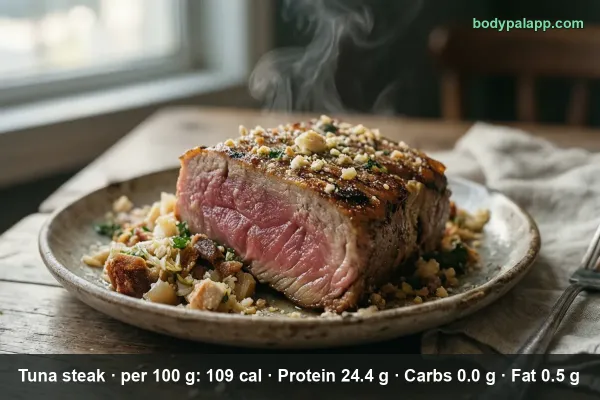
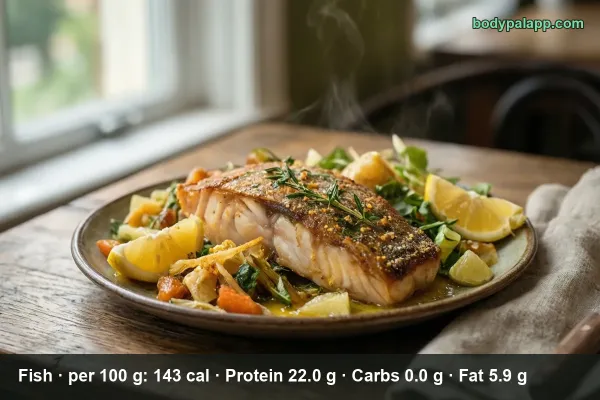
Here is how tuna fish stacks up against canned tuna, tuna steak and generic fish, per 100 g and per usual serving.
Verdict: For the lowest calories stick with canned tuna at 86 per 100 g; tuna steak at 109 is the better pick if you want more protein (24.4 g) and far less sodium (45 mg). Generic fish lands at 143 with 5.9 g of fat, so choose it for flavor, not for a lean protein hit.
Tuna fish FAQs
How many calories are in a can of tuna fish?
A standard can is about 115 g, which works out to 98 calories. A 3 oz portion (85 g) is 72 calories.
Is tuna fish good for weight loss?
Canned tuna is 85 calories per 100 g with 19 g protein and 0.9 g fat, so one standard can gives 21.9 g protein for 98 calories.
Tuna fish vs tuna steak: which has fewer calories?
Canned tuna fish is 85 calories per 100 g, while a fresh tuna steak is 109 calories per 100 g, a difference of 24 calories.
How much protein is in tuna fish?
There is 19 g of protein per 100 g. That is 16.2 g in a 3 oz portion (85 g) and 21.9 g in a standard can (115 g).
How many calories and how much protein are in 100 g of tuna fish?
100 g of canned tuna fish has 85 calories and 19 g of protein, which is 38% of the daily protein value. The same amount carries 0.9 g of fat, 0.1 g of carbs and 219 mg of sodium.
How much fat is in tuna?
Canned tuna fish has 0.9 g of fat per 100 g and 1.1 g in a standard 115 g can. Only 0.2 g per 100 g is saturated, and fat supplies just 10% of the calories.
What are the macros of tuna fish?
Tuna fish gets 90% of its calories from protein, 10% from fat and 0% from carbs. Per 100 g that works out to 19 g of protein, 0.9 g of fat and 0.1 g of carbohydrate.
How many calories are in a cup of tuna fish?
A cup of canned tuna fish (135 g) has 115 calories. It also delivers 25.7 g of protein, 51% of the daily value, along with 1.3 g of fat and 296 mg of sodium.
How many calories are in a 3 oz serving of tuna fish?
A 3 oz portion (85 g) of canned tuna fish has 72 calories and 16.2 g of protein. It carries 0.8 g of fat and 186 mg of sodium, 8% of the daily value.