Canned tuna calories come to 142 for one drained can (165 g) of light tuna in water, and 86 per 100 g. Almost all of that is protein: 90% of the calories, or 32.1 g per can, which covers 64% of the daily value. Fat barely registers at 1.6 g. Sodium is the number that adds up.
142kcal
1 drained can · 165 g, canned in water, drained
90%protein
32 gProtein
0 gCarbs
1.6 gFat
How to burn off 142 kcal
—Walking, brisk
—Jogging
—Cycling, moderate
—Swimming
Skip the math. BodyPal counts these calories from your steps and workouts automatically.
Nutrition facts
Canned in water, drained · per 165 g
Calories
142 kcal
Protein
32 g
Carbohydrate
0 g
Fat
1.6 g
Saturated fat
0.3 g
Cholesterol
59 mg
Sodium
408 mg
Potassium
295 mg
Iron
2.7 mg
Source: USDA FoodData Central
🛡️
Verified nutrition data
Numbers on this page come from USDA FoodData Central, the U.S. Department of Agriculture’s food composition database, and from manufacturer labels where a branded product is named. Last verified September 2026. How we verify our data →
Canned tuna: calories, protein and sodium by serving
Percent of daily value uses the FDA reference of 2,000 kcal a day.
Serving
kcal
Protein
Carbs
Fat
Sodium
% DV kcal
1 can, drained (165 g)
142
32.1 g
0 g
1.6 g
408 mg
7%
Can in oil (171 g)
339
49.8 g
0 g
14 g
711 mg
17%
3 oz portion (85 g)
73
16.5 g
0 g
0.8 g
210 mg
4%
100 g
86
19.4 g
0 g
1 g
247 mg
4%
3 × 1 can, drained (165 g)
426
96.2 g
1,223 mg
5 × 1 can, drained (165 g)
710
160.4 g
2,038 mg
One can is a 142-calorie meal base
A standard drained can weighs 165 g and delivers 142 calories, just 7% of the daily calorie value. That is small enough that the tuna itself rarely decides whether a meal is light or heavy. The bread, mayo, crackers and pasta around it usually do.
The 3 oz portion (85 g) used on many labels comes in at 73 calories, roughly half a can. If you split one can across two sandwiches, that is the figure to log for each. Weigh drained tuna once and you will see how far a fork-flaked serving can drift from the label.
Scaling up stays predictable because nothing is hiding in the fish. Two cans total 284 calories and 64.2 g of protein. Three cans reach 426 calories and 96.2 g of protein. Even 5 cans, far more than most people eat in a day, add up to only 710 calories. The sodium tells a different story at that volume, and it gets its own section below.
Protein supplies 90% of the calories
Per 100 g, drained light tuna in water carries 19.4 g of protein, 1 g of fat and 0 g of carbohydrate. The calorie split follows directly: 90% from protein, 10% from fat, nothing from carbs. Few foods in the pantry are this lopsided.
That makes a can one of the most efficient ways to move a protein total. One can's 32.1 g covers 64% of the daily value for protein while using only 7% of the calorie budget. The smaller 3 oz portion still brings 16.5 g, or 33% of the daily value, for 73 calories.
Fat stays minimal at 1.6 g per can, with saturated fat at 0.2 g per 100 g and cholesterol at 36 mg per 100 g. There is no fiber and no sugar. That means tuna on its own will not fill you the way vegetables, beans or whole grains do, which is the strongest case for pairing it rather than eating it straight from the can.
Sodium is the row to watch
Tuna packed in water is still a salted product. Each drained can holds 408 mg of sodium, 18% of the daily value, while supplying only 7% of the calories. Per 100 g the figure is 247 mg, or 11% of the daily value. Potassium, by contrast, sits at 179 mg per 100 g.
The gap widens as cans stack up. Two cans reach 815 mg, three cans hit 1,223 mg, and 5 cans land at 2,038 mg, close to a full day's daily value for sodium on fish alone. If you lean on canned tuna as a daily protein source, this is the line that limits how many cans make sense.
If you watch sodium, the add-ons count as much as the fish. Pickles, soy sauce, salted crackers and deli bread all stack on top of the 408 mg already in the can. Fresh vegetables, plain rice, potatoes or a squeeze of lemon add flavor without pushing the total much higher.
Oil-packed tuna more than doubles the count
The packing liquid is the biggest swing on the label. A 171 g can of tuna in oil comes to 339 calories with 14 g of fat, against 142 calories and 1.6 g of fat for the water-packed can. Most of that gap is the oil, not the fish.
The oil can also lists 49.8 g of protein and 711 mg of sodium, which is 31% of the daily value. In calorie terms it takes 17% of the daily value in a single can, versus 7% for water-packed. That is a real difference if you eat tuna several times a week.
If calories are your goal, pick water-packed and add your own fat where you can measure it, like a spoon of olive oil or a slice of avocado. If you prefer oil-packed for flavor, log it as the oil version, since the two cans are far apart. BodyPal can log either one from a photo of the can or the plate.
How does canned tuna compare?
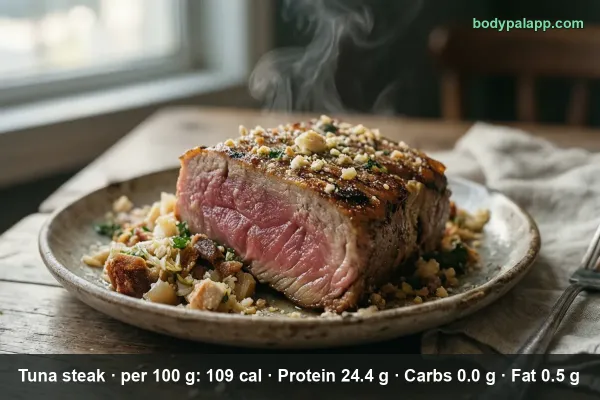
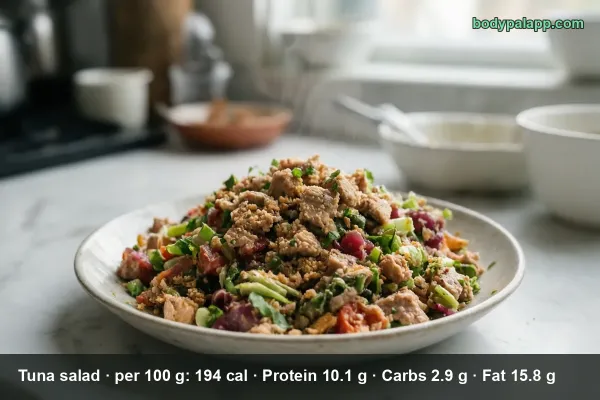
Here is how drained canned tuna stacks up against tuna fish, tuna steak and tuna salad, per 100 g and per usual serving.
Verdict: For the fewest calories, canned tuna at 86 per 100 g and tuna fish at 85 are effectively tied, while tuna steak costs about a third more at 109 but brings 24.4 g of protein and just 45 mg of sodium. Skip tuna salad if you are counting: at 194 calories and 15.8 g of fat per 100 g, it carries 2.3 times the calories of plain canned tuna.
Canned tuna FAQs
How many calories are in a can of tuna?
A drained 165 g can of light tuna in water is about 142 calories. A 3 oz portion (85 g) is 73 calories.
Is canned tuna good for weight loss?
A drained can in water has 142 calories with 32.1 g protein and 1.6 g fat. The same size can packed in oil is 339 calories.
Canned tuna or tuna steak: which has fewer calories?
Canned tuna in water has 86 calories per 100 g, against 109 per 100 g for tuna steak.
How much protein is in a can of tuna?
About 32.1 g in a drained 165 g can in water, or 16.5 g in a 3 oz portion (85 g).
How many calories are in a small can of tuna?
A 3 oz portion (85 g) of drained tuna in water has 73 calories, with 16.5 g of protein and 0.8 g of fat. If your small can drains to about that weight, log it at that figure.
How much fat is in a can of tuna?
A drained can of light tuna in water has 1.6 g of fat, which is only 10% of its calories. A can packed in oil jumps to 14 g of fat and 339 calories.
What is the nutrition breakdown of canned tuna?
Per 100 g, drained tuna in water has 86 calories, 19.4 g of protein, 1 g of fat, 0 g of carbs and 247 mg of sodium. There is no fiber or sugar.
How many calories are in canned tuna per 100 g?
Canned light tuna in water, drained, has 86 calories per 100 g. That covers 39% of the daily value for protein and 11% for sodium, but only 4% of daily calories.