Balsamic vinegar calories come to 14 for 1 tbsp (16 g) and 88 per 100 g. Almost every one of those calories is carbohydrate, and most of that carbohydrate is sugar: 2.4 g in a tablespoon. Portion size decides everything here, because a splash barely counts while a full cup reaches 224.
14kcal
1 tablespoon · 16 g, plain, bottled
3%protein
0.1 gProtein
3 gCarbs
0 gFat
How to burn off 14 kcal
—Walking, brisk
—Jogging
—Cycling, moderate
—Swimming
Skip the math. BodyPal counts these calories from your steps and workouts automatically.
Nutrition facts
Plain, bottled · per 16 g
Calories
14 kcal
Protein
0.1 g
Carbohydrate
2.7 g
Fat
0 g
Saturated fat
0 g
Sodium
4 mg
Potassium
18 mg
Iron
0.1 mg
Source: USDA FoodData Central
🛡️
Verified nutrition data
Numbers on this page come from USDA FoodData Central, the U.S. Department of Agriculture’s food composition database, and from manufacturer labels where a branded product is named. Last verified October 2026. How we verify our data →
Balsamic vinegar: calories, protein and sodium by serving
Percent of daily value uses the FDA reference of 2,000 kcal a day.
Serving
kcal
Protein
Carbs
Fat
Sodium
% DV kcal
1 tbsp (16 g)
14
0.1 g
2.7 g
0 g
4 mg
1%
1 tsp (5.3 g)
5
0 g
0.9 g
0 g
1 mg
0%
1 cup (255 g)
224
1.2 g
43.4 g
0 g
59 mg
11%
100 g
88
0.5 g
17 g
0 g
23 mg
4%
3 × 1 tbsp (16 g)
42
0.2 g
11 mg
5 × 1 tbsp (16 g)
70
0.4 g
18 mg
A tablespoon is 14 calories, a cup is 224
The standard serving is 1 tbsp (16 g), and it carries 14 calories, or 1% of the daily calorie value. A teaspoon (5.3 g) is 5 calories. That is small enough that a drizzle over sliced tomatoes hardly moves your total for the day.
Few people measure their pours, though. Two tablespoons (32 g) bring 28 calories, three (48 g) bring 42, and five (80 g) reach 70. Five tablespoons sounds like a lot until you watch someone flood a caprese plate or a bowl of strawberries. At that point the vinegar costs about as much as a small piece of fruit.
A full cup (255 g) lands at 224 calories, 11% of the daily value, with 38.1 g of sugars. Nobody drinks a cup. But glazes and reductions start from that kind of volume and cook it down, so the calories stay in the pan while the water leaves. A spoonful of thick glaze is denser than a spoonful of the thin vinegar.
Carbs supply 97% of the calories
Per 100 g, balsamic vinegar has 17 g of carbs, 0.5 g of protein and 0 g of fat. The calorie split follows directly: 97% from carbs, 3% from protein, nothing from fat. There is no saturated fat at all.
Most of those carbs are sugars, 15 g out of 17 per 100 g. In a tablespoon that means 2.4 g of sugars inside 2.7 g of carbs; in a teaspoon, 0.8 g inside 0.9 g. That sweetness is what separates balsamic from sharp white vinegar, and it is the whole reason the calorie count is higher.
Protein is a rounding error: 0.1 g per tablespoon and only 1.2 g even in a full cup. Balsamic adds flavor, not fullness. Count it as a condiment that brings a little sugar, not as a food that will hold you until the next meal.
Sodium barely registers
Plenty of condiments are mostly salt. Balsamic vinegar is not one of them: 4 mg of sodium per tablespoon, which rounds to 0% of the daily value, and 23 mg per 100 g.
Even a full cup holds just 59 mg, 3% of the daily value. Five tablespoons come to 18 mg. If you watch sodium, the vinegar itself is not the issue. The salt, cheese, olives or bottled dressing sitting next to it on the plate usually is, so look there first.
Potassium sits at 112 mg per 100 g. That is a modest figure for something you eat by the spoonful, so treat it as a small extra rather than a reason to pour more. The real selling point stays the same: big flavor for very little sodium and very few calories.
The oil, not the vinegar, sets the salad total
On its own, balsamic is one of the lightest ways to add flavor to a plate. The calories in a vinaigrette come from what gets mixed in with it. Bottled balsamic dressing lists 158 calories per 100 g with 11.7 g of fat, against 88 and 0 for the plain vinegar.
If you want the tang without the fat, dress greens with plain balsamic and add oil by the teaspoon so you can actually count it. It also works on roasted vegetables, grilled chicken, strawberries or tomato with mozzarella, where a tablespoon goes a long way.
The brand list on this page runs from Monari Federzoni Balsamic Vinegar of Modena to Alessi White Balsamic Vinegar and infused versions like pear or ginger. Read the label on flavored bottles, since added sweetness can change the numbers. BodyPal can log a drizzle from a photo of your plate.
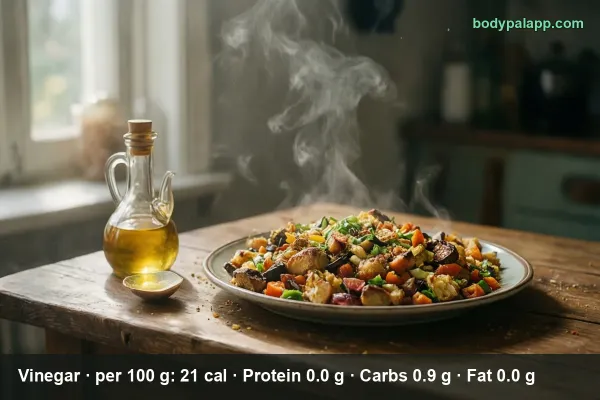
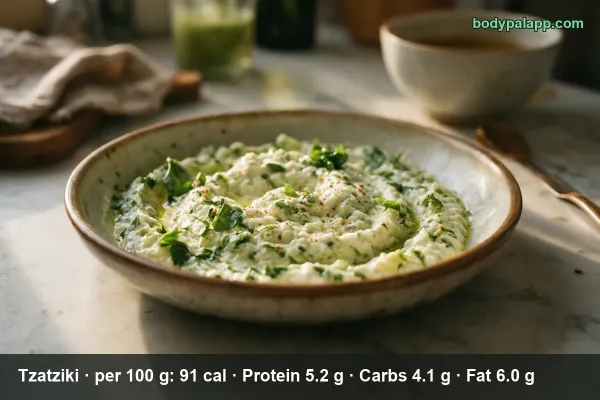
How does balsamic vinegar compare?
Here is how balsamic vinegar stacks up against plain vinegar, balsamic dressing and tzatziki, per 100 g and per usual serving.
Verdict: For the fewest calories, plain vinegar wins at 21 per 100 g, though balsamic at 88 still costs only 14 per tablespoon. Skip bottled balsamic dressing if you are cutting: 47 calories per 2 Tbsp and 533 mg of sodium per 100 g make it the heaviest choice here.
Most popular balsamic vinegar brands in the United States
Labels are rounded per 15 ml tablespoon and vary with how much grape must the vinegar contains, so they read higher than the main number above. Source: manufacturer labels / USDA FoodData Central.
Balsamic vinegar FAQs
How many calories are in a tablespoon of balsamic vinegar?
One tablespoon (16 g) of balsamic vinegar has 14 calories, and a teaspoon (5.3 g) has 5.
Is balsamic vinegar good for weight loss?
A tablespoon adds 14 calories and 0 g of fat, so it flavors salads with far fewer calories than oil-based dressings.
Balsamic vinegar vs regular vinegar: which has fewer calories?
Regular vinegar has 21 calories per 100 g, while balsamic vinegar has 88 because of its natural grape sugars.
How much sugar is in balsamic vinegar?
Balsamic vinegar has 14.95 g of sugar per 100 g, which is about 2.4 g per tablespoon out of 2.7 g of carbs.
Does balsamic vinegar have calories?
Yes, 88 calories per 100 g and 14 per tablespoon (16 g). Nearly all of them, 97%, come from carbs, mostly sugars. It has 0 g of fat, so it is light, but not calorie-free.
How many calories are in balsamic vinegar dressing?
Bottled balsamic dressing has 47 calories per 2 Tbsp (30 g), or 158 per 100 g. The jump over plain balsamic vinegar comes from 11.7 g of fat per 100 g, and sodium climbs to 533 mg.
What does USDA FoodData Central list for balsamic vinegar?
The USDA row "Vinegar, balsamic" (FDC 172241) gives 88 calories per 100 g, or 14 per tablespoon of 16 g. Per 100 g it lists 17 g of carbs, 15 g of sugars and 23 mg of sodium.
How many calories are in 100 grams of balsamic vinegar?
Balsamic vinegar has 88 calories per 100 g, about 4% of the daily calorie value. That amount holds 17 g of carbs, 15 g of sugars, 0.5 g of protein and 0 g of fat.