
How many calories are in tzatziki?
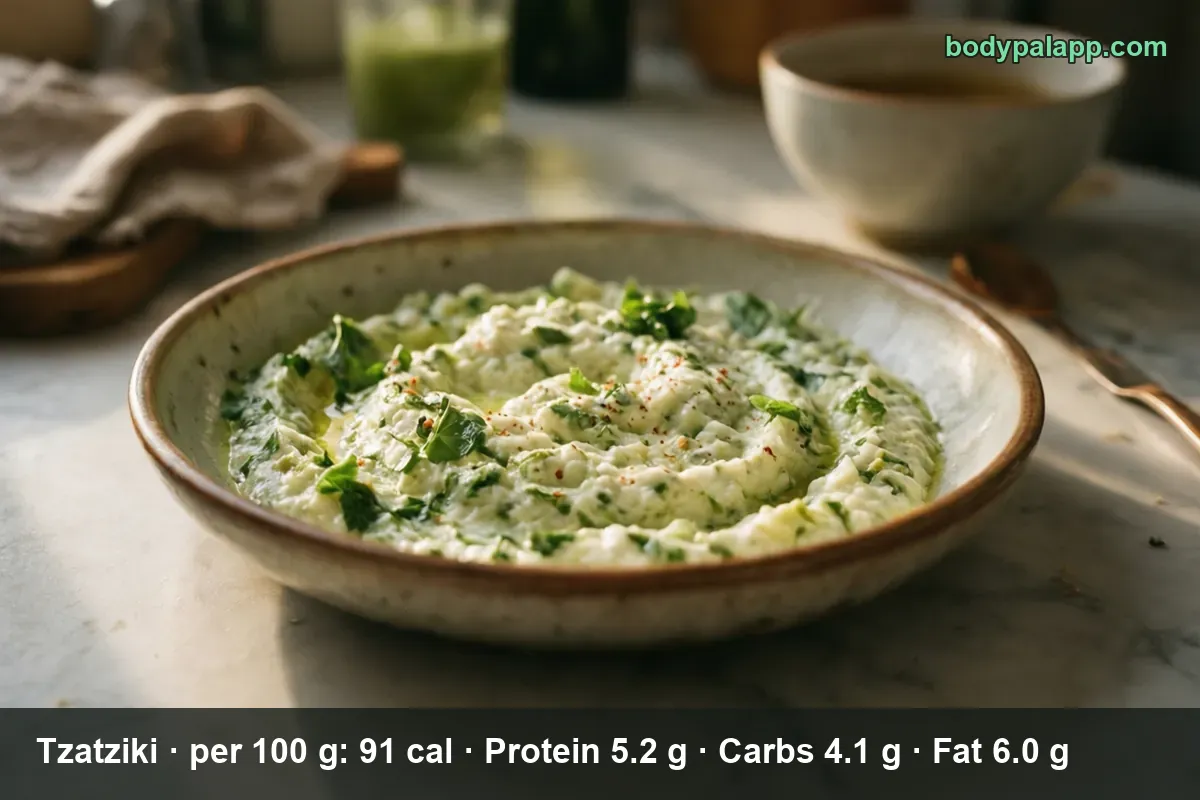
Two tablespoons of plain tzatziki come to 27 calories, and 100 g of it comes to 91 calories. That makes it one of the lightest cold sauces in the USDA database — a yogurt dip with 6 g of fat and 4.1 g of carbohydrate per 100 g. The catch is not the calories. It is the salt.
On this page
- Tzatziki quick facts
- US servings from one tablespoon to a whole tub
- Store tubs and other tzatziki versions
- Sodium is the row to watch
- How does tzatziki compare?
- Most popular tzatziki brands
- Tzatziki FAQs
Tzatziki quick facts
The row that matches the bowl on most American tables is FNDDS 2705448, "Tzatziki dip", from the 2021–2023 survey release. It is the only USDA entry for the food itself rather than for a dish made with it: plain strained-yogurt dip with cucumber, garlic and herbs, the kind you scoop with a pita chip or spread inside a wrap. Retail tubs are a different animal — they are label data, and they get their own section further down.
The serving column below is two tablespoons, 30 g, which is the label serving American brands print. USDA does not publish a household measure at exactly that weight for this record, so the 30 g column is our own arithmetic from the USDA 100 g figure.
| Nutrient | Per 100 g | Per 2 tablespoons (30 g) | % Daily Value |
|---|---|---|---|
| Calories | 91 | 27 | — |
| Total fat | 6 g | 1.8 g | 2% |
| Saturated fat | 1.89 g | 0.6 g | 3% |
| Carbohydrate | 4.1 g | 1.2 g | 0% |
| Dietary fiber | 0.2 g | 0.1 g | 0% |
| Total sugars | 2.5 g | 0.8 g | — |
| Protein | 5.22 g | 1.6 g | 3% |
| Sodium | 307 mg | 92 mg | 4% |
% Daily Value is based on a 2,000-calorie diet.
Verified nutrition data
Numbers on this page come from USDA FoodData Central, the U.S. Department of Agriculture’s food composition database, and from manufacturer labels where a branded product is named. Last verified September 2026. How we verify our data →
Two rows you would see on a package are missing here on purpose. Added sugars and trans fat are not published in this FNDDS release, so there is nothing honest to put in those cells. Cholesterol runs 10 mg per 100 g, or 3 mg in the two-tablespoon serving (1% DV), and potassium 150 mg per 100 g, or 45 mg per serving (1% DV) — small enough that neither changes a decision.
US servings from one tablespoon to a whole tub
| Serving | Weight | Calories |
|---|---|---|
| 1 tablespoon | 15 g | 14 kcal |
| 2 tablespoons, label serving | 30 g | 27 kcal |
| 1 oz | 28 g | 25 kcal |
| Scoop, quantity not specified | 60 g | 55 kcal |
| 1 individual container | 70 g | 64 kcal |
| Per 100 g | 100 g | 91 kcal |
Three of those weights come straight from USDA household measures for this record: the single tablespoon, the unspecified-quantity scoop that surveys use when nobody measured, and the individual container that comes in a snack pack. The 30 g label serving and the 1 oz line are our own arithmetic from the USDA 100 g figure, not USDA servings.
The practical spread is small and that is the point. Even the whole 70 g tub is 64 calories — less than a tablespoon of mayonnaise or oil. Tzatziki is one of the few condiments where portion anxiety is wasted energy; you can be generous with it and still stay under 100 calories.
Store tubs and other tzatziki versions
| Version | Per 100 g | Label serving | Calories |
|---|---|---|---|
| Plain tzatziki dip, USDA | 91 kcal | 2 tbsp (30 g) | 27 kcal |
| Store-bought tub, Cedar's | 125 kcal | 2 Tbsp (28 g) | 35 kcal |
| Light tub, The Farm At Red Hill | 50 kcal | 2 Tbsp (30 g) | 15 kcal |
| Spicy tub, Summer Fresh | 167 kcal | 2 Tbsp (30 g) | 50 kcal |
| Dairy-free tzatziki | 100 kcal | 2 tbsp (30 g) | 30 kcal |
| Tzatziki dressing, bottled | 267 kcal | 2 Tbsp (30 ml) | 80 kcal |
This table is the reason a generic number can mislead you. The plain USDA dip is 91 calories per 100 g; Cedar's Cucumber Garlic Dill runs 125, about 37% higher, because retail tubs use fuller-fat yogurt and oil to hold texture on a shelf. Summer Fresh Spicy is 167. The Farm At Red Hill sits at 50. Three other tubs land in between: Esti Authentic Greek Lemon at 111 per 100 g, Esti Organic at 125 and Real Foods Tzatziki Sauce at 133.
Read down the tub rows and the same two spoonfuls swing from 15 calories to 50 — more than triple, depending on which lid you unscrew. That is a larger gap than most people assume exists inside a single product name.
The bottled dressing is the outlier worth flagging. At 267 calories per 100 g it is nearly three times the dip, because it is built on oil rather than yogurt. The 80-calorie figure for two tablespoons is our own arithmetic from that 100 g number. If a recipe says "tzatziki" and you reach for a squeeze bottle in the dressing aisle, you are logging a different food.
Sodium is the row to watch
Calories are not what makes tzatziki worth a second look on a nutrition label. Sodium is. Per 100 g the dip carries 307 mg, which is 13% of the FDA Daily Value of 2,300 mg — a little more than an eighth of a teaspoon of table salt. Finish a 70 g individual container and you have taken in 215 mg, or 9% of the day's sodium, for 64 calories. Calorie-cheap, sodium-expensive.
That trade is fine in isolation. It matters when tzatziki is riding on top of something already salted: a gyro, a rice bowl, a shawarma plate. The Dietary Guidelines for Americans put most adults well over the sodium limit already, and condiments are one of the quiet contributors. If you are watching blood pressure, the light tubs are usually the lower-sodium picks too — check the label, since brands vary more than the generic row suggests.
The row that earns tzatziki its reputation is protein. 5.22 g per 100 g is 10% DV, and because the food is so light, that works out to 5.7 g of protein per 100 calories. For a strained-yogurt product that tracks with what MyPlate counts in the dairy group. Very few sauces do anything useful on that row at all.
How does tzatziki compare?
| Sauce or dip | Per 100 g | US serving | Calories |
|---|---|---|---|
| Tzatziki dip | 91 kcal | 2 tbsp (30 g) | 27 kcal |
| Curry sauce | 95 kcal | 2 tbsp (30 g) | 29 kcal |
| Mole sauce | 75 kcal | 2 tbsp (30 g) | 23 kcal |
| Bean dip with refried beans | 119 kcal | 2 tbsp (30 g) | 36 kcal |
The per-serving numbers for all four are our own arithmetic from the USDA 100 g figures at a common 30 g scoop, so the comparison is apples to apples. Of the three neighbors, only mole sauce is lighter per 100 g, and it gets there with a carbohydrate base — 10.77 g per 100 g against tzatziki's 4.1 g. Bean dip matches tzatziki on protein (5.44 g versus 5.22 g) but carries nearly four times the carbohydrate. Curry sauce is almost identical in calories and has 1.39 g of protein, a quarter of what tzatziki brings.
Our take: for weight control, tzatziki is the pick in this group — it is nearly the lightest per gram and the only one that adds meaningful protein while doing it. For fullness, bean dip earns its extra nine calories per serving with fiber-bearing legumes. Curry sauce is the one to skip if you are choosing on nutrition alone, since it costs the same as tzatziki and gives back almost nothing. And if you are buying rather than making, the tub you choose moves the number more than the food category does.
Most popular tzatziki brands in the United States
Ranked by how widely each product appears among foods sold in the United States, from the BodyPal food database of over 3.3 million products. Calories are the figures printed on each Nutrition Facts label, checked against USDA FoodData Central.
| Product | Calories (per 100 g) |
|---|---|
| Cedar's Cucumber Garlic Dill Tzatziki | 125 cal |
| The Farm At Red Hill Tzatziki | 50 cal |
| Esti Organic Tzatziki | 125 cal |
| Summer Fresh Spicy Tzatziki | 167 cal |
| Real Foods Tzatziki Sauce | 133 cal |
| Esti Authentic Greek Lemon Tzatziki | 111 cal |
Brand popularity: BodyPal food database. Nutrition: manufacturer labels / USDA FoodData Central.
Tzatziki FAQs
How many calories are in tzatziki?
Two tablespoons of plain tzatziki carry 27 calories, scaled from the USDA figure of 91 calories per 100 g. That is one of the lightest things you can put on a plate by the spoonful, with 1.8 g of fat, 1.2 g of carbohydrate and 1.6 g of protein in that same 30 g scoop.
How many calories are in 2 tablespoons of tzatziki?
27 calories for 30 g of the plain USDA dip. A retail tub usually reads higher: Cedar's lists 35 calories for its 28 g label serving and Summer Fresh Spicy lists 50 for 30 g, while The Farm At Red Hill lists only 15. The lid in your fridge beats the generic number.
Is tzatziki healthy?
By the numbers it does well: 91 calories per 100 g, 5.22 g of protein (10% DV) and 1.89 g of saturated fat. The weak row is sodium at 307 mg per 100 g, 13% of the Daily Value. If you are watching salt rather than calories, that is the line to read first.
Is tzatziki good for weight loss?
At 27 calories per two tablespoons it is one of the cheapest ways to make plain food taste like something. A whole 70 g container is 64 calories. If you are swapping it in for a mayonnaise-based or oil-based sauce, the saving per spoonful is real and it comes with 1.6 g of protein.
How much protein is in tzatziki?
5.22 g per 100 g, which is 10% of the Daily Value, or 1.6 g in a two-tablespoon serving. Because the food is so light, that works out to 5.7 g of protein per 100 calories. Curry sauce manages 1.39 g per 100 g and mole sauce 0.98 g, so tzatziki is the standout here.
How much sodium is in tzatziki sauce?
307 mg per 100 g, or 13% of the 2,300 mg Daily Value, which is a little more than an eighth of a teaspoon of table salt. Two tablespoons come to 92 mg (4% DV) and a 70 g individual container to 215 mg (9% DV) for only 64 calories.
Is store-bought tzatziki higher in calories than homemade?
Usually yes against the USDA plain dip row of 91 calories per 100 g: Cedar's is 125, Real Foods 133 and Summer Fresh Spicy 167. USDA publishes no separate recipe entry for a homemade batch, so there is no honest home-cooked figure to quote — the plain dip row is the closest stand-in.
How many calories are in tzatziki on a gyro?
Between 27 and 55 calories in practice. A restrained two-tablespoon smear is 27; USDA's unspecified-quantity serving, the one surveys use when nobody measured, is 60 g and 55 calories. Sodium moves more than calories do — that 60 g scoop carries 184 mg on top of an already salty sandwich.
Similar foods
- Sriracha — 6 cal per teaspoon
- A1 Sauce — 16 cal per tablespoon
- Curry Sauce — 30 cal per 2 Tbsp
- Orange Peel — 6 cal per tbsp
- Pickled Sushi Ginger — 5 cal per teaspoon
- Tomato Paste — 13 cal per tablespoon
Count it without the math
Point the camera at the bowl and BodyPal counts the tzatziki for you, tub or homemade.


How long does it take to burn off tzatziki?
Two tablespoons (30 g) is 27 kcal. Enter your weight and the amount you ate to see how long it takes you to burn that off:
lb
| Activity | Time to burn 27 kcal |
|---|---|
| Walking, brisk | 5 min |
| Cycling, moderate | 3 min |
| Swimming, moderate | 4 min |
| Jogging | 3 min |
| Weight training, moderate | 6 min |
Times are for a 155 lb adult at a steady pace; change the weight to see yours. The amount is set to the portion in the text (30 g); change it to what you actually ate. BodyPal works this out from your steps automatically.
One food is easy to picture; a whole day is harder. See how many calories you need a day and what a deficit actually looks like.