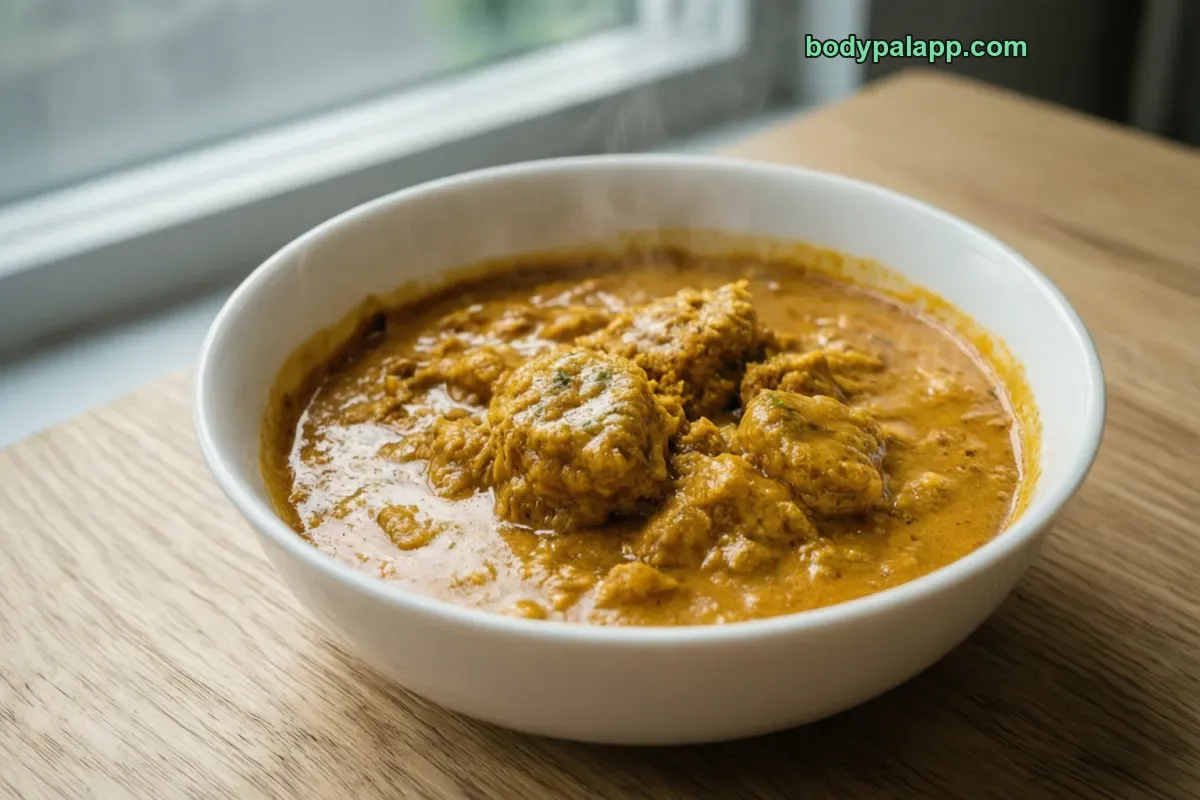
Curry sauce calories come to 30 for 2 Tbsp (32 g) and 95 per 100 g of the prepared, ready-to-eat sauce. The number to notice is the fat: 74% of those calories come from fat, so the total climbs fast once you pour by the ladle instead of the spoon.
30kcal
1 2 tablespoons · 32 g, prepared, ready to eat
6%protein
0.4 gProtein
2 gCarbs
2.6 gFat
How to burn off 30 kcal
—Walking, brisk
—Jogging
—Cycling, moderate
—Swimming
Skip the math. BodyPal counts these calories from your steps and workouts automatically.
Nutrition facts
Prepared, ready to eat · per 32 g
Calories
30 kcal
Protein
0.4 g
Carbohydrate
1.6 g
Fat
2.6 g
Saturated fat
0.8 g
Cholesterol
0 mg
Sodium
123 mg
Potassium
86 mg
Iron
0.3 mg
Source: USDA FoodData Central
🛡️
Verified nutrition data
Numbers on this page come from USDA FoodData Central, the U.S. Department of Agriculture’s food composition database, and from manufacturer labels where a branded product is named. Last verified September 2026. How we verify our data →
Curry sauce: calories, protein and sodium by serving
Percent of daily value uses the FDA reference of 2,000 kcal a day.
Serving
kcal
Protein
Carbs
Fat
Sodium
% DV kcal
2 Tbsp (32 g)
30
0.4 g
1.6 g
2.6 g
123 mg
2%
1 Tbsp (16 g)
15
0.2 g
0.8 g
1.3 g
61 mg
1%
100 g
95
1.4 g
5 g
8.2 g
383 mg
5%
3 × 2 Tbsp (32 g)
91
1.3 g
368 mg
5 × 2 Tbsp (32 g)
152
2.2 g
613 mg
Two tablespoons is 30 calories, but few people stop there
The label serving is 2 Tbsp (32 g), which carries 30 calories, 2.6 g of fat and 123 mg of sodium. That is 2% of the daily calorie value and 5% of the sodium daily value. A single tablespoon halves it to 15 calories. On paper, this is a light sauce.
The catch is how it gets served. Double the serving to 64 g and you reach 61 calories and 245 mg of sodium. Three servings, or 96 g, come to 91 calories and 368 mg of sodium. Five servings, 160 g, which is what a heavy ladle over a full plate can easily be, land at 152 calories and 613 mg of sodium.
So measure once. Level 2 Tbsp out of the jar, spoon it over your plate and look at how much surface it covers. That picture becomes your reference. If your plate usually looks wetter than that, log the bigger multiple, not the label serving.
Fat supplies about three quarters of every calorie
Per 100 g, curry sauce has 8.2 g of fat, 5 g of carbs and 1.4 g of protein. Turned into calories, fat accounts for 74%, carbs 20% and protein just 6%. That is the profile of a fat-based sauce, not a tomato-based one, and it explains why something that tastes light can still add up.
Saturated fat is 2.5 g per 100 g, roughly a third of the total fat. Against the 20 g daily value that is modest at a 2 Tbsp serving, but worth counting if you routinely pour 160 g.
Protein barely registers: 0.4 g in 2 Tbsp, 1% of the daily value. The sauce brings flavor and fat, not substance. Whatever goes under it has to supply the protein, and that choice matters far more than the sauce itself.
Sodium is the row to watch
Per 100 g, curry sauce carries 383 mg of sodium, 17% of the 2300 mg daily value. At 2 Tbsp that drops to 123 mg, or 5%, which is easy to absorb into a day. The issue is volume again: 160 g brings 613 mg, and that is before the rest of the plate.
The other rows are quiet. Sugars sit at 3.4 g per 100 g and 1.1 g per 2 Tbsp, a small share of an already small carb count. Fiber matches protein at 1.4 g per 100 g. Potassium is 268 mg per 100 g. None of these change much about how the sauce fits your day.
If you watch sodium, look at the whole dish. Seasoned meat, salted rice and bread all add their own. Keep the sauce to a measured serving and it stays a minor contributor rather than the main one.
Let the plate, not the sauce, carry the meal
Curry sauce is a coating, so its calories ride on whatever it covers. Over chicken, tofu, lentils or a pile of vegetables, keeping the sauce between one and three label servings holds it to somewhere between 30 and 91 calories, while the base supplies the protein and fiber the sauce lacks.
Rice and bread are where the plate grows. The sauce itself stays small; the starch underneath sets most of the total. If you want more sauce flavor across the plate, thin it with a splash of stock or water while heating. The calories stay the same, but they stretch over more food.
Jarred versions vary widely, from Patak's and Seeds of Change to Lee Kum Kee and Kikkoman Thai red curry, so check the label of the one you buy. BodyPal can log your curry from a photo, sauce included.
How does curry sauce compare?
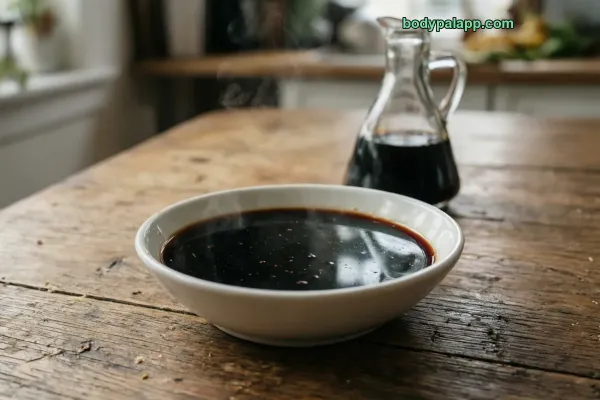
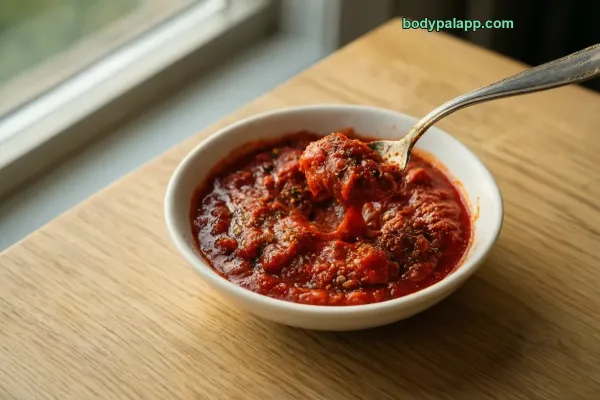
Here is curry sauce next to enchilada sauce, soy sauce and pizza sauce, per 100 g and per usual serving.
Verdict: If calories are the priority, enchilada sauce wins at 30 per 100 g against 95 for curry sauce, with pizza sauce close behind at 54. If sodium is the worry, pizza sauce is lowest at 348 mg per 100 g, and soy sauce at 5,493 mg is the one to use by the drop.
Most popular curry sauce brands in the United States
Ranked by popularity in the BodyPal database
# Productkcal / 100 g
1Roland Rogan Josh Medium Luxury Curry Sauce1/4 cup · 60 g167 kcal
2Kikkoman Thai Red Curry Sauce1/4 cup · 63 g159 kcal
3Roland Madras Hot Curry Sauce1/4 cup · 60 g167 kcal
Named restaurant-style curry sauces such as tikka masala and coconut curry are richer, with added oil, cream or coconut milk, so they read higher per 100 g than the plain reference curry sauce above. Source: manufacturer labels / USDA FoodData Central.
Curry sauce FAQs
How many calories are in curry sauce?
A 2-tablespoon serving (32 g) is about 30 calories, and one tablespoon is 15 calories. Per 100 g the figure is 95 calories.
Is curry sauce good for weight loss?
Curry sauce is 95 calories per 100 g, with 8.2 g fat and 1.4 g fiber, so a 2-tablespoon serving adds about 30 calories and 2.6 g fat.
Curry sauce vs enchilada sauce: which has fewer calories?
Curry sauce is 95 calories per 100 g compared with 30 for enchilada sauce, so curry sauce has roughly three times more calories per 100 g.
How much fat is in curry sauce?
A 2-tablespoon (32 g) serving has 2.6 g of fat, of which 0.8 g is saturated. Per 100 g that is 8.22 g fat and 383 mg sodium.
Is curry sauce high in calories?
Not per spoon: 2 Tbsp (32 g) has 30 calories and 100 g has 95. It only becomes significant in volume, since a 160 g pour, five label servings, adds 152 calories.
What are the macros in curry sauce?
Per 100 g, curry sauce has 1.4 g of protein, 5 g of carbs and 8.2 g of fat. By calories that is 6% protein, 20% carbs and 74% fat, so fat drives the total.
How much sodium is in curry sauce?
A 2 Tbsp (32 g) serving has 123 mg of sodium, 5% of the daily value. Per 100 g it is 383 mg, or 17%, so a generous pour adds up quickly.
How much sugar is in curry sauce?
A 2 Tbsp serving has 1.1 g of sugars within 1.6 g of carbs. Per 100 g that rises to 3.4 g of sugars and 5 g of carbs, a small part of the sauce's calories.