
How many calories are in a BBQ rib?
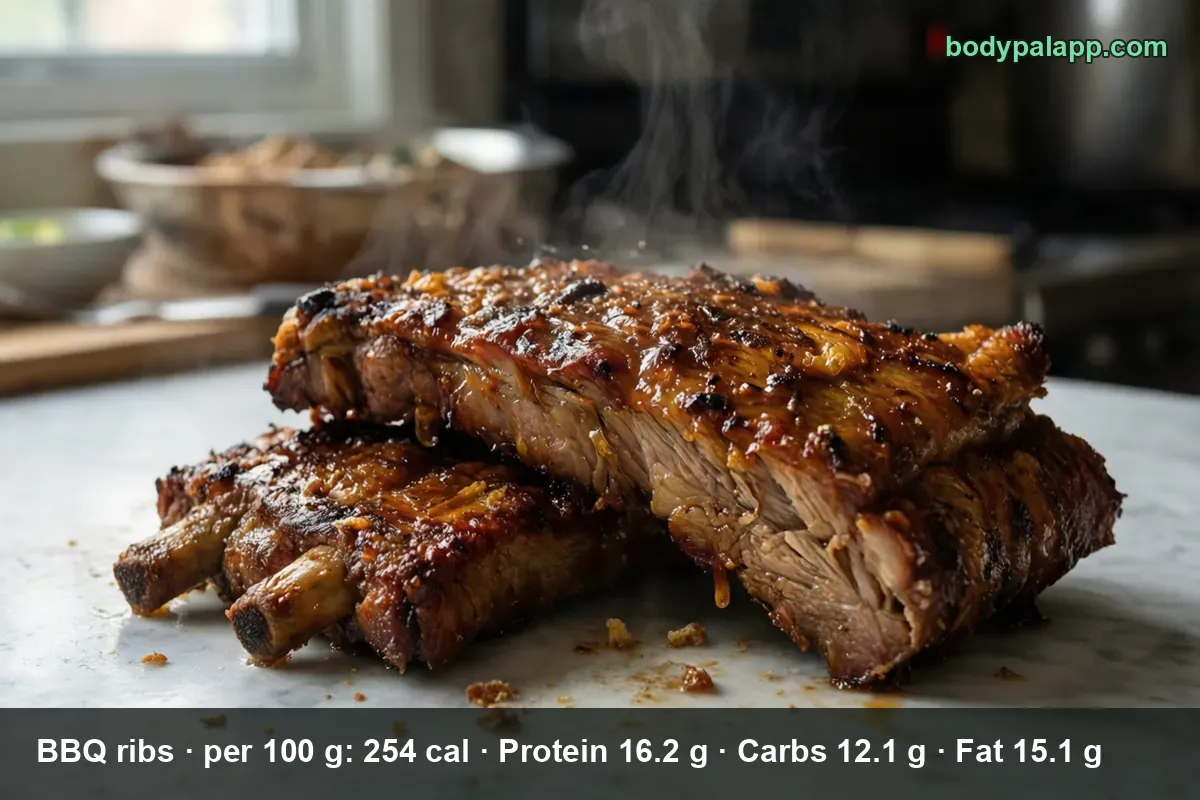
Three glazed BBQ ribs weigh about 105 g and carry 267 calories. Per 100 g, sauce and all, pork ribs run 254 calories, with 16.22 g of protein and 15.12 g of fat. One rib pulled off the rack is 89. The carb line is not zero, and that is the whole story of this page.
On this page
- BBQ rib quick facts
- US servings, from one rib to a cup of picked meat
- Bare ribs, braised ribs and the sauce difference
- Sodium and saturated fat are the rows to watch
- How do BBQ ribs compare?
- Most popular bbq ribs brands
- FAQ
BBQ rib quick facts
The rib in your hand at a cookout is already sauced, so this page is built on FNDDS 2705894, "Pork, ribs", the USDA record for ribs as a finished dish. It is the only generic pork rib entry that carries the glaze inside the numbers: 12.13 g of carbohydrate and 678 mg of sodium per 100 g, neither of which exists in raw pork. The older SR Legacy spareribs records are bare meat, and they live further down this page as their own versions.
That record also publishes a household measure of "1 rib," which is how ribs actually get counted on a plate. Three ribs is the serving most people build a meal around, so it anchors the table below.
| Nutrient | Per 100 g | Per 3 ribs (105 g) | % Daily Value |
|---|---|---|---|
| Calories | 254 | 267 | — |
| Total fat | 15.12 g | 15.9 g | 20% |
| Saturated fat | 5.43 g | 5.7 g | 29% |
| Carbohydrate | 12.13 g | 12.7 g | 5% |
| Dietary fiber | 0.3 g | 0.3 g | 1% |
| Total sugars | 9.89 g | 10.4 g | — |
| Protein | 16.22 g | 17.0 g | 34% |
| Sodium | 678 mg | 712 mg | 31% |
| Cholesterol | 58 mg | 61 mg | 20% |
| Potassium | 236 mg | 248 mg | 5% |
% Daily Value is based on a 2,000-calorie diet.
Verified nutrition data
Numbers on this page come from USDA FoodData Central, the U.S. Department of Agriculture’s food composition database, and from manufacturer labels where a branded product is named. Last verified September 2026. How we verify our data →
Two label rows are missing on purpose. Added sugars and trans fat have no entry here, because this FNDDS release does not publish those two nutrients for prepared dishes, and guessing at a split between the sugar in the sauce and the sugar in the meat would be inventing a number. Total sugars has no Daily Value of its own, which is why that cell stays empty.
US servings, from one rib to a cup of picked meat
| Serving | Weight | Calories |
|---|---|---|
| 1 oz raw, cooked yield | 20 g | 51 kcal |
| 1 rib, bone removed | 35 g | 89 kcal |
| 1 oz cooked | 28.4 g | 72 kcal |
| Three ribs | 105 g | 267 kcal |
| 1 cup, chopped | 135 g | 343 kcal |
| Per 100 g | 100 g | 254 kcal |
The 35 g rib, the 20 g cooked yield from an ounce of raw ribs and the chopped cup are all USDA household measures for this record. The three-rib serving and the cooked ounce are our own arithmetic from the USDA 100 g figure, not USDA servings.
Two of those rows deserve a second look. An ounce of raw ribs cooks down to about 20 g of edible meat, so the weight on the butcher's package is not the weight you are eating; a rack that goes on the grill at 2 lb comes off closer to 1.4 lb of meat and bone. And "1 cup, chopped" is the quiet trap. At 135 g it is 343 calories, nearly four ribs' worth in one measuring cup, which is why picked rib meat piled on nachos or into a sandwich adds up faster than the same food eaten off the bone. Bones slow you down. A cup does not.
Bare ribs, braised ribs and the sauce difference
| Version | Per 100 g | Typical serving | Calories |
|---|---|---|---|
| BBQ ribs, sauced | 254 kcal | three ribs, 105 g | 267 kcal |
| Ribs, NFS | 254 kcal | 3 oz, 85 g | 216 kcal |
| Spareribs, braised | 397 kcal | 3 oz, 85 g | 337 kcal |
| Spareribs, roasted | 361 kcal | 3 oz, 85 g | 307 kcal |
| Spareribs, raw | 277 kcal | 4 oz raw, 113 g | 313 kcal |
| Barbecue pork, no sauce | 249 kcal | 3 oz, 85 g | 212 kcal |
| Pork retail cuts, cooked | 238 kcal | 3 oz, 85 g | 202 kcal |
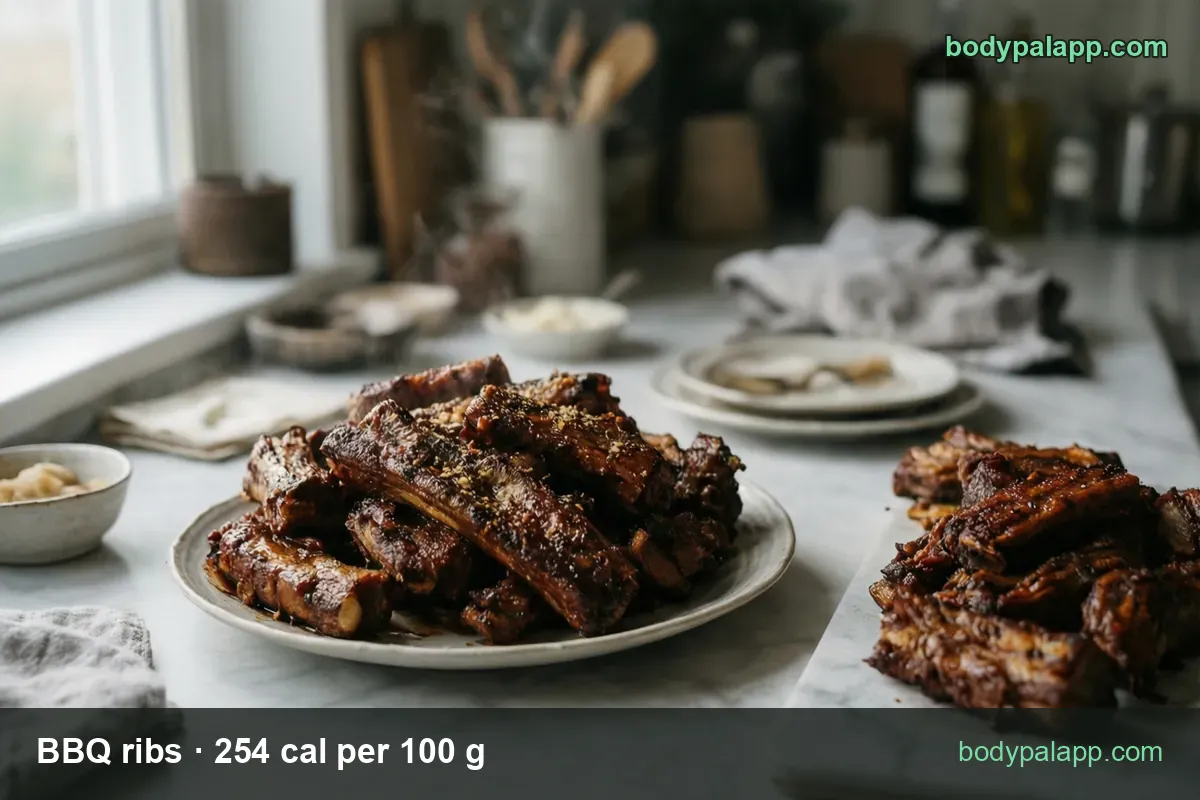
Read that table the wrong way and you would conclude that sauce saves you calories. It does not. The sauced dish comes in at 254 per 100 g because it is a whole rib including the leaner meat, while braised and roasted spareribs at 397 and 361 are pure fatty cut with the water cooked out of them. Braising drives off moisture and concentrates everything left behind: 30.3 g of fat and 29.06 g of protein per 100 g against 23.4 g and 15.47 g in the same ribs raw.
Raw versus cooked matters here more than on almost any other meat page. Four ounces of raw spareribs is 113 g and 313 calories, and after cooking that same piece is closer to three ounces on the plate. Weigh ribs raw and you are counting water and shrinkage; weigh them cooked and you are counting what you ate.
Store racks are their own category. USDA Branded lists Tony Roma's baby back pork ribs at 171 calories per 100 g plain and 236 with barbecue sauce on them, Kingsford St. Louis style center cut ribs at 214, and Butcher's Prime pork spareribs at 271 per 100 g. When there is a label in front of you, use the label.
Sodium and saturated fat are the rows to watch
Three ribs deliver 712 mg of sodium, 31% of the FDA Daily Value of 2,300 mg, which is roughly a third of a teaspoon of table salt before anything else on the plate. Almost all of it is glaze: bare braised spareribs carry 93 mg per 100 g, while the sauced record carries 678 mg. Sauce is doing seven times the salting that the pork is.
The same is true of sugar. Pork has none. The 9.89 g of total sugars per 100 g, 10.4 g in a three-rib serving, arrives entirely in the glaze, and it is what turns a zero-carb cut into a 12.13 g carbohydrate dish.
Saturated fat is the other line. A three-rib serving is 5.7 g, 29% of the 20 g Daily Value. Go with 3 oz of braised spareribs instead and you are at 9.5 g, roughly 47%, from a serving that fits in your palm. If you are watching saturated fat, the sauced ribs are the softer landing of the two, and trimming the visible fat before saucing helps more than switching sauces.
The protein side is genuinely good news. Seventeen grams in three ribs is 34% of the Daily Value, and pork ribs count squarely in the protein foods group described by MyPlate and the Dietary Guidelines for Americans. It is a real protein food wearing a candy coat.
How do BBQ ribs compare?
| Cut | Per 100 g | US serving | Calories |
|---|---|---|---|
| BBQ ribs, sauced | 254 kcal | three ribs, 105 g | 267 kcal |
| Ribs, NFS | 254 kcal | 3 oz, 85 g | 216 kcal |
| Barbecue pork, no sauce | 249 kcal | 3 oz, 85 g | 212 kcal |
| Pork, ham hocks | 268 kcal | 3 oz, 85 g | 228 kcal |
Our take: as a group these four are remarkably tight, with only 19 calories per 100 g between the lightest and the heaviest, so choosing between them is not a calorie decision. It is a protein and sodium decision. Barbecue pork without sauce gives you 24.75 g of protein per 100 g against 16.22 g for the sauced rib, which makes it the better pick for a filling plate at the same calorie cost. If you want the ribs, take the ribs and count them by the piece: at 89 calories each, four ribs and a pile of slaw is a normal dinner, while a cup of picked rib meat on top of a sandwich is a second meal hiding in a first one.
Most popular bbq ribs brands in the United States
Ranked by how widely each product appears among foods sold in the United States, from the BodyPal food database of over 3.3 million products. Calories are the figures printed on each Nutrition Facts label, checked against USDA FoodData Central.
| Product | Calories (per 100 g) |
|---|---|
| Tony Roma's Baby Back Pork Ribs | 171 cal |
| Tony Roma's Baby Back Pork Ribs BBQ | 236 cal |
| Butcher's Prime Pork Spareribs | 271 cal |
| Kingsford Half Slab St. Louis Style Pork Ribs | 214 cal |
| Lloyd's Babyback Pork Ribs | 226 cal |
| Jack Daniel's Pork Ribs Tennessee Honey | 211 cal |
Brand popularity: BodyPal food database. Nutrition: manufacturer labels / USDA FoodData Central.
BBQ rib FAQs
How many calories are in one BBQ rib?
One rib is 89 calories. USDA lists a single cooked rib with the bone removed at 35 g, which at 254 calories per 100 g works out to 89. Three of them, a normal plate, come to 267 calories with 17 g of protein and 712 mg of sodium.
How many calories in a half rack of ribs?
About 533 calories for six ribs. USDA has no record for a half rack, so that is our own arithmetic from the 35 g rib and the 254 calories per 100 g figure: six ribs is roughly 210 g of meat. A full rack of twelve lands near 1,067 calories.
How many calories in 3 oz of pork ribs?
Three ounces of sauced pork ribs is 85 g and 216 calories, our scaling from the USDA 100 g figure. The same 3 oz of braised spareribs is 337 calories and roasted spareribs 307, because those cuts are bare fatty meat with the moisture already cooked out of them.
How much protein is in BBQ ribs?
Three ribs give you 17 g of protein, 34% of the Daily Value, from 16.22 g per 100 g. A cup of chopped rib meat at 135 g is closer to 21.9 g. Braised spareribs are denser still at 29.06 g per 100 g, since braising drives off water and concentrates what is left.
How much sugar is in BBQ ribs?
Three ribs carry 10.4 g of total sugars, from 9.89 g per 100 g. All of it comes from the glaze, since pork itself has none: bare roasted spareribs list 0 g of carbohydrate. USDA does not publish an added sugars figure for this record, so the split cannot be stated exactly.
Are BBQ ribs high in sodium?
Yes — three ribs hold 712 mg of sodium, 31% of the 2,300 mg Daily Value, and a chopped cup reaches 915 mg or 40%. Braised spareribs without sauce carry just 93 mg per 100 g against 678 mg here, so the barbecue glaze is doing nearly all of the salting.
Are baby back ribs lower in calories than spare ribs?
Usually, yes — USDA Branded lists Tony Roma's baby back pork ribs at 171 calories per 100 g plain, while Butcher's Prime pork spareribs come in at 271. Baby backs are cut from the leaner loin end; spareribs come from the belly side and carry more fat, which is where the gap comes from.
Do dry-rub ribs have fewer calories than sauced ribs?
They lose the sugar and most of the salt, not the fat: barbecue pork with no sauce is 249 calories per 100 g with 0 g of carbohydrate, against 254 calories and 12.13 g for sauced ribs. That is a small calorie difference and a large one for sugar, sodium and anyone counting carbs.
Similar foods
- Barbecue Rib — 89 cal per rib
- Chicken Drumette — 183 cal for 4 drumettes
- Chicken Wing With Skin — 100 cal per wing
- Pork Ribs — 267 cal for 3 ribs
- Ribs — 267 cal for 3 ribs
- Chicken Breast Tender — 38 cal per tender
Count it without the math
Point the camera at the plate and BodyPal counts the ribs for you, glaze included.


How long does it take to burn off BBQ ribs?
Three ribs (105 g) is 267 kcal. Enter your weight and the amount you ate to see how long it takes you to burn that off:
lb
| Activity | Time to burn 267 kcal |
|---|---|
| Walking, brisk | 53 min |
| Cycling, moderate | 33 min |
| Swimming, moderate | 38 min |
| Jogging | 31 min |
| Weight training, moderate | 59 min |
Times are for a 155 lb adult at a steady pace; change the weight to see yours. The amount is set to the portion in the text (105 g); change it to what you actually ate. BodyPal works this out from your steps automatically.
Want the bigger picture? Calculate your daily calorie needs — your maintenance figure, a target for losing or gaining, and the date you get there.