
How Many Calories in Ribs?
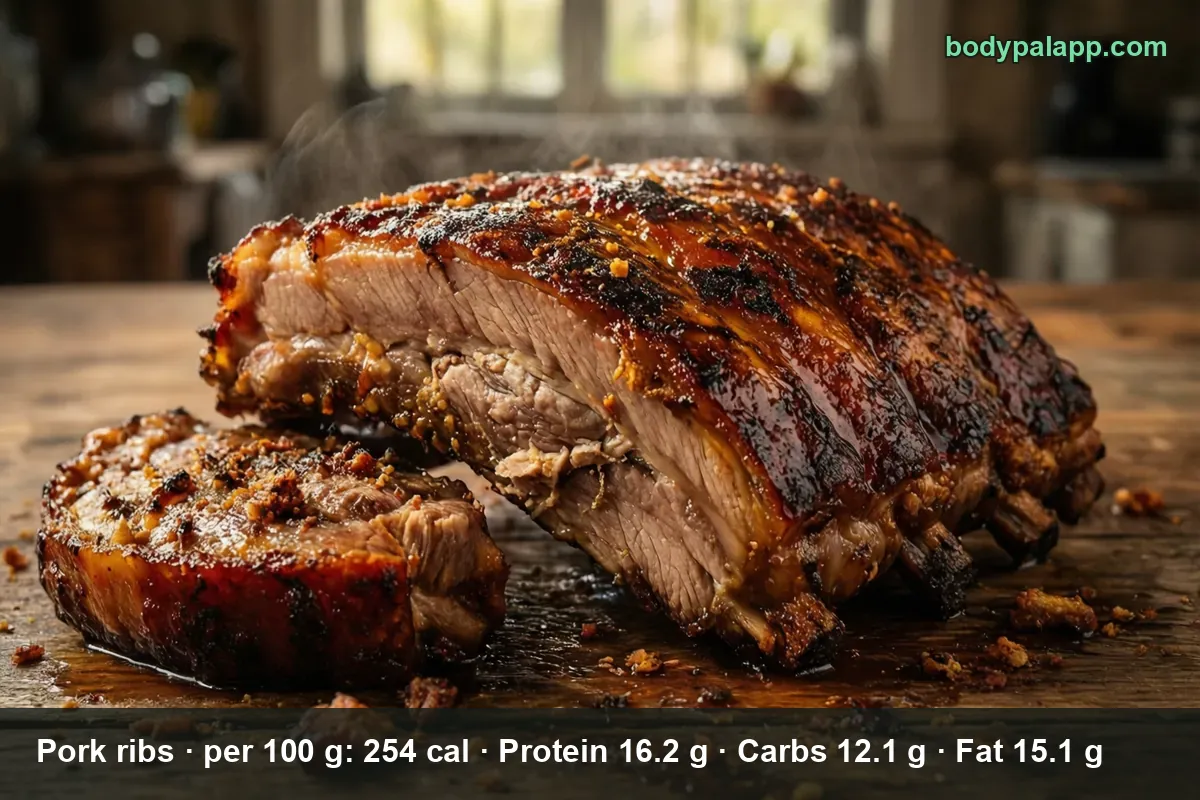
Three barbecue pork ribs are 267 calories — that is 105 g of meat off the bone, at 254 calories per 100 g. One rib on its own is 89. A full rack of twelve comes to 1,067 calories and 2,848 mg of sodium, which is 124% of a day's worth before anything else reaches the plate.
On this page
- Ribs quick facts
- What USDA means by one rib
- Rack math and the bone you should not weigh
- The sauce is 30 percent of every rib
- Sodium is the number that ends the day
- Baby back against spare ribs
- Boneless and country-style ribs
- Beef ribs, short ribs and prime rib
- How ribs compare on a barbecue plate
- Most popular rib brands
- FAQ
Ribs quick facts
The reference here is the rib as Americans actually eat it: sauced and cooked, meat only, bone left on the plate. USDA files that under Pork, ribs, survey record 2705894.
| Nutrient | Per 100 g | Per 3 ribs (105 g) | % Daily Value |
|---|---|---|---|
| Calories | 254 | 267 | — |
| Total fat | 15.12 g | 15.9 g | 20% |
| Saturated fat | 5.43 g | 5.7 g | 29% |
| Carbohydrate | 12.13 g | 12.7 g | 5% |
| Dietary fiber | 0.3 g | 0.3 g | 1% |
| Total sugars | 9.89 g | 10.4 g | — |
| Protein | 16.22 g | 17.0 g | 34% |
| Sodium | 678 mg | 712 mg | 31% |
| Cholesterol | 58 mg | 61 mg | 20% |
| Potassium | 236 mg | 248 mg | 5% |
% Daily Value is based on a 2,000-calorie diet.
Verified nutrition data
Numbers on this page come from USDA FoodData Central, the U.S. Department of Agriculture’s food composition database, and from manufacturer labels where a branded product is named. Last verified September 2026. How we verify our data →
There is no added sugars row on this page. USDA does not publish an added sugars figure for its generic rib record, and inventing one from the sauce would be a guess, so total sugars is the only honest line to give. Total sugars carry no Daily Value under the FDA label rules, which is why that cell stays empty.
Look at the carbohydrate row for a second. Twelve grams of carbs in a piece of pork makes no sense until you know what USDA put in the recipe, and that turns out to explain most of this page.
What USDA means by one rib
Here is the single most useful thing on this page, and almost nobody says it out loud: the word "rib" covers two completely different amounts of meat.
USDA's portion file gives one rib, bone removed, as 35 g of meat. That is a baby back rib, and two supermarket labels in the USDA Branded database agree with it — a Safeway St. Louis style pack lists a 140 g serving as "about 4 ribs", which works out to 35 g apiece.
Then a second Safeway pack, same style of ribs, lists the same 140 g serving as "about 2 ribs". Seventy grams each. Same word, double the meat.
| What one rib means | Meat off the bone | Calories |
|---|---|---|
| Baby back rib | 35 g | 89 |
| St. Louis or spare rib | 70 g | 178 |
| Beef rib, center cut, sauced | 107 g | 315 |
The beef line comes from a Lloyd's center-cut label in USDA Branded: 214 g for two ribs, 629 calories, so roughly 315 each.
So "I had three ribs" is either 267 calories or 533, and the person saying it usually does not know which. If you are logging from memory, the fix takes one second: baby backs are the short, curved ones off the loin; spares and St. Louis cuts are the long, flat, heavy ones off the belly. Curved and small, count 89. Long and flat, count 178.
Rack math and the bone you should not weigh
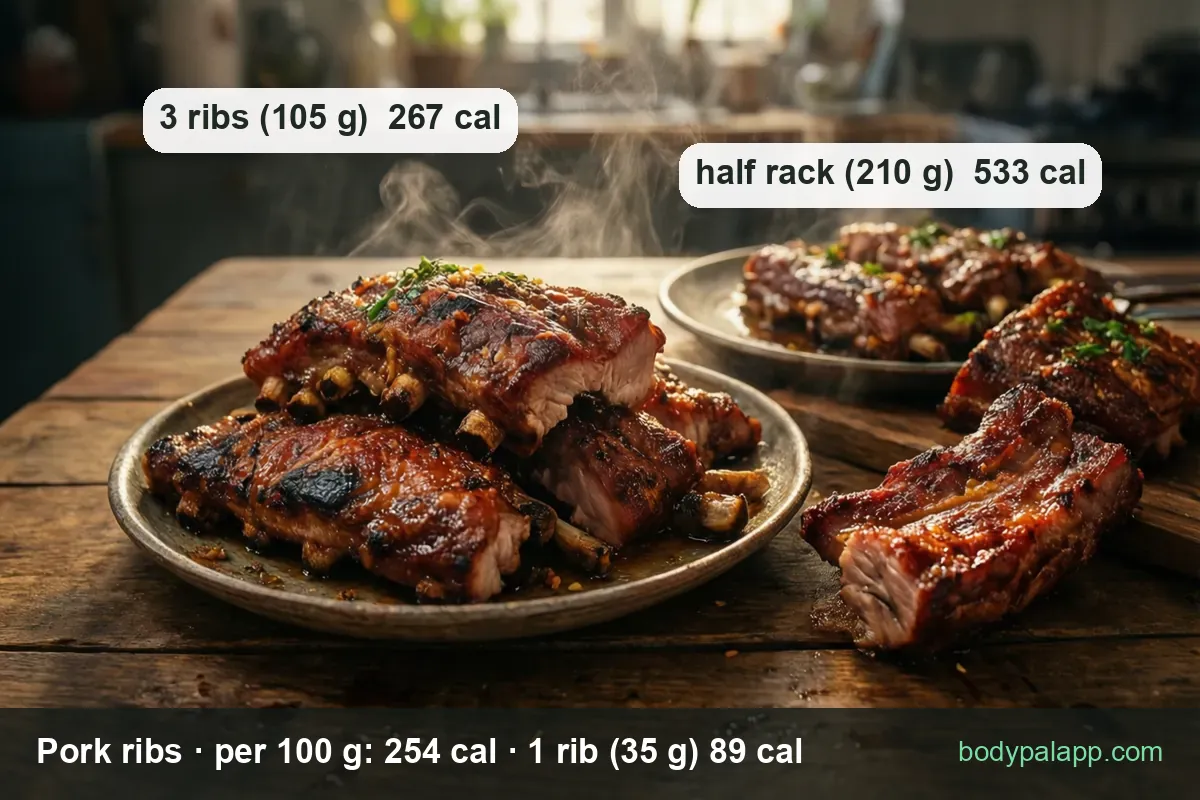
A rack is twelve bones. That is not a rule of thumb; it is the product description on a Smithfield loin back rib slab in USDA Branded, which promises "no less than 12 rib bones per slab." Twelve baby backs at 35 g of meat each is 420 g of edible pork.
| Serving | Meat weight | Calories |
|---|---|---|
| 1 rib | 35 g | 89 |
| 3 ribs | 105 g | 267 |
| Half rack, 6 ribs | 210 g | 533 |
| Full rack, 12 ribs | 420 g | 1,067 |
| 1 cup, chopped | 135 g | 343 |
| 3 oz | 85 g | 216 |
| 1 oz | 28 g | 71 |
A half rack at 533 calories is an ordinary dinner. A full rack at 1,067 is most of a day's calories for a lot of people, and it is the default order at almost every rib joint in the country.
Now the trap that ruins rib logging. Every number above is meat only. USDA weighs the edible part and throws the bone away, but a kitchen scale does not. Put a rack on the scale as it comes off the grill and you are weighing pork plus a row of bones, then multiplying that whole figure by 254 calories per 100 g — an overshoot of roughly a third.
Two ways around it. Count ribs instead of grams, using 35 g or 70 g per bone depending on the cut. Or weigh the plate before and after and log the difference, since the bones stay on it either way.
The sauce is 30 percent of every rib
USDA does not treat a barbecue rib as meat. It treats it as a recipe, and the recipe is published: 70 g of roasted pork back ribs, 30 g of barbecue sauce, 0.8 g of table salt. That is what record 2705894 is made of.
Run the parts and the whole page falls into place:
- The sauce brings about 52 of the 254 calories per 100 g, a fifth of the total.
- It brings all 12.13 g of carbohydrate and nearly all of the 9.89 g of sugars. Pork has none.
- It brings 308 of the 678 mg of sodium, with the pinch of salt adding another 310 and the meat itself contributing only 66.
So sauce and salt account for well over half the sodium in a barbecue rib, and every carbohydrate in it.
Generic barbecue sauce runs 172 calories per 100 g. One tablespoon (17 g) is 29 calories, 5.7 g of sugar and 175 mg of sodium. A quarter cup (70 g), which is what a basting brush moves in about four passes, is 120 calories, 23.3 g of sugar and 719 mg of sodium.
Dry-rubbed ribs are a genuinely different food. Back ribs roasted with no sauce are 292 calories per 100 g — denser than the sauced version, because sauce is mostly water and sugar — but with zero carbs and 94 mg of sodium instead of 678. If you want ribs without the sugar, the rub is the answer, not a smaller portion.
Sodium is the number that ends the day
Calories are why people search for ribs. Sodium is the reason they should.
- 3 ribs (105 g): 712 mg, 31% of the Daily Value
- Half rack (210 g): 1,424 mg, 62%
- Full rack (420 g): 2,848 mg, 124%
The FDA limit is 2,300 mg a day, so a full rack is a little over a teaspoon and a quarter of table salt on its own, before the beans, the slaw or the cornbread. The CDC puts most American adults well over that line already, and restaurant barbecue is one of the places it happens fastest.
Saturated fat behaves the same way. Three ribs carry 5.7 g, a reasonable 29% of the day. A full rack carries 22.8 g, or 114% — the Dietary Guidelines ask for under 10% of daily calories from saturated fat, and one rack clears the whole allowance by itself.
None of this makes a rib a bad food. Three of them give 17 g of protein for 267 calories, which is a real return, and MyPlate counts pork among the protein foods it wants on the plate. The half rack is where ribs stop being a portion and start being the entire day's sodium budget.
One footnote for anyone logging "ribs" with no detail: USDA's mixed record, Ribs NFS, is 85% pork and 15% beef and lands at 254 calories per 100 g with 674 mg of sodium. Identical, near enough. If you do not know what kind of ribs you ate, the generic number is safe.
Baby back against spare ribs
Strip the sauce off and the two cuts separate hard. These are USDA's plain cooked records, no seasoning, no glaze.
| Cut, cooked without sauce | Per 100 g | 3 oz (85 g) | Protein per 100 g |
|---|---|---|---|
| Back ribs, roasted | 292 | 248 | 23.01 g |
| Spareribs, braised | 397 | 337 | 29.06 g |
| Spareribs, roasted | 361 | 307 | 20.89 g |
Baby backs are the leaner rib by a wide margin: 105 calories per 100 g less than braised spares. They are cut from along the loin, which is why — spares come off the belly, next door to bacon.
The other thing worth knowing is what cooking does to the number. Raw back ribs are 224 calories per 100 g and roasted ones are 292, a jump of 30%. Raw spareribs go from 277 to 397 when braised, up 43%. Nothing was added; water left. That is why 4 oz of raw ribs is closer to 3 oz cooked, and why logging a raw weight against a cooked number quietly undercounts you.
Boneless and country-style ribs
Country-style ribs are not ribs. They are cut from the loin end or the shoulder, they usually arrive with no bone at all, and they are the leanest thing sold under the word in America.
| Country-style rib, cooked | Per 100 g | Protein per 100 g |
|---|---|---|
| Boneless, lean only, roasted | 219 | 29.2 g |
| Boneless, lean only, broiled | 216 | 27.83 g |
| Boneless, lean and fat, broiled | 247 | 26.28 g |
| Boneless, lean and fat, roasted | 270 | 26.4 g |
| Bone-in, lean and fat, roasted | 359 | 21.75 g |
The trimmed boneless version at 219 calories per 100 g with 29.2 g of protein is a different proposition from a barbecue rib — more protein per calorie than a chicken thigh, and no sugar anywhere near it. The bone-in roasted cut at 359 is the opposite end: USDA sizes one of those racks at 138 g, which is 495 calories for what looks on the plate like a modest portion.
For the search that brings most people here, boneless pork ribs, use 247 calories per 100 g for the ordinary untrimmed kind and 219 if you cut the fat off.
Beef ribs, short ribs and prime rib
Beef short ribs are the most expensive thing in this whole category. Braised with the fat left on, they are 471 calories per 100 g — 42 g of fat — which makes a 3 oz portion 400 calories. Trim them to lean only and they drop to 295 per 100 g, or 251 for 3 oz. That trim saves 149 calories on a small serving, the largest single saving available on this page.
USDA also sizes one braised short rib piece, the yield from a pound of raw ribs, at 225 g. That is 1,060 calories in one bone.
Two clarifications people search for and rarely get answered:
Beef back ribs have no separate USDA record. They come off the same rib primal that produces the roast, so the honest citation is the whole rib cut, roasted, at 365 calories per 100 g.
Prime rib is not ribs. It is that same roasted beef rib section: 365 calories per 100 g, 310 for a 3 oz slice. Half the people typing rib searches are looking for this, and it is a different animal, a different cut and a different meal from a sauced pork rib.
How ribs compare on a barbecue plate
| Item | Per 100 g | US serving | Calories | Protein |
|---|---|---|---|---|
| Pork ribs, barbecued | 254 | 3 ribs (105 g) | 267 | 17.0 g |
| Beef short ribs, braised | 471 | 3 oz (85 g) | 400 | 18.3 g |
| Beef brisket, barbecued | 231 | 1 thick slice (90 g) | 208 | 26.5 g |
| Pulled pork in barbecue sauce | 168 | 1 cup (249 g) | 418 | 32.8 g |
| Chicken wing, grilled with sauce | 250 | 1 wing (55 g) | 138 | 10.5 g |
Our take: brisket wins the plate. A thick slice is 208 calories with 26.5 g of protein, the best protein-per-calorie deal in the row, and it beats three ribs on both counts. Pulled pork looks heavy at 418 because a cup is a genuinely big serving, but per calorie it is still ahead of ribs thanks to 32.8 g of protein.
Ribs sit in the middle, and they are fine there — as long as the order is a half rack. Beef short ribs are the one to think twice about: 400 calories for three ounces, with more fat than protein, is the steepest price on the table.
Most popular rib brands in the United States
Ranked by how widely each product appears among foods sold in the United States, from the BodyPal food database of over 3.3 million products. Calories are the figures printed on each Nutrition Facts label, checked against USDA FoodData Central.
| Product | Calories (per 100 g) |
|---|---|
| Lloyd’s Baby Back Pork Ribs in Original BBQ Sauce | 243 cal |
| Lloyd’s Baby Back Pork Ribs in Honey Hickory BBQ Sauce | 250 cal |
| Lloyd’s Center Cut Beef Ribs with Original BBQ Sauce | 294 cal |
| Curly’s Hickory Smoked Baby Back Pork Ribs | 214 cal |
| Safeway St. Louis Style Ribs, Tangy BBQ | 257 cal |
| Hy-Vee Baby Back Ribs | 236 cal |
Brand popularity: BodyPal food database. Nutrition: manufacturer labels / USDA FoodData Central.
Ribs FAQs
How many calories in ribs?
254 calories per 100 g of barbecue pork ribs, meat off the bone. Three ribs weigh 105 g and come to 267 calories, with 17 g of protein and 712 mg of sodium. A half rack of six is 533 calories.
How many calories in one rib?
89 calories for a baby back rib, which USDA weighs at 35 g of meat once the bone is out. A St. Louis or spare rib is double that meat at 70 g, so it lands at about 178 calories. Beef center-cut ribs run near 315 apiece.
How many calories in a full rack of ribs?
1,067 calories for a full baby back rack: 12 bones, 420 g of meat, at 254 calories per 100 g. A half rack is 533. The rack also carries 2,848 mg of sodium, 124% of the Daily Value, and 22.8 g of saturated fat.
How many calories in barbecue ribs compared with plain ribs?
254 calories per 100 g sauced against 292 for back ribs roasted without sauce. The sauced number is lower per gram because sauce is mostly water, but it brings 12.13 g of carbohydrate and 678 mg of sodium per 100 g instead of 94.
How many calories in pork spare ribs?
397 calories per 100 g braised, which makes a 3 oz portion 337 calories. Roasted spareribs are 361 per 100 g, or 307 for 3 oz. Spares are the belly cut and run well above baby backs, which are 292 per 100 g roasted.
Are ribs high in sodium?
Yes. Barbecue pork ribs carry 678 mg of sodium per 100 g, so three ribs are 712 mg and 31% of the Daily Value. A full rack reaches 2,848 mg, or 124% of the 2,300 mg FDA limit. Most of it comes from the sauce and the cure, not the pork.
How much protein is in ribs?
16.22 g per 100 g, so three ribs give 17 g of protein, which is 34% of the Daily Value for 267 calories. A half rack gives 34.1 g. Braised spareribs are richer at 29.06 g per 100 g, and country-style boneless ribs reach 29.2 g.
How many calories in boneless or country-style ribs?
247 calories per 100 g for boneless country-style ribs broiled with the fat on, and 219 for the trimmed lean-only version, which still carries 29.2 g of protein. Country-style ribs are cut from the loin or shoulder, so they are not true ribs at all.
Similar foods
- Barbecue Rib — 89 cal per rib
- BBQ Rib — 267 cal for 3 ribs
- Chicken Drumette — 183 cal for 4 drumettes
- Chicken Wing With Skin — 100 cal per wing
- Pork Ribs — 267 cal for 3 ribs
- Chicken Breast Tender — 38 cal per tender
Count the rack, not the guess
Point the camera at the plate and BodyPal works out how many ribs are on it, sauce and sodium included.


How long does it take to burn off ribs?
Three barbecue pork ribs (105 g) is 267 kcal. Enter your weight and the amount you ate to see how long it takes you to burn that off:
lb
| Activity | Time to burn 267 kcal |
|---|---|
| Walking, brisk | 53 min |
| Cycling, moderate | 33 min |
| Swimming, moderate | 38 min |
| Jogging | 31 min |
| Weight training, moderate | 59 min |
Times are for a 155 lb adult at a steady pace; change the weight to see yours. The amount is set to the portion in the text (105 g); change it to what you actually ate. BodyPal works this out from your steps automatically.
Burning it off is one side of it. The other is knowing your number: work out how many calories you need a day, with macros and a goal date.