
How many calories are in berries?
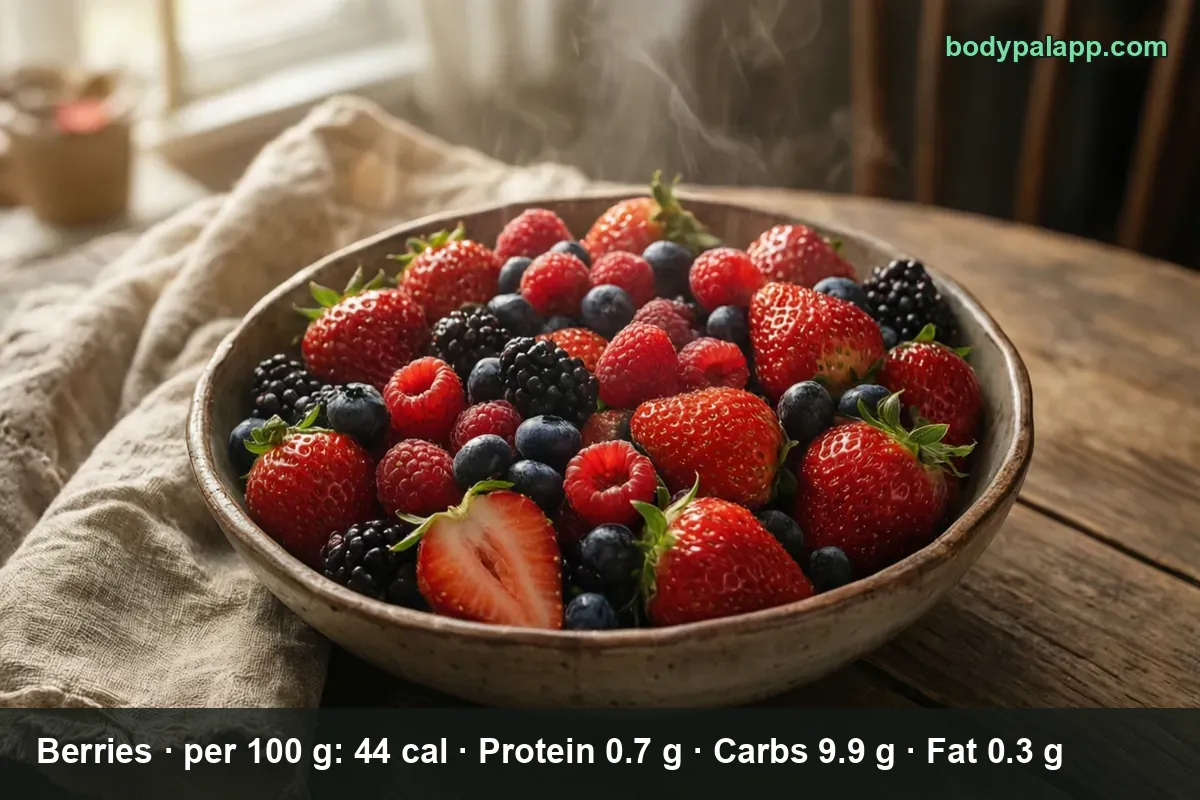
A 1-cup serving of mixed berries weighs 150 g and carries 66 calories. Per 100 g the fresh mix runs 44 calories, so a big bowl stays cheap in a way almost no other sweet food does. The cup brings 9.3 g of sugar, all of it from the fruit, and 3.0 g of fiber.
On this page
- Berries quick facts
- US servings, from half a cup to a two-cup bowl
- Frozen, dried, and one berry at a time
- Fiber is the row that pays
- How do berries compare?
- Most popular berries brands
- Berry FAQs
Berries quick facts
When you tip a clamshell of strawberries, blueberries and blackberries into one bowl, the record that matches it is FNDDS 2709271, "Berries, NFS" - USDA's entry for a plain mix of fresh berries with nothing added. That is the number below. The individual berries have their own records, and they spread wider than most people expect, so they get their own section further down.
The mixed record is the honest default for a breakfast bowl or a handful thrown on yogurt. If you only ever buy one kind, skip to the variant table and use that berry's row instead.
| Nutrient | Per 100 g | Per 1 cup (150 g) | % Daily Value |
|---|---|---|---|
| Calories | 44 | 66 | — |
| Total fat | 0.25 g | 0.4 g | 0% |
| Saturated fat | 0.01 g | 0.0 g | 0% |
| Carbohydrate | 9.94 g | 14.9 g | 5% |
| Dietary fiber | 2 g | 3.0 g | 11% |
| Total sugars | 6.21 g | 9.3 g | — |
| Protein | 0.66 g | 1.0 g | 2% |
| Sodium | 0 mg | 0 mg | 0% |
% Daily Value is based on a 2,000-calorie diet.
Verified nutrition data
Numbers on this page come from USDA FoodData Central, the U.S. Department of Agriculture’s food composition database, and from manufacturer labels where a branded product is named. Last verified September 2026. How we verify our data →
Two rows you would see on a package are missing here on purpose. This FNDDS edition does not publish added sugars or trans fat for fresh berries, so those lines are left out rather than written as zero. Cholesterol is 0 mg, as it is in every plant food, and potassium comes to 207 mg a cup, about 4% of the FDA Daily Value of 4,700 mg.
The sugar row deserves one word of context. All 9.3 g in a cup is naturally occurring, which is why the % Daily Value cell is a dash: total sugars have no Daily Value, and only added sugars carry the 50 g limit.
US servings, from half a cup to a two-cup bowl
| Serving | Weight | Calories |
|---|---|---|
| 1 oz | 28.3 g | 12 kcal |
| 1/2 cup | 75 g | 33 kcal |
| 1 cup | 150 g | 66 kcal |
| 2 cups, a full breakfast bowl | 300 g | 132 kcal |
| Per 100 g | 100 g | 44 kcal |
The 1-cup and 1/2-cup lines are USDA household measures for this record. The 2-cup bowl and the single ounce are our own arithmetic from the USDA 100 g figure, not USDA servings - useful because a deep bowl is closer to two cups than one, and because dried berries are sold by the ounce.
Here is the practical part. Berries are so light that measuring precision barely matters: guess a cup when you actually ate a cup and a half, and you are off by 33 calories. Do that with granola and you are off by 200. If you are going to eyeball one food in your day, make it this one.
Frozen, dried, and one berry at a time
| Version | Per 100 g | Typical serving | Calories |
|---|---|---|---|
| Fresh mixed berries | 44 kcal | 1 cup (150 g) | 66 kcal |
| Frozen mixed berries | 52 kcal | 1 cup (150 g) | 78 kcal |
| Blackberries, raw | 43 kcal | 1 cup (150 g) | 65 kcal |
| Cranberries, raw | 46 kcal | 1 cup (100 g) | 46 kcal |
| Raspberries, raw | 57 kcal | 1 cup (150 g) | 86 kcal |
| Blueberries, raw | 64 kcal | 1 cup (150 g) | 96 kcal |
| Blueberries, dried | 317 kcal | 1 oz (28.3 g) | 90 kcal |
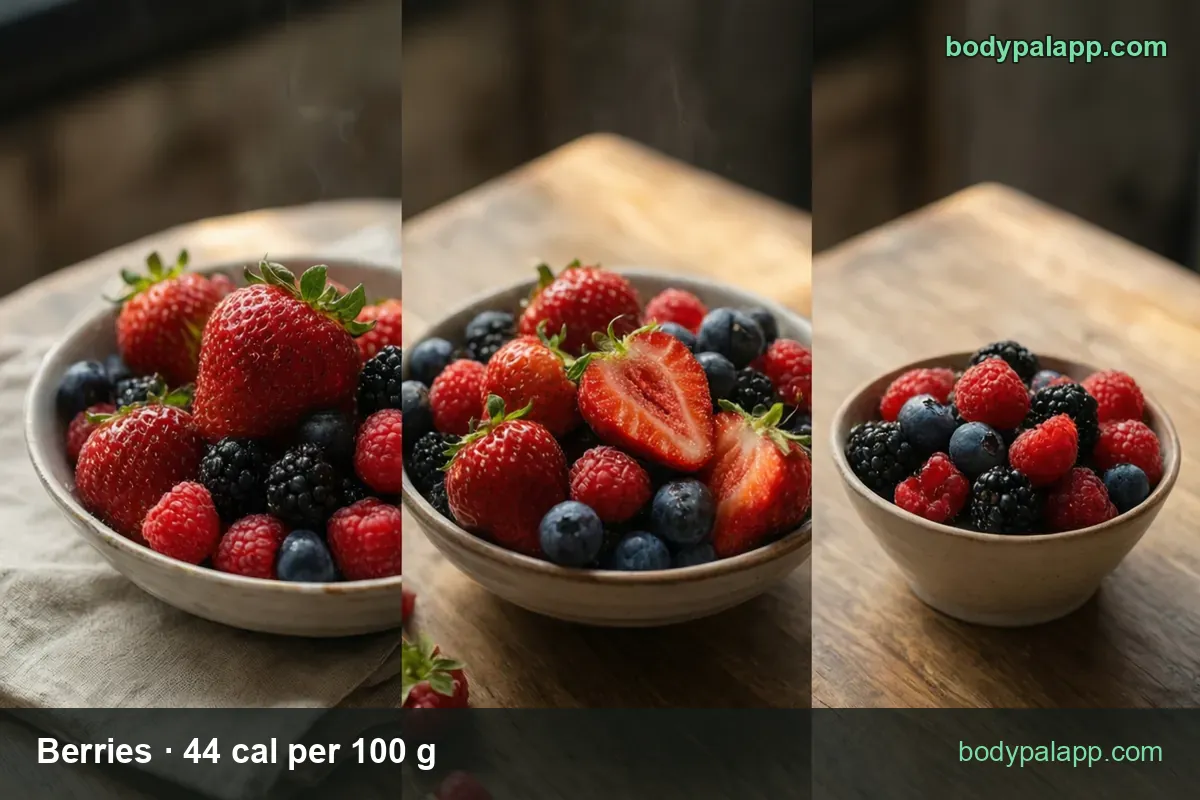
Frozen is the surprise. The USDA frozen mix sits at 52 calories per 100 g against 44 fresh, which turns a cup into 78 calories instead of 66. Nothing is added in the freezer; the frozen blend simply leans on denser small fruit and less air in the cup. It pays you back in fiber - 4.1 g per 100 g against 2 g fresh.
Blueberries are the heavy end of the fresh range at 64 calories per 100 g, and a cup of them is 96 calories, about half again as much as the mixed bowl. Blackberries are the light end of the table at 43, and strawberries are lighter still at 36. Cranberries are listed against a 100 g cup rather than 150 g because raw cranberries pack loosely, so their cup is 46 calories.
Dried is a different food. Dried blueberries run 317 calories per 100 g, so a 1 oz handful is 90 calories - more than a whole 150 g cup of fresh mixed berries. On the shelf you will also see dried specialty berries sold as superfoods: goji, mulberry and golden berries all land near 367 calories per 100 g, or about 110 calories for the 3 Tbsp (30 g) serving on the label. Frozen retail bags stay honest instead, at roughly 60 calories for a 0.75 cup (140 g) scoop.
Fiber is the row that pays
A cup of mixed berries gives 3.0 g of fiber, 11% of the 28 g Daily Value, for 66 calories. That ratio is the reason berries survive on almost any eating plan. But the mixed bowl is the weakest of the berries above on this measure, and the gap is large.
Raspberries carry 6.5 g of fiber per 100 g. Scale that to a 150 g cup - our own arithmetic from the USDA figure - and you get about 9.8 g, roughly 35% of the Daily Value, for 86 calories. Blackberries come to about 8.0 g a cup, near 28%. If fiber is the thing you keep falling short on, swapping the generic mix for raspberries costs you 20 calories and more than triples the fiber.
Raspberries win on sugar too: 2.68 g per 100 g, against 9.36 g for blueberries. That is the widest spread between two foods that most people treat as interchangeable.
The Dietary Guidelines for Americans put fruit at the center of a healthy pattern, and MyPlate counts one cup of berries as one cup from the fruit group, with about 2 cups of fruit a day suggested for many adults. If you are watching calories rather than adding them, a cup of fresh mixed berries is the cheapest way to fill half of that.
How do berries compare?
| Food | Per 100 g | US serving | Calories |
|---|---|---|---|
| Fresh mixed berries | 44 kcal | 1 cup, 150 g | 66 kcal |
| Frozen mixed berries | 52 kcal | 1 cup, 150 g | 78 kcal |
| Cranberries, raw | 46 kcal | 1 cup, 100 g | 46 kcal |
| Blueberries, raw | 64 kcal | 1 cup, 150 g | 96 kcal |
Our take: for weight loss, buy the plain fresh mix and stop thinking about it - 66 calories a cup is small enough that the tracking effort costs more than the food does. For fullness, buy raspberries and accept the extra 20 calories a cup, or blackberries at 65 calories for no extra cost, because the fiber is where the staying power lives. Frozen is the better value pick for anything you blend or cook, and the 12-calorie premium per cup is not worth avoiding. The only berries that need real attention are the dried ones.
Most popular berries brands in the United States
Ranked by how widely each product appears among foods sold in the United States, from the BodyPal food database of over 3.3 million products. Calories are the figures printed on each Nutrition Facts label, checked against USDA FoodData Central.
| Product | Calories (per 100 g) |
|---|---|
| Navitas Organics Organic Mulberry Berries | 367 cal |
| Navitas Organics Organic Goji Berries | 367 cal |
| Wyman's Fresh Frozen Mixed Berries | 43 cal |
| Navitas Organics Organic Golden Berries | 367 cal |
Brand popularity: BodyPal food database. Nutrition: manufacturer labels / USDA FoodData Central.
Berry FAQs
How many calories are in a cup of berries?
A 1-cup serving of mixed berries weighs 150 g and carries 66 calories, since USDA lists the fresh mix at 44 calories per 100 g. That cup also brings 14.9 g of carbohydrate, 3.0 g of fiber and 9.3 g of natural sugar, with no sodium and no fat worth counting.
How many calories in 1/2 cup of mixed berries?
Half a cup of mixed berries is 75 g and 33 calories, exactly half the full cup. It carries 7.5 g of carbohydrate, 1.5 g of fiber and 4.7 g of sugar. That is the smallest fruit portion most people bother to log, and it barely moves a daily total.
Are frozen berries higher in calories than fresh?
Yes, slightly. Frozen mixed berries run 52 calories per 100 g against 44 fresh, so a cup is 78 instead of 66. Freezing adds nothing; the USDA frozen mix simply holds denser fruit. You also get 4.1 g of fiber per 100 g instead of 2 g, which is a fair trade.
Which berry has the fewest calories?
Strawberries, at 36 calories per 100 g. A 150 g cup works out to about 54 calories by our own arithmetic from that figure, under any other berry on this page. Blackberries follow at 43, the mixed bowl at 44 and cranberries at 46. Blueberries are the heaviest fresh berry at 64.
Which berry has the most fiber?
Raspberries, with 6.5 g of fiber per 100 g, which makes a 150 g cup roughly 9.8 g, or 35% of the 28 g Daily Value. Blackberries are next at 5.3 g per 100 g. The plain mixed bowl gives 2 g per 100 g, so a cup of it lands at 3.0 g.
How many carbs are in a cup of berries?
A cup of mixed berries holds 14.9 g of carbohydrate, 5% of the Daily Value, and 3.0 g of that is fiber. Blueberries are the carb-heavy berry at 14.57 g per 100 g, against 9.94 g for the mixed bowl. Frozen mixed berries sit at 12.47 g per 100 g.
Are dried berries fattening?
Dried berries are not fattening on their own, but they are concentrated. Dried blueberries run 317 calories per 100 g, so a 1 oz handful of 28.3 g is 90 calories, more than a whole 150 g cup of fresh mixed berries at 66. Measure them instead of pouring them.
Do berries count toward my daily fruit servings?
Yes. One cup of berries counts as one cup from the fruit group under MyPlate, which suggests about 2 cups of fruit a day for many adults. At 66 calories a cup, fresh mixed berries are among the cheapest ways to fill half of that target.
Similar foods
- Nectarine — 31 cal for 1/2 medium
- White Nectarine — 62 cal per medium nectarine
- Blackberries — 2 cal per blackberry
- Papaya — 34 cal for 1/2 small papaya
- Black Plum — 30 cal per plum
- Cranberries — 46 cal per cup whole
Count it without the math
Point the camera at the bowl and BodyPal counts the berries for you, cup or handful.


How long does it take to burn off berries?
A 1-cup (150 g) serving is 66 kcal. Enter your weight and the amount you ate to see how long it takes you to burn that off:
lb
| Activity | Time to burn 66 kcal |
|---|---|
| Walking, brisk | 13 min |
| Cycling, moderate | 8 min |
| Swimming, moderate | 9 min |
| Jogging | 8 min |
| Weight training, moderate | 15 min |
Times are for a 155 lb adult at a steady pace; change the weight to see yours. The amount is set to the portion in the text (150 g); change it to what you actually ate. BodyPal works this out from your steps automatically.
One food is easy to picture; a whole day is harder. See how many calories you need a day and what a deficit actually looks like.