
How many calories are in a nectarine?
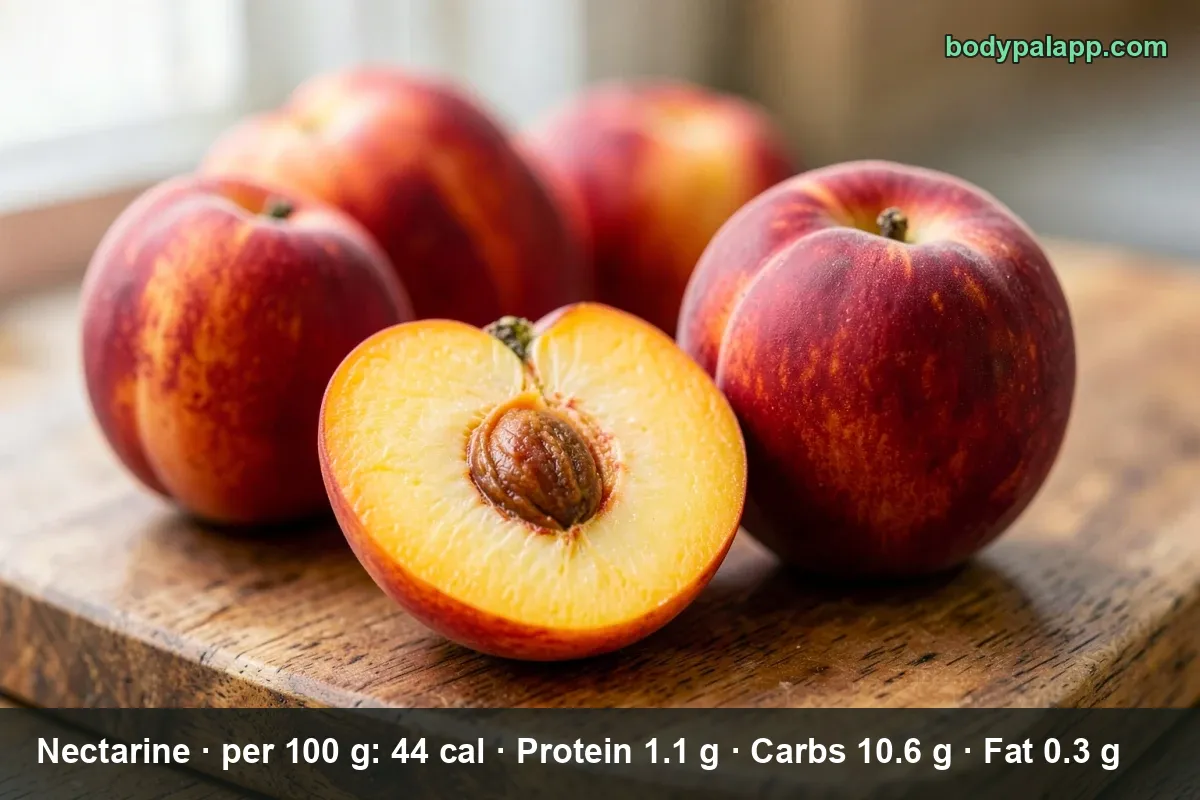
One medium nectarine, 2-1/2 inches across and about 142 g, carries 62 calories. Raw nectarine runs 44 calories per 100 g, with 0.32 g of fat and no sodium at all. In that one fruit you get 15.0 g of carbohydrate, 11.2 g of it sugar, plus 2.4 g of fiber.
On this page
- Nectarine quick facts
- US servings, from one ounce to a large nectarine
- Halves, slices and the second USDA row
- Canned and dried nectarines
- Fiber, potassium and the sugar question
- How does a nectarine compare?
- Most popular nectarine brands
- FAQ
Nectarine quick facts
The row behind every number here is SR Legacy 169914, "Nectarines, raw". It is the only nectarine record in USDA FoodData Central that carries a complete profile, including total sugars, which is the number most people actually want from a piece of fruit. It is also the record that holds the household measures: small, medium, large, and a cup of slices. Every figure on this page is for the raw fruit, even where the photos show it roasted or diced.
| Nutrient | Per 100 g | Per 1 medium (142 g) | % Daily Value |
|---|---|---|---|
| Calories | 44 | 62 | — |
| Total fat | 0.32 g | 0.5 g | 1% |
| Saturated fat | 0.03 g | 0.0 g | 0% |
| Carbohydrate | 10.55 g | 15.0 g | 5% |
| Dietary fiber | 1.7 g | 2.4 g | 9% |
| Total sugars | 7.89 g | 11.2 g | — |
| Protein | 1.06 g | 1.5 g | 3% |
| Sodium | 0 mg | 0 mg | 0% |
% Daily Value is based on a 2,000-calorie diet.
Verified nutrition data
Numbers on this page come from USDA FoodData Central, the U.S. Department of Agriculture’s food composition database, and from manufacturer labels where a branded product is named. Last verified September 2026. How we verify our data →
There is no added sugars row on this page. The SR Legacy edition does not carry that field at all, and a raw nectarine has nothing added to it in the first place. Cholesterol is 0 mg, as it is in any fruit. Potassium is the mineral worth naming: 201 mg per 100 g, or 285 mg in a medium fruit, which is 6% of the 4,700 mg Daily Value on the FDA's Daily Value reference.
US servings, from one ounce to a large nectarine
| Serving | Weight | Calories |
|---|---|---|
| 1 oz | 28.4 g | 12 kcal |
| Half a medium nectarine | 71 g | 31 kcal |
| 1 medium (2-1/2" dia) | 142 g | 62 kcal |
| 1 cup slices | 143 g | 63 kcal |
| 1 large (2-3/4" dia) | 156 g | 69 kcal |
| Per 100 g | 100 g | 44 kcal |
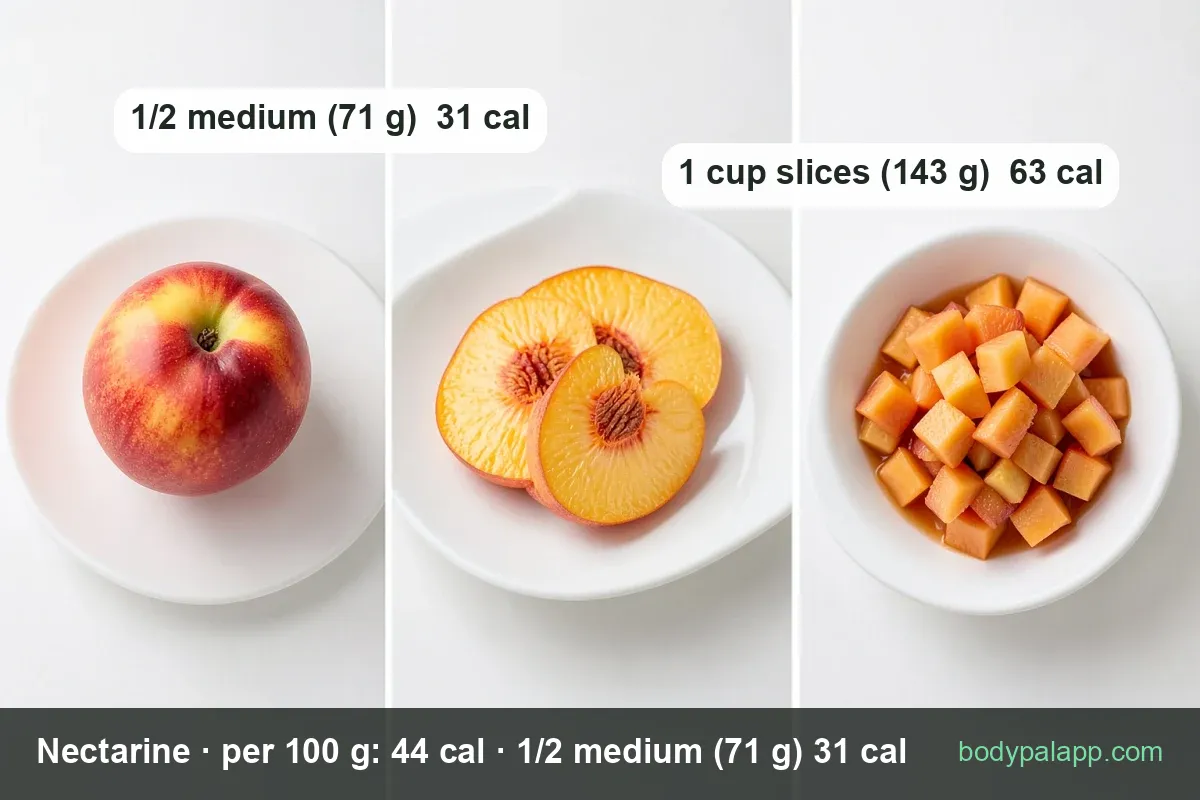
Three of those are USDA household measures straight off record 169914: the medium fruit, the large fruit, and the cup of slices. The 1 oz row and the half-fruit row are our own arithmetic from the USDA 100 g figure, not USDA servings, so treat them as clean scaling rather than a measured portion.
The interesting line is the cup. A cup of slices weighs 143 g and a medium nectarine weighs 142 g, so the cup lands at 63 calories against the whole fruit's 62. Chopping fruit into a bowl feels like a smaller commitment than eating it whole, and the log says it is the same commitment plus one calorie. Going up a size costs less than most people expect too: the jump from medium to large is 14 g and 7 calories.
Halves, slices and the second USDA row
| Version | Per 100 g | Typical piece | Calories |
|---|---|---|---|
| Whole nectarine, raw | 44 kcal | 1 medium (142 g) | 62 kcal |
| Sliced nectarine | 44 kcal | 1 cup slices (143 g) | 63 kcal |
| Half a nectarine | 44 kcal | half a medium (71 g) | 31 kcal |
| Foundation sample, raw | 39 kcal | 1 fruit, 2-1/2" (142 g) | 55 kcal |
That last row is the one nobody explains. USDA holds a second raw nectarine record, Foundation 327357, from newer laboratory samples. Same fruit, same description, and it comes out at 39 calories per 100 g instead of 44 — an 11% gap. Scale it to a medium fruit and you get 55 calories rather than 62. That is why one calorie site tells you a nectarine is 55 and the next says 62: they copied different USDA tables, not different fruit.
We use the SR Legacy row because the Foundation sample has no total sugars value, and a fruit page without a sugar number is missing the point. The Foundation record also lists 13 mg of sodium where SR Legacy lists 0 mg, a difference small enough to ignore in either direction. A third record, FNDDS 2709245, is a survey entry at 43 calories per 100 g that blends the two.
Store-brand fresh nectarines line up with the raw record almost exactly. Brandt Nectarines list 43 calories per 100 g and 60 for a 5 oz (140 g) fruit; Sweet 2 Eat California Nectarines list 44 per 100 g and 61 for one 138 g fruit; Woot Froot sliced nectarines list 47 per 100 g and 40 for a 3 oz (85 g) serving. If your fruit came with a barcode, the label and the USDA row will not argue.
Canned and dried nectarines
| Version | Per 100 g | Label serving | Calories |
|---|---|---|---|
| Dole diced nectarines in fruit juice | 71 kcal | 1 cup (113 g) | 80 kcal |
| Nutty & Fruity dried nectarines | 285 kcal | 1.4 oz (40 g) | 114 kcal |
| Ugly dried diced nectarines | 300 kcal | 1/4 cup (40 g) | 120 kcal |
Canned in juice is the quiet one. At 71 calories per 100 g it is not a diet disaster, but a 113 g cup lands at 80 calories while a fresh nectarine weighing 142 g lands at 62. The smaller portion is the bigger number, because the packing juice gets logged along with the fruit.
Dried is where the arithmetic turns. At 285 to 300 calories per 100 g, dried nectarine is six to seven times the raw fruit per gram. A 40 g handful, which is what both brands call a serving, runs 114 to 120 calories — roughly two whole medium nectarines at 124, in something you can eat in under a minute without noticing. Nothing was added; the water left. If you snack from a bag of dried fruit while working, weigh it once and you will probably never do it by eye again.
Fiber, potassium and the sugar question
A medium nectarine gives you 2.4 g of fiber, 9% of the 28 g Daily Value. That is a genuine contribution from 62 calories, and it is the reason a whole nectarine sits better than the same calories in juice. Two of them in a day cover about 17% of the fiber Daily Value for 124 calories total, which is one of the cheaper ways to move that number.
Sugar is the row people flinch at: 11.2 g in one fruit. All of it is naturally occurring, so none of it counts against the FDA's 50 g Daily Value for added sugars, and total sugars have no Daily Value of their own on the Nutrition Facts label. The Dietary Guidelines for Americans put the added sugars limit at under 10% of calories, and whole fruit does not participate in that budget.
Potassium is the underrated part: 285 mg per medium fruit, 6% of the Daily Value, in a fruit with 0 mg of sodium. If you are watching sodium, fresh nectarine is about as safe as food gets — there is nothing to watch. MyPlate counts one medium nectarine as roughly a cup-equivalent of fruit, which puts a single piece against a daily target rather than a snack log.
How does a nectarine compare?
| Fruit | Per 100 g | US serving | Calories |
|---|---|---|---|
| Nectarine, raw | 44 kcal | one medium, 142 g | 62 kcal |
| Papaya, raw | 43 kcal | 1 cup 1" pieces, 145 g | 62 kcal |
| Blackberries, raw | 43 kcal | 1 cup, 144 g | 62 kcal |
| Peaches, canned in juice | 44 kcal | 1 cup, 248 g | 109 kcal |
Our take: three of these four land on exactly 62 calories, and it has nothing to do with the fruit. Papaya, blackberries and a nectarine all sit between 43 and 44 calories per 100 g, and the servings people actually take all weigh 142 to 145 g. The canned peaches break the pattern only because a cup of them weighs 248 g. For a snack, pick by texture and price, not by calories — they are the same. For volume at a fixed calorie count, the cup measures win, because 144 g of blackberries occupies far more of a bowl than one nectarine occupies of a hand.
Most popular nectarine brands in the United States
Ranked by how widely each product appears among foods sold in the United States, from the BodyPal food database of over 3.3 million products. Calories are the figures printed on each Nutrition Facts label, checked against USDA FoodData Central.
| Product | Calories (per 100 g) |
|---|---|
| Dole Diced Nectarines in Fruit Juice | 71 cal |
| Brandt Nectarines | 43 cal |
| Sweet 2 Eat California Nectarines | 44 cal |
| Woot Froot Sliced Nectarines | 47 cal |
| Nutty & Fruity Nectarines (dried) | 285 cal |
| Ugly Diced Nectarines (dried) | 300 cal |
Brand popularity: BodyPal food database. Nutrition: manufacturer labels / USDA FoodData Central.
Nectarine FAQs
How many calories are in one nectarine?
One medium nectarine, about 142 g, has 62 calories. That comes from USDA's raw nectarine record at 44 calories per 100 g. A large fruit at 156 g takes it to 69, and half a nectarine drops it to 31. Fat is 0.5 g, so almost everything here is carbohydrate.
How many calories in half a nectarine?
Half a medium nectarine weighs about 71 g and comes to 31 calories. That is our own arithmetic from the USDA 100 g figure of 44 calories, not a USDA household serving. Half the fruit also gives you 1.2 g of fiber and 5.6 g of sugar.
How many calories in a cup of sliced nectarines?
A cup of nectarine slices weighs 143 g and holds 63 calories, one more than a whole medium fruit at 142 g. Slicing does not shrink the number; a cup simply happens to hold about one fruit's worth. You also get 2.4 g of fiber and 11.3 g of sugar.
How much sugar is in a nectarine?
A medium nectarine carries 11.2 g of total sugars, or 7.89 g per 100 g. All of it is naturally occurring, so none of it counts toward the FDA's 50 g Daily Value for added sugars. Total sugars have no Daily Value of their own on the label.
How many carbs are in a nectarine?
One medium nectarine holds 15.0 g of carbohydrate, which is 5% of the FDA Daily Value of 275 g. Of that, 11.2 g is sugar and 2.4 g is fiber. Per 100 g the raw fruit sits at 10.55 g of carbohydrate, low enough that a second one barely moves the day.
Do nectarines have fiber?
Yes, 2.4 g in one medium fruit, which is 9% of the FDA's 28 g Daily Value. Per 100 g the raw fruit gives 1.7 g. Two nectarines in a day would cover about 17% of the fiber Daily Value, for 124 calories total. Not a fiber powerhouse, but a solid share for the calories.
Are dried nectarines high in calories?
Dried nectarines run 285 to 300 calories per 100 g, six to seven times the 44 of the fresh fruit. A 40 g portion, which is 1.4 oz or a quarter cup, comes to 114 to 120 calories, about the same as two whole medium nectarines at 124.
Are canned nectarines in juice as low in calories as fresh?
No — Dole's diced nectarines in fruit juice list 71 calories per 100 g against 44 for the raw fruit, because the packing juice comes with the fruit. A 1 cup serving of 113 g is 80 calories, more than one medium fresh nectarine at 62 even though it weighs less than 142 g.
Similar foods
- Berries — 66 cal per cup
- White Nectarine — 62 cal per medium nectarine
- Blackberries — 2 cal per blackberry
- Papaya — 34 cal for 1/2 small papaya
- Black Plum — 30 cal per plum
- Cranberries — 46 cal per cup whole
Count it without the math
Point the camera at the plate and BodyPal counts the nectarine for you, halved, sliced or roasted.


How long does it take to burn off a nectarine?
One medium nectarine (142 g) is 62 kcal. Enter your weight and the amount you ate to see how long it takes you to burn that off:
lb
| Activity | Time to burn 62 kcal |
|---|---|
| Walking, brisk | 12 min |
| Cycling, moderate | 8 min |
| Swimming, moderate | 9 min |
| Jogging | 7 min |
| Weight training, moderate | 14 min |
Times are for a 155 lb adult at a steady pace; change the weight to see yours. The amount is set to the portion in the text (142 g); change it to what you actually ate. BodyPal works this out from your steps automatically.
Want the bigger picture? Calculate your daily calorie needs — your maintenance figure, a target for losing or gaining, and the date you get there.