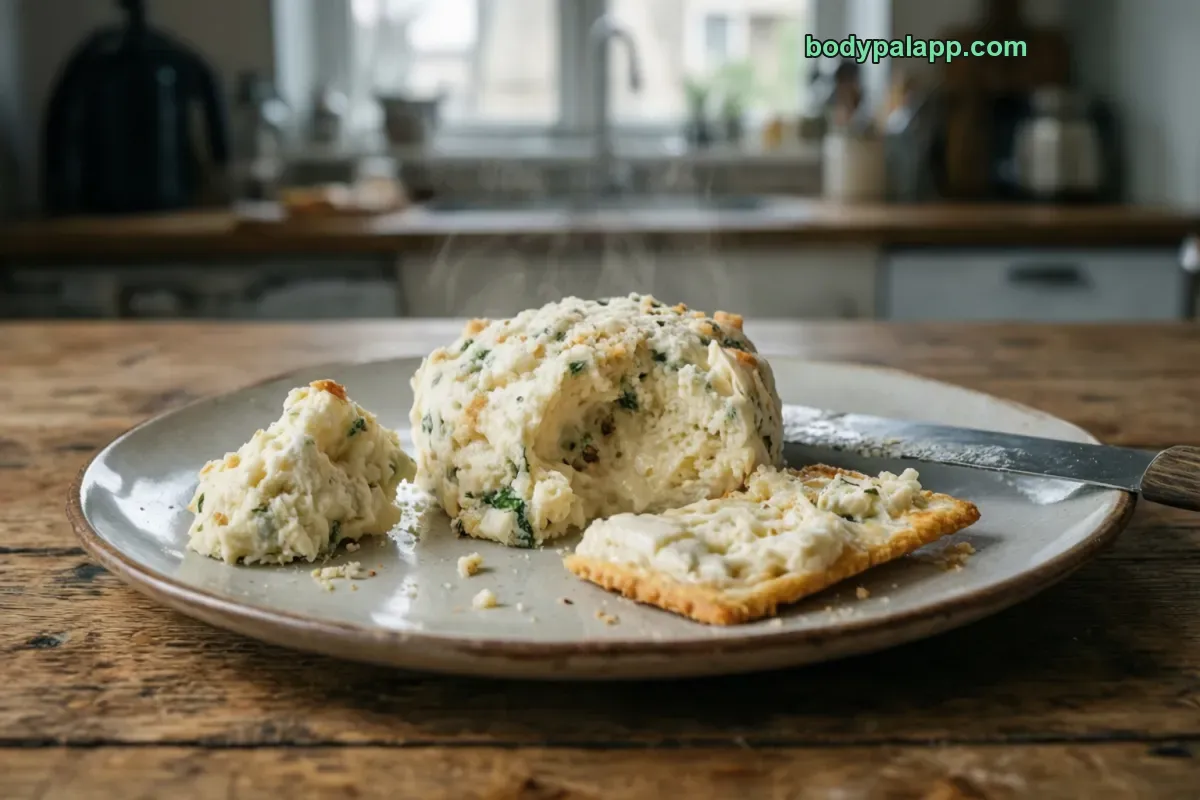
Boursin cheese calories come to 80 for a 2 Tbsp (23 g) serving and 348 per 100 g. The thing to notice is the fat: it supplies 86% of the calories, so this is a small-portion spread. The Light version brings the same serving down to 50 calories.
80kcal
1 2 tablespoons · 23 g, packaged, per label
10%protein
2 gProtein
1 gCarbs
8 gFat
How to burn off 80 kcal
—Walking, brisk
—Jogging
—Cycling, moderate
—Swimming
Skip the math. BodyPal counts these calories from your steps and workouts automatically.
Nutrition facts
Packaged, per label · per 23 g
Calories
80 kcal
Protein
2 g
Carbohydrate
1 g
Fat
8 g
Saturated fat
4.5 g
Cholesterol
25 mg
Sodium
110 mg
Source: USDA FoodData Central
🛡️
Verified nutrition data
Numbers on this page come from USDA FoodData Central, the U.S. Department of Agriculture’s food composition database, and from manufacturer labels where a branded product is named. Last verified September 2026. How we verify our data →
Boursin cheese: calories, protein and sodium by serving
Percent of daily value uses the FDA reference of 2,000 kcal a day.
Serving
kcal
Protein
Carbs
Fat
Sodium
% DV kcal
2 Tbsp (23 g)
80
2 g
1 g
8 g
110 mg
4%
Light, 2 Tbsp (23 g)
50
3 g
1 g
4 g
130 mg
2%
1 oz (28 g)
97
2.4 g
1.2 g
9.7 g
134 mg
5%
100 g
348
8.7 g
4.4 g
34.8 g
478 mg
17%
3 × 2 Tbsp (23 g)
240
6 g
330 mg
5 × 2 Tbsp (23 g)
400
10 g
550 mg
Each 2 Tbsp scoop adds another 80 calories
The label serving is 2 Tbsp (23 g), which carries 80 calories, 8 g of fat and 110 mg of sodium. On a single cracker that is a modest smear. The catch is that Boursin is soft and crumbly, so almost nobody measures it, and one generous knife-load on a bagel can easily be twice the label amount.
Here is how the total moves. Two servings (46 g) reach 160 calories, three servings (69 g) reach 240, and five servings (115 g) land at 400 calories with 550 mg of sodium. Five servings sounds like a lot until you picture a cheese board where the foil-wrapped wheel slowly shrinks over an evening. If you prefer to weigh by the ounce, 1 oz (28 g) comes to 97 calories.
The practical fix is simple. Put your portion on a plate instead of eating straight from the package, and the numbers stay close to the label. If you snap a photo of that plate, BodyPal can log it from the picture, which is handy on a crowded cheese board.
Fat supplies 86% of the calories
Per 100 g, Boursin has 34.8 g of fat, 8.7 g of protein and 4.4 g of carbs, with 0 g of sugar and 0 g of fiber. Turned into calories, fat makes up 86%, protein 10% and carbs 5%. This is a rich, whipped spread built on cream, not a firm high-protein cheese.
That protein figure matters if you lean on cheese to reach a protein target. A 2 Tbsp serving gives just 2 g, or 4% of the daily value, next to 8 g of fat. Treat Boursin as a flavor ingredient and get your protein from what you spread it on or serve beside it, such as eggs, chicken or fish.
Carbs barely register. At 1 g per serving and no sugar at all, Boursin slots easily into low-carb eating, where a higher fat load is usually expected anyway. For everyone else, the useful takeaway is that nearly every calorie you add with a knife is fat.
Saturated fat is the row to watch
Of the 34.8 g of fat in 100 g of Boursin, 19.6 g is saturated. The daily value for saturated fat is 20 g, so 100 g of this cheese uses up almost the entire day's amount. Few people sit down to 100 g at once, but 115 g, the five-serving mark, is an easy amount to reach at a party.
Cholesterol is also notable at 109 mg per 100 g, a bit over a third of the 300 mg daily value. Sodium is milder than you might expect from a seasoned cheese. A 2 Tbsp serving has 110 mg, or 5% of the daily value, and 100 g has 478 mg, which is 21%.
If you watch saturated fat, the label serving is the natural place to stop. Measure once with a real tablespoon to see what 23 g looks like on a cracker. After that, eyeballing gets far more accurate, and the saturated fat stays a small share of your day.
Boursin Light cuts a serving to 50 calories
Boursin Light Gourmet Spreadable Cheese, Garlic & Herbs is the lower-calorie choice in the range. The same 2 Tbsp (23 g) serving has 50 calories instead of 80, with 4 g of fat instead of 8 g. Protein even rises slightly, from 2 g to 3 g, so the Light spread is a better deal on every count except one.
That exception is sodium. Light lists 130 mg per serving, which is 6% of the daily value, against 110 mg for the original. On one cracker the gap is small, yet it runs the opposite way from what most shoppers assume about a light product.
Flavor varieties such as Basil & Chive or Red Chili Pepper share the same soft, rich style, but the figures on this page are for Garlic & Herb, so check each label. If cutting calories is the goal, switching to Light is the easiest win. If taste comes first, keep the original and simply use less of it.
How does boursin cheese compare?
Here is Boursin next to three other cheeses on our site, compared per 100 g and per usual serving.
Verdict: Pick Boursin if sodium is your concern, since its 478 mg per 100 g is the lowest here and far below the 1,660 mg in American cheese. Pick colby jack if you want a cheese that pulls its weight in protein, with 23.2 g per 100 g against just 8.7 g for Boursin.
Most popular boursin cheese brands in the United States
How many calories are in 2 tablespoons of Boursin cheese?
Two tablespoons (23 g) of Boursin Garlic & Herb have 80 calories. Per 100 g it is 348 calories.
Is Boursin cheese good for weight loss?
Boursin Garlic & Herb has 348 calories per 100 g, most of it from fat (34.8 g). The Light version has 217 calories per 100 g, or 50 per 2 tablespoons.
Boursin vs American cheese: which has fewer calories?
Boursin has 348 calories per 100 g and American cheese has 366, so Boursin is slightly lower.
How much fat is in Boursin cheese?
Two tablespoons (23 g) contain 8.0 g of fat, 2.0 g of protein and 1.0 g of carbs.
What are the macros in Boursin cheese?
Per 100 g, Boursin has 34.8 g of fat, 8.7 g of protein and 4.4 g of carbs, with 0 g of sugar. That means 86% of its calories come from fat, 10% from protein and 5% from carbs.
Is Boursin cheese fattening?
Boursin is energy dense at 348 calories per 100 g, but a 2 Tbsp serving is only 80 calories, or 4% of the daily value. The real risk is portion size, since five servings reach 400 calories.
What does the Boursin nutrition label show per serving?
One 2 Tbsp (23 g) serving lists 80 calories, 8 g of fat, 1 g of carbs, 2 g of protein, 0 g of sugar and 110 mg of sodium. The Light version shows 50 calories and 4 g of fat for the same serving.
How many calories are in a whole package of Boursin?
Boursin has 348 calories per 100 g, so check the net weight on the box and scale from there. As a reference point, 115 g, or five 2 Tbsp servings, comes to 400 calories and 550 mg of sodium.
How much does a serving of Boursin weigh?
A 2 Tbsp serving of Boursin weighs 23 g and has 80 calories. If you measure in ounces, 1 oz is 28 g and comes to 97 calories, with 9.7 g of fat.