
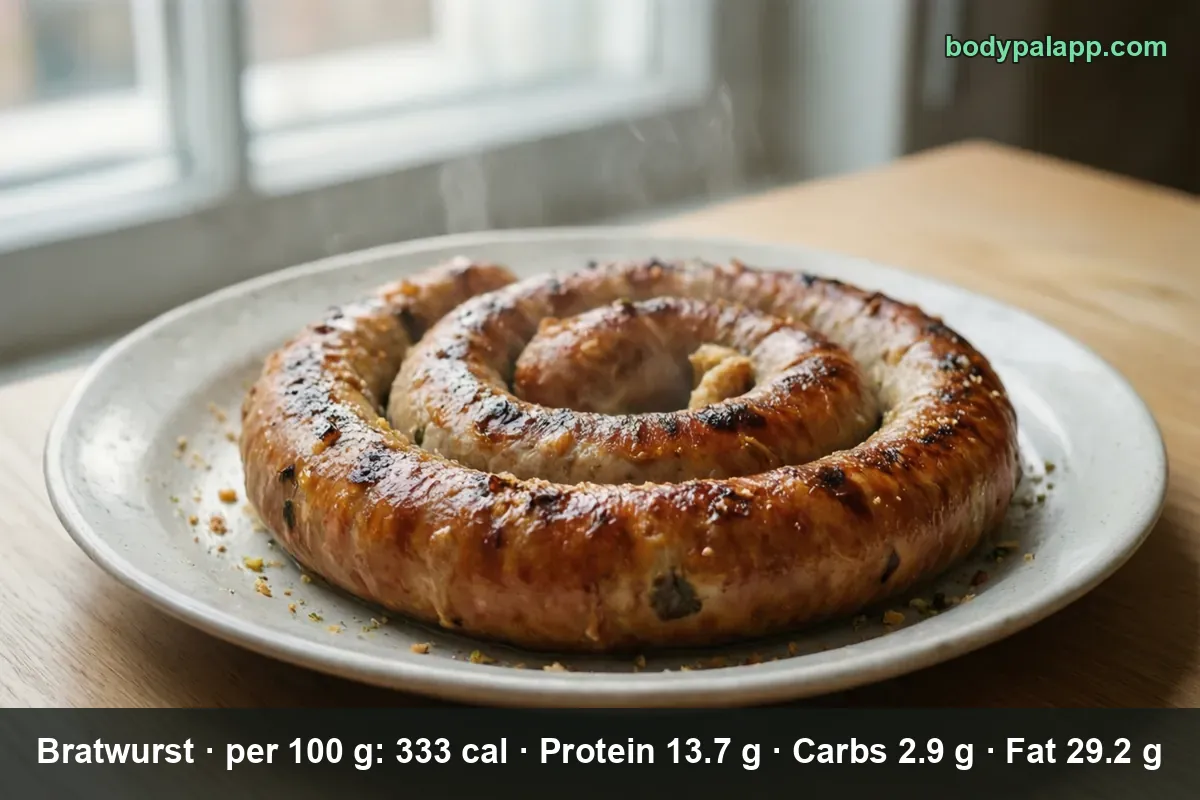
How many calories are in a bratwurst?
One cooked bratwurst link weighs 85 g and carries 283 calories. Per 100 g the sausage runs 333 calories, almost all of it fat and protein, since 2.85 g of carbohydrate is the entire carb column. A smaller bun-size griller link of 75 g lands at 250. The roll is separate.
On this page
- Bratwurst quick facts
- US servings from one ounce to two links
- Every kind of brat and what it costs you
- Saturated fat is the row to watch
- How does bratwurst compare to other sausages?
- Most popular bratwurst brands
- Bratwurst FAQs
Bratwurst quick facts
The row behind every number here is SR Legacy 171620, "Bratwurst, pork, cooked". That is the sausage most Americans actually hold: pork, seasoned, already cooked through on the grill or in the pan. It also comes with a household measure built in, one cooked link of 85 g, so the headline number is not a scaling exercise.
There is a second record, FNDDS 2706174, with an identical nutrient profile but a smaller 75 g link. Same sausage, different assumption about size, and that assumption is worth 33 calories. The table below uses the 85 g link.
| Nutrient | Per 100 g | Per 1 cooked link (85 g) | % Daily Value |
|---|---|---|---|
| Calories | 333 | 283 | — |
| Total fat | 29.18 g | 24.8 g | 32% |
| Saturated fat | 10 g | 8.5 g | 42% |
| Carbohydrate | 2.85 g | 2.4 g | 1% |
| Dietary fiber | 0 g | 0 g | 0% |
| Total sugars | 0 g | 0 g | — |
| Protein | 13.72 g | 11.7 g | 23% |
| Sodium | 846 mg | 719 mg | 31% |
% Daily Value is based on a 2,000-calorie diet.
Verified nutrition data
Numbers on this page come from USDA FoodData Central, the U.S. Department of Agriculture’s food composition database, and from manufacturer labels where a branded product is named. Last verified September 2026. How we verify our data →
Two rows you would see on a package are missing here. Added sugars and trans fat are not published in the SR Legacy edition of this record, so they are left out rather than guessed at, and by composition a plain pork brat has no added sugar anyway. Cholesterol comes to 63 mg per link, 21% of the Daily Value, and potassium to 296 mg, about 6%.
US servings from one ounce to two links
| Serving | Weight | Calories |
|---|---|---|
| 1 cubic inch | 15 g | 50 kcal |
| 1 oz | 28 g | 93 kcal |
| 1 bun-size or griller link | 75 g | 250 kcal |
| 1 cooked link | 85 g | 283 kcal |
| 2 links cooked | 170 g | 566 kcal |
| Per 100 g | 100 g | 333 kcal |
The 85 g cooked link and the 75 g griller link are both USDA household measures, which is why they sit at the center of this page. The two-link row is our own arithmetic from the USDA 100 g figure, not a USDA serving, and so is any per-ounce math you do at the counter.
That difference between 250 and 283 is the practical trap. Nothing about the recipe changed. The casing simply got longer. A five-brat package that splits 13 oz between five links and one that splits 15 oz between five links give you two different dinners, and the label on the front will not warn you about it. Weigh the link once and you will know which package you buy.
Every kind of brat and what it costs you
USDA carries eight bratwurst records, and the spread between them is much wider than the word "bratwurst" suggests.
| Version | Per 100 g | Typical serving | Calories | Sodium per 100 g |
|---|---|---|---|---|
| Pork bratwurst, classic | 333 kcal | 1 cooked link (85 g) | 283 kcal | 846 mg |
| Veal bratwurst | 341 kcal | 1 serving, 2.96 oz (84 g) | 286 kcal | 60 mg |
| Chicken bratwurst | 176 kcal | 1 serving, 2.96 oz (84 g) | 148 kcal | 72 mg |
| Pork and beef link, raw | 323 kcal | 1 link (70 g) | 226 kcal | 1112 mg |
| Smoked beef and pork | 297 kcal | 1 serving, 2.33 oz (66 g) | 196 kcal | 848 mg |
| Bratwurst with cheese | 334 kcal | 1 bun-size link (75 g) | 250 kcal | 904 mg |
Chicken is the one real lever. At 176 calories per 100 g it is just over half the pork figure, so the same 84 g serving is 148 calories instead of 283, and it brings more protein doing it: 19.44 g per 100 g against 13.72 g. If you want two brats on the plate and one dinner's worth of calories, that is the swap.
Veal is the surprise in the other direction. It is the highest-calorie record in the set at 341 per 100 g, yet the lowest in sodium by a distance, 60 mg per 100 g against 846 mg for pork. Veal brats are made without the heavily seasoned brine, which is also why they taste flatter off the grill. Chicken sits close behind at 72 mg.
Cheese does less than you would expect to the calories and more than you would expect to the salt. Bratwurst with cheese is 334 calories per 100 g, one calorie above plain pork, but 904 mg of sodium against 846 mg. The 75 g cheese-link figure of 250 calories is our own arithmetic from the USDA 100 g number, not a listed serving. And the "lite, smoked" record cuts calories hard, down to 186 per 100 g, while carrying 982 mg of sodium, more than the classic link it replaces.
Store brands land inside this range rather than outside it. Lidl's original brat is 321 calories per 100 g, Johnsonville's original and its beer brats 317 each, the cheddar and beer tailgate version 305, the smoked link 303, and the cooked link the highest of the group at 348. On the label that reads as 200 to 260 calories per link, and the gap is mostly link size, not recipe.
Saturated fat is the row to watch
Most people worry about the salt in a bratwurst. The number that actually moves is saturated fat. One 85 g link carries 8.5 g, which is 42% of the FDA Daily Value of 20 g, while its 719 mg of sodium is 31% of the 2,300 mg limit. Two links and you are at 17 g of saturated fat, 85% of the day, before anything else is eaten.
The Dietary Guidelines for Americans put saturated fat below 10% of daily calories, which is where that 20 g figure comes from on a 2,000-calorie day. A brat is not off the table because of it. It just means the rest of the day should be built around leaner protein, and MyPlate's protein guidance points the same way.
If sodium is your concern instead, the raw pork and beef link is the one to watch: 1,112 mg per 100 g, the highest of the eight records, because the uncooked seasoning brine is still fully in the meat. And if you are counting carbs, this food barely registers. A link holds 2.4 g of carbohydrate, no fiber and no sugar at all.
How does bratwurst compare to other sausages?
| Sausage | Per 100 g | US serving | Calories |
|---|---|---|---|
| Bratwurst, pork | 333 kcal | one cooked link, 85 g | 283 kcal |
| Polish sausage | 337 kcal | 85 g | 286 kcal |
| Italian sausage | 317 kcal | 85 g | 269 kcal |
| Chorizo | 341 kcal | 85 g | 290 kcal |
The 85 g servings for the three neighbors are our own arithmetic from their USDA 100 g figures, matched to the bratwurst link so the comparison is fair.
Our take: swapping one grill sausage for another is not a calorie decision. Across all four, an 85 g piece runs from 269 to 290 calories, a spread of 21, which is less than the difference between a 75 g brat and an 85 g brat. Where they do separate is protein: Italian sausage brings 18.2 g per 100 g and chorizo 19.3 g against 13.72 g for bratwurst, so the same calories buy you more of what keeps you full. Only Polish sausage, at 12.45 g, gives you less. If you are on the patio and want the leanest plate, the honest answer is not a different sausage, it is a chicken brat.
Most popular bratwurst brands in the United States
Ranked by how widely each product appears among foods sold in the United States, from the BodyPal food database of over 3.3 million products. Calories are the figures printed on each Nutrition Facts label, checked against USDA FoodData Central.
| Product | Calories (per 100 g) |
|---|---|
| Lidl Original Bratwurst | 321 cal |
| Johnsonville Beer Brats Bratwurst | 317 cal |
| Johnsonville Tailgate Cheddar & Beer Bratwurst | 305 cal |
| Johnsonville Original Bratwurst | 317 cal |
| Johnsonville Cooked Bratwurst | 348 cal |
| Johnsonville Smoked Bratwurst | 303 cal |
Brand popularity: BodyPal food database. Nutrition: manufacturer labels / USDA FoodData Central.
Bratwurst FAQs
How many calories are in a bratwurst?
A cooked pork bratwurst link of 85 g has 283 calories, based on USDA's figure of 333 calories per 100 g. A smaller bun-size griller link of 75 g comes to 250. The number covers the sausage alone, with no roll, mustard or sauerkraut added.
How many calories are in a bratwurst without the bun?
All 283 calories in an 85 g link are the sausage itself, because the USDA record covers cooked bratwurst only. This page carries no number for the roll, since that record does not include one. Skip the bun and the plate still costs you 283 calories.
How many calories are in a Johnsonville bratwurst?
Between 200 and 260 calories per link on the label. Johnsonville Original and Beer Brats are both 260 for an 82 g grilled link, the Tailgate Cheddar and Beer version 250, the cooked link 230 for 66 g, and the smoked link 200 for 66 g.
How many calories are in a beer brat?
Johnsonville Beer Brats list 260 calories for one grilled link of 82 g, or 317 per 100 g. That is slightly lighter per gram than the USDA pork bratwurst at 333. The 260 and 317 figures come from the product label rather than a USDA composite.
Is bratwurst high in protein?
One 85 g link gives 11.7 g of protein, 23% of the Daily Value, which is solid but not remarkable for meat. The chicken version does better: 19.44 g per 100 g against 13.72 g for pork. Per calorie, bratwurst is a fat food that happens to carry protein.
How much sodium is in a bratwurst?
An 85 g cooked link carries 719 mg of sodium, 31% of the 2,300 mg Daily Value, or roughly a third of a teaspoon of table salt. Two links push that to 1,438 mg. Veal bratwurst is the outlier at 60 mg per 100 g against 846 mg for pork.
Are chicken brats lower in calories than pork brats?
Yes, by a wide margin: chicken bratwurst runs 176 calories per 100 g against 333 for pork, so a same-size serving of about 84 g is 148 calories instead of 283. Chicken also brings more protein, 19.44 g per 100 g, and far less sodium at 72 mg.
How many calories are in 2 bratwurst links?
Two cooked 85 g links come to 566 calories, our own arithmetic from the USDA 100 g figure rather than a listed serving. That plate also carries 17 g of saturated fat, 85% of the Daily Value, and 1,438 mg of sodium before any bun or condiment.
Similar foods
- Lamb Loin Chop — 282 cal per 3 oz
- Chorizo — 256 cal per link
- Jimmy Dean Sausage — 88 cal per patty
- Pork Sausage — 150 cal for 2 links
- Pork Sausage Link — 75 cal per cooked link
- Sausage Link — 75 cal per link
Count it without the math
Point the camera at the plate and BodyPal counts the brat for you, casing, cheese and all.


How long does it take to burn off bratwurst?
One cooked link (85 g) is 283 kcal. Enter your weight and the amount you ate to see how long it takes you to burn that off:
lb
| Activity | Time to burn 283 kcal |
|---|---|
| Walking, brisk | 57 min |
| Cycling, moderate | 35 min |
| Swimming, moderate | 40 min |
| Jogging | 33 min |
| Weight training, moderate | 1 hr 3 min |
Times are for a 155 lb adult at a steady pace; change the weight to see yours. The amount is set to the portion in the text (85 g); change it to what you actually ate. BodyPal works this out from your steps automatically.
This table assumes you know your daily total. If you do not, the daily calorie calculator works it out from five numbers.