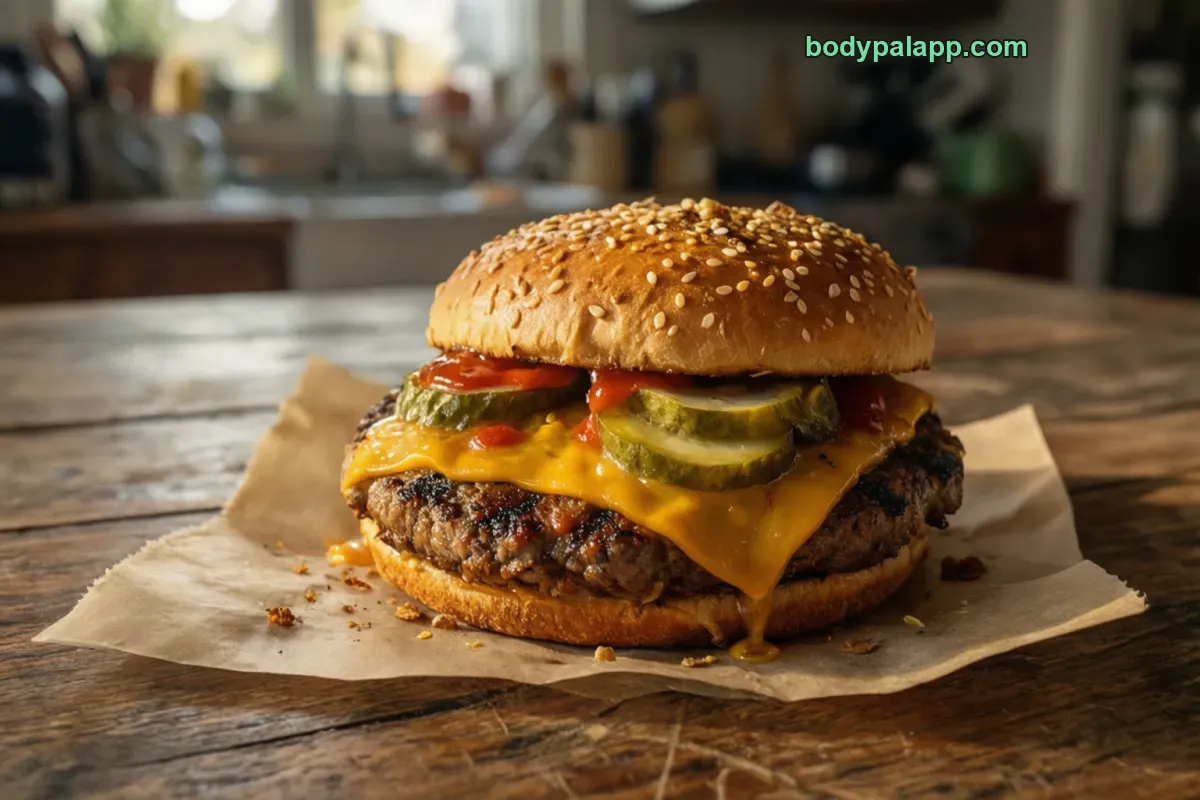
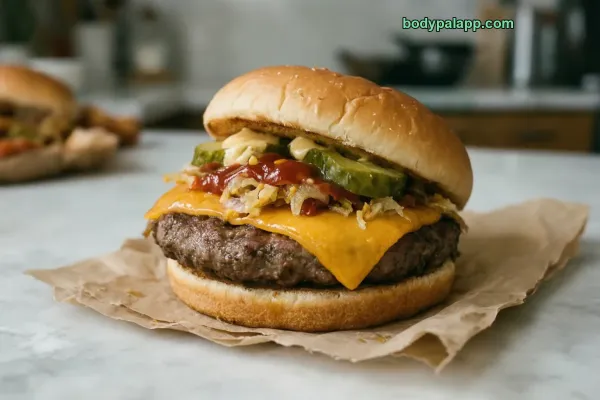
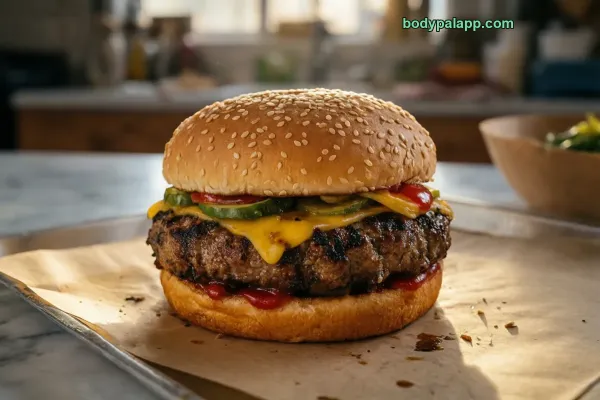
Burger King cheeseburger calories come to 380 for one cheeseburger (133 g), or 286 per 100 g. Fat is the biggest player at 47% of those calories, and the sodium is just as hard to ignore: 801 mg, or 35% of the daily value, in one small sandwich.
380kcal
1 cheeseburger · 133 g, fast food
20%protein
19.4 gProtein
32 gCarbs
19.7 gFat
How to burn off 380 kcal
—Walking, brisk
—Jogging
—Cycling, moderate
—Swimming
Skip the math. BodyPal counts these calories from your steps and workouts automatically.
Nutrition facts
Fast food · per 133 g
Calories
380 kcal
Protein
19.4 g
Carbohydrate
32 g
Fat
19.7 g
Saturated fat
9.1 g
Cholesterol
60 mg
Sodium
801 mg
Potassium
237 mg
Iron
3.3 mg
Source: USDA FoodData Central
🛡️
Verified nutrition data
Numbers on this page come from USDA FoodData Central, the U.S. Department of Agriculture’s food composition database, and from manufacturer labels where a branded product is named. Last verified September 2026. How we verify our data →
Burger king cheeseburger: calories, protein and sodium by serving
Percent of daily value uses the FDA reference of 2,000 kcal a day.
Serving
kcal
Protein
Carbs
Fat
Sodium
% DV kcal
1 cheeseburger (133 g)
380
19.4 g
31.5 g
19.7 g
801 mg
19%
Double cheeseburger (162 g)
457
27.3 g
28.2 g
26.1 g
910 mg
23%
100 g
286
14.6 g
23.7 g
14.8 g
602 mg
14%
3 × 1 cheeseburger (133 g)
1,141
58.1 g
2,402 mg
5 × 1 cheeseburger (133 g)
1,902
96.9 g
4,003 mg
Two cheeseburgers cost 761 calories
One cheeseburger (133 g) is 380 calories, about 19% of the daily value for calories. That reads like a modest lunch. The trouble is that few people stop at one small burger, and the total climbs in a straight line with every extra sandwich.
Two cheeseburgers weigh 266 g and land at 761 calories with 1,601 mg of sodium. Three reach 1,141 calories and 2,402 mg of sodium. Order five for a group and eat them yourself, and you are at 1,902 calories and 4,003 mg of sodium, with 96.9 g of protein along for the ride.
The double cheeseburger (162 g) is the smarter upgrade if you want more meat. It comes to 457 calories and 27.3 g of protein, against 761 calories and 38.8 g for two singles. You get a bigger, meatier sandwich for far fewer calories than doubling the order, because you skip the second bun.
Fat supplies nearly half the calories
The calorie split is 47% fat, 33% carbs and 20% protein. Per 100 g that means 14.8 g of fat, 23.7 g of carbs and 14.6 g of protein. The beef patty and the cheese carry most of the fat, while the bun drives the carbs.
In one cheeseburger you get 19.7 g of fat, 31.5 g of carbs and 19.4 g of protein. That protein covers 39% of the daily value, which is respectable for a sandwich this size. Saturated fat runs 6.8 g per 100 g, so the patty and cheese are doing most of the damage on that row.
Fiber is close to absent at 1.3 g per burger, and sugars sit at 6 g, mostly from the bun and ketchup. Low fiber plus high fat means the burger is dense but not especially filling for its calories. If staying full matters to you, what you put next to it counts more than the burger itself.
Sodium is the row to watch
At 801 mg, one cheeseburger delivers 35% of the daily value for sodium. Per 100 g it is 602 mg, or 26%. For a sandwich that supplies only 19% of daily calories, that is a lopsided trade: you spend sodium almost twice as fast as you spend calories.
The double cheeseburger pushes sodium to 910 mg, or 40% of the daily value. Two singles go further, to 1,601 mg. By the third burger you are at 2,402 mg, past a full day's daily value before counting fries or a drink.
If you watch sodium, treat a single cheeseburger as the anchor of the meal and keep the rest of the tray plain. Skipping salted sides makes a bigger difference here than trimming the burger itself.
One burger fits a day; the combo is the risk
These are USDA fast-food values for the Burger King cheeseburger, listed as "BURGER KING, Cheeseburger". On its own, 380 calories and 19.4 g of protein fit comfortably into most days of eating. The numbers only get heavy when the burger becomes one item in a bigger order.
Pair it with something that adds fiber and volume without much fat: a side salad, apple slices or a plain vegetable side. Water or an unsweetened drink keeps the meal near the burger's own total instead of doubling it. If you want a second sandwich, the double cheeseburger at 457 calories is the leaner way to get there.
Logging a fast-food stop is where totals usually go missing. BodyPal can log the cheeseburger from a photo, so the 380 calories and 801 mg of sodium land in your day before you forget them.
How does burger king cheeseburger compare?
Here is how the Burger King cheeseburger stacks up against a McDonald's cheeseburger and a bacon cheeseburger, per 100 g and per usual serving.
Verdict: For the fewest calories, pick the McDonald's cheeseburger at 313 per serving, though it carries slightly more sodium at 626 mg per 100 g versus 602. For the most protein, the bacon cheeseburger leads at 17.3 g per 100 g, but its 564-calorie sandwich makes the Burger King cheeseburger at 380 the better middle ground.
Burger king cheeseburger FAQs
How many calories are in a Burger King cheeseburger?
About 380 calories in one cheeseburger (133 g). A double cheeseburger (162 g) has about 457.
Is a Burger King cheeseburger good for weight loss?
One cheeseburger has 380 calories with 19.7 g fat and 31.5 g carbs. It also carries about 801 mg of sodium.
Burger King cheeseburger vs McDonald's cheeseburger: which has fewer calories?
Per 100 g the Burger King cheeseburger has 286 calories and the McDonald's cheeseburger 263. The Burger King one is also heavier at 133 g.
How much protein is in a Burger King cheeseburger?
About 19.4 g of protein per cheeseburger (133 g), or 14.6 g per 100 g.
How many calories are in a Burger King cheeseburger per 100 g?
A Burger King cheeseburger has 286 calories per 100 g. That breaks down to 14.8 g of fat, 23.7 g of carbs and 14.6 g of protein, with fat supplying 47% of the calories.
How many calories are in a Burger King double cheeseburger?
A Burger King double cheeseburger (162 g) has 457 calories. It also brings 27.3 g of protein and 910 mg of sodium, which is 40% of the daily value, so it beats two singles at 761 calories.
How much sodium is in a BK cheeseburger?
One BK cheeseburger has 801 mg of sodium, or 35% of the daily value. Per 100 g it is 602 mg. Two cheeseburgers reach 1,601 mg, so sides and a second sandwich add up quickly.
How much fat is in a cheeseburger from Burger King?
A Burger King cheeseburger has 19.7 g of fat. Fat makes up 47% of its 380 calories, and saturated fat runs 6.8 g per 100 g, mostly from the patty and cheese.
How many calories are in two Burger King cheeseburgers?
Two Burger King cheeseburgers come to 761 calories and 266 g. Together they carry 38.8 g of protein and 1,601 mg of sodium, more than a single double cheeseburger at 457 calories.