
How Many Calories in a Burger Patty?
A cooked beef burger patty — 3 oz (85 g) of the standard 80/20 blend — is 230 calories, or 270 per 100 g. Raw, that same patty weighs 4 oz and reads 287. The calories in a burger patty get decided before it ever reaches a bun: by the lean ratio stamped on the package and by the heat you cook it over.
On this page
- Burger patty quick facts
- What the package weight hides
- Patty sizes, ounce by ounce
- Broiled or pan-broiled
- What the lean ratio actually buys
- Sodium: the patty is not the problem
- Saturated fat is the real cost
- Frozen, chicken and veggie patties
- How does a burger patty compare?
- Most popular burger patty brands
- FAQ
Burger patty quick facts
The reference on this page is the patty most Americans are actually holding: USDA SR Legacy 171797, "Beef, ground, 80% lean meat / 20% fat, patty, cooked, broiled." Plain beef, cooked over direct heat, nothing added. Every number below is the meat alone — no bun, no cheese, no sauce.
| Nutrient | Per 100 g | Per 1 patty, 3 oz (85 g) | % Daily Value |
|---|---|---|---|
| Calories | 270 | 230 | — |
| Total fat | 17.78 g | 15.1 g | 19% |
| Saturated fat | 6.764 g | 5.7 g | 29% |
| Carbohydrate | 0.0 g | 0.0 g | 0% |
| Dietary fiber | 0.0 g | 0.0 g | 0% |
| Total sugars | 0.0 g | 0.0 g | — |
| Protein | 25.75 g | 21.9 g | 44% |
| Sodium | 75 mg | 64 mg | 3% |
% Daily Value is based on a 2,000-calorie diet.
Verified nutrition data
Numbers on this page come from USDA FoodData Central, the U.S. Department of Agriculture’s food composition database, and from manufacturer labels where a branded product is named. Last verified September 2026. How we verify our data →
Two rows do the work. Protein is the reason anyone eats this: 21.9 g in one patty, 44% of the day, from something that supplies only about 11% of a 2,000-calorie day. Saturated fat is the bill: 5.7 g, or 29% of the FDA Daily Value.
Two rows you would expect are missing, and both absences are deliberate. There is no added-sugars line because USDA does not collect that value for plain meat in this dataset, and writing a zero would imply a measurement nobody made. Trans fat does have a measured value — 0.771 g per 100 g, so 0.7 g in a patty — but FDA sets no Daily Value for it, so it sits here in the text rather than in a column that would have to stay blank.
The rest of the panel is quietly good. One patty carries 75 mg of cholesterol (25% DV) and 258 mg of potassium (5% DV), plus iron at 2.48 mg per 100 g and calcium at 24 mg per 100 g.
What the package weight hides
Here is the gap that costs people calories every cookout, and it runs in the direction most guides never mention.
You buy a quarter pound. Four ounces of raw 80/20 ground beef — 113 g, straight off the butcher paper — is 287 calories, from a raw record of 254 per 100 g. That is the number the package math gives you. Cook it, and the patty stops being a quarter pound. Water and rendered fat leave in the pan, the disc comes off the grate at roughly 85 g, and it is now 230 calories.
Fifty-seven calories per patty, gone into the flames. USDA measured the same shrink on its leaner records: the 85/15 broiled entry carries a portion described as one patty yielded from a quarter pound of raw meat, and it weighs 77 g.
The practical version: a four-pack of quarter-pounders is 1,148 calories on the label and 920 on the plate. Log the raw figure for meat you ate cooked and you overcount by more than 200 calories across a family dinner. Weigh the patty at one stage — raw or cooked — and match it to the record for that stage. Never mix them.
Patty sizes, ounce by ounce
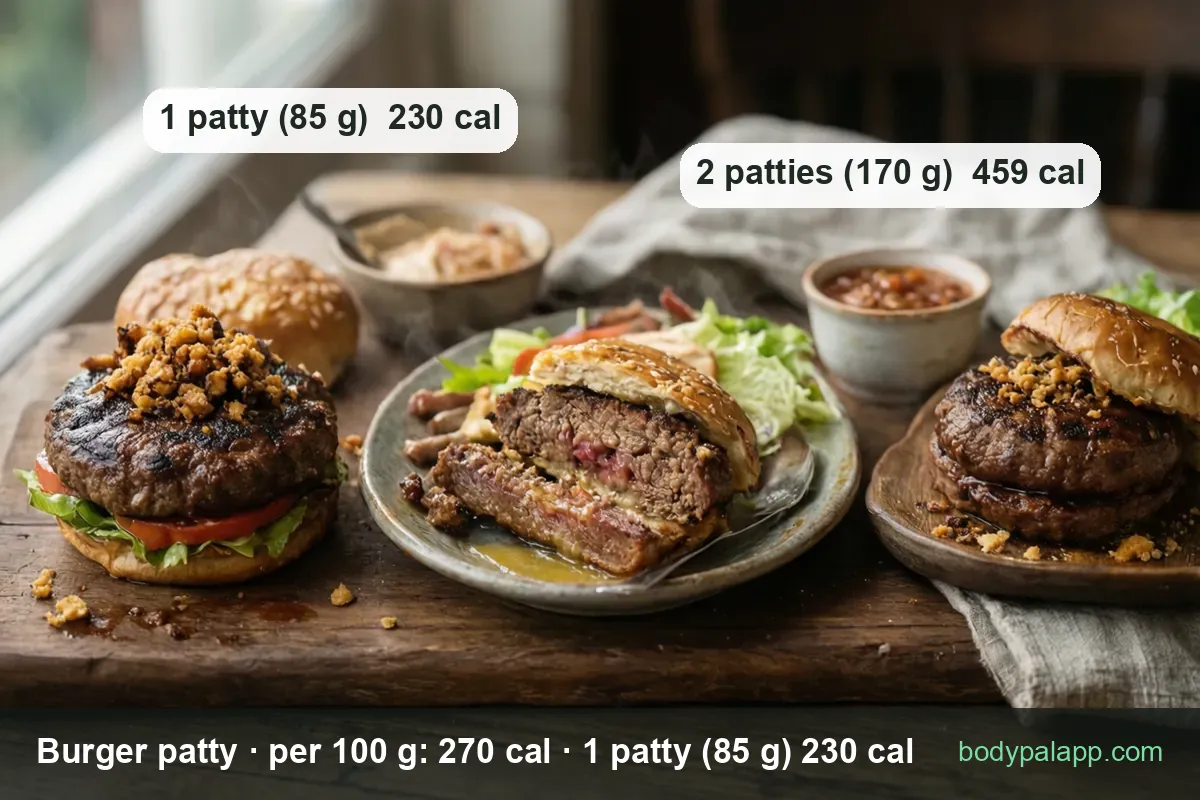
Built from 270 calories per 100 g, cooked and broiled:
| Portion | Weight | Calories |
|---|---|---|
| 1 oz cooked | 28 g | 76 |
| 1 patty, 3 oz cooked | 85 g | 230 |
| 2 patties, a double burger | 170 g | 459 |
| 100 g cooked | 100 g | 270 |
| 4 oz raw, before cooking | 113 g | 287 |
The 3 oz weight is the only household portion USDA publishes for this record, and it is not an accident: 85 g cooked is what a quarter-pound raw patty becomes.
Patties come in more than one size, though, and USDA's survey record for ground beef patties — 272 calories per 100 g, within 1% of the main record — puts numbers on the three you see at a counter. A small patty of 65 g is 177 calories, a medium or quarter-pound patty of 85 g is 231, and a large 120 g patty is 326. Going from a small to a large adds 149 calories of beef alone, more than a slice of American cheese would.
The double is the row worth staring at. Two patties is 459 calories, 43.8 g of protein and 11.5 g of saturated fat before anything else is assembled around it.
Broiled or pan-broiled
Identical meat, identical weight, two heat sources, and USDA records a 24-calorie-per-100-g gap between them.
| Same 80/20 beef | Per 100 g | Per 3 oz patty (85 g) |
|---|---|---|
| Broiled | 270 | 230 |
| Pan-broiled | 246 | 209 |
Broiling and grilling let fat and water drip away, so what is left on the grate is denser meat. A skillet keeps some of that liquid in contact with the patty, and the finished gram is a little more dilute. The effect holds one blend down: 85/15 comes out at 250 per 100 g broiled (213 per patty) and 232 pan-broiled (197 per patty), and USDA's quarter-pound yield portion for the pan-broiled version, 83 g, lands at 193 calories.
So the honest range for one 80/20 patty is 209 to 230 calories depending on nothing but your cooking surface. That is a 21-calorie spread — real, but smaller than a single splash of ketchup, and far smaller than the ratio you pick at the meat case.
What the lean ratio actually buys
Every blend below is broiled, and every serving is one 3 oz (85 g) patty:
| Blend | Per 100 g | Per patty (85 g) |
|---|---|---|
| 70% lean / 30% fat | 277 | 235 |
| 75% lean / 25% fat | 279 | 237 |
| 80% lean / 20% fat | 270 | 230 |
| 85% lean / 15% fat | 250 | 213 |
| 90% lean / 10% fat | 217 | 184 |
| 93% lean / 7% fat | 193 | 164 |
| 95% lean / 5% fat | 174 | 148 |
Notice the top of the ladder does not behave. The 75/25 patty is 237 calories and the fattier 70/30 is 235 — the leaner blend reads higher. Above about a quarter fat, so much of it renders out that the ratio on the label stops predicting the number on the plate. The ladder only becomes reliable from 80/20 down.
From there it is steep and worth using. Stepping from 80/20 to 90/10 drops a patty from 230 to 184 calories. Go to 95/5 and it is 148 — 36% off the original patty.
Here is the part the price tag does not explain. That saving costs you no protein at all. An 80/20 patty holds 21.9 g; 90/10 holds 22.2 g; 95/5 holds 22.3 g. You give up 46 calories and gain 0.3 g of protein. Anyone counting calories while chasing protein should be buying the leanest grind they can stand, and the only real trade is texture: less fat means a drier patty, which is a cooking problem, not a nutrition one.
Sodium: the patty is not the problem
Plain ground beef is close to sodium-free. One 3 oz patty is 64 mg, 3% of the Daily Value — of a daily 2,300 mg that amounts to about a teaspoon of table salt. Eat two patties and you are still at 128 mg.
That number surprises people because burgers have a reputation as salty food. They are. The sodium simply is not in the beef. It arrives with the bun, the cheese, the pickles and the sauce, none of which are counted anywhere on this page.
Two comparisons make the point sharply:
- USDA's survey record for a ground beef patty — the dish as Americans actually cook it, seasoning included — runs 383 mg of sodium per 100 g. That is roughly 326 mg in a 3 oz patty, 14% DV, five times the meat's own sodium. Almost all of it is what came out of your hand at the counter.
- A veggie burger patty with no bun carries 569 mg per 100 g, 25% DV in a single patty and 7.6 times the sodium of beef, gram for gram. Plant-based does not mean unsalted; the salt is doing structural work in a product that has no fat to carry flavor.
If sodium is the number you watch, salt the patty yourself and you control roughly 260 mg per burger. Buy it pre-formed and seasoned, and the decision has already been made for you.
Saturated fat is the real cost
Calories are not the reason to think twice about a burger patty. The ratio between the columns is.
One 3 oz 80/20 patty is 19% DV of total fat but 29% DV of saturated fat, from a serving that is only about 11% of a 2,000-calorie day. Saturated fat is running at roughly two and a half times the pace of the calories carrying it.
Scale that to how burgers are actually eaten. A double patty at 170 g is 11.5 g of saturated fat, 57% of the Daily Value — before a slice of cheese, which is itself a saturated-fat food. The Dietary Guidelines for Americans cap saturated fat at 10% of daily calories, and a double cheeseburger makes that a difficult day.
Leaner grinds fix this faster than they fix calories. The 90/10 patty brings saturated fat down to 3.9 g (about 20% DV) and 95/5 to 2.5 g (13% DV). Two 90/10 patties carry less saturated fat than one 80/20 patty plus half of another.
Frozen, chicken and veggie patties
Not every patty on an American grill is fresh 80/20, and the alternatives do not line up the way you would guess.
Frozen beef patties are the heaviest thing here: 295 calories per 100 g cooked, so 251 calories for a 3 oz patty. USDA also lists a whole unit yielded from a pound of raw meat at 313 g, which is 923 calories in one enormous patty. Frozen pucks tend to be pressed from fattier trim, and the number shows it.
Chicken patties, the breaded frozen kind, look light because they are small. One 60 g patty is 172 calories — but per 100 g it is 287, denser than an 80/20 beef patty, with 12.84 g of carbohydrate from breading and 532 mg of sodium. Swapping beef for a breaded chicken patty is a smaller win than the plate suggests.
Veggie patties without a bun run 177 calories for a 100 g patty, with 15.7 g of protein, 14.27 g of carbohydrate and 4.9 g of fiber — the only fiber in this entire article, since beef has none. The cost is that sodium figure of 569 mg.
How does a burger patty compare?
Every row is one patty as it is normally served, with the serving weight named:
| Patty, cooked | Per 100 g | Per serving | Protein | Carbs | Fat |
|---|---|---|---|---|---|
| Beef 80/20, broiled (3 oz, 85 g) | 270 | 230 | 21.9 g | 0.0 g | 15.1 g |
| Beef 90/10, broiled (3 oz, 85 g) | 217 | 184 | 22.2 g | 0.0 g | 10.0 g |
| Beef 95/5, broiled (3 oz, 85 g) | 174 | 148 | 22.3 g | 0.0 g | 5.8 g |
| Veggie patty, no bun (1 patty, 100 g) | 177 | 177 | 15.7 g | 14.3 g | 6.3 g |
| Chicken patty, frozen (1 patty, 60 g) | 287 | 172 | 8.9 g | 7.7 g | 11.7 g |
Our take: for protein at the lowest calorie cost, 95/5 beef wins and it is not close — 148 calories for 22.3 g of protein beats the veggie patty's 177 calories for 15.7 g, and beats the chicken patty twice over. If you want the burger to taste like a burger, 90/10 is the sensible default: 184 calories, full beef protein, and 1.8 g less saturated fat than 80/20 for a texture most people cannot pick out under a bun. The veggie patty earns its place for the fiber and for people avoiding meat, not on the calorie math, and the MyPlate protein group counts all of these as protein foods regardless. The breaded chicken patty is the one to skip: the least protein, the most sodium per gram, and calories that came from the coating.
Most popular burger patty brands in the United States
Ranked by how widely each product appears among foods sold in the United States, from the BodyPal food database of over 3.3 million products. Calories are the figures printed on each Nutrition Facts label, checked against USDA FoodData Central.
| Product | Calories (per 100 g) |
|---|---|
| Schweid & Sons The One Percenter Burger Patty (2.5 oz) | 282 cal |
| Schweid & Sons The One Percenter Burger Patty (5.3 oz) | 293 cal |
| Schweid & Sons CAB Custom Blend Chuck Brisket Burger Patty | 293 cal |
| Schweid & Sons Katana Blend Wagyu Ground Beef Burger Patty | 293 cal |
| Schweid & Sons CAB Chuck Brisket Sliders Burger Patty | 282 cal |
| Schweid & Sons 80% Lean Grass-Fed Beef Burger Patty | 167 cal |
Brand popularity: BodyPal food database. Nutrition: manufacturer labels / USDA FoodData Central.
Burger patty FAQs
How many calories are in a burger patty?
230 calories in one 3 oz (85 g) cooked beef patty made from standard 80/20 ground beef, which is 270 per 100 g. That patty carries 21.9 g of protein and 15.1 g of fat. Raw, before it shrinks on the grill, the same patty is 287 calories.
How many calories are in a quarter pound burger patty?
287 calories raw and about 230 cooked. A quarter pound is 4 oz (113 g) of raw 80/20 ground beef at 254 calories per 100 g; broiling drives out water and fat until the patty weighs roughly 85 g. The package number describes meat you have not eaten yet.
How many calories are in an 80/20 burger patty?
230 calories for a 3 oz (85 g) cooked 80/20 patty, or 209 if you pan-broil it instead of grilling. Per 100 g the numbers are 270 broiled and 246 pan-broiled. The same meat raw is 254 calories per 100 g.
How much protein is in a burger patty?
21.9 g in a 3 oz cooked 80/20 patty, which is 44% of the Daily Value, from 25.75 g per 100 g. Leaner grinds barely change it: 90/10 gives 22.2 g and 95/5 gives 22.3 g for far fewer calories. A double patty reaches 43.8 g.
How many calories are in two burger patties?
459 calories for two 3 oz 80/20 patties, 170 g of cooked beef in total. That double brings 43.8 g of protein and 11.5 g of saturated fat, which is 57% of the Daily Value before any cheese is added. Sodium stays low at 128 mg.
Is a burger patty healthy without the bun?
It is a dense protein food with one clear cost. A 3 oz patty gives 21.9 g of protein (44% DV) and only 64 mg of sodium (3% DV), alongside 5.7 g of saturated fat, or 29% DV. Choosing 90/10 instead cuts that to about 3.9 g while keeping the protein.
How many calories are in a veggie burger patty?
177 calories for a 100 g veggie patty with no bun, with 15.7 g of protein, 14.27 g of carbohydrate and 4.9 g of fiber. It carries 569 mg of sodium, 25% of the Daily Value and 7.6 times as much per gram as plain beef.
How many calories are in a frozen burger patty?
251 calories for a 3 oz (85 g) cooked frozen beef patty, at 295 per 100 g — the fattiest patty in USDA's records. A whole unit yielded from a pound of raw meat weighs 313 g cooked and comes to 923 calories on its own.
Similar foods
- Philly Cheesesteak — 420 cal per sandwich
- Chicken Strips And Fries — 542 cal for 4 strips
- Costco Food Court Pizza — 377 cal per slice
- Mcdonald'S Hash Brown — 144 cal per hash brown
- Pizza Hut Medium Pizza — 2000 cal per pizza
- Bacon Egg And Cheese Mcgriddle — 449 cal per McGriddle
Count it without the math
Point the camera at the plate and BodyPal logs the patty, the bun and everything stacked between them in one shot.


How long does it take to burn off a burger patty?
A 3 oz cooked 80/20 patty is 230 kcal. Enter your weight and the amount you ate to see how long it takes you to burn that off:
lb
| Activity | Time to burn 230 kcal |
|---|---|
| Walking, brisk | 46 min |
| Cycling, moderate | 29 min |
| Swimming, moderate | 33 min |
| Jogging | 27 min |
| Weight training, moderate | 51 min |
Times are for a 155 lb adult at a steady pace; change the weight to see yours. The amount is set to the portion in the text (3 oz); change it to what you actually ate. BodyPal works this out from your steps automatically.
This table assumes you know your daily total. If you do not, the daily calorie calculator works it out from five numbers.