
How many calories are in chicken strips and fries?
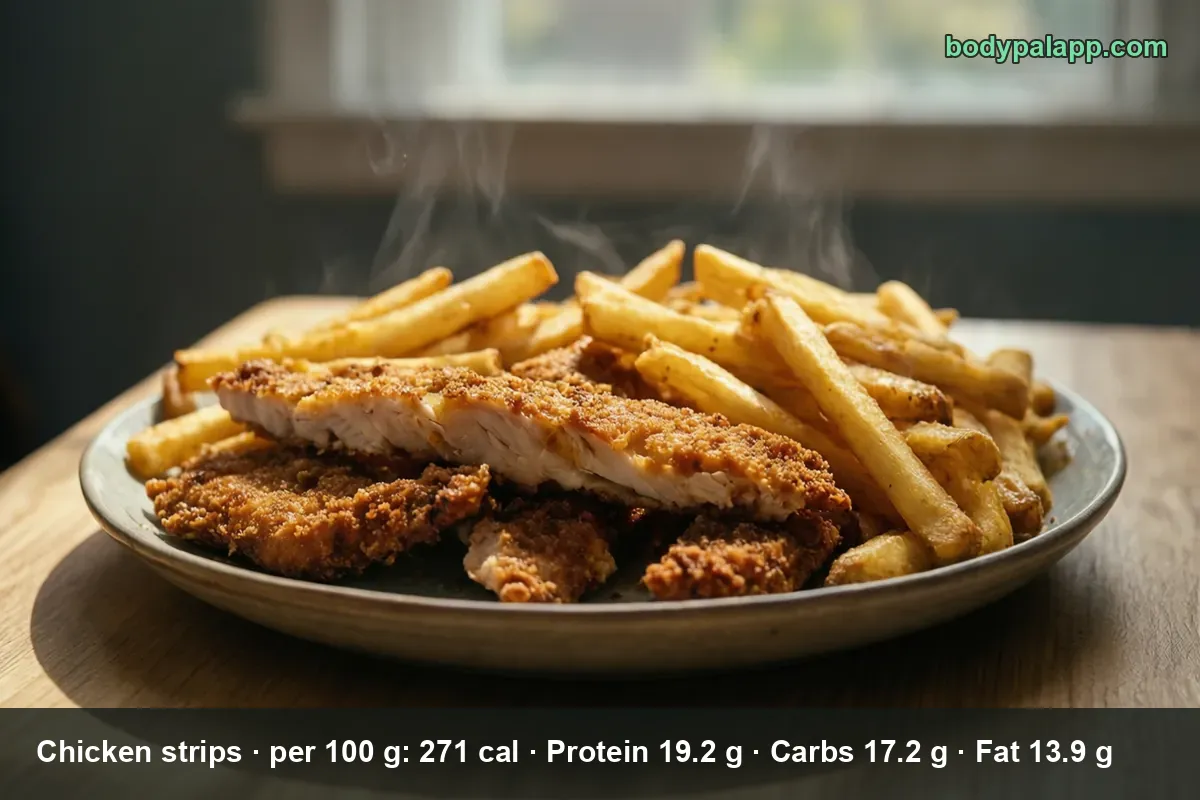
A four-strip basket of breaded chicken strips from a fast-food counter weighs about 200 g and carries 542 calories. Per 100 g the strips run 271 calories. One strip on its own is 136. The fries beside them are a separate line: USDA publishes no combined record for the plate.
On this page
- Chicken strip quick facts
- US servings, from one chicken fry to a full basket
- Fast food, frozen and school lunch strips
- Sodium is the row that moves
- How do chicken strips compare?
- Most popular chicken strips brands
- FAQ
Chicken strip quick facts
The row behind these numbers is FNDDS 2706099, "Chicken tenders or strips, breaded, from fast food". People searching for a strip-and-fries basket are almost always holding food from a counter, not a tray of tenders they breaded themselves, so the fast-food record is the honest match. USDA does keep separate records for restaurant, school-lunch and frozen strips, and those land further down the page.
One warning before the table. There is no USDA record for "chicken strips and fries" as a single dish. Everything below is the chicken alone. The fries are their own food and have to be logged as a second line, which is exactly why the total on a receipt-sized basket surprises people.
| Nutrient | Per 100 g | Per 4-strip basket (200 g) | % Daily Value |
|---|---|---|---|
| Calories | 271 | 542 | — |
| Total fat | 13.95 g | 27.9 g | 36% |
| Saturated fat | 2.49 g | 5.0 g | 25% |
| Carbohydrate | 17.25 g | 34.5 g | 13% |
| Dietary fiber | 1.2 g | 2.4 g | 9% |
| Total sugars | 0.4 g | 0.8 g | — |
| Protein | 19.22 g | 38.4 g | 77% |
| Sodium | 769 mg | 1538 mg | 67% |
% Daily Value is based on a 2,000-calorie diet.
Verified nutrition data
Numbers on this page come from USDA FoodData Central, the U.S. Department of Agriculture’s food composition database, and from manufacturer labels where a branded product is named. Last verified September 2026. How we verify our data →
Two rows you might expect are missing. This FNDDS edition does not publish added sugars or trans fat for breaded chicken, so neither appears above; with 0.4 g of total sugars per 100 g, there is essentially nothing sweet in a strip anyway. Cholesterol works out to 96 mg for the basket, 32% of the Daily Value, and potassium to 746 mg, about 16%.
The 200 g basket weight is our own arithmetic from the USDA figures — four strips at USDA's 50 g household measure — rather than a serving USDA publishes as such.
US servings, from one chicken fry to a full basket
| Serving | Weight | Calories |
|---|---|---|
| 1 chicken fry | 14 g | 38 kcal |
| 1 oz | 28 g | 76 kcal |
| 1 tender, strip or finger | 50 g | 136 kcal |
| Per 100 g | 100 g | 271 kcal |
| 1 cup | 140 g | 379 kcal |
| 4 strips, basket portion | 200 g | 542 kcal |
The chicken fry, the single strip and the cup are USDA household measures for this record. The ounce and the four-strip basket are our own arithmetic scaled from the USDA 100 g figure, not USDA servings.
The cup is the trap. A cup of strips is 140 g of food, which is 379 calories and 1,077 mg of sodium — 47% of a day's sodium from a measuring cup that looks modest on the counter. It is nearly three times the single-strip serving people picture when they log "some chicken strips." If you are eyeballing, count pieces rather than volume: strips do not pack, and the air between them makes a cup look like less than it is.
Chicken fries deserve their own note. At 14 g each they are 38 calories a piece, so a sleeve of nine is roughly the same chicken as two and a half regular strips. Thin shapes carry more breading per gram of meat, which is where the extra fat rides in.
Fast food, frozen and school lunch strips
| Version | Per 100 g | Typical piece | Calories |
|---|---|---|---|
| Fast-food strips, basket | 271 kcal | 4 strips, 200 g | 542 kcal |
| Restaurant strips | 283 kcal | 1 strip, 50 g | 142 kcal |
| Strips from other sources | 262 kcal | 1 strip, 50 g | 131 kcal |
| School lunch strips | 270 kcal | 1 strip, 40 g | 108 kcal |
| Frozen strips baked at home | 240 kcal | 1 strip, 40 g | 96 kcal |
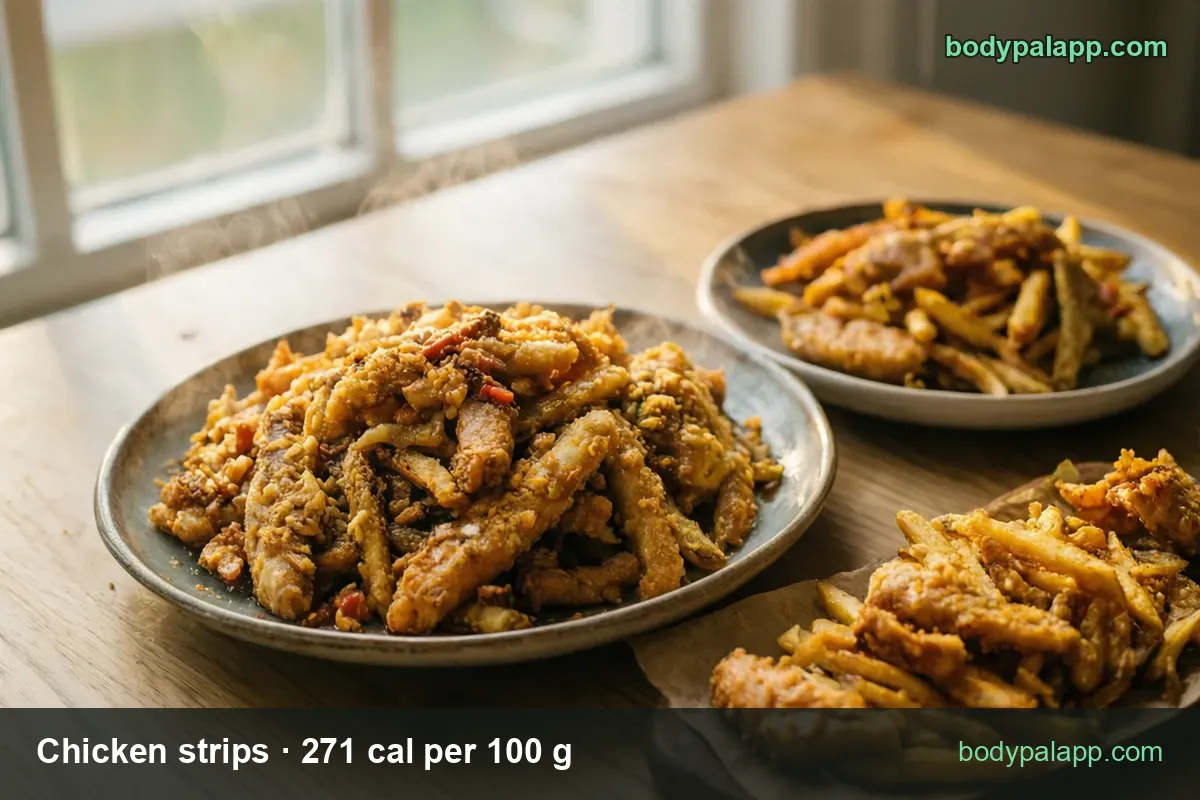
Restaurant strips are the heaviest of the five at 283 calories per 100 g, with 15.62 g of fat against 13.95 g for the fast-food version. Thicker batter and a fryer that runs all night explain the gap; the meat underneath is nearly identical, at 18.82 g of protein per 100 g versus 19.22 g.
Frozen strips baked at home are the lightest row on the board, 240 calories per 100 g. Skip the second fry and you save 62 calories on a 200 g serving — 480 instead of 542 — plus a large chunk of sodium, 527 mg per 100 g against 769 mg. That is the single most useful swap on this page, and it costs nothing but oven time.
School-lunch strips look mild at 270 calories per 100 g until you read the breakdown: 22.86 g of carbohydrate and only 15.67 g of protein per 100 g, the most coating of any record here and less meat than every version except the frozen one. Sodium is the payoff, 511 mg per 100 g, the lowest of the five.
Retail bags sit near the frozen end. Among US branded records, tenders run from about 186 calories per 100 g for Bell & Evans breaded breast tenders up to 247 for Meijer's battered tender-shaped patties, with Tyson batter-dipped tenders at 238 and Foster Farms all-natural breast tenders at 202. Every one of them is below the 271 of a fast-food basket, because nothing in the bag has been through a commercial fryer yet.
Sodium is the row that moves
Protein is the reason people order strips, and it delivers: 38.4 g in a four-strip basket, 77% of the Daily Value, more than most people get from a whole dinner. USDA's MyPlate protein guidance puts a typical adult in the 5–6 ounce-equivalent range a day, and one basket covers most of it.
Sodium arrives faster. The same basket is 1,538 mg, 67% of the FDA Daily Value of 2,300 mg — about two-thirds of a teaspoon of table salt — and that is before the fries are salted and before a cup of ranch or honey mustard goes next to them. Protein and sodium climb together here, but sodium crosses the line first: by the third strip you are at half a day's sodium and only 58% of the protein Daily Value.
Saturated fat is the quiet row that behaves well. At 5.0 g the basket is 25% of the Daily Value, less than a single fast-food cheeseburger patty, because the breading soaks up frying oil rather than animal fat. If you are watching one number on this plate, make it the sodium.
How do chicken strips compare?
| Item | Per 100 g | US serving | Calories |
|---|---|---|---|
| Chicken strips, fast food | 271 kcal | 4 strips, 200 g | 542 kcal |
| Chicken tenders or strips, NFS | 271 kcal | 1 oz, 28 g | 76 kcal |
| Chicken patty, breaded | 287 kcal | 1 oz, 28 g | 80 kcal |
| Chicken nuggets, NFS | 307 kcal | 1 oz, 28 g | 86 kcal |
Our take: strips are the lightest breaded chicken per gram in this group, tied with the generic NFS record at 271 calories per 100 g, and they carry the most protein — 19.22 g per 100 g against 15.92 g for nuggets and 14.85 g for a breaded patty. The reason is geometry. A strip is one solid piece of breast with a thin shell, while nuggets are small and mostly surface, which is how they end up 36 calories heavier per 100 g. If the choice on the menu board is strips or nuggets, take the strips, order the smaller count, and spend the difference on the fries you actually wanted.
Most popular chicken strips brands in the United States
Ranked by how widely each product appears among foods sold in the United States, from the BodyPal food database of over 3.3 million products. Calories are the figures printed on each Nutrition Facts label, checked against USDA FoodData Central.
| Product | Calories (per 100 g) |
|---|---|
| Tyson Batter Dipped Chicken Breast Tenders | 238 cal |
| Foster Farms All Natural Breast Tenders | 202 cal |
| Bell & Evans Breaded Chicken Breast Tenders | 186 cal |
| Golden Platter Gluten Free Chicken Tenders | 194 cal |
| Meijer Battered Tender Shaped Chicken Breast Patties | 247 cal |
| Snap Kitchen Almond Crusted Chicken Strips | 222 cal |
Brand popularity: BodyPal food database. Nutrition: manufacturer labels / USDA FoodData Central.
Chicken strip FAQs
How many calories are in chicken strips and fries?
The chicken half of the plate is 542 calories for a four-strip, 200 g basket, or 271 calories per 100 g. USDA publishes no single record for strips served with fries, so the potatoes have to be logged as their own line — no honest combined number exists.
How many calories in one chicken strip?
One fast-food chicken strip weighing 50 g is 136 calories, with 9.6 g of protein, 7.0 g of fat and 385 mg of sodium. That 50 g is the USDA household measure for a single tender, and it is the unit worth logging if you take one or two from someone else's basket.
How many calories in 3 chicken tenders?
Three tenders at the USDA 50 g size come to 407 calories, 28.8 g of protein and 1,154 mg of sodium — half a day's sodium before any sauce. That figure is our own arithmetic from the 271-calorie 100 g record. A three-piece from a restaurant fryer runs closer to 425.
Are chicken strips high in protein?
Yes. Breaded strips carry 19.22 g of protein per 100 g, and a 200 g basket delivers 38.4 g, which is 77% of the Daily Value. That is the strongest row on the label. The trade is the 27.9 g of fat and 1,538 mg of sodium arriving with it.
How much sodium is in a chicken strip basket?
A four-strip, 200 g basket carries 1,538 mg of sodium, 67% of the 2,300 mg Daily Value and about two-thirds of a teaspoon of table salt. Fries, ketchup and dipping sauce all sit on top of that. A single strip is 385 mg, so the count climbs quickly.
Are frozen chicken strips lower in calories than fast food ones?
Yes, by a useful margin. Frozen strips baked at home are 240 calories per 100 g against 271 for the fast-food version, so a 200 g serving is 480 rather than 542 — a 62-calorie gap. Sodium drops further, from 769 mg to 527 mg per 100 g.
Chicken strips vs chicken nuggets: which has fewer calories?
Strips win. Breaded chicken nuggets are 307 calories per 100 g and strips 271, which works out to 86 against 76 calories per ounce. Nuggets also pack more breading around less meat: 15.92 g of protein per 100 g versus 19.22 g for strips. Ounce for ounce, strips are the better pick.
How many carbs are in breaded chicken tenders?
Breaded tenders carry 17.25 g of carbohydrate per 100 g, almost all of it breading. One 50 g strip is 8.6 g and a 200 g basket 34.5 g, or 13% of the Daily Value. School-lunch strips are the highest at 22.86 g per 100 g, with more coating on each piece.
Similar foods
- Costco Food Court Pizza — 377 cal per slice
- Mcdonald'S Hash Brown — 144 cal per hash brown
- Pizza Hut Medium Pizza — 2000 cal per pizza
- Bacon Egg And Cheese Mcgriddle — 449 cal per McGriddle
- Bacon Egg Cheese Mcgriddle — 449 cal per sandwich
- Bacon, Egg And Cheese Mcgriddle — 449 cal per sandwich
Count it without the math
Point the camera at the basket and BodyPal counts the strips and the fries as separate lines for you.


How long does it take to burn off 542 kcal of chicken strips?
A 4-strip basket (200 g) is 542 kcal. Enter your weight and the amount you ate to see how long it takes you to burn that off:
lb
| Activity | Time to burn 542 kcal |
|---|---|
| Walking, brisk | 1 hr 48 min |
| Cycling, moderate | 1 hr 8 min |
| Swimming, moderate | 1 hr 17 min |
| Jogging | 1 hr 4 min |
| Weight training, moderate | 2 hr |
Times are for a 155 lb adult at a steady pace; change the weight to see yours. The amount is set to the portion in the text (200 g); change it to what you actually ate. BodyPal works this out from your steps automatically.
Want the bigger picture? Calculate your daily calorie needs — your maintenance figure, a target for losing or gaining, and the date you get there.