
How many calories are in a burger?
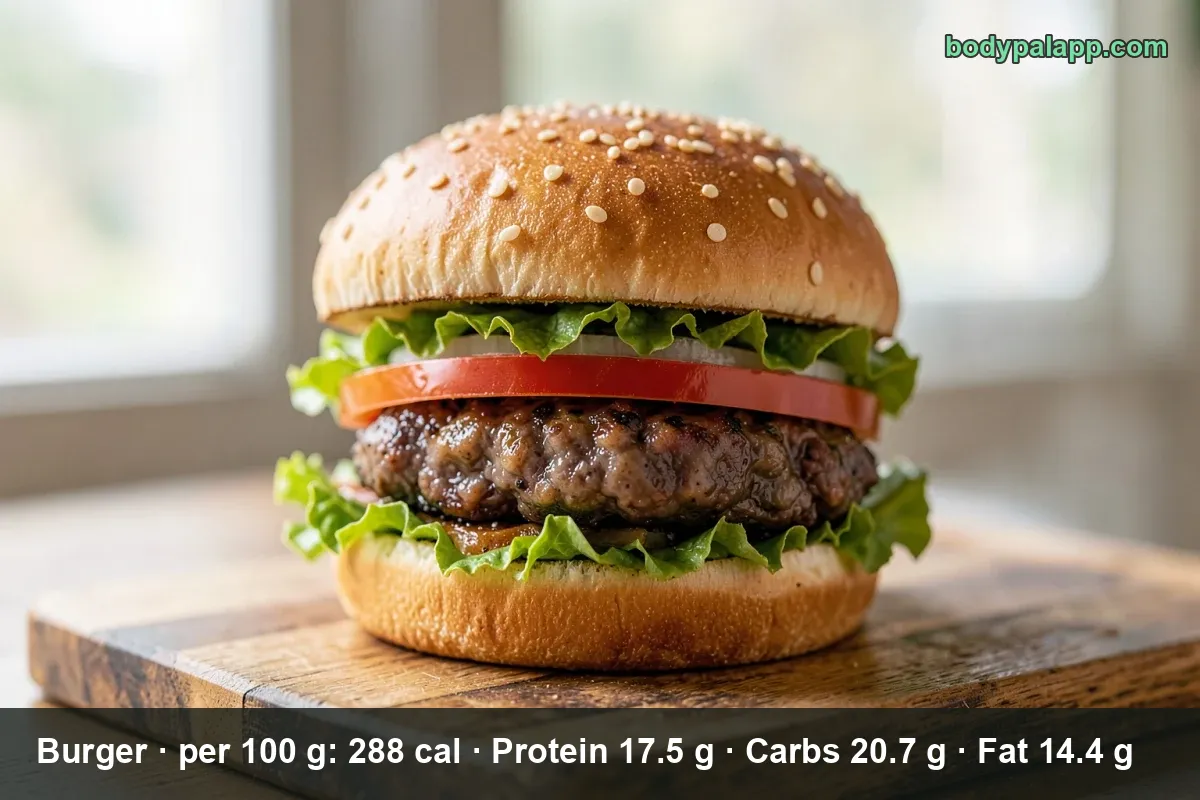
One hamburger weighing 145 g carries 418 calories, and the sandwich as a whole runs 288 calories per 100 g. That is USDA's generic beef burger in a bun — no chain, no size, no cheese named. Add cheese and the record shifts to a 165 g cheeseburger at 488 calories.
On this page
- Burger quick facts
- US servings, from one ounce to two burgers
- Cheeseburgers, sliders and the school lunch burger
- Saturated fat, not calories, is the row to watch
- How does a burger compare?
- Most popular burger brands
- FAQ
Burger quick facts
The number above comes from FNDDS 2706920, "Hamburger, NFS" in USDA's Survey Foods 2021–2023 release. NFS means "not further specified": a beef patty in a bun, with whatever normally goes on it, and no brand or restaurant attached. That is the food most people are holding when they ask this question, and it is the record that comes with a real household measure — one hamburger, 145 g.
Chain products are in the database too, but a Burger King or Wendy's entry answers a different question. Those are specific sandwiches with their own weights. This page stays with the generic burger and puts the sizes and styles in their own sections below.
| Nutrient | Per 100 g | Per 1 hamburger (145 g) | % Daily Value |
|---|---|---|---|
| Calories | 288 | 418 | — |
| Total fat | 14.38 g | 20.9 g | 27% |
| Saturated fat | 5.5 g | 8.0 g | 40% |
| Carbohydrate | 20.68 g | 30.0 g | 11% |
| Dietary fiber | 0.7 g | 1.0 g | 4% |
| Total sugars | 3 g | 4.4 g | — |
| Protein | 17.51 g | 25.4 g | 51% |
| Sodium | 355 mg | 515 mg | 22% |
% Daily Value is based on a 2,000-calorie diet.
Verified nutrition data
Numbers on this page come from USDA FoodData Central, the U.S. Department of Agriculture’s food composition database, and from manufacturer labels where a branded product is named. Last verified September 2026. How we verify our data →
Two rows are missing on purpose. FNDDS does not publish added sugars or trans fat for prepared mixed dishes, so there is nothing to print for either one, and no honest way to estimate them from the rest of the record. Cholesterol and potassium do exist here: the same burger carries 71 mg of cholesterol (24% DV) and 332 mg of potassium (7% DV).
One more thing worth knowing before you weigh anything. A "quarter-pound" burger is named for the raw patty, and grilling drives off water and fat, so the patty that reaches the bun is lighter than the one that hit the grill. USDA's 145 g is the finished sandwich, cooked and assembled — that is what you should be logging, not the package weight of the meat.
US servings, from one ounce to two burgers
| Serving | Weight | Calories |
|---|---|---|
| 1 oz | 28.4 g | 82 kcal |
| One slider-size burger | 70 g | 202 kcal |
| One hamburger, USDA size | 145 g | 418 kcal |
| One large restaurant burger | 200 g | 576 kcal |
| Two hamburgers | 290 g | 835 kcal |
| Per 100 g | 100 g | 288 kcal |
Only the 145 g line is a USDA household measure. The ounce, the slider weight, the 200 g restaurant burger and the pair are our own arithmetic from the USDA 100 g figure, not USDA servings — the density stays at 288 per 100 g and the weight does the rest.
That last point is the whole game with burgers. A slider and a 200 g restaurant burger have almost identical calories per gram, because they are the same construction: beef, bun, a little dressing. What separates 202 calories from 576 is not the recipe, it is the size of the thing in your hand. Weigh the sandwich once on a kitchen scale and you will log burgers correctly forever.
Cheeseburgers, sliders and the school lunch burger
| Version | Per 100 g | Typical piece | Calories |
|---|---|---|---|
| Hamburger, NFS | 288 kcal | 1 hamburger (145 g) | 418 kcal |
| Cheeseburger, NFS | 296 kcal | 1 cheeseburger (165 g) | 488 kcal |
| Hamburger, small patty on white bun | 287 kcal | 1 hamburger (115 g) | 330 kcal |
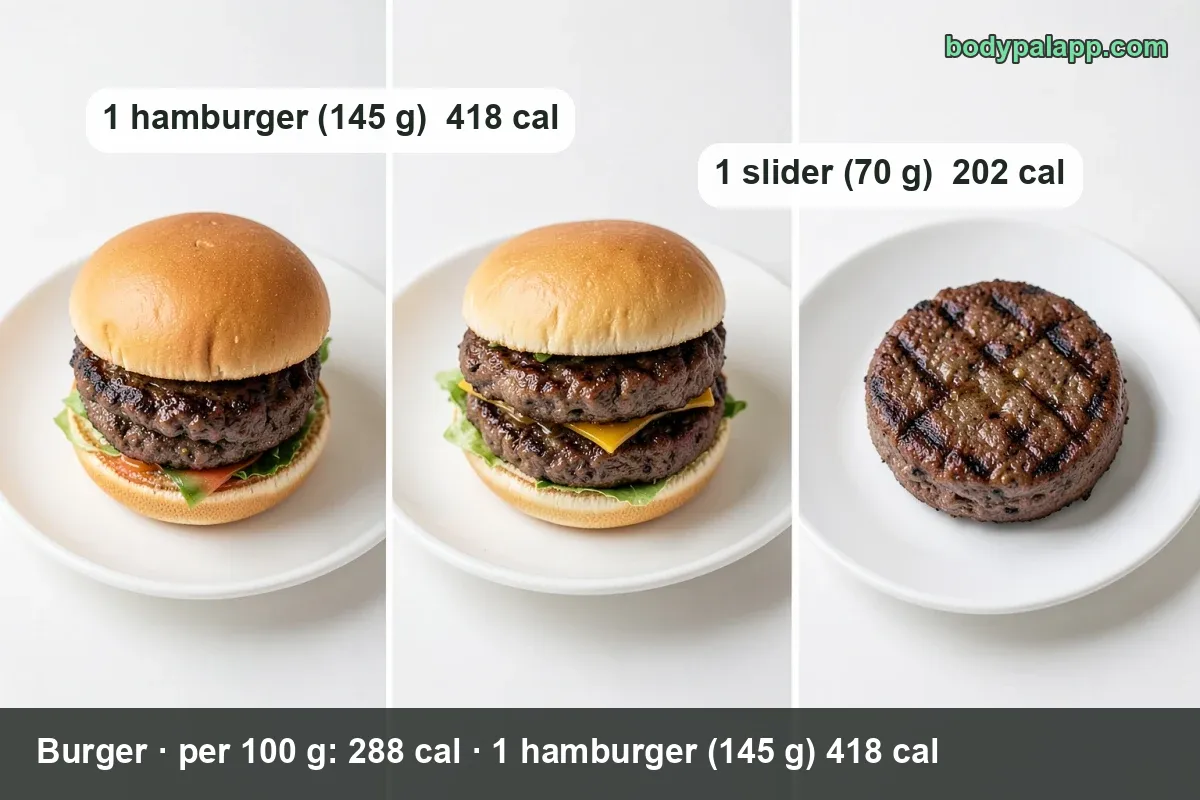
| Hamburger slider | 288 kcal | 1 miniature (70 g) | 202 kcal |
| Cheeseburger slider | 297 kcal | 1 miniature (80 g) | 238 kcal |
| School cafeteria hamburger | 243 kcal | 1 hamburger (90 g) | 219 kcal |
| School cafeteria cheeseburger | 250 kcal | 1 cheeseburger (100 g) | 250 kcal |
Cheese looks harmless per 100 g — 296 against 288, a difference you would never notice. The damage arrives through weight and salt. The cheeseburger record is a 165 g sandwich, so the plate cost is 488 calories, and sodium climbs from 355 mg per 100 g to 438 mg. Scaled to that 165 g sandwich, that is roughly 723 mg of sodium — our own arithmetic from the USDA 100 g figure, not a USDA serving.
Sliders are the honest small option. Two of them, at 70 g each, come to 404 calories, which lands almost exactly on one standard burger. The cafeteria versions are the lightest records in the set at 243 and 250 per 100 g, because the patties are smaller relative to the bread and leaner overall.
The bun matters more than most people expect. USDA's wheat-bun hamburger runs 281 calories per 100 g, close enough to the white-bun version to be a rounding error, but it carries 2.2 g of fiber per 100 g against 0.7 g — more than three times as much, for a swap that costs nothing. Going the other direction, the double hamburger on a white bun sits at 290 calories per 100 g, and the second patty pushes carbohydrate down from 20.68 g to 13.02 g while protein rises to 19.51 g. A double is not a calorie disaster per gram. It is simply a bigger sandwich made of more meat.
Among packaged options, USDA's Branded database lists a Chop House Steak Burger patty at 265 calories per 100 g, or 400 calories for the 151 g patty on its label — before any bun.
Saturated fat, not calories, is the row to watch
418 calories is an ordinary lunch. The saturated fat is where a burger separates itself from other 400-calorie sandwiches: 8.0 g in one hamburger, which is 40% of the FDA Daily Value of 20 g. The Dietary Guidelines for Americans put the target at less than 10% of daily calories from saturated fat, and one burger takes a large bite out of that before dinner is even discussed.
Sodium behaves better than its reputation. At 515 mg, one burger is 22% DV — about a fifth of a teaspoon of table salt. The fries and the soda beside it usually do more damage than the sandwich.
Then there is the row nobody counts: 25.4 g of protein, or 51% of the Daily Value, from a single hamburger. That is a full protein-food serving and then some. If you are choosing lunch on satiety per calorie, a plain burger is a genuinely strong pick — it just spends its budget on saturated fat rather than on carbohydrate.
How does a burger compare?
| Burger | Per 100 g | US serving | Calories |
|---|---|---|---|
| Hamburger, NFS | 288 kcal | 1 hamburger (145 g) | 418 kcal |
| Cheeseburger, NFS | 296 kcal | 1 cheeseburger (165 g) | 488 kcal |
| Hamburger slider | 288 kcal | 1 miniature (70 g) | 202 kcal |
| School cafeteria hamburger | 243 kcal | 1 hamburger (90 g) | 219 kcal |
Our take: for weight loss, the slider wins and it is not close — 202 calories buys you a real burger with 12.4 g of protein, and the cafeteria burger at 219 calories is the only record in this table under 250 per 100 g. For satiety, take the standard 145 g hamburger and skip the cheese: you keep all 25.4 g of protein and drop the 70 extra calories and the extra salt the cheese slice brings. The one choice we would argue against is ordering a cheeseburger and then eating half of it. Order the smaller burger whole instead.
Most popular burger brands in the United States
Ranked by how widely each product appears among foods sold in the United States, from the BodyPal food database of over 3.3 million products. Calories are the figures printed on each Nutrition Facts label, checked against USDA FoodData Central.
| Product | Calories (per 100 g) |
|---|---|
| Chop House Steak Burger | 265 cal |
Brand popularity: BodyPal food database. Nutrition: manufacturer labels / USDA FoodData Central.
Burger FAQs
How many calories are in a burger?
418 calories in one standard 145 g hamburger, which works out to 288 calories per 100 g. That is USDA's generic beef burger in a bun, with no restaurant or size specified. A slider version of the same sandwich is 202 calories, and a large 200 g restaurant burger comes to 576.
How many calories are in a cheeseburger?
488 calories for USDA's 165 g cheeseburger, against 418 for a plain hamburger. Per 100 g the two are almost identical, 296 against 288, so the extra calories come mostly from the bigger sandwich rather than the cheese itself. Sodium rises too, from 355 mg per 100 g to 438 mg.
How many calories in a burger without the bun?
418 calories is the figure with the bun, and USDA's FNDDS does not publish a patty-only hamburger record, so we will not invent one. The closest signal is the double hamburger, where a second patty replaces bread: carbohydrate falls from 20.68 g per 100 g to 13.02 g and protein rises to 19.51 g.
How much protein is in a burger?
25.4 g of protein in one 145 g hamburger, or 17.51 g per 100 g. That is 51% of the FDA Daily Value of 50 g from a single sandwich, which is why a plain burger holds off hunger better than most lunches of the same calorie count. A 70 g slider gives 12.4 g.
How much saturated fat is in a burger?
8.0 g of saturated fat in one 145 g hamburger, which is 40% of the FDA Daily Value of 20 g. Per 100 g the figure is 5.5 g. Total fat is 20.9 g per burger, 27% DV. This row, not the calorie count, is the strongest argument for a smaller burger.
How many calories in a slider?
202 calories in a 70 g hamburger slider, and 238 in an 80 g cheeseburger slider. Per 100 g a slider is 288 calories, exactly the same density as a full-size burger, because it is the same food built small. Two hamburger sliders come to 404, near one standard burger.
How much sodium is in a hamburger?
515 mg of sodium in one 145 g hamburger, which is 22% of the 2,300 mg Daily Value, or about a fifth of a teaspoon of table salt. Per 100 g the burger holds 355 mg. A cheeseburger is saltier at 438 mg per 100 g, since processed cheese brings its own sodium.
Is a burger healthy?
One burger delivers 25.4 g of protein for 418 calories, which is a good trade, alongside 8.0 g of saturated fat, or 40% of a day's Daily Value. If you are watching saturated fat, a slider at 202 calories or a smaller 115 g burger at 330 is the better pick.
Similar foods
- Chicken Chalupa — 490 cal per chalupa
- In-N-Out Fries — 360 cal per order
- Smash Burger — 418 cal per hamburger
- Bacon Egg And Cheese Croissant — 370 cal per sandwich
- Chicken Cheese Quesadilla — 402 cal per full circle
- Croissant Breakfast Sandwich — 370 cal per sandwich
Count it without the math
Point the camera at the plate and BodyPal counts the burger for you, bun and all.


How long does it take to burn off a burger?
One hamburger (145 g) is 418 kcal. Enter your weight and the amount you ate to see how long it takes you to burn that off:
lb
| Activity | Time to burn 418 kcal |
|---|---|
| Walking, brisk | 1 hr 24 min |
| Cycling, moderate | 52 min |
| Swimming, moderate | 1 hr |
| Jogging | 49 min |
| Weight training, moderate | 1 hr 33 min |
Times are for a 155 lb adult at a steady pace; change the weight to see yours. The amount is set to the portion in the text (145 g); change it to what you actually ate. BodyPal works this out from your steps automatically.
This table assumes you know your daily total. If you do not, the daily calorie calculator works it out from five numbers.