
How many calories are in a smash burger?
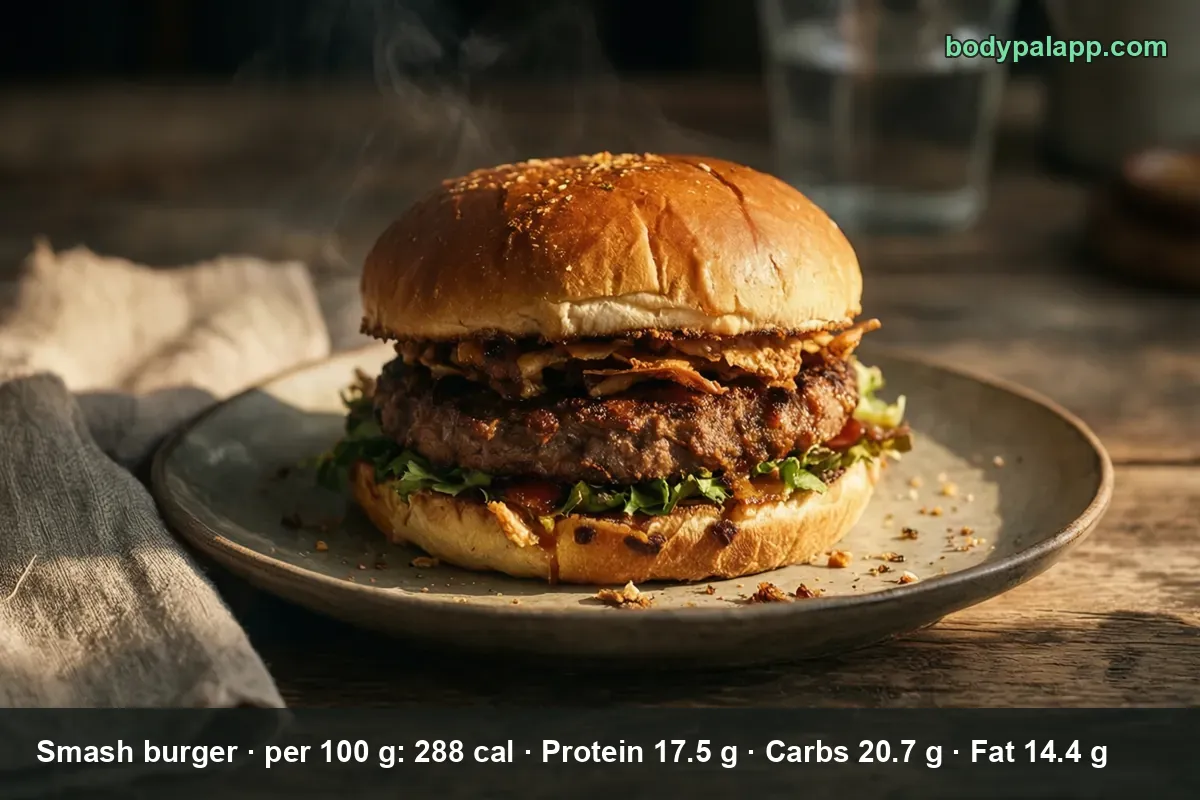
A smash burger built the usual way — one thin patty, a white bun, onions and lettuce — comes to 418 calories for a 145 g burger, or 288 calories per 100 g. A slice of American cheese takes it to 488. The beef and the fat it fries in do most of the damage, not the bun.
On this page
- Smash burger quick facts
- US servings, from one ounce to a whole burger
- Cheese, doubles and sliders
- Saturated fat is the ceiling, not carbs
- How does a smash burger compare?
- Most popular smash burger brands
- Smash burger FAQs
Smash burger quick facts
A smash burger has no record of its own in the federal database. What it is, nutritionally, is a hamburger with a thin patty pressed onto a hot griddle, so the row that matches the plate is FNDDS 2706920, "Hamburger, NFS" from the 2021-2023 survey. It comes with a real USDA household measure — one hamburger, 145 g — which is the thing a person actually picks up. Plain, no cheese, exactly like the burger in the photo above.
If your burger has cheese on it, the numbers move, and there is a separate record for that further down the page. Nothing here is averaged between sources.
| Nutrient | Per 100 g | Per one burger (145 g) | % Daily Value |
|---|---|---|---|
| Calories | 288 | 418 | — |
| Total fat | 14.38 g | 20.9 g | 27% |
| Saturated fat | 5.5 g | 8.0 g | 40% |
| Carbohydrate | 20.68 g | 30.0 g | 11% |
| Dietary fiber | 0.7 g | 1.0 g | 4% |
| Total sugars | 3 g | 4.4 g | — |
| Protein | 17.51 g | 25.4 g | 51% |
| Sodium | 355 mg | 515 mg | 22% |
% Daily Value is based on a 2,000-calorie diet.
Verified nutrition data
Numbers on this page come from USDA FoodData Central, the U.S. Department of Agriculture’s food composition database, and from manufacturer labels where a branded product is named. Last verified September 2026. How we verify our data →
Two rows you would see on a wrapper are missing here: added sugars and trans fat. FNDDS does not publish either value for mixed dishes like burgers, so rather than guess, those lines are left off. Cholesterol comes in at 71 mg per burger (24% DV) and potassium at 332 mg (7% DV).
US servings, from one ounce to a whole burger
Only one line below is a USDA serving: the 145 g burger. Everything else is our own arithmetic from the 288-calories-per-100-g figure, which is the honest way to handle a food that comes in whatever size the griddle cook decided on.
| Serving | Weight | Calories |
|---|---|---|
| 1 oz | 28 g | 81 kcal |
| Half a burger | 72.5 g | 209 kcal |
| 3 oz | 85 g | 245 kcal |
| 4 oz | 113 g | 325 kcal |
| One burger, standard size | 145 g | 418 kcal |
| Per 100 g | 100 g | 288 kcal |
The ounce lines are useful for one specific reason. Restaurant smash burgers are advertised by raw patty weight — a "double 2 oz smash" or a "quarter-pound smash" — and that number describes the beef before it hits the griddle, not the sandwich you eat. Raw beef loses roughly a quarter of its weight to water and rendered fat on a flat-top, so 4 oz of raw ground beef lands closer to 3 oz cooked. The 145 g burger in the table is the finished sandwich, bun included, and that is what the 418 refers to.
If you are logging a homemade one, weigh the whole thing after it comes off the pan. That single habit removes more error than any estimate of patty thickness.
Cheese, doubles and sliders
| Version | Per 100 g | Typical portion | Calories |
|---|---|---|---|
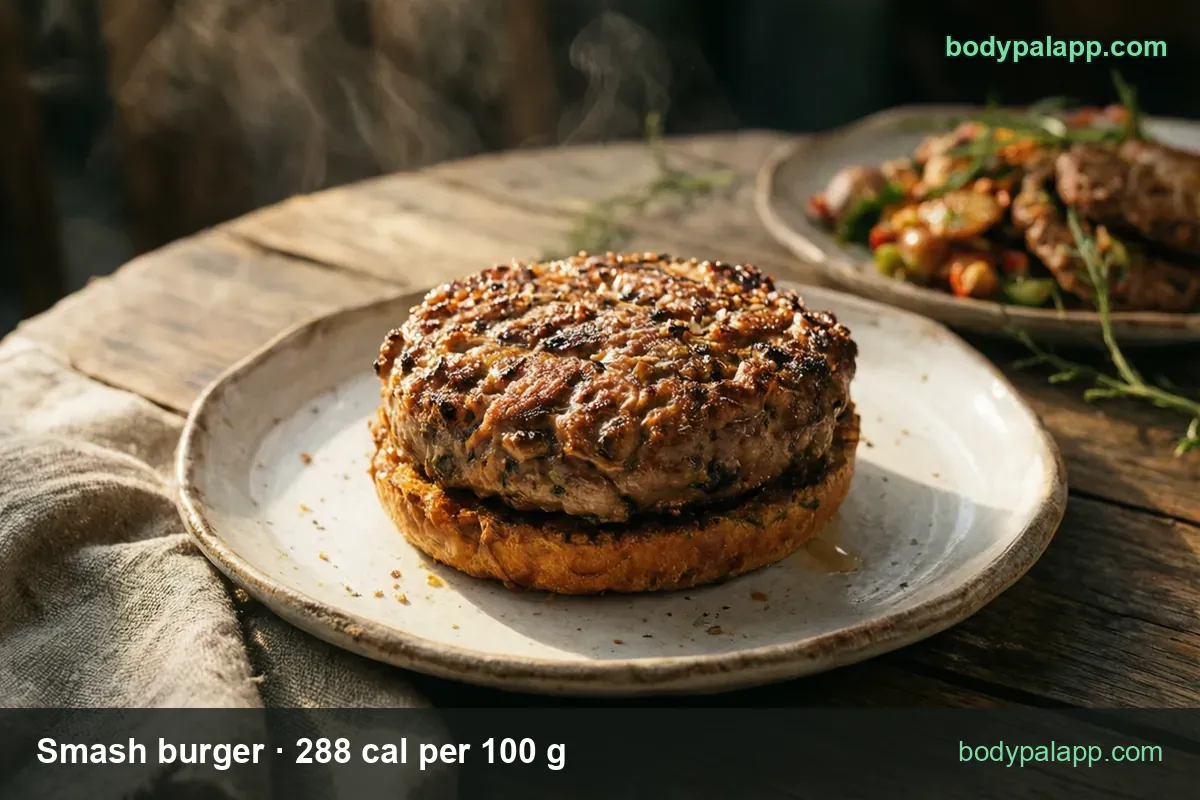
| Smash burger, plain | 288 kcal | one burger, 145 g | 418 kcal |
| With cheese | 296 kcal | one cheeseburger, 165 g | 488 kcal |
| Double smash burger | 289 kcal | per 100 g only | 289 kcal |
| Double smash cheeseburger | 296 kcal | per 100 g only | 296 kcal |
| Smash burger slider | 288 kcal | one miniature burger, 70 g | 202 kcal |
| Cheeseburger slider | 297 kcal | one miniature, 80 g | 238 kcal |
The cheese line is the surprise. A slice adds eight calories per 100 g — 296 against 288, a rounding error over a whole burger. What it adds is sodium: 438 mg per 100 g against 355 mg, up 23%. On a 165 g cheeseburger that works out to roughly 723 mg by our own arithmetic from the 100 g figure, about 31% of a day's sodium in one sandwich.
The double behaves the way you would hope and not the way most people fear. Per 100 g it is 289 calories, one single calorie above a plain single. The composition is what shifts: carbohydrate falls from 20.68 g to 14.26 g per 100 g and protein rises from 17.51 g to 19.18 g, because a second patty adds beef without adding bun. A double is not a denser food. It is a bigger one, with a better protein-to-calorie ratio inside it. FNDDS publishes no household weight for the double record, so there is no per-burger number to quote — only the per-100 g line, which is why that column reads the way it does.
Sliders are the same recipe scaled down: 288 calories per 100 g, 202 for a 70 g mini. Two of them come to 404 calories, still short of one full-size burger.
One more gap worth naming: there is no USDA record for a smash burger without its bun, so the popular "no bun" number cannot be quoted from this data. The closest honest signal is the double record, where cutting the bun's share of the weight drops carbohydrate by about a third per 100 g.
Supermarket freezers sell their own version of this food, and the labels sit in the same range. Pick Five Cheeseburger Sliders run 272 calories per 100 g, 340 for a two-slider serving; a 7 Select Bacon Cheeseburger is 310 per 100 g and 651 for the 210 g burger. These are packaged products, not restaurant smash burgers, but they show how little the format varies once beef meets bun.
Saturated fat is the ceiling, not carbs
Look down the Daily Value column and one row stands out. A single 145 g burger delivers 8.0 g of saturated fat, 40% of the FDA Daily Value of 20 g. Carbohydrate, the thing burgers usually get blamed for, sits at 11%. The Dietary Guidelines for Americans put the saturated fat target at under 10% of daily calories, which is where that 20 g comes from — so one burger uses two fifths of it before you have eaten anything else that day.
Sodium is the second line to watch: 515 mg, 22% of the 2,300 mg limit, or about a quarter teaspoon of table salt. Fries and a sauce cup will roughly double that in a single sitting.
The row working in your favor is protein. 25.4 g per burger is 51% of the Daily Value, and MyPlate counts that as a substantial share of a day's protein foods. If you are choosing between a 418-calorie burger and a 418-calorie pastry, the burger wins on satiety by a wide margin — the protein and fat both slow it down.
How does a smash burger compare?
| Burger | Per 100 g | US serving | Calories |
|---|---|---|---|
| Smash burger, plain | 288 kcal | one burger, 145 g | 418 kcal |
| Cheeseburger | 296 kcal | one cheeseburger, 165 g | 488 kcal |
| Hamburger slider | 288 kcal | one miniature burger, 70 g | 202 kcal |
| McDonald's hamburger | 263 kcal | one hamburger, 100 g | 263 kcal |
Our take: the McDonald's record is the only one in this table under 288 calories per 100 g, and it gets there by being smaller and bunnier, not better — 13.3 g of protein per 100 g against 17.51 g. For weight loss, the slider is the useful pick: 202 calories buys the same flavor at half the commitment. For staying full through an afternoon, take the plain single at 418 and skip the cheese, because the slice costs you 70 calories on the plate and 9% of a day's sodium while adding almost nothing you would miss. The double is the smart order for anyone chasing protein — same calories per gram, more beef per bite.
Most popular smash burger brands in the United States
Ranked by how widely each product appears among foods sold in the United States, from the BodyPal food database of over 3.3 million products. Calories are the figures printed on each Nutrition Facts label, checked against USDA FoodData Central.
| Product | Calories (per 100 g) |
|---|---|
| Pick Five Cheeseburger Sliders | 272 cal |
| Signature Select Cheeseburger Sliders | 259 cal |
| 7 Select Bacon Cheeseburger | 310 cal |
| First Street Hamburger Sliders | 261 cal |
| Banquet Cheeseburger Sliders | 300 cal |
Brand popularity: BodyPal food database. Nutrition: manufacturer labels / USDA FoodData Central.
Smash burger FAQs
How many calories are in a smash burger?
A standard smash burger is 418 calories: one 145 g hamburger at 288 calories per 100 g, from the USDA's generic Hamburger, NFS record. It carries 25.4 g of protein, 20.9 g of fat and 515 mg of sodium. Add a slice of cheese and a 165 g cheeseburger reaches 488 calories.
How many calories in a double smash burger?
The USDA double record runs 289 calories per 100 g, one calorie above a single. What changes is the mix: carbohydrate drops from 20.68 g to 14.26 g per 100 g while protein climbs from 17.51 g to 19.18 g. FNDDS publishes no household weight for the double, so there is no per-burger figure.
How many calories in a smash burger with cheese?
A cheeseburger is 488 calories for one 165 g burger, or 296 calories per 100 g. The slice adds only eight calories per 100 g over a plain burger, but sodium jumps from 355 mg to 438 mg per 100 g and saturated fat from 5.5 g to 6.86 g. Cheese costs salt, not calories.
Is a smash burger healthier than a regular burger?
Per 100 g there is almost nothing in it: 288 calories for the generic hamburger, 285 for a fast food burger with one small patty, 297 for the older SR Legacy record. The difference sits in the bread — the fast food record carries 28.27 g of carbohydrate per 100 g against 20.68 g for the generic burger.
How much protein is in a smash burger?
One 145 g burger holds 25.4 g of protein, 51% of the 50 g Daily Value, at 17.51 g per 100 g. The double record raises that to 19.18 g per 100 g while carbohydrate falls to 14.26 g, because a second patty adds beef without adding bun. The beef supplies nearly all of it.
Are smash burgers high in sodium?
One 145 g burger holds 515 mg of sodium, 22% of the 2,300 mg Daily Value and roughly a quarter teaspoon of table salt. A cheeseburger is heavier: 438 mg per 100 g, about 723 mg for a 165 g burger by our own arithmetic, or 31% of the day. Fries and sauces come on top.
How many calories in a smash burger slider?
A slider is 202 calories for one 70 g miniature burger, at 288 calories per 100 g — the same recipe in a smaller portion. A cheeseburger slider is 238 calories for 80 g, at 297 per 100 g. Two plain sliders come to 404 calories, still under a single full-size burger at 418.
Do smash burgers have more calories than fast food burgers?
Roughly the same per gram: 288 calories per 100 g for the generic burger, 285 for the fast food record with one small patty, 263 for the McDonald's hamburger. Portion decides the total. The McDonald's burger weighs 100 g and lands at 263 calories, well under the 418 of a 145 g burger.
Similar foods
- Burger — 418 cal per hamburger
- Chicken Chalupa — 490 cal per chalupa
- In-N-Out Fries — 360 cal per order
- Bacon Egg And Cheese Croissant — 370 cal per sandwich
- Chicken Cheese Quesadilla — 402 cal per full circle
- Croissant Breakfast Sandwich — 370 cal per sandwich
Count it without the math
Point the camera at the plate and BodyPal counts the burger for you, cheese slice and all.


How long does it take to burn off a smash burger?
One burger (145 g) is 418 kcal. Enter your weight and the amount you ate to see how long it takes you to burn that off:
lb
| Activity | Time to burn 418 kcal |
|---|---|
| Walking, brisk | 1 hr 24 min |
| Cycling, moderate | 52 min |
| Swimming, moderate | 1 hr |
| Jogging | 49 min |
| Weight training, moderate | 1 hr 33 min |
Times are for a 155 lb adult at a steady pace; change the weight to see yours. The amount is set to the portion in the text (145 g); change it to what you actually ate. BodyPal works this out from your steps automatically.
Burning it off is one side of it. The other is knowing your number: work out how many calories you need a day, with macros and a goal date.